Abrahamic theology refers to the religious beliefs and doctrines that originate from the figure of Abraham, a patriarch in Judaism, Christianity, and Islam.
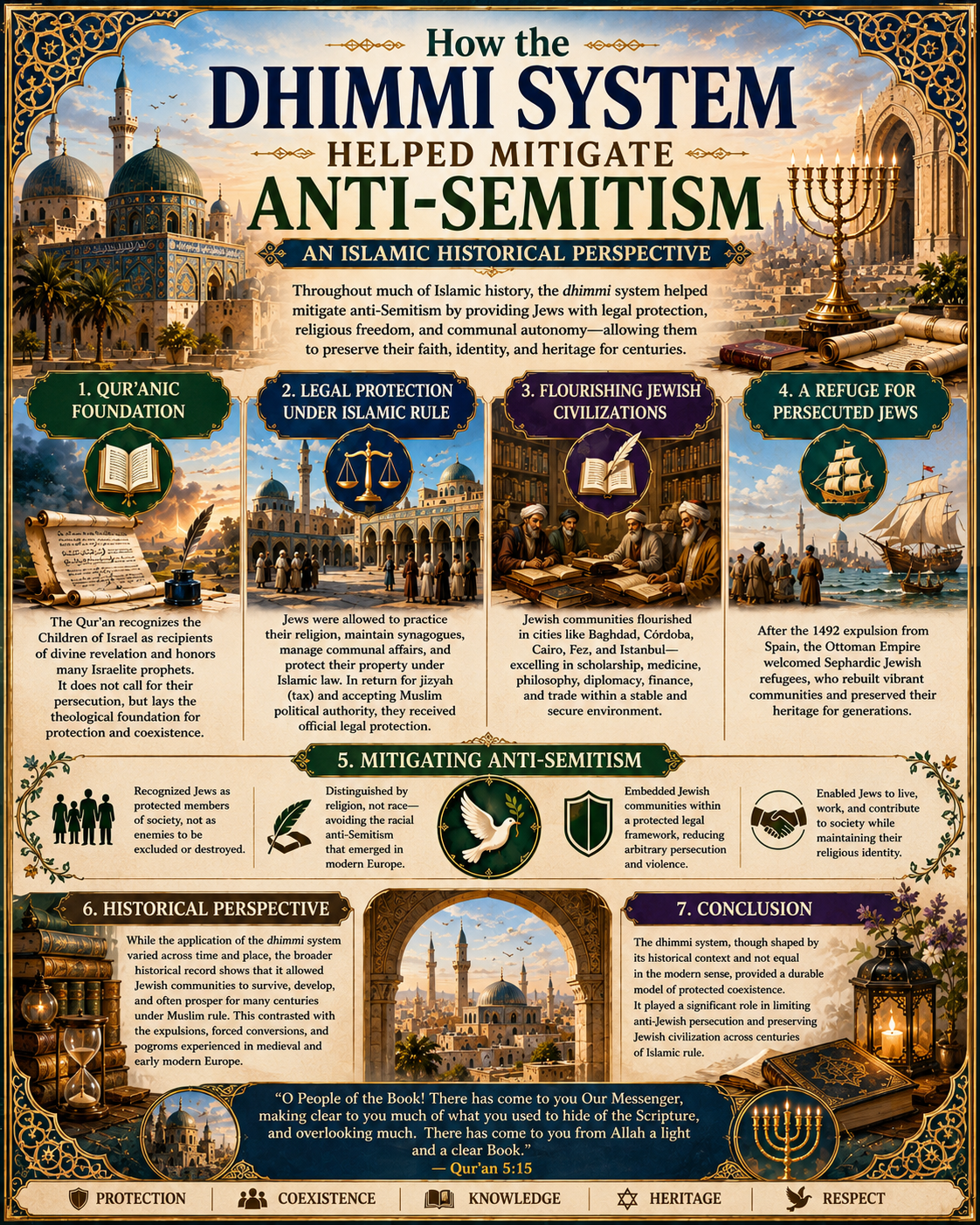
Throughout much of Islamic history, the dhimmi system helped mitigate anti-Semitism by providing Jewish communities with a recognized legal status, religious protection, and communal autonomy. Although it did not establish complete legal equality between Muslims and non-Muslims, it created a framework in which Jews could preserve their faith, institutions, and identity for centuries.
Unlike many societies where Jews periodically faced expulsion, forced conversion, or extermination, Islamic civilization generally recognized Jews as Ahl al-Kitāb (“People of the Book”) and incorporated them into society under the protection of Islamic law.
📖 The Qur’anic Foundation
The Qur’an provides the theological basis for this relationship. It recognizes the Children of Israel as recipients of divine revelation and honours many Israelite prophets, including Moses, David, Solomon, Zachariah, John, and Jesus. While the Qur’an criticizes certain individuals or communities for specific acts of disobedience, it does not portray Jews as a people to be persecuted or eliminated.
This theological recognition laid the foundation for a legal system that protected Jewish communities instead of treating them as perpetual enemies.
🕌 Legal Protection Under Islamic Rule
Under the dhimmi system, Jews were permitted to practice Judaism, maintain synagogues according to prevailing legal conditions, administer many of their own communal affairs, and protect their property and families under Islamic governance.
In return for paying the jizyah tax and accepting Muslim political authority, Jewish communities received official legal protection. This institutional recognition significantly reduced the likelihood of arbitrary persecution and enabled Jewish communal life to continue across vast regions of the Muslim world.
Rather than existing merely by tolerance, Jews occupied a recognized place within the Islamic legal order.
🌍 Flourishing Jewish Civilizations
The stability provided by the dhimmi system allowed many Jewish communities to flourish intellectually, economically, and culturally.
Cities such as Baghdad, Córdoba, Cairo, Fez, and later Istanbul became important centres of Jewish scholarship, commerce, medicine, philosophy, diplomacy, and finance. Jewish scholars wrote influential works, physicians served Muslim rulers, and merchants participated in extensive international trade networks.
These achievements were possible because Islamic governance generally offered security and continuity for Jewish communal life.
🚢 A Refuge for Persecuted Jews
One of the clearest demonstrations of this protective framework came after the expulsion of Jews from Spain in 1492.
While Catholic Spain forced large numbers of Jews into exile or conversion, the Ottoman Empire welcomed many Sephardic Jewish refugees. They rebuilt prosperous communities throughout the empire, preserving their religious traditions, language, and culture for generations.
This episode illustrates how Islamic rule often served as a refuge for Jews fleeing persecution elsewhere.
⚖️ Mitigating Anti-Semitism
The dhimmi system helped mitigate anti-Semitism because it recognized Jews as protected members of society rather than as a people to be excluded or destroyed.
Classical Islamic law distinguished communities primarily by religion, not by race. As a result, Jews retained legal recognition and communal rights even though they occupied a distinct legal status.
This differed fundamentally from the racial anti-Semitism that emerged in modern Europe, where Jews were increasingly portrayed as an inherently inferior or dangerous race regardless of their beliefs or conduct.
By embedding Jewish communities within a protected legal framework, Islamic civilization limited many of the conditions that historically fostered widespread anti-Jewish persecution.
📚 Historical Perspective
Like every civilization, the Muslim world experienced periods of injustice, discrimination, and occasional persecution. The application of the dhimmi system varied between rulers, regions, and historical periods.
Nevertheless, the broader historical record shows that the dhimmi framework generally enabled Jewish communities to survive, develop, and often prosper for many centuries under Muslim rule. It provided a durable institutional basis for coexistence that contrasted with the repeated expulsions, forced conversions, inquisitions, and pogroms experienced by many Jewish communities in parts of medieval and early modern Europe.
🕊️ Conclusion
The dhimmi system stands as one of the principal historical mechanisms through which Islamic civilization helped mitigate anti-Semitism. By recognizing Jews as People of the Book, guaranteeing their legal protection, safeguarding their religious life, and integrating them into society, Islamic law created conditions that allowed Jewish communities to endure and flourish across much of the Muslim world.
Although the system reflected the hierarchical norms of its historical context and did not provide modern concepts of equal citizenship, it nevertheless represented a durable model of protected coexistence. In historical terms, it played a significant role in limiting anti-Jewish persecution and preserving Jewish civilization across centuries of Islamic rule.
The Chapel of the Ascension: A Shared Sacred Shrine Under Islamic Custodianship
🕌 The Chapel of the Ascension: A Shared Sacred Shrine Under Islamic Custodianship
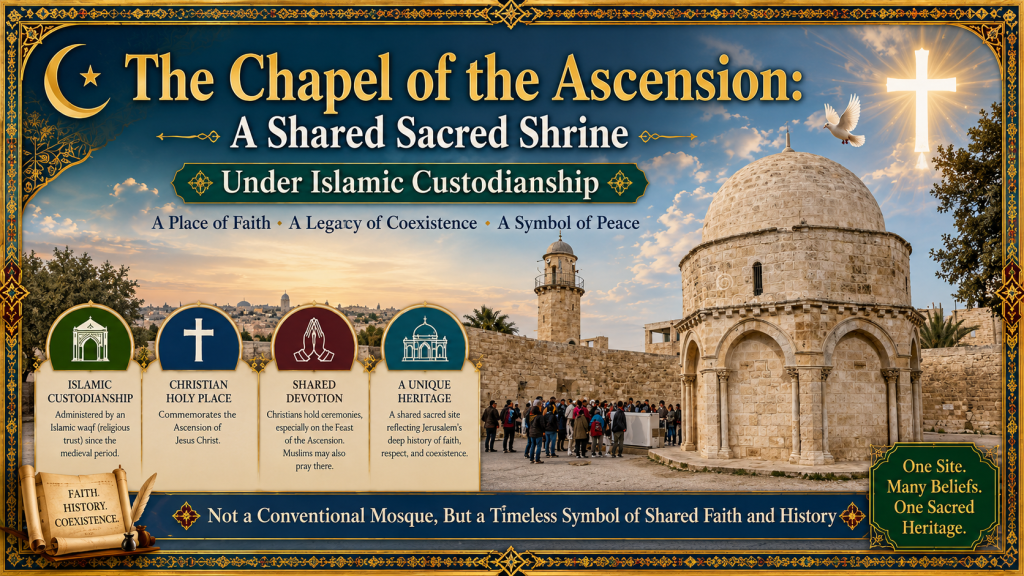
🕊️ The Chapel of the Ascension on the Mount of Olives occupies a unique and historically layered position.
⛪ It is not generally regarded today as an active mosque in the formal congregational sense, but it has long been under Islamic custodianship and contains Islamic architectural and devotional features.
📜 The site commemorates the Christian belief that Jesus Christ ascended to heaven from the Mount of Olives.
🏛️ Early Christians built churches there beginning in the Byzantine period.
🌙 After the Muslim conquest of Jerusalem in the 7th century, the site continued to be visited by Christians.
⚔️ During the medieval Islamic period — especially under the Ayyubids after Saladin recaptured Jerusalem in 1187 — the structure came under Muslim administration.
🧭 A small mihrab, or prayer niche indicating the direction of Mecca, was added, reflecting Islamic use and guardianship.
🤲 Islamic tradition also reveres Jesus Christ, known as ʿĪsā, so the site retained significance for Muslims as well.
🏷️ Today, the building is usually called the “Chapel of the Ascension” by Christians.
🕌 It is administered by an Islamic waqf, or religious trust.
✝️ Christians are permitted to hold certain ceremonies there, especially on the Feast of the Ascension.
🕋 Muslims may also pray there.
🌍 Architecturally and legally, it has Islamic custodianship, but functionally it is more of a shared sacred shrine than a standard neighborhood mosque.
⚖️ From an Islamic administrative perspective, it has historically functioned partly as a Muslim shrine and prayer site under waqf authority.
⛪ From mainstream Christian usage, it remains a Christian holy place commemorating the Ascension.
🕊️ From a modern functional perspective, it is usually described as a shared sacred site rather than a conventional mosque.
🏙️ This type of layered sacred space is not unusual in Jerusalem, where several holy places have shifted administration or been shared among religious communities across centuries.
“Guardians of the Sacred Key: The Muslim Family Entrusted Since the Time of Saladin”
JERUSALEM — In a world often defined by division, a remarkable and centuries-old tradition in Jerusalem continues to defy expectations—where a Muslim family holds the keys to Christianity’s holiest shrine: the Church of the Holy Sepulchre.
This is not myth. It is history—alive, uninterrupted, and quietly powerful.
⸻
🔑 A Legacy Born in the Age of Saladin
The story begins in 1187, when the great Muslim leader Saladin recaptured Jerusalem from the Crusaders. In a move that stunned both allies and enemies, he chose not revenge—but reconciliation.
Rather than placing the sacred church under exclusive Christian control—risking sectarian conflict among rival denominations—Saladin made a bold decision:
👉 He entrusted the keys of the church to a neutral Muslim family.
A decision not just political—but profoundly symbolic.
⸻
🕌 The Families Who Hold the Trust
For over 800 years, two Muslim families have carried this sacred responsibility:
The Nuseibeh family – responsible for physically opening and closing the church doors
The Joudeh family – entrusted with safeguarding the key itself
Every morning, before dawn breaks over Jerusalem, a member of the Nuseibeh family climbs a ladder to unlock the massive wooden doors—watched by representatives of multiple Christian denominations.
Every evening, they return again—to close it.
The ritual is precise. Timeless. Undisputed.
⸻
⚖️ A Solution to Centuries of Conflict
The Church of the Holy Sepulchre is shared by several Christian sects—Greek Orthodox, Armenian Apostolic, Roman Catholic, Coptic, Ethiopian, and Syriac Orthodox.
Historically, tensions between these groups have run deep—even erupting into physical confrontations.
👉 The Muslim custodianship serves as a neutral mechanism—preventing disputes over control of access.
In effect, a Muslim family became the guarantor of peace among Christians.
⸻
🌍 A Living Symbol of Coexistence
In an age of headlines dominated by religious conflict, this quiet tradition tells a different story:
A Muslim legacy protecting a Christian sanctuary
A trust passed down generation to generation
A shared city where faiths intersect—not only in tension, but in trust
As one member of the Nuseibeh family once said:
“We are not just opening a door. We are preserving history.”
⸻
⚡ The Deeper Meaning
What began as a strategic decision by Saladin has become something far greater:
👉 A living covenant of coexistence 👉 A symbol of interfaith balance 👉 A reminder that power can be exercised with restraint—and wisdom
In Jerusalem, where every stone carries memory, one small iron key continues to unlock more than a door.
It unlocks a story the world rarely hears— a story of trust across faiths, preserved for over eight centuries.
📖 The Abrahamic covenant and the Sinai covenant are two of the most important themes shared by Judaism, Christianity, and Islam. While both the Apostle Paul and Islam clearly distinguish between these two covenants, they reach very different conclusions about how God’s promises to Abraham were ultimately fulfilled.
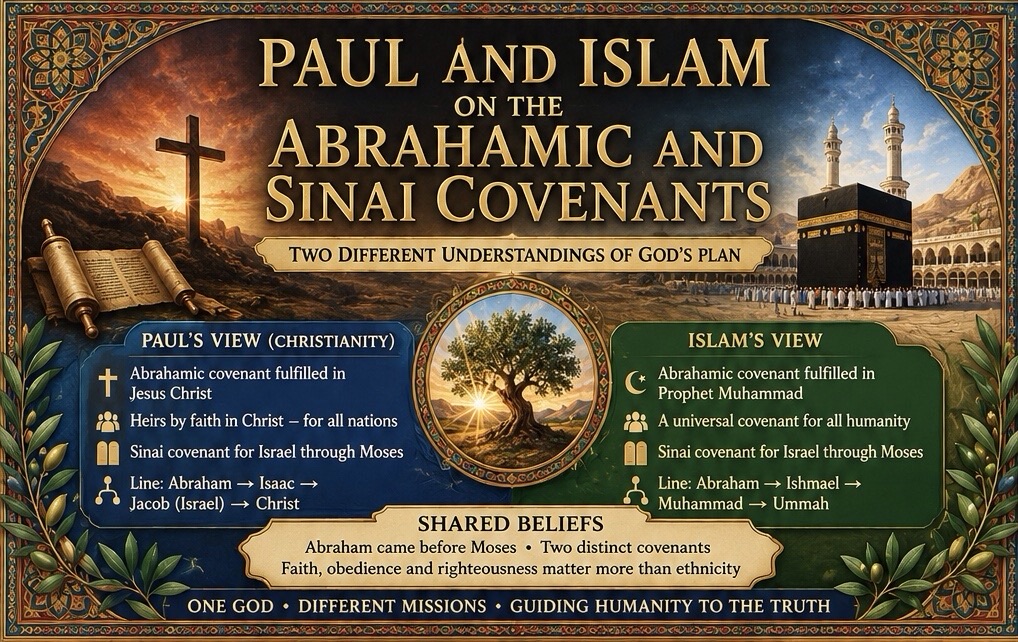
🧭 According to Paul, the covenant God made with Abraham came long before the Law of Moses was given at Mount Sinai. Because of this, Paul argues that God’s promise to Abraham cannot be limited or replaced by the later Mosaic Law. Instead, Christians believe the Abrahamic covenant reaches its fulfillment in Jesus Christ.
✝️ Paul teaches that anyone—Jew or Gentile—can become an heir of Abraham through faith in Christ without first becoming part of the Jewish nation or observing the full Mosaic Law. In this way, Abraham becomes the spiritual father of all believers rather than only the ancestor of Israel.
📜 Paul also explains that the Sinai covenant had a specific purpose. It established Israel as God’s covenant nation and introduced the Torah, priesthood, sacrifices, festivals, and many religious laws. However, Paul says this covenant did not cancel God’s earlier promise to Abraham.
☪️ Islam also distinguishes between the Abrahamic covenant and the Sinai covenant, but its understanding is different. From the Islamic perspective, the Abrahamic covenant belongs to Abraham and his son Ishmael and ultimately reaches its fulfillment through the Prophet Muhammad and the Muslim community (ummah).
🕌 The Qur’an describes Abraham as neither a Jew nor a Christian but as a man who fully submitted himself to God. Muslims therefore see Abraham as the model of pure monotheism that existed before both the Torah and the Gospel.
🌍 Within this Islamic understanding, the Abrahamic covenant is universal. It is seen as a covenant meant for all humanity rather than for one nation alone. By contrast, the Sinai covenant is understood as a separate covenant given specifically to the Children of Israel through the Prophet Moses.
🤝 Muslims point to several key moments in the lives of Abraham and Ishmael as expressions of this covenant. These include Abraham leaving Hagar and the infant Ishmael in the valley of Mecca, Abraham’s willingness to sacrifice his son in obedience to God, the joint construction of the Kaaba (House of God), and their prayer that God would send a future messenger from among their descendants.
🕋 According to Islamic belief, that prayer was fulfilled through the coming of the Prophet Muhammad. Muslims therefore understand Muhammad not as introducing a new religion but as completing the original faith of Abraham.
⚖️ One of the biggest differences between Christianity and Islam concerns the identity of the son connected to Abraham’s covenant.
📖 In the biblical tradition, Genesis identifies Isaac as the son Abraham was commanded to offer. Paul therefore follows the covenantal line from Abraham through Isaac, then Jacob (Israel), and finally to Jesus Christ.
📚 Paul also uses the story of Sarah and Hagar in his Letter to the Galatians as an allegory. In his interpretation, Isaac represents the covenant of promise and freedom, while Hagar represents the covenant associated with the Law.
☪️ Islam presents a different interpretation. The Qur’an does not explicitly name the son in the near-sacrifice story, but classical Islamic scholarship traditionally identifies him as Ishmael, based on the narrative sequence where Abraham first receives news of a son, then faces the sacrificial trial, followed by the announcement of Isaac’s birth.
🧭 From this perspective, the covenantal line is understood as Abraham, Ishmael, Muhammad, and finally the worldwide Muslim community. The Sinai covenant, meanwhile, remains connected specifically to Moses and the Children of Israel.
🛤️ As a result, the two traditions describe two different covenantal paths. Christianity traces the Abrahamic promise through Isaac to Christ, while Islam traces it through Ishmael to Muhammad.
🌎 Despite these major differences, Paul and Islam also share some important similarities. Both agree that Abraham came before Moses and that the Abrahamic covenant should not be confused with the Sinai covenant.
🤲 Both traditions also reject the idea that biological descent from Abraham alone guarantees covenantal status. Paul teaches that faith in Christ is what makes someone a true heir of Abraham. Islam similarly teaches that the true followers of Abraham are those who worship the One God and live according to His guidance.
📖 In both views, faith and obedience are considered more important than ethnicity alone, even though they disagree about how the Abrahamic covenant reaches its fulfillment.
📰 The comparison shows that Christianity and Islam begin with a similar observation—that Abraham’s covenant came before the covenant at Mount Sinai—but they interpret history in different ways. Christians believe the promise finds its fulfillment in Jesus Christ, while Muslims believe it reaches completion through the Prophet Muhammad and the establishment of the universal Muslim community.
🌟 Ultimately, this comparison highlights both the shared heritage and the major theological differences between Christianity and Islam. Both traditions honor Abraham as a central figure of faith, yet each offers a distinct understanding of God’s covenantal plan and its fulfillment in history.
Do the Torah and the Bible contain a divine command to commemorate Isaac’s near-sacrifice?
Do the Torah and the Bible contain a divine command to commemorate Isaac’s near-sacrifice?
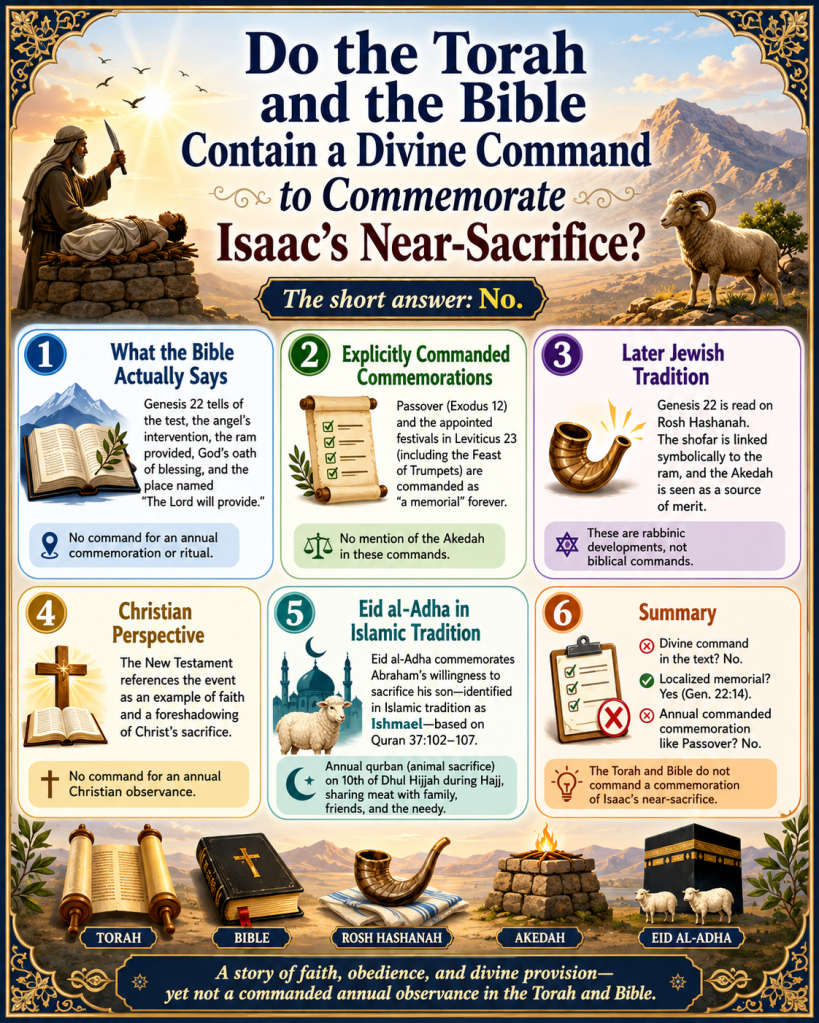
No, the Torah and the Bible do not contain a divine command to commemorate Isaac’s near-sacrifice (the Akedah, or “binding,” in Genesis 22).
📜 What the Text Actually Says
In Genesis 22 (the only detailed account in the Torah/Bible):
• God commands Abraham to perform the sacrifice of Isaac as a test (vv. 1–2).
• Abraham obeys and prepares to do so.
• An angel intervenes at the last moment (vv. 11–12), and a ram is provided as a substitute (v. 13).
• God then swears an oath of blessing and multiplication of descendants because of Abraham’s obedience (vv. 16–18).
• Abraham names the place “The Lord will provide” (YHWH Yireh), and the text notes that people say “On the mount of the Lord it shall be provided” to this day (v. 14). This is a localized proverbial saying about God’s provision, not a commanded ritual or annual observance.
There is no instruction anywhere in Genesis 22 — or elsewhere in the Torah or the rest of the Bible — for the Israelites (or later communities) to institute an annual festival, holiday, sacrifice, reading, or other ritual specifically to commemorate the near-sacrifice itself.
⚖️ Comparison with Explicitly Commanded Commemorations
Contrast this with clear divine commands for remembrance:
• Passover (Exodus 12): God explicitly commands an annual observance with specific rituals (lamb, bitter herbs, unleavened bread, retelling the story) “as a memorial” and “a statute forever.”
• Appointed festivals in Leviticus 23, including the Feast of Trumpets (later associated with Rosh Hashanah): These have direct commands for rest, offerings, and blowing trumpets — with no mention of the Akedah.
The Akedah (binding of Isaac) story has profound theological weight (faith, obedience, divine provision, the covenant oath), but the text itself does not turn it into a mandated annual commemoration.
🕍 Later Jewish Tradition (Not Biblical Command)
In rabbinic Judaism:
• Genesis 22 is read as the Torah portion on the second day of Rosh Hashanah.
• The shofar (ram’s horn) blown on Rosh Hashanah is symbolically linked by later interpreters to the ram that replaced Isaac.
• The Akedah is seen as a source of merit and a reminder for God to show mercy.
These practices are post-biblical rabbinic developments. Multiple Jewish sources acknowledge that “there is nothing in the biblical text that suggests this” association with Rosh Hashanah. The Torah’s command for the day (Leviticus 23:23–25) is simply a “memorial of blowing of trumpets,” with no reference to Isaac or the binding.
✝️ Christian Perspective
The New Testament references the event typologically (e.g., Hebrews 11:17–19 sees it as an example of faith; some see it foreshadowing Christ’s sacrifice), but it issues no command for an annual Christian observance of Isaac’s near-sacrifice.
🕌 Eid al-Adha in Islamic Tradition
In Islamic tradition, Eid al-Adha explicitly commemorates Abraham’s willingness to sacrifice his son — identified in Muslim exegesis as Ishmael — as described in Quran 37:102–107, where a divine vision leads to the son’s willing submission and God’s ransom with a ram.
On the 10th of Dhul Hijjah (coinciding with the Hajj), Muslims perform the ritual animal sacrifice (qurban), distributing the meat to family, friends, and the needy. This is a divinely ordained annual observance emulating Abraham’s (and his son’s) submission, unlike the Torah and Bible, which contain no mandated ritual commemoration of Isaac’s near-sacrifice.
📌 Summary
• Divine command in the text? No — only the original test/command to Abraham, the intervention, the substitute, and the resulting oath of blessing.
• Localized memorial? Yes — the place name and saying in Genesis 22:14.
This distinction is relevant in Abrahamic theology discussions, as Islamic tradition (Eid al-Adha) does include an explicit ritual commemoration of Abraham’s willingness to sacrifice his son (understood in Muslim tradition as Ishmael), with animal sacrifice as a continuing practice.
The Torah/Bible account of Isaac does not have an equivalent commanded ongoing ritual in the text itself.
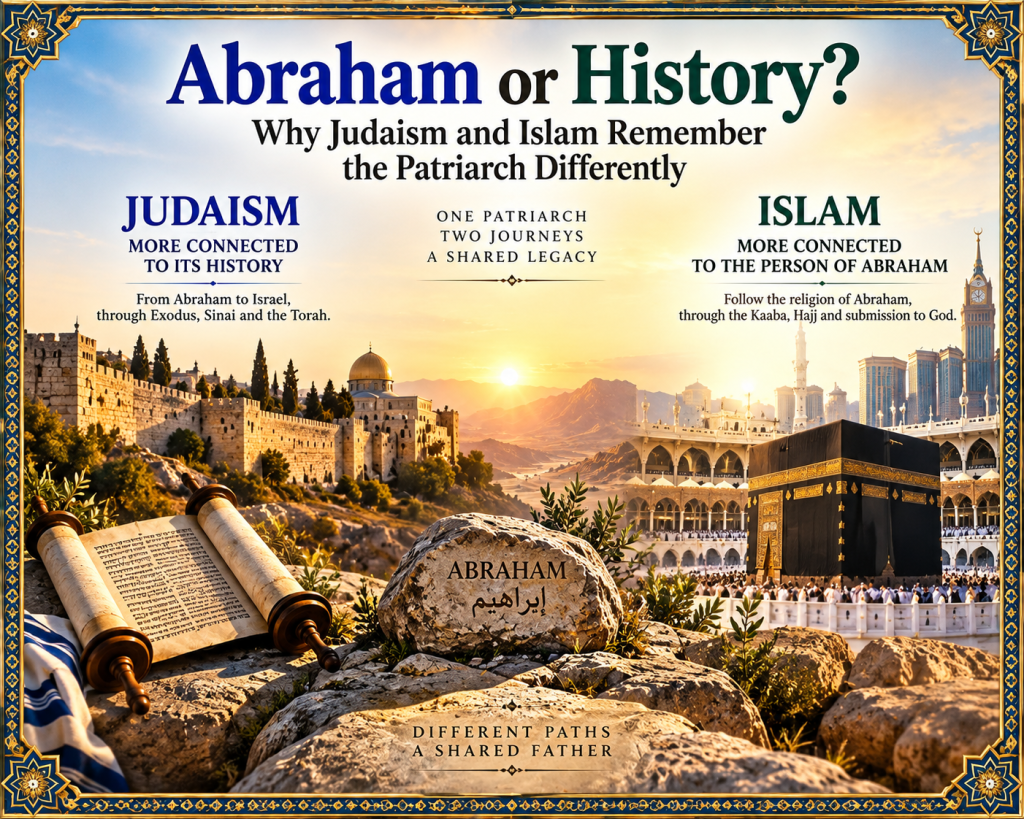
📜 Abraham or History? Why Judaism and Islam Remember the Patriarch Differently
📜 Abraham or History? Why Judaism and Islam Remember the Patriarch Differently
Judaism and Islam both look back to Abraham as one of the great figures of faith. Yet the two religions place him within their religious life in noticeably different ways.
A useful way of describing the contrast is this: Judaism is strongly shaped by the historical experience of Israel, while Islam places unusually strong emphasis on Abraham himself as a model of faith and submission to God.
That distinction can be seen most clearly in the religious stories and rituals at the center of each tradition.
✡️ Judaism: From Abraham to the History of Israel
Abraham is fundamental to Judaism. The Hebrew Bible presents him as the patriarch from whom Israel’s covenantal story begins.
But the story does not stop with Abraham.
The biblical line continues through Isaac, Jacob and the Twelve Tribes of Israel. From there, Jewish identity becomes deeply connected with the collective history of the Israelite people—especially slavery in Egypt, the Exodus, the revelation of the Torah at Mount Sinai and the covenant established through Moses.
These events remain embedded in Jewish religious life.
Passover recalls the Exodus from Egypt. The Torah given through Moses stands at the center of Jewish law and religious practice. Jewish prayers and festivals repeatedly recall God’s relationship with Israel across history.
In this sense, Abraham is the beginning of the story, but Sinai and the historical experience of Israel become central to Jewish communal identity.
☪️ Islam: Returning Directly to Abraham
Islam approaches Abraham—known as Ibrāhīm—somewhat differently.
The Qur’an does not present Abraham merely as an ancestor of a particular people. It repeatedly presents him as a model of pure monotheism who existed before the later religious divisions between Jews and Christians.
The Qur’an declares:
“So follow the religion of Abraham, inclining to truth.” — Qur’an 3:95
Another particularly important verse is Qur’an 16:123:
“Then We revealed to you: Follow the religion of Abraham, inclining to truth.”
The second is especially significant because it is a direct divine instruction to Prophet Muhammad ﷺ to follow the millah of Abraham.
Muslims are therefore instructed to follow the millat Ibrāhīm—the religion or way of Abraham.
This connection becomes especially visible in Mecca.
According to the Qur’an, Abraham and Ishmael raised the foundations of the Kaaba and prayed that God would raise a messenger among their descendants (Qur’an 2:127–129).
The yearly Hajj pilgrimage, which commemorates Abraham’s near-sacrifice of his son Ishmael, positions this Abrahamic tradition at the core of Muslim religious awareness.
The Kaaba, sacrifice, pilgrimage and other traditions associated with Abraham, Ishmael and Hagar connect Muslims repeatedly with the Abrahamic story.
For Muslims, therefore, Abraham is not simply a figure from sacred history. He is a continuing model of what it means to surrender oneself completely to God.
🕋 Two Ways of Remembering Abraham
The difference should not be exaggerated. Judaism remains profoundly Abrahamic, while Islam also has its own powerful sacred history after Abraham.
But their centers of emphasis are different.
Judaism largely follows the historical trajectory:
Abraham → Isaac → Jacob → Israel → Exodus → Sinai → Torah
Islam places greater emphasis on another trajectory:
Abraham → Ishmael → Kaaba → pure monotheism → Muhammad → restoration of the religion of Abraham
This helps explain why Jewish religious identity is so closely tied to the historical memory of Israel, while Islam presents Abraham as a universal model of monotheism, transcending the religious and national identities that arose after him.
🌍 One Patriarch, Two Religious Memories
The contrast, then, is not that Judaism belongs to history while Islam belongs to Abraham. Both religions have history, covenant, scripture and an Abrahamic inheritance.
The difference is one of religious emphasis.
Judaism remembers Abraham primarily within the unfolding covenantal history of Israel. Islam presents Abraham more directly as a universal spiritual prototype whose faith Muslims are commanded to follow.
Perhaps the distinction can be summarized in one sentence:
For Judaism, Abraham begins the sacred history of Israel; for Islam, Abraham’s way becomes a religious ideal that believers are explicitly called to recover and follow.
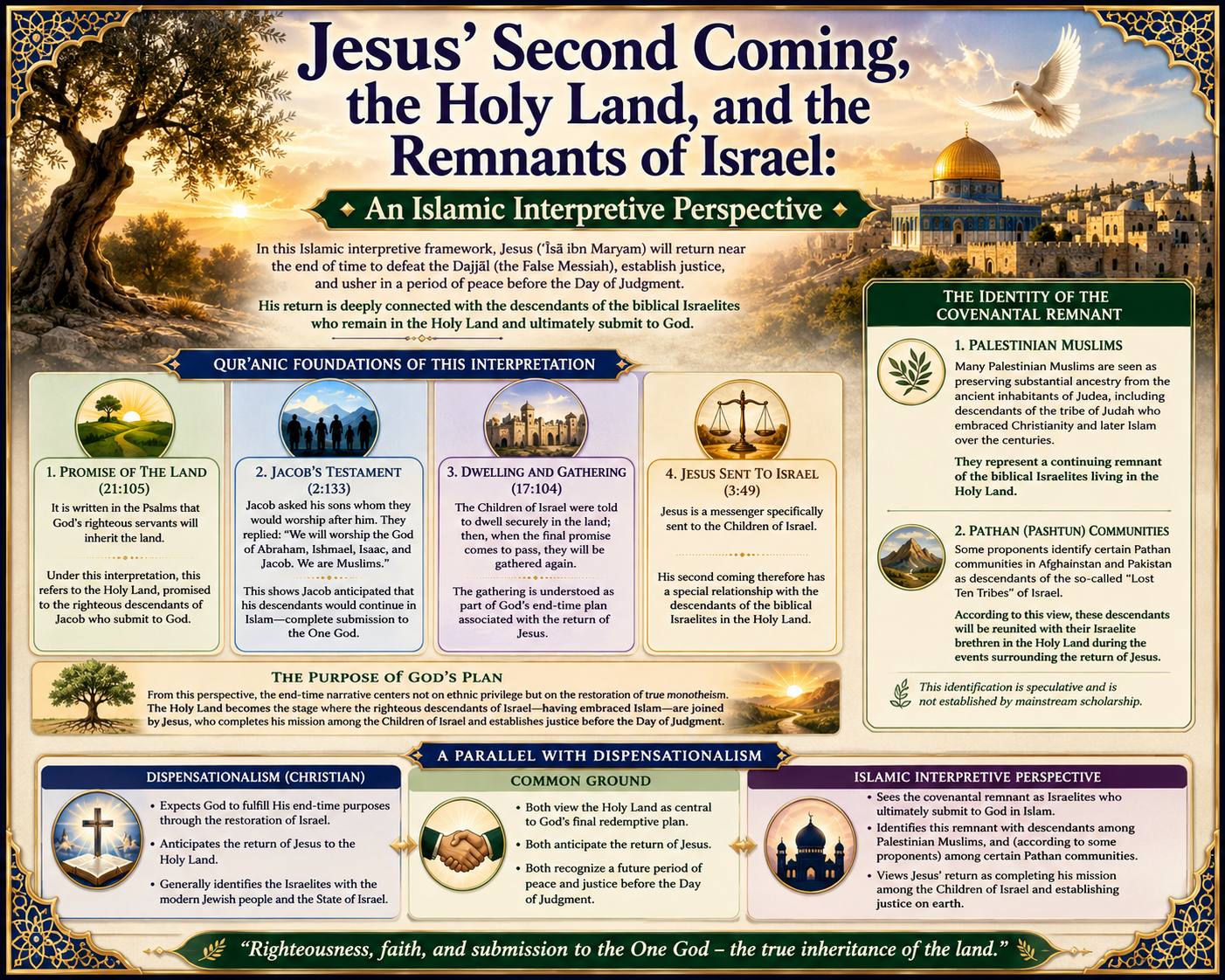
Many Muslims believe that Jesus (ʿĪsā ibn Maryam) will return to the Holy Land near the end of time to fulfill his divinely appointed mission. According to authentic Islamic traditions, he will defeat the Dajjāl (the False Messiah), establish justice, and usher in a period of peace before the Day of Judgment.
Within one contemporary Islamic interpretive framework, Jesus’ return is understood not merely as a universal event but as one deeply connected with the descendants of the biblical Israelites who remain in the Holy Land and ultimately submit to God.
This interpretation draws upon several Qur’anic passages.
📖 Surah al-Anbiyāʾ (21:105) declares:
“Indeed, We have written in the Psalms after the Reminder (Torah) that My righteous servants shall inherit the land.”
Proponents interpret this verse as referring to the Holy Land. They argue that because the promise is said to have been written in the Psalms (Zabūr)—a scripture associated with the biblical Israelites—it points to the descendants of Jacob. Within this interpretive framework, the verse is understood as promising that the righteous among the descendants of Jacob, having submitted to God in true faith, will ultimately inherit the Holy Land.
📖 Surah al-Baqarah (2:133) recalls Jacob’s final words to his sons, asking whom they would worship after him. They replied that they would worship the God of Abraham, Ishmael, Isaac, and Jacob, declaring:
“We are Muslims (those who submit to Him).”
This passage is understood to show that, from a Qur’anic perspective, Jacob anticipated that his descendants would continue in Islam—understood in its Qur’anic sense as complete submission to the One God—and therefore asked them to reaffirm their commitment to that faith before his death.
📖 Surah al-Isrāʾ (17:104) states that the Children of Israel would dwell in the land and later be gathered again:
“Afterward We said to the Children of Israel, ‘Dwell securely in the land; then, when the final promise comes to pass, We will bring you together.’”
Within this interpretive framework, the gathering is understood as part of God’s end-time plan associated with the return of Jesus.
📖 Surah Āl ʿImrān (3:49) identifies Jesus as a messenger specifically sent to the Children of Israel. Accordingly, proponents argue that his second coming also has a special relationship to the descendants of the biblical Israelites living in and connected to the Holy Land.
Some advocates of this interpretation further argue that many Palestinian Muslims preserve substantial ancestry from the ancient inhabitants of Judea, including descendants of the tribe of Judah who embraced Christianity and later Islam over the centuries. In this view, they represent a continuing remnant of the biblical Israelites residing in the Holy Land.
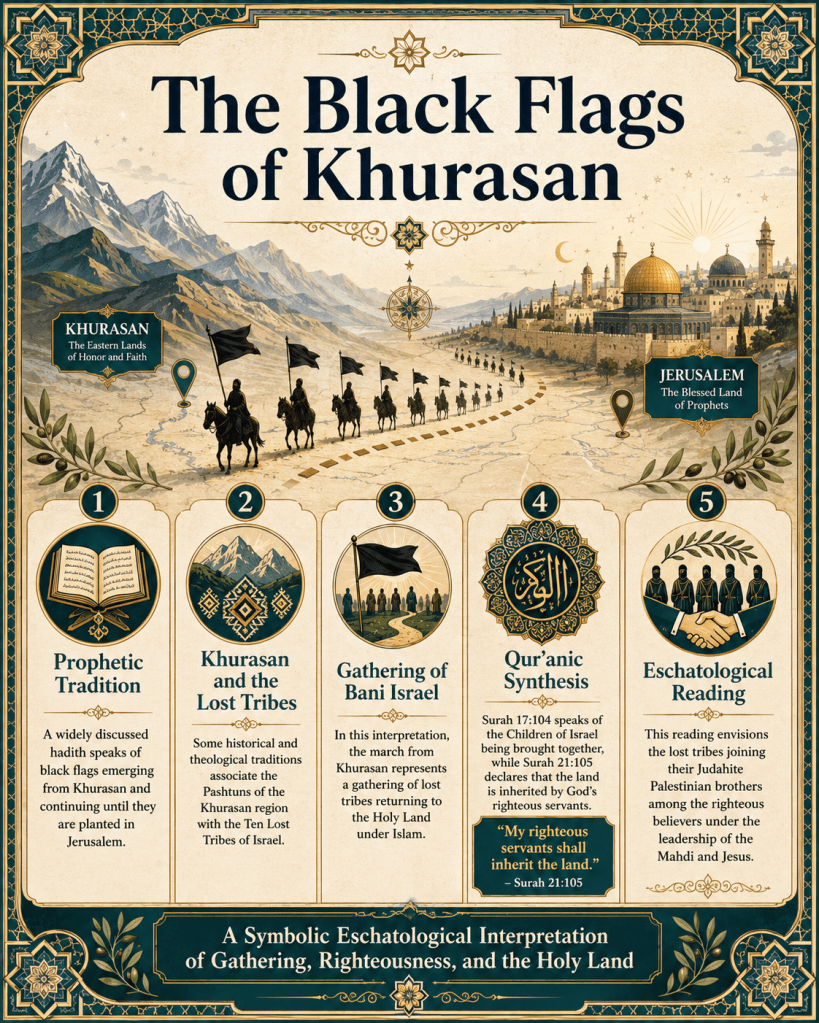
Some proponents additionally identify certain Pathan (Pashtun) communities in Afghanistan and Pakistan with descendants of the so-called “Lost Ten Tribes” of Israel. According to this interpretation, these descendants will be reunited with their Israelite brethren in the Holy Land during the events surrounding the return of Jesus. This identification, however, remains speculative and is not established by mainstream scholarship.
From this perspective, the end-time narrative centers not on ethnic privilege but on the restoration of true monotheism. The Holy Land becomes the stage where the righteous descendants of Israel—having embraced Islam—are joined by Jesus, who completes his mission among the Children of Israel and establishes justice before the Day of Judgment.
🌿 A Parallel with Dispensationalism
Proponents of this interpretation observe an interesting parallel with Christian Dispensationalism.
Dispensationalism expects God to fulfill His end-time purposes through the restoration of Israel and the return of Jesus to the Holy Land. Likewise, this Islamic interpretive model sees the Holy Land, the descendants of the biblical Israelites, and the return of Jesus as central to the unfolding of the last days.
The principal difference lies in the identity of those Israelites. Whereas Dispensationalism generally identifies them with the modern Jewish people and the State of Israel, this Islamic interpretive framework proposes that the covenantal remnant consists of Israelites who ultimately submit to God in Islam, including those whom it identifies as descendants preserved among Palestinian Muslims, with additional Israelite descendants among certain Pathan communities.
Thus, while the theological conclusions differ, both eschatological frameworks assign a central role to the Holy Land, the descendants of Israel, and the return of Jesus in God’s final redemptive plan.
📜 🏞️ Could Palestinians Be Descendants of Biblical Jews?
What happened to the people of Judea after the Roman period? Historian Shlomo Sand offers a different answer to that question in his book, “The Invention of the Jewish People.”
The familiar story says that the modern Jewish people are the direct descendants of those exiled from the Holy Land by the Romans, who then preserved their identity in a single, unbroken line for nearly 2,000 years.
Sand challenges that story. He argues that it is not supported by strong historical evidence. According to Sand, the Roman authorities did not carry out a full-scale deportation of the entire population of the Holy Land. The region, he says, remained inhabited, and many of its people likely stayed in place.
From that point of view, Sand suggests another possibility. Some of the people who continued to live in the land over many centuries may have been descended from ancient Jews and Judeans.
Over time, he argues, those populations changed their religion and identity. During the Byzantine period, many may have converted to Christianity. Later, with the rise of Islam, some may have become Muslims.
Their descendants, Sand implies, could include today’s Palestinians.
Jesus’ Great Tribulation and the Ethnic Cleansing of Palestinians: A Comparative Eschatological Reflection
🔥 Jesus’ Great Tribulation and the Ethnic Cleansing of Palestinians: A Comparative Eschatological Reflection
In Christian eschatology, the “Great Tribulation” refers to a period of extreme suffering, oppression, deception, displacement, and crisis before divine judgment and final deliverance. The phrase is most famously found in Matthew 24, where Jesus warns of a time of terrifying distress connected with Jerusalem, Judea, false messiahs, desolation, and the urgent flight of civilians: “let those who are in Judea flee to the mountains.” The passage speaks of suffering so severe that, unless the days were shortened, no flesh would be saved. (Bible Gateway)
Although Christians differ on how to interpret this prophecy, the imagery of the Great Tribulation has often been associated with catastrophic historical suffering: siege, war, exile, persecution, and the collapse of ordinary life. Some Christian traditions interpret Matthew 24 primarily in relation to the Roman destruction of Jerusalem in 70 CE. Others see it as a future end-time crisis involving Israel, the nations, and the final return of Christ. Still others read it as a recurring pattern of history: whenever empire, violence, deception, and religious nationalism combine to crush the innocent, the world experiences something that resembles “tribulation.”
When this biblical language is placed beside the modern Palestinian experience, especially the ethnic cleansing associated with Zionist expansion and the creation of the State of Israel, striking parallels appear. This does not mean that the Palestinian catastrophe must be identified dogmatically as the exact fulfillment of Matthew 24. Rather, it means that the Palestinian experience can be examined through the moral and symbolic lens of the Great Tribulation.
Tribulation as Forced Flight
In Matthew 24, Jesus describes a moment when people in Judea must flee urgently. The image is not abstract. It is the image of civilians escaping danger, leaving homes behind, and running for survival. The warning not to return for one’s belongings emphasizes the suddenness and terror of the crisis.
The Palestinian Nakba of 1948 carries a similar historical pattern. During the war surrounding the creation of Israel, hundreds of thousands of Palestinians lost their homes and became refugees. UNRWA states that when it began operations in 1950, it was responding to the needs of about 750,000 Palestine refugees—people who had lost both home and livelihood as a result of the 1948 conflict. (UNRWA)
For Palestinians, the Nakba was not merely a military defeat. It was a civilizational rupture. Villages were depopulated, families were scattered, and an indigenous Arab society was broken apart. In this sense, the Palestinian experience resembles the biblical language of tribulation: not only suffering, but uprooting; not only war, but exile.
Desolation and the Loss of Homeland
The Great Tribulation in Matthew 24 is connected to the “abomination of desolation,” a phrase rooted in the book of Daniel and associated with desecration, devastation, and the violation of sacred space. In the immediate Gospel context, the warning concerns Judea and Jerusalem, places heavy with covenantal and historical meaning.
For Palestinians, the desolation of the homeland has been experienced through destroyed villages, confiscated land, settlement expansion, military occupation, home demolitions, and the denial of return. The land itself becomes a site of trauma. A village is not only a collection of houses; it is memory, ancestry, graves, olive trees, mosques, churches, family names, and local history.
Modern human rights organizations have also described Israel’s rule over Palestinians in terms of domination, dispossession, forced transfer, and systematic discrimination. Human Rights Watch concluded in 2021 that Israeli authorities were committing the crimes against humanity of apartheid and persecution, while Amnesty International’s 2022 report described massive seizures of Palestinian land and property, forcible transfer, movement restrictions, and denial of rights as components of a system of apartheid. (Human Rights Watch)
In Christian moral terms, desolation is not merely the destruction of buildings. It is the profaning of human dignity and the turning of a people’s homeland into a place of fear.
False Messianism and Religious Nationalism
Matthew 24 also warns of false messiahs and false prophets. This is important because the Great Tribulation is not only a political crisis; it is also a spiritual crisis. People are deceived by sacred language. Violence is justified through claims of divine destiny. Power clothes itself in prophecy.
This point is especially relevant when comparing Christian eschatology with Zionist ethnic cleansing. Political Zionism began as a modern nationalist movement, but it has often been supported by religious arguments that treat Jewish control of the land as a divinely mandated necessity. Some Christian Zionist interpretations go even further, viewing the modern State of Israel as a direct fulfillment of biblical prophecy and therefore placing Palestinian suffering outside the center of moral concern.
From a critical theological perspective, this creates a dangerous form of religious nationalism. When a state, army, or ethnic project is treated as untouchable because it is imagined to carry divine authority, the victims of that project can become invisible. Palestinians then appear not as human beings made in the image of God, but as obstacles to prophecy.
This is precisely where the warning of Matthew 24 becomes morally powerful. The text warns believers not to be deceived by spectacular religious claims. A movement can use biblical language and still produce oppression. It can speak of promise while creating exile. It can speak of restoration while destroying another people’s homes.
The Palestinians as a People Under Tribulation
The Great Tribulation is marked by suffering so severe that survival itself becomes uncertain. This aspect resonates strongly with the Palestinian condition, especially in Gaza. OCHA reported in 2024 that the number of internally displaced people in Gaza had risen to between 1.7 and 1.9 million, with displacement driven by evacuation orders, destruction of infrastructure, lack of services, and fear of hostilities. (UN OCHA OPT)
The Palestinian story therefore contains many features associated with tribulation: mass displacement, siege, hunger, bombardment, humiliation, fear, and the feeling of abandonment by the world. In Gaza, the language of “tribulation” becomes more than metaphor. It describes a people pushed to the edge of existence.
Yet Christian eschatology also insists that tribulation does not have the final word. In the biblical imagination, God hears the cry of the oppressed. The suffering of the innocent is not forgotten. The powers of the world may dominate temporarily, but divine justice stands over history.
A Reversal of Popular Christian Zionist Readings
Many Christian Zionists read the Great Tribulation as a future period in which Israel suffers before being finally delivered by God. But the Palestinian experience forces a serious theological question: what if modern eschatological readings have misidentified the victims?
If the Bible repeatedly condemns oppression, land theft, bloodshed, and the crushing of the stranger, then Christians cannot interpret prophecy in a way that blesses the displacement of Palestinians. The prophets of Israel did not defend Israel unconditionally. They judged Israel when it oppressed the weak, shed innocent blood, or trusted in political power rather than righteousness.
Therefore, a Christian reading of the Great Tribulation should not begin with loyalty to a modern nation-state. It should begin with the suffering body: the refugee, the child under rubble, the mother searching for shelter, the family expelled from ancestral land, the people told they have no right to return.
In that sense, Palestinians may be seen not as enemies of biblical prophecy, but as among those whose suffering exposes the misuse of prophecy.
Similarities and Differences
The comparison between the Great Tribulation and the ethnic cleansing of Palestinians is powerful, but it must be made carefully.
The similarities are clear. Both involve fear, flight, desolation, persecution, and the collapse of normal life. Both are connected to the land of Judea/Palestine. Both raise questions about false religious claims, political power, and the suffering of the innocent.
The differences are also important. In Christian doctrine, the Great Tribulation is an eschatological category with different interpretations among premillennialists, amillennialists, postmillennialists, preterists, and historicists. The ethnic cleansing of Palestinians is a historical and political reality documented through refugee records, human rights reports, eyewitness testimony, and international debate. One belongs to theological interpretation; the other belongs to modern history.
Therefore, the strongest argument is not that “Matthew 24 equals Palestine” in a simplistic sense. The stronger argument is that the Palestinian catastrophe resembles the kind of suffering, deception, and desolation that the language of Great Tribulation is meant to reveal.
Conclusion
The Great Tribulation in Christian eschatology is a warning about a time when violence, deception, and desolation overwhelm human life. The ethnic cleansing of Palestinians by Zionist forces, beginning with the Nakba and continuing through occupation, displacement, settlement expansion, and siege, can be read as a modern historical tragedy that echoes this biblical pattern.
For Christians, the lesson should be sobering. Prophecy must never be used to sanctify injustice. The Bible’s eschatological hope is not a license for ethnic cleansing, nor a blessing over the suffering of another people. If the Great Tribulation teaches anything, it is that God sees the oppressed, judges arrogant power, exposes false prophecy, and stands with those whose homes, lands, and lives have been shattered.
The Palestinian people, in this reading, are not outside the moral concern of biblical faith. They stand at the center of one of the great ethical tests of modern Christian eschatology.
This raises one final eschatological question, especially when considered alongside the return of Jesus in Islamic eschatology: if many Palestinians are, at least in part, descendants of the ancient inhabitants of the Holy Land—including Judeans, Samaritans, Israelites, Christians, and other local peoples who remained through successive empires and later became Arabized and Islamized—then how should Christians and Muslims understand their suffering? Could it be that the very people often treated as obstacles to prophecy are themselves living witnesses to the ancient peoples of the land? If so, the Palestinian tragedy becomes even more theologically unsettling: the displaced may not be outsiders to biblical history, but descendants of the ancient inhabitants of the Holy Land during the time of the prophets, Jesus, and the earliest believers.
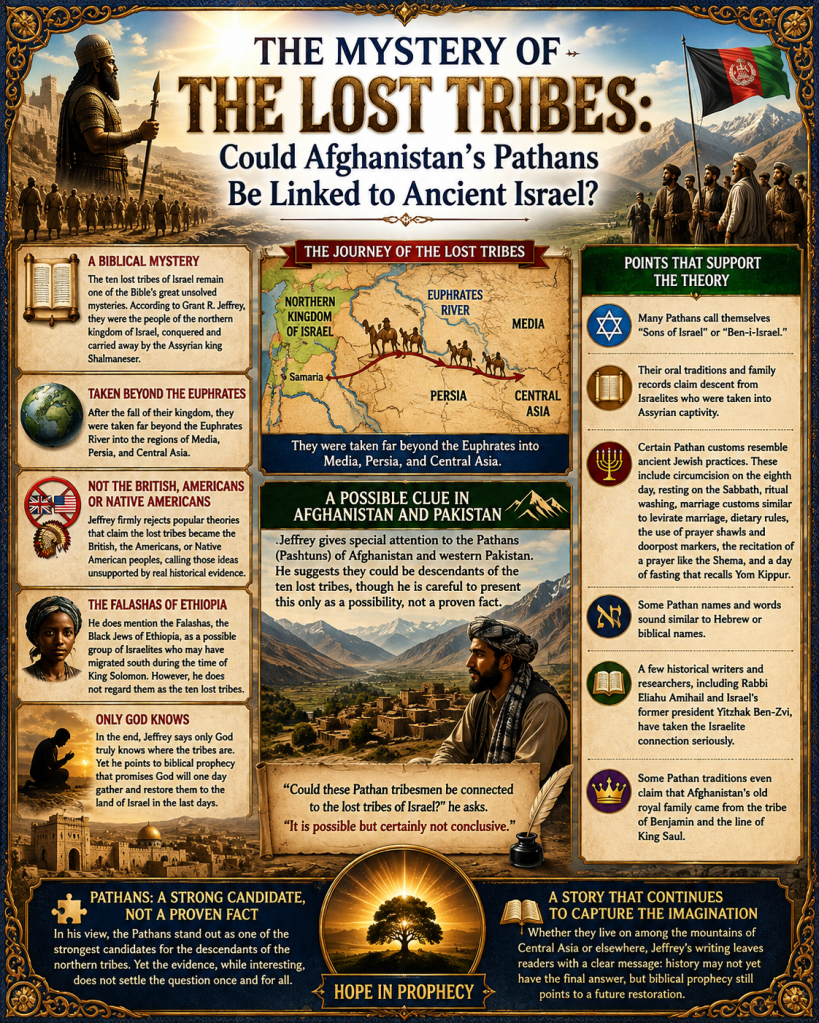
The Mystery of the Lost Tribes: Could Afghanistan’s Pathans Be Linked to Ancient Israel?
🕵️ The Mystery of the Lost Tribes: Could Afghanistan’s Pathans Be Linked to Ancient Israel?
📚 Short Biography of Grant R. Jeffrey
Grant R. Jeffrey (1948–2012) was a Canadian author, Bible teacher, and researcher best known for writing about biblical prophecy, archaeology, Israel, and end-times theology. He became a popular figure in evangelical Christian prophecy circles and wrote numerous books examining how historical events and archaeological discoveries might relate to biblical predictions.
📖 The ten lost tribes of Israel remain one of the Bible’s great unsolved mysteries. According to author Grant R. Jeffrey, these were the people of the northern kingdom of Israel who were conquered and carried away by the Assyrian king Shalmaneser. After the fall of their kingdom, they were taken far beyond the Euphrates River into the regions of Media, Persia, and Central Asia.
🌍 Jeffrey stresses that these tribes did not simply disappear. He believes they remained a large and distinct population for a long time, even though their exact identity and location are unknown today. He firmly rejects popular theories that claim the lost tribes became the British, the Americans, or Native American peoples, calling those ideas unsupported by real historical evidence.
🇪🇹 He does mention the Falashas, the Black Jews of Ethiopia, as a possible group of Israelites who may have migrated south during the time of King Solomon. However, he does not regard them as the ten lost tribes.
🙏 In the end, Jeffrey says only God truly knows where the tribes are. Yet he points to biblical prophecy that promises God will one day gather and restore them to the land of Israel in the last days.
🏔️ A Possible Clue in Afghanistan and Pakistan
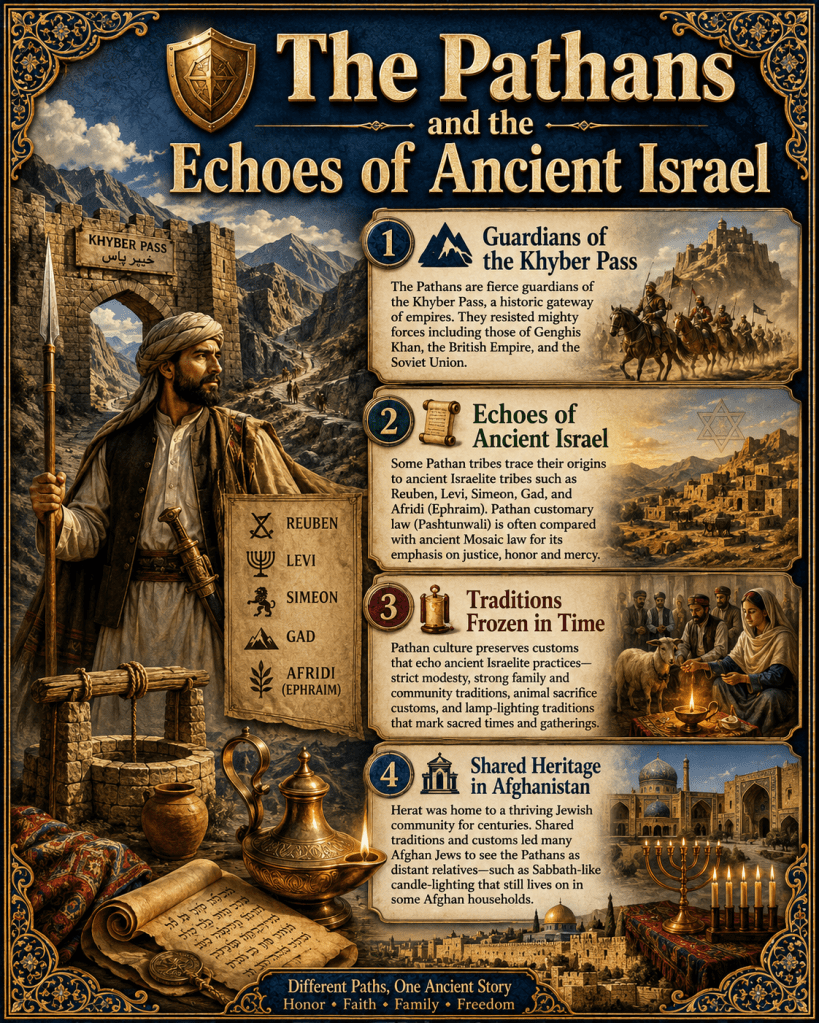
🧭 Among the many theories, Jeffrey gives special attention to the Pathans (also known as Pashtuns) of Afghanistan and western Pakistan. He suggests they could be descendants of the ten lost tribes, though he is careful to present this only as a possibility, not a proven fact.
🔎 Several points, he notes, have led researchers to consider the idea:
🇮🇱 Many Pathans call themselves “Sons of Israel” or “Ben-i-Israel.”
📜 Their oral traditions and family records claim descent from Israelites who were taken into Assyrian captivity.
🕯️ Certain Pathan customs resemble ancient Jewish practices. These include circumcision on the eighth day, resting on the Sabbath, ritual washing, marriage customs similar to levirate marriage, dietary rules, the use of prayer shawls and doorpost markers, the recitation of a prayer like the Shema, and a day of fasting that recalls Yom Kippur.
🔤 Some Pathan names and words sound similar to Hebrew or biblical names.
📚 A few historical writers and researchers, including Rabbi Eliahu Amihail and Israel’s former president Yitzhak Ben-Zvi, have taken the Israelite connection seriously.
👑 Some Pathan traditions even claim that Afghanistan’s old royal family came from the tribe of Benjamin and the line of King Saul.
⚖️ Despite these intriguing details, Jeffrey is cautious. “Could these Pathan tribesmen be connected to the lost tribes of Israel?” he asks. “It is possible but certainly not conclusive.”
🧩 In his view, the Pathans stand out as one of the strongest candidates for the descendants of the northern tribes. Yet the evidence, while interesting, does not settle the question once and for all.
🌄 The story of the ten lost tribes continues to capture the imagination. Whether they live on among the mountains of Central Asia or elsewhere, Jeffrey’s writing leaves readers with a clear message: history may not yet have the final answer, but biblical prophecy still points to a future restoration.
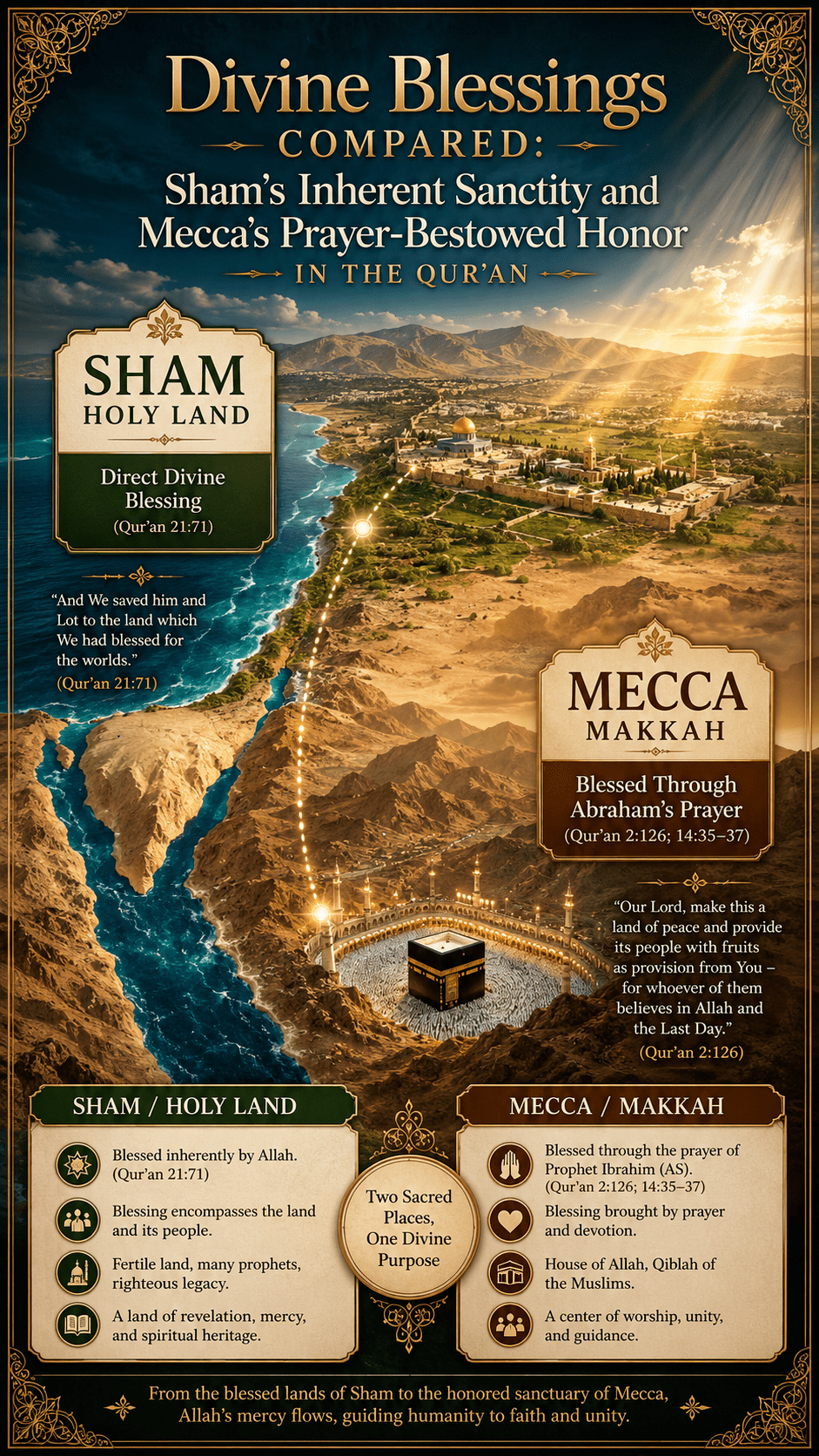
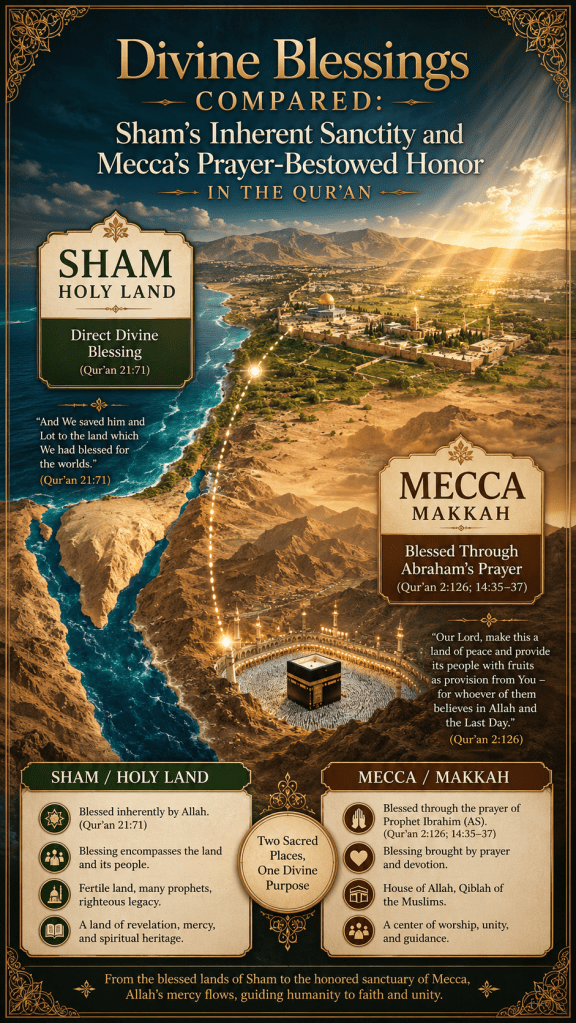
⚖️ Divine Blessings Compared: Sham’s Inherent Sanctity and Mecca’s Prayer-Bestowed Honor in the Qur’an
The difference between the divine blessing of the land of Sham (Greater Syria, including Palestine) as mentioned in Surah 21:71 and the blessing of Mecca (Makkah) in the Qur’an lies in the source and nature of the sanctity attributed to each location.
Here’s a structured comparison:
⸻
📍1. Sham (Greater Syria / Holy Land / Jerusalem) – Direct Divine Blessing
🔹 Qur’anic Reference:
Surah Al-Anbiya’ (21:71):
“And We delivered him [Ibrahim] and Lot to the land which We had blessed for the worlds.”
• The land itself is blessed by Allah directly, without mentioning any human prayer or intervention.
• Classical and modern scholars identify this “blessed land” as Sham, specifically Palestine, including Jerusalem.
• This indicates intrinsic and pre-existing sanctity granted by divine will.
⸻
📍2. Mecca (Makkah) – Blessed Through Prophetic Prayer of Abraham
🔹 Qur’anic References:
• Surah Al-Baqarah (2:126):
“And [remember] when Abraham said, ‘My Lord, make this a safe city and provide its people with fruits…’”
• Surah Ibrahim (14:35–37):
“My Lord, make this city secure and keep me and my sons away from worshipping idols… I have settled some of my descendants in an uncultivated valley near Your sacred House…”
🔸 Key Point:
• Mecca was originally a barren valley (valley of Bakkah) without vegetation.
• Its sanctity and blessings came as a result of Abraham’s prayer and the subsequent building of the Kaʿbah (House of God).
• The Qur’an presents Mecca’s blessing and safety as a response to prophetic supplication.
⸻
⚖️ Summary of the Difference
Source of Blessing:
• Sham / Holy Land: Direct divine declaration — “…the land which We had blessed…” (Surah 21:71).
• Sham / Holy Land: Already blessed when Ibrahim and Lut arrived.
• Mecca / Makkah: Became blessed due to Abraham’s prayer for the settlement of his offsprings.
Nature of Sanctity:
• Sham / Holy Land: Inherent, natural sanctity as a land for all nations.
• Mecca / Makkah: Earned sanctity through prophetic action and ritual significance.
Historical Role
• Sham / Holy Land: Site of many prophets (e.g., Ibrahim, Musa, Isa).
• Mecca / Makkah: Site of the Kaʿbah and the final prophet Muhammad ﷺ.
⸻
🧭 Theological Implications
• Sham is viewed as a blessed land for all peoples and times, with spiritual, historical, and eschatological significance (e.g., place of Jesus’ return, land of many prophets).
• Mecca stands as the spiritual epicenter of Islam — the qiblah of all Muslims and the destination of the Hajj — yet its blessed status in the Qur’an is portrayed not as an inherent quality from the beginning, but as a divine bestowal granted in response to the supplication and devotion of Prophet Ibrahim عليه السلام.
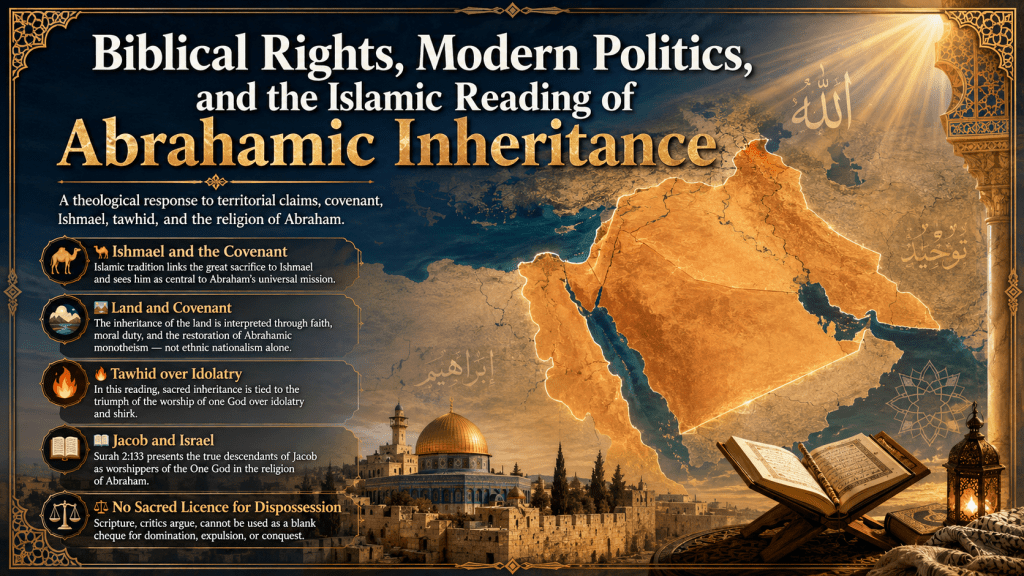
Biblical Rights, Modern Politics, and the Islamic Reading of Abrahamic Inheritance
🌍 A Controversial Claim Raises Deeper Theological Questions
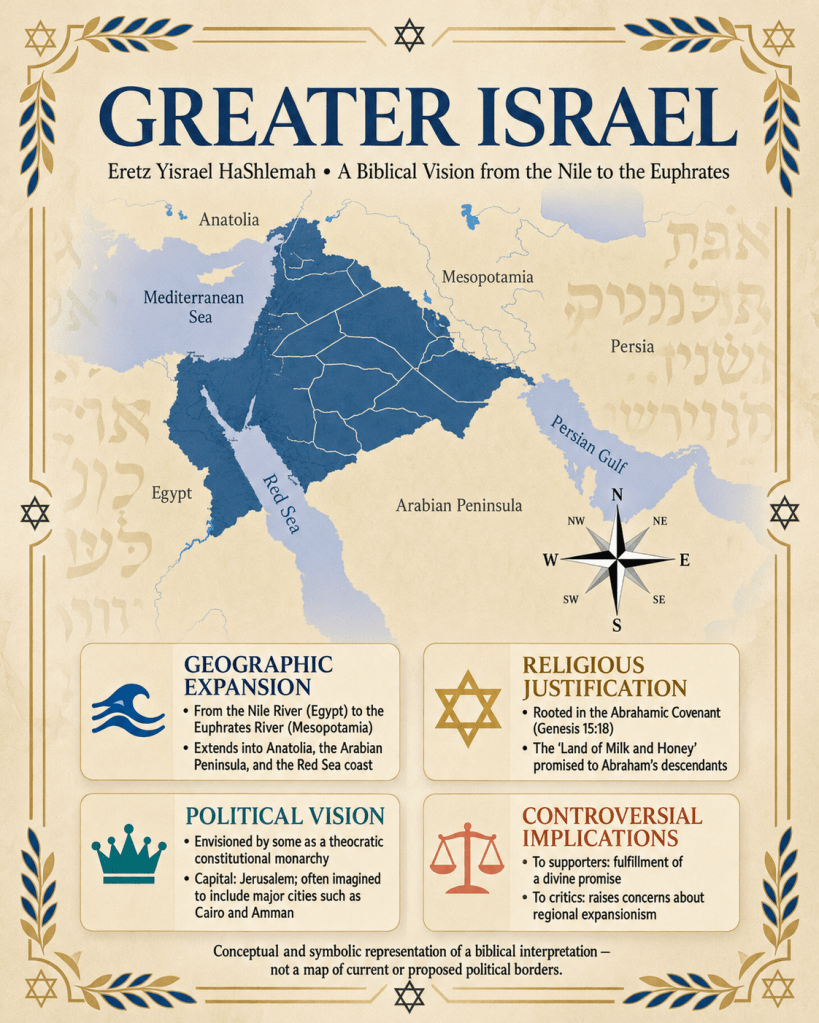
The claim that Israel has a “biblical right” to take over the Middle East is not merely a political statement. It is a claim loaded with theological assumptions, historical implications, and moral consequences.
Such a claim is often challenged by Muslim theologians and critics of religious nationalism, who argue that sacred scripture should not be used as a justification for modern territorial expansion.
📜 Scripture and the Limits of Political Power
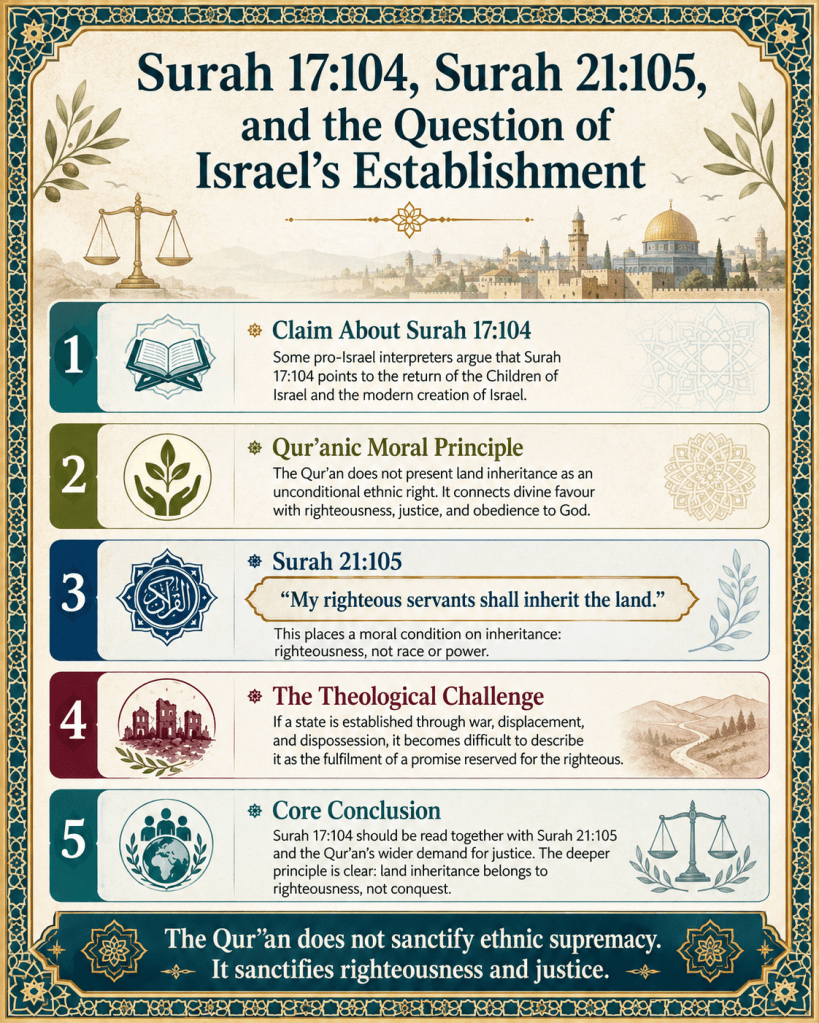
From this perspective, no scripture should be treated as a blank cheque for conquest, displacement, or domination. The covenant with Abraham is understood not as a licence for oppression or ethnic supremacy, but as a sacred responsibility tied to faith and moral conduct.
In the Qur’anic worldview, divine covenant is connected to righteousness, justice, submission to God, and moral accountability. It is not based merely on race, ethnicity, or political control over land.
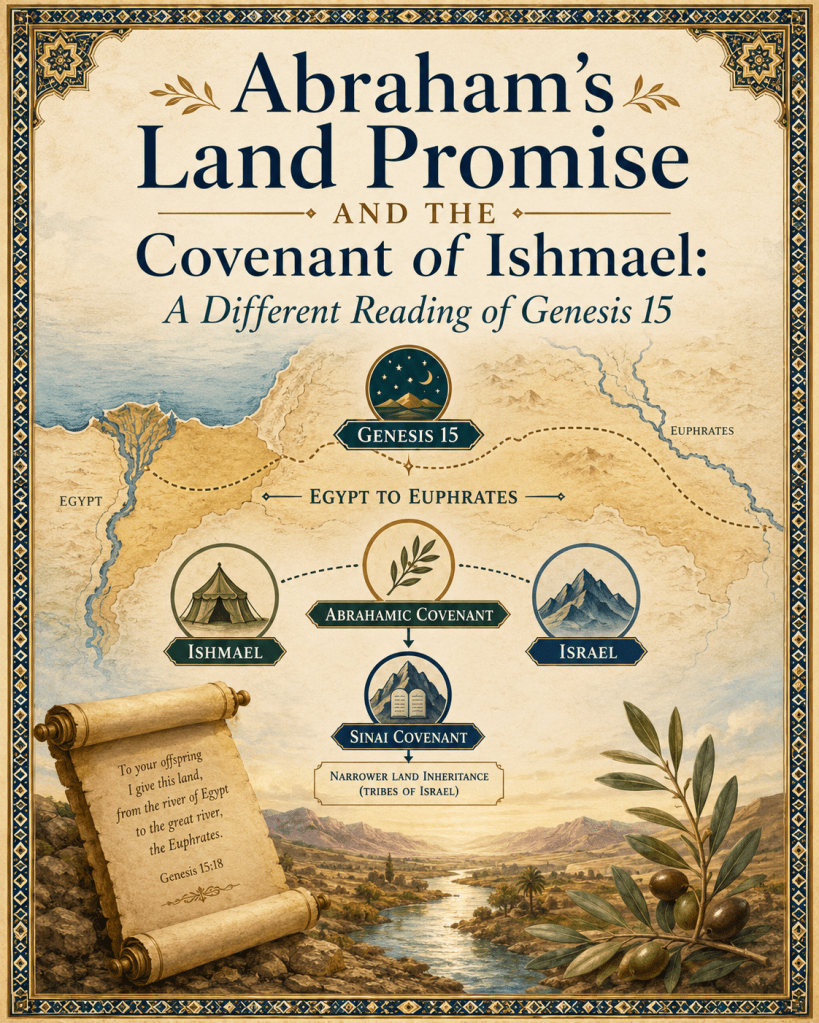
🐪 Ishmael and the Abrahamic Covenant
A central point in the Islamic reading of Abrahamic history concerns the identity of the son associated with the great sacrifice. While Jewish and Christian traditions generally identify Isaac, Islamic tradition identifies Ishmael.
This distinction is theologically significant because Ishmael is not viewed in Islam as an outsider to the Abrahamic covenant. Rather, he is seen as central to the universal continuation of Abraham’s mission.
Through Ishmael came the line associated with Prophet Muhammad ﷺ. Through Prophet Muhammad ﷺ, Muslims believe that the Abrahamic message of pure monotheism was restored in its final form.
🏞️ Land, Covenant, and the Religion of Abraham
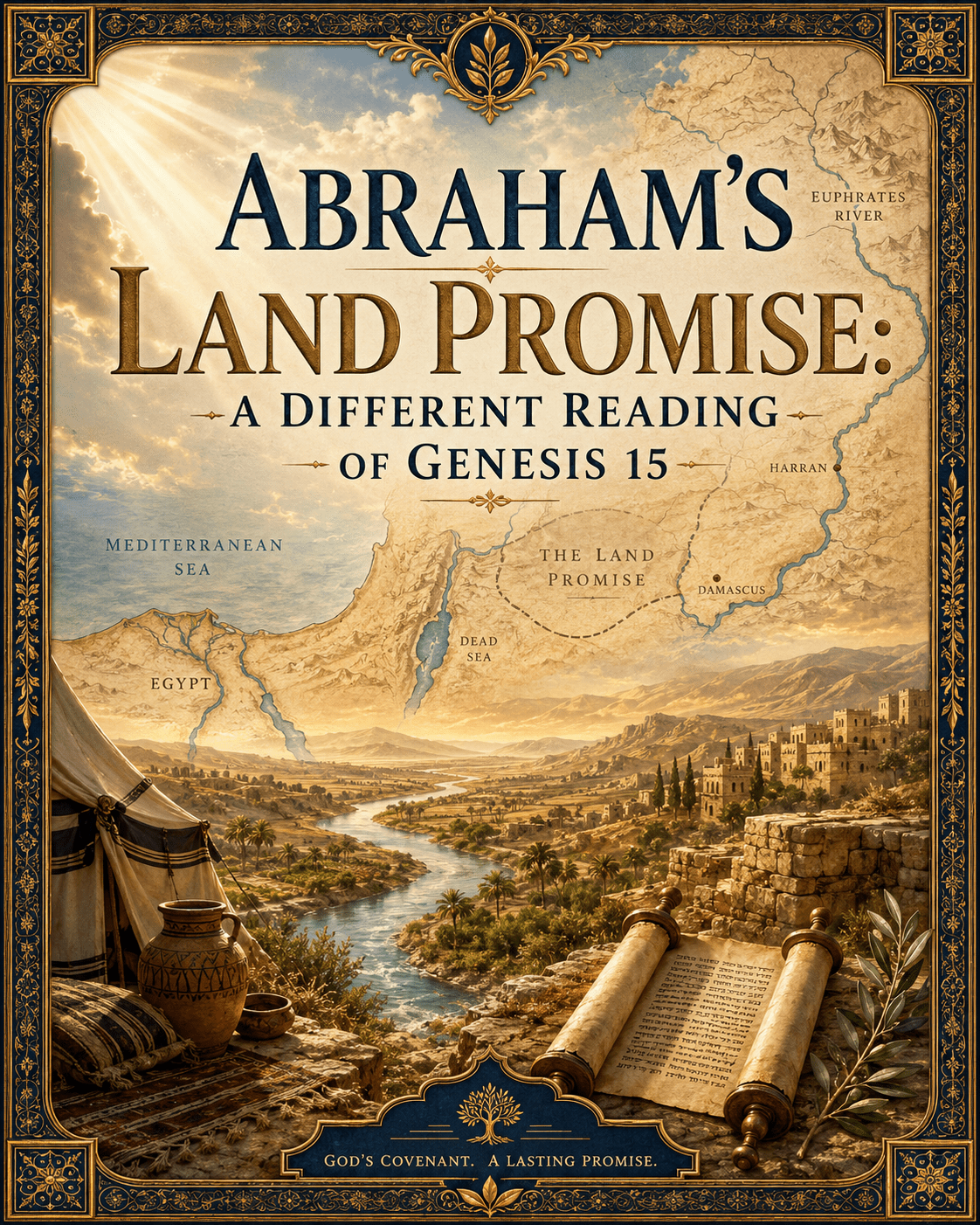
Within this Islamic theological framework, the inheritance of the land from the river of Egypt to the river Euphrates is not viewed merely as a question of ethnic descent or political possession.
Rather, it is interpreted as a covenantal fulfilment linked to the eradication of idolatry and the restoration of the religion of Abraham.
Historically, this interpretation sees the spread of Islam across the lands associated with the Abrahamic promise as a fulfilment of that covenantal inheritance. Through the descendants of Ishmael and the followers of Prophet Muhammad ﷺ, the message of the oneness of God (tawḥīd) spread across the region.
🔥 The Triumph of Tawḥīd Over Idolatry
In this reading, the land was not inherited through racial superiority, ethnic nationalism, or modern state power. It was inherited through the triumph of Abrahamic monotheism over shirk, or the association of partners with God.
The deeper issue, therefore, is not merely who controls territory, but whether the land is associated with the worship of the One God and the rejection of idolatry.
The true mark of Abrahamic inheritance, according to this view, is not bloodline alone, but faithfulness to Abraham’s creed: submission to God, rejection of false gods, and commitment to divine justice.
📖 Jacob, Israel, and the Religion of Abraham
Another important Qur’anic passage in this discussion is Surah al-Baqarah 2:133, where Jacob asks his sons what they will worship after him, and they answer that they will worship the One God — the God of Abraham, Ishmael, Isaac, and Jacob — and submit to Him. In an Islamic theological reading, this verse presents the true descendants of Jacob, or Israel, as those who ultimately return to the religion of Abraham, understood in Islam as submission to the One God.
Some interpreters extend this idea by arguing that the true descendants of Israel who sincerely preserve the Abrahamic faith would eventually be absorbed into Islam, the final form of the religion of Abraham. Within this view, groups such as Palestinians — sometimes linked by certain historical arguments to ancient Judah — and Afghans — sometimes associated in popular traditions with the Ten Lost Tribes of Israel — are seen as possible examples of Israelite-descended peoples who entered Islam. Nevertheless, the debate surrounding these ethnic identifications persists, despite the endorsement of some Israeli historians.
⚖️ Biblical Promise and Moral Accountability
Even within the biblical tradition, the land promise is not always presented as detached from obedience to God. The prophets repeatedly warned the Israelites that injustice, arrogance, bloodshed, and oppression would bring divine judgment.
For this reason, critics argue that a claim of “biblical right” without justice becomes deeply problematic. It risks turning sacred covenant into political ideology dressed in religious language.
🕊️ Abraham Was Not a Nationalist Conqueror
From an Islamic perspective, Abraham was neither a nationalist conqueror nor a tribal supremacist. He was a model of pure monotheism, submission, hospitality, and moral uprightness.
To invoke Abraham as a justification for dispossessing another people is therefore seen by critics as a betrayal of the ethical spirit of Abrahamic faith.
🌐 No Sacred Licence for Dispossession
The Middle East, in this theological view, does not belong to any modern government by automatic divine entitlement. It belongs to God, who commands justice among all peoples — Jews, Christians, Muslims, and others.
Therefore, no state should claim sacred permission to dominate, expel, or dispossess another people in the name of religion.
🧠 Toward a More Honest Abrahamic Theology
A more honest Abrahamic theology would reject the use of scripture as a weapon of domination. It would insist that divine covenant must be joined with justice, mercy, and submission to God.
In this reading, the true heirs of Abraham are not those who expand borders by force. They are those who uphold the oneness of God (tawḥīd), reject idolatry, practice justice, and submit sincerely to the One God, following the religion of Abraham in faith, worship, and moral responsibility.
Ya’juj and Ma’juj, Jerusalem, and the Promise of Inheriting the Holy Land in Surah al-Anbiyā’
📖 Introduction
Surah al-Anbiyā’ contains a fascinating sequence of verses when read as a whole. The surah begins with the migration of Prophet Abraham (Ibrahim) to the blessed land, then moves to the emergence of Ya’juj and Ma’juj (Gog and Magog) near the end of time, and finally concludes with the promise that the earth will be inherited by the righteous servants of Allah.
Some researchers view this arrangement of verses as a historical and eschatological narrative centered on the Holy Land of Palestine and the city of Jerusalem (Bayt al-Maqdis). According to this reading, Surah al-Anbiyā’ portrays a historical journey that begins with the granting of the Holy Land to Prophet Abraham, followed by the rise of a great power in the end times that comes to dominate Jerusalem, and ultimately concludes with the return of the Holy Land to the believers through Divine intervention.
🌿🕋 The Beginning of the Holy Land’s History: Prophet Abraham and the Blessed Land
Allah says:
“And We delivered Abraham and Lot to the land which We had blessed for all peoples.”
(Surah al-Anbiyā’ 21:71)
Classical Muslim commentators generally understand this verse as referring to the region of Greater Syria (Bilād al-Shām), which includes Palestine, Jerusalem, and its surrounding areas.
This verse demonstrates that Palestine is not merely a geographical territory, but a land chosen by Allah as a center of prophetic history. It was here that many prophets were sent, revelation descended, and the struggle for monotheism unfolded throughout history.
From this perspective, Surah al-Anbiyā’ begins its narrative with the granting of the blessed land to Prophet Abraham عليه السلام, the father of the prophets and a central figure in the Abrahamic tradition.
🕌⏳ Jerusalem and the Signs of the End Times
Allah then says:
“And it is forbidden for a city which We have destroyed; they should not return.”
(Surah al-Anbiyā’ 21:95)
According to this eschatological interpretation, the city (qaryah) mentioned in this verse refers specifically to Jerusalem (Bayt al-Maqdis), the holy city that has repeatedly experienced destruction, conquest, exile, and changing political control throughout history.
The verse is interpreted as indicating that Jerusalem will once again flourish and attract worldwide attention once the prohibition is lifted through the release of Ya’juj and Ma’juj.
🌊🌍 The Release of Ya’juj and Ma’juj
Allah says:
“Until when Ya’juj and Ma’juj (Gog and Magog) are released, and they surge down from every elevation.”
(Surah al-Anbiyā’ 21:96)
The majority of Muslim scholars understand Ya’juj and Ma’juj (Gog and Magog) as real human peoples who will emerge shortly before the Day of Judgment.
However, some symbolic interpretations view Ya’juj and Ma’juj (Gog and Magog) as a civilizational movement or global force that produces major transformations in world history.
Within this interpretive framework, Ya’juj and Ma’juj (Gog and Magog) are associated with modern Zionism, which succeeded in gathering Jewish communities from across the world into Palestine and Jerusalem.
Supporters of this interpretation argue that the connection between verses 95 and 96 is highly significant. Verse 95 speaks about the return of the inhabitants of a city that had previously been subjected to a Divine prohibition, while verse 96 describes the release of Ya’juj and Ma’juj (Gog and Magog).
According to this interpretation, the sequence of verses suggests a cause-and-effect relationship: the release of Ya’juj and Ma’juj marks the lifting of the divine prohibition over Jerusalem, allowing the city to be restored through the Zionist movement and repopulated by Jewish communities from the diaspora. Some also associate this restoration with Jewish aspirations to rebuild the Third Temple. Within this interpretive framework, Ya’juj and Ma’juj are understood as representing the modern Zionist movement or the wider global forces associated with it.
According to this reading, the phrase:
“they surge down from every elevation”
is understood as depicting the convergence of a global movement arriving from many nations and continents to resettle Jerusalem. The large-scale migration of Jewish diaspora communities to Palestine during the nineteenth and twentieth centuries is viewed as the historical
⚔️🕌 Jerusalem as the Center of End-Time Conflict
In numerous authentic hadiths, the region of Greater Syria (Shām) is described as a blessed land and the focal point of many major events preceding the Day of Judgment.
The Prophet ﷺ said:
إِذَا فَسَدَ أَهْلُ الشَّامِ فَلَا خَيْرَ فِيكُمْ
“When the people of Shām become corrupted, there will be no goodness left in you.”
This hadith presents Shām, with Jerusalem at its spiritual center, as a barometer of the moral and religious condition of the Muslim Ummah.
The Prophet ﷺ signaled that when Shām and its people become corrupted, that corruption reflects a broader corruption within the Muslim community, because Shām is one of the centers of blessing, faith, and struggle in the end times.
For this reason, some researchers view the conflict centered on Jerusalem as more than merely a geopolitical conflict; they regard it as part of an eschatological drama long foretold in revelation.
Within this framework, Zionist control of Jerusalem is seen as a historical phase preceding Divine intervention at the end of time.
📜✨ Allah’s Promise in the Psalms (Zabur)
After mentioning Ya’juj and Ma’juj (Gog and Magog), Surah al-Anbiyā’ presents a profound promise:
“And indeed We have written in the Psalms after the Reminder that My righteous servants shall inherit the earth.”
(Surah al-Anbiyā’ 21:105)
Some commentators explain that the “Reminder” refers to the Torah, while the “Psalms” refer to the Book of David (Dawud).
They also interpret the term al-ard (“the land” or “the earth”) in Surah al-Anbiyā’ 21:105 as referring specifically to the Holy Land of Shām and Palestine rather than the entire world in a general sense.
This interpretation is based on the context of the verse, which mentions the Torah and the Psalms, two scriptures closely connected with the history of the Israelite prophets in that land. Accordingly, the verse is understood as a promise that the Holy Land will ultimately be inherited by Allah’s righteous servants.
Thus, the verse indicates that the promise of the righteous inheriting the land of Shām had already been established in the earlier scriptures.
In the context of Palestine, the verse is interpreted as a guarantee that the rule of any power opposing Allah’s will cannot endure forever. Rather, the Holy Land will ultimately return to those who uphold justice and believe in Allah.
🌟🕊️ The Return of Jesus and the Final Victory
Authentic hadiths explain that Jesus (ʿĪsā) عليه السلام will descend in the end times to defeat the Antichrist (Dajjāl) and establish justice on earth.
After the era of great tribulation comes to an end, peace will return and a government founded upon truth and justice will be established.
Within this interpretive framework, Surah al-Anbiyā’ depicts three major stages in the history of the Holy Land:
1. 🌿 The granting of the blessed land to Abraham and his faithful descendants (21:71).
2. 🕌 The transformation of Jerusalem into a global center and prosperous city through large-scale Zionist Jewish settlement associated with the release of Ya’juj and Ma’juj (Gog and Magog) (21:95–96).
3. 📜 The inheritance of the Holy Land by Allah’s righteous servants as promised in the Psalms (21:105).
The descent of Jesus عليه السلام is viewed as the culmination of this process, when oppression is ended and Allah’s promise concerning the inheritance of the land is finally fulfilled.
🌅 Conclusion
When read thematically, Surah al-Anbiyā’ may be seen as a narrative that begins with Abraham in the land of Palestine and ends with the victory of the righteous in that same land.
According to this eschatological interpretation, verse 21:71 refers to the beginning of the Holy Land’s history under Abraham, verses 21:95–96 foretell the return of Jerusalem as a center of world attention following the release of Ya’juj and Ma’juj (Gog and Magog), while verse 21:105 promises that the land will ultimately be inherited by Allah’s righteous servants.
Within this reading, the rise of Zionism and the flourishing of Jerusalem under Jewish settlement are viewed as one of the final phases of history preceding the descent of Jesus عليه السلام, before the fulfillment of Allah’s promise that the blessed land will return to those who believe and establish justice.
Is the Destroyed City in Surah al-Anbiyā’ Jerusalem?
21:95 “And it is forbidden for a town which We have destroyed that they should return.”
21:96 “Until, when Ya’juj and Ma’juj are released, and they descend swiftly from every elevation.”
A more interpretive translation:
“It is impossible for a destroyed city whose people We have destroyed to return, until Ya’juj and Ma’juj are released, and they rush down from every high place.”
⸻
🔍 Lexical Explanation of Verse 21:95
وَحَرَامٌ — wa-ḥarāmun
The word ḥarām here means forbidden, prohibited, impossible, or prevented.
It does not necessarily mean “religiously unlawful” in the legal sense. In this verse, it carries the meaning of a Divine barrier or impossibility.
So the phrase suggests that something is blocked by Allah’s decree.
⸻
عَلَىٰ قَرْيَةٍ — ʿalā qaryatin
Qaryah usually means a town, city, settlement, or inhabited community.
It does not only refer to a small village. In Qur’anic usage, qaryah can refer to a major city or civilization, depending on context.
For example, Makkah is also referred to as Umm al-Qurā, “Mother of the Cities.”
So qaryah here may mean a destroyed city or community.
⸻
أَهْلَكْنَاهَا — ahlaknāhā
This comes from the root هلك / h-l-k, meaning to destroy, ruin, perish, or cause to fall.
Ahlaknāhā means:
“We destroyed it.”
The pronoun -hā refers back to qaryah, the town or city.
This destruction may refer to physical destruction, the destruction of its people, or the collapse of its social and religious order.
⸻
أَنَّهُمْ لَا يَرْجِعُونَ — annahum lā yarjiʿūn
This phrase means:
“that they shall not return.”
The verb yarjiʿūn comes from رجع / r-j-ʿ, meaning to return, come back, revert, or restore.
The key question is: return to what?
Classical interpretations often understand it as:
They will not return to worldly life after destruction.
However, some thematic or eschatological readings understand it as:
The inhabitants of a destroyed city will not return to it, or the city will not be restored, until a later end-time event.
This second reading is more interpretive and should be presented carefully.
⸻
🔍 Lexical Explanation of Verse 21:96
حَتَّىٰ إِذَا — ḥattā idhā
This phrase means:
“until when…”
It introduces a turning point or a major event.
Here, it links verse 95 to verse 96. This connection is important because verse 96 begins with ḥattā, suggesting that the situation described before continues until a major eschatological event occurs.
⸻
فُتِحَتْ — futiḥat
This comes from the root فتح / f-t-ḥ, meaning to open.
Futiḥat is passive:
“are opened” or “are released.”
This may imply that Ya’juj and Ma’juj were previously restrained, blocked, or contained, and then a barrier is opened for them.
This wording connects with Surah al-Kahf 18:94–99, where Dhul-Qarnayn builds a barrier against Ya’juj and Ma’juj, and near the end of time that barrier will collapse by Allah’s decree.
⸻
يَأْجُوجُ وَمَأْجُوجُ — Ya’jūj wa Ma’jūj
These are the Arabic names for Gog and Magog.
In mainstream Islamic belief, they are real human peoples who will emerge near the end of time.
Some symbolic interpretations understand them as representing destructive civilizational forces, chaotic global powers, or mass movements. However, that symbolic reading is not the dominant classical interpretation and should be identified as interpretive rather than definitive.
⸻
وَهُم مِّن كُلِّ حَدَبٍ — wa-hum min kulli ḥadabin
This means:
“and they, from every ḥadab…”
Ḥadab means a raised place, elevation, hill, slope, ridge, or high ground.
The phrase min kulli ḥadab means:
“from every elevation” “from every high place” “from every hill and slope”
It gives the image of a vast multitude spreading rapidly from all directions.
⸻
يَنسِلُونَ — yansilūn
This comes from the root نسل / n-s-l, meaning to move quickly, rush, hasten, or stream forth.
So the phrase:
مِّن كُلِّ حَدَبٍ يَنسِلُونَ
means:
“They rush down from every elevation.”
The image is not slow movement. It is rapid, overflowing, and overwhelming movement, like a flood of people descending from many high places.
⸻
🧠 Semantic Explanation
Semantically, the two verses form a powerful sequence:
Verse 95 speaks of a destroyed qaryah, a city or community, whose return is blocked or forbidden.
Verse 96 then introduces the release of Ya’juj and Ma’juj as a turning point:
“Until, when Ya’juj and Ma’juj are released…”
This creates a strong literary link between the blocked return/restoration in verse 95 and the great end-time upheaval in verse 96.
However, the meaning depends on the interpretive approach.
📚 Mainstream Classical Reading
In many classical tafsīr works, verse 95 is understood to mean that when Allah destroys a sinful town or people, they do not return to worldly life. Their opportunity for repentance and worldly action has ended.
Then verse 96 moves to the final signs of the Hour, especially the release of Ya’juj and Ma’juj.
According to this reading, the verses describe:
destruction, no return to worldly life, then the approach of the final Hour.
🕌 Eschatological-Thematic Reading
In a thematic reading, verse 95 may be understood as referring to a destroyed city whose return or restoration remains blocked until a later end-time development.
Because verse 96 immediately mentions the release of Ya’juj and Ma’juj, some interpreters see a connection between:
the return/restoration of a destroyed city, the release of Ya’juj and Ma’juj, and the great upheavals before the Day of Judgment.
But it is important to phrase this carefully. The verse itself does not explicitly name Jerusalem. Identifying the qaryah as Jerusalem is an interpretive proposal, not the plain literal wording of the verse.
☀️ Conclusion
Although Surah al-Anbiyā’ 21:95 does not explicitly name Jerusalem, the identification of the qaryah as Jerusalem becomes more plausible when compared with Surah al-Baqarah 2:259. In that verse, the Qur’an speaks of a man who passed by a ruined town and wondered how Allah would restore it after its destruction. Many commentators have associated that ruined town with Bayt al-Maqdis, or Jerusalem, especially in relation to its historical destruction and later restoration.
This parallel is significant because both passages speak of a destroyed qaryah and the question of its return or restoration. Therefore, supporters of this interpretation argue that Surah 21:95 may also allude to Jerusalem as a city once destroyed, placed under a Divine restriction, and later restored in connection with the great events preceding the Hour.
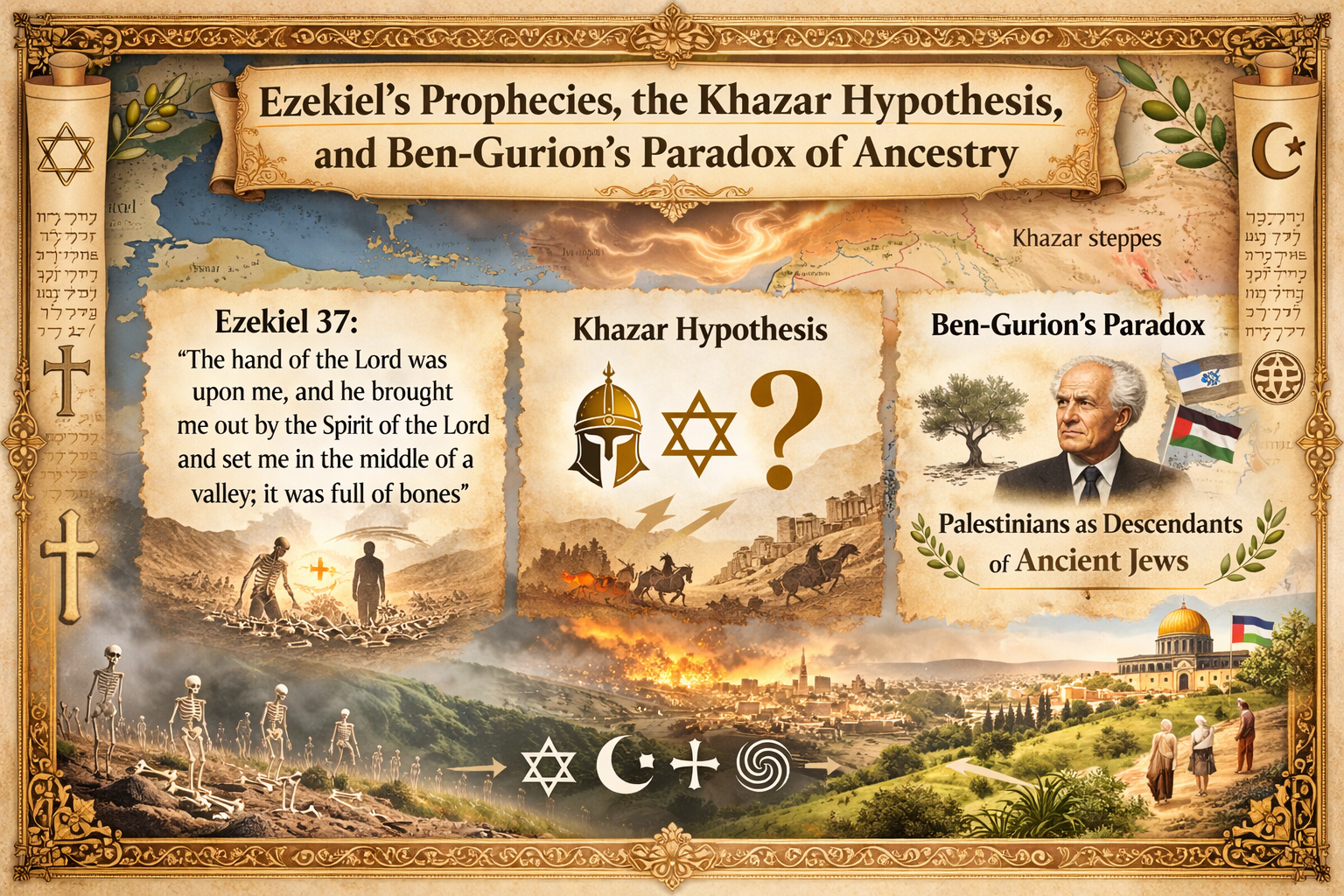
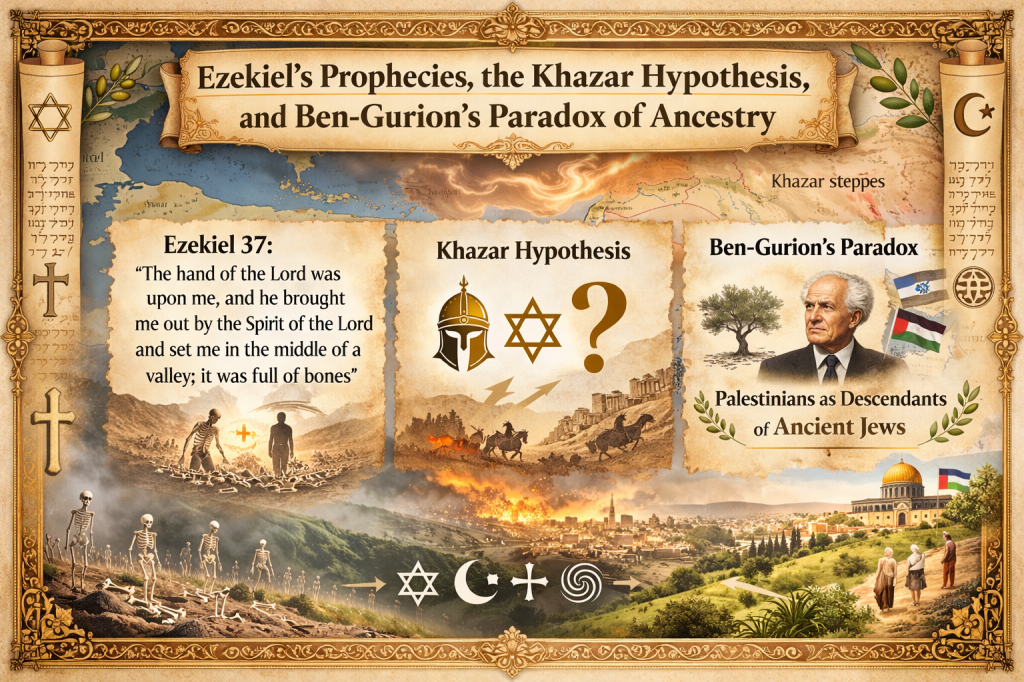
Ezekiel’s Prophecies, the Khazar Hypothesis, and Ben-Gurion’s Paradox of Ancestry
📜 Introduction
The establishment of the modern State of Israel in 1948 has often been framed as the fulfillment of biblical prophecy. Many point to Ezekiel 37—the “valley of dry bones”—as the divine foretelling of Israel’s national resurrection. Yet competing perspectives challenge this narrative. Some scholars argue that the prophecy of Ezekiel 37 remains unfulfilled and that the events surrounding the modern state may instead align with Ezekiel 38–39, where Gog and Magog rise against the land. This interpretive debate is further complicated by the Khazar hypothesis regarding Ashkenazi origins and by a paradoxical statement from David Ben-Gurion, Israel’s first Prime Minister, who acknowledged that many Palestinians may be direct descendants of the ancient Jews.
⸻
The Khazar Hypothesis and Ashkenazi Identity 🏰✡️
The “Khazar hypothesis” proposes that Ashkenazi Jews largely descend from the Khazars, a Turkic people whose ruling class converted to Judaism in the 8th–9th centuries. While contested and not universally accepted, this theory has influenced theological interpretations, especially among those who question the legitimacy of modern Zionism in biblical terms.
If modern Ashkenazim descend primarily from converts rather than the exiled tribes of Israel, then the biblical framework of “return” to the land becomes less clear. Critics argue that in such a scenario, the establishment of Israel would not represent Ezekiel’s vision of restored Israel, but rather a foreign incursion upon it.
⸻
Ezekiel 37: The Vision of Restoration 🌄✡️
Ezekiel 37 presents a powerful vision of dry bones coming to life, symbolizing not only physical restoration to the land but also spiritual renewal:
“I will put My Spirit in you, and you shall live, and I will place you in your own land” (Ezek. 37:14).
Proponents of Zionism often point to Israel’s rebirth after the Holocaust as a miraculous fulfillment of this passage. Yet critics note that the modern state is largely secular and political, lacking the covenantal transformation envisioned in the text. For them, the true restoration of Israel described by Ezekiel 37 has not yet taken place .
⸻
Ezekiel 38–39: Gog and Magog in the Holy Land ⚔️🌍
Ezekiel 38–39 describes the invasion of the holy land by Gog of Magog and his allies, leading to a climactic confrontation in which God Himself intervenes.
Some interpreters argue that modern Israel, rather than fulfilling Ezekiel 37, fits more closely with this apocalyptic scenario. By this reasoning, the presence of Khazar-descended Jews in the land could correspond to the role of Gog and Magog—outsiders whose settlement sparks the eschatological conflict.
⸻
Ben-Gurion’s Paradox: Palestinians as Descendants of Ancient Jews 🌿☪️
David Ben-Gurion himself complicated the Zionist narrative. He acknowledged the belief that many Palestinians were descendants of the ancient Jews who had remained in the land after the Roman expulsions of 70 CE and 135 CE. Over time, these communities converted—first to Christianity and later to Islam—while retaining cultural and agricultural continuities with their ancestors.
Ben-Gurion’s rationale rested on several perspectives:
1. Historical Continuity: Not all Jews were exiled; many remained and gradually assimilated into the local population.
2. Sociological Evidence: Palestinian fellahin (peasants) preserved agricultural practices and customs resembling those of ancient Israelites.
3. Ideological Reflection: If Palestinians were indeed descendants of ancient Jews, then the paradox arises that those seen as “strangers” by Zionism might actually be the truer heirs of the land promised in scripture.
⸻
Theological and Political Implications ⚖️
This paradox destabilizes the neat narrative of prophecy fulfillment. If Ashkenazim are linked to Khazars, while Palestinians carry Israelite ancestry, then the lines between “restoration” and “intrusion” blur.
Ezekiel 37 may then point toward a future yet to come—a spiritual return of covenant fidelity—while Ezekiel 38–39 foreshadows the current geopolitical struggle involving outsiders in the land.
⸻
Conclusion
The convergence of the Khazar hypothesis, Ezekiel’s prophecy, and Ben-Gurion’s reflections highlights the complexities of modern Israel’s identity.
Is the state a fulfillment of the valley of dry bones, or is it the stage for Gog and Magog? Is the true Israelite heritage found in the Jewish immigrants of Europe, or in the Palestinians who never left the land?
These questions reveal not only theological tensions but also the paradox at the heart of Israel’s national story: prophecy, history, and identity remain contested and unresolved.
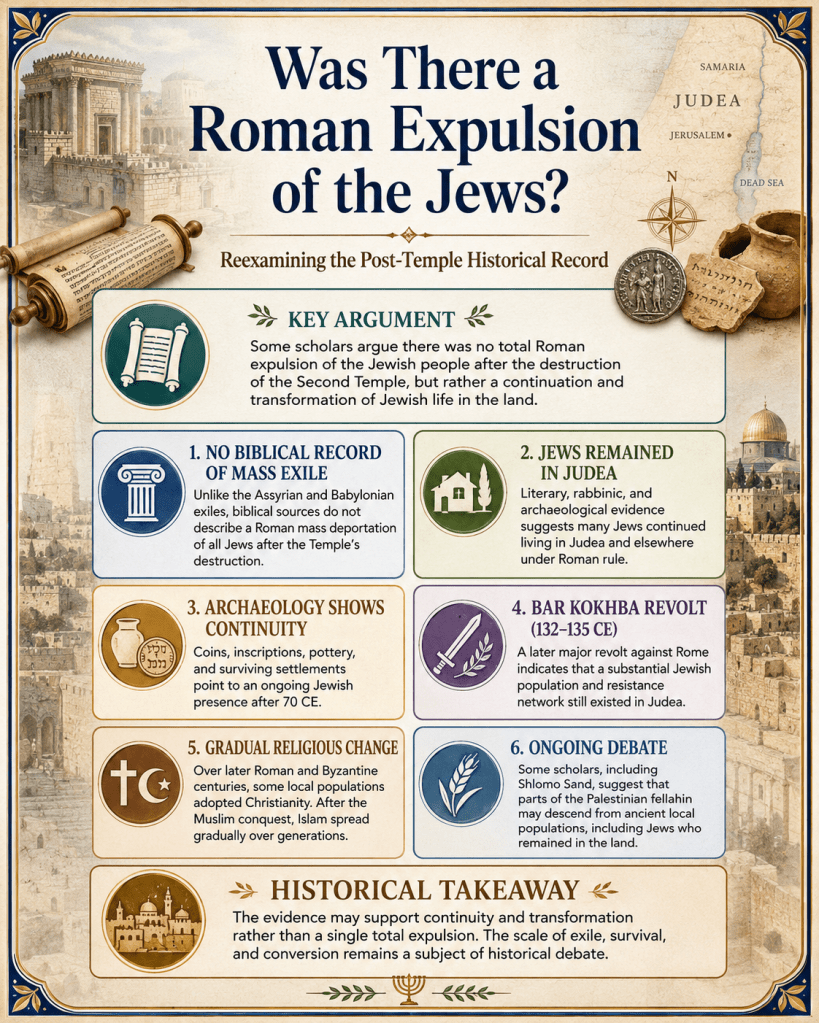
Was There a Roman Expulsion of the Jews?
🏛️ Reexamining the Post-Temple Historical Record
📜 The argument that there was no expulsion of the Jewish people after the destruction of the Second Temple by the Romans is based on several points:
📖 The biblical sources do not mention any Roman mass deportation or exile of the Jewish people after the destruction of the Second Temple, unlike the Assyrian captivity of the northern Kingdom of Israel and the Babylonian captivity of Judah, both of which are described in detail in the Hebrew Bible.
🏡 Many Jews continued to live in Judea and other parts of Palestine under Roman rule, as evidenced by archaeological finds, literary sources, and rabbinic traditions. Some of these Jews participated in later revolts against the Romans, such as the Bar Kokhba revolt of 132–135 CE, which resulted in further devastation and repression.
🏺 The archaeological evidence does not support the idea of a large-scale expulsion or depopulation of Judea by the Romans. On the contrary, many Jewish settlements continued to exist and flourish in the region after 70 CE, as attested by coins, inscriptions, pottery, and other artifacts. Some of these settlements were even fortified and rebelled against the Romans again in the Bar Kokhba revolt of 132–135 CE, which shows that there was still a significant Jewish presence and resistance in Judea.
🏛️ The historical evidence indicates that many Jews remained in Judea under Roman rule, either as farmers, artisans, merchants, or soldiers. Some of them even attained high positions in the Roman administration, such as Tiberius Julius Alexander, who was the governor of Egypt and a close friend of Titus, the destroyer of Jerusalem.
✝️ During the later Roman and Byzantine periods, however, the religious landscape of the Holy Land changed significantly. As Christianity became increasingly dominant within the empire, especially after the fourth century CE, many inhabitants of the region — including some people of Jewish background and related local populations — gradually adopted Christianity. Conversion occurred through a variety of social, economic, political, and religious processes, though the scale and extent remain debated among historians.
☪️ Following the Muslim conquest of the Holy Land in the seventh century CE, another major transformation took place. Over subsequent centuries, Islam spread gradually throughout the region. Some local populations, including some with Jewish and Christian ancestry, eventually converted to Islam through complex processes involving social integration, taxation structures, intermarriage, cultural interaction, and changing political realities. Conversion was generally a gradual process extending across generations rather than a single sudden event.
🧭 Therefore, based on these points, some scholars argue that there was no expulsion of the Jewish people after the destruction of the Second Temple by the Romans, but rather a continuation and transformation of Jewish life in Judea and elsewhere.
🌾 In this context, some Israeli scholars, including Shlomo Sand, have argued that some Palestinian fellahin, or rural farming communities, may be descendants of ancient local populations of the land, including biblical Jews who remained in Palestine rather than being exiled.
According to this view, over many centuries, some of these communities gradually adopted Christianity and later Islam, while continuing to live on the same land. This interpretation challenges the simple idea that the ancient Jewish population disappeared entirely from the region after the Roman destruction of Jerusalem.
Reevaluating the Link Between Modern Israel and Biblical Israel: A Theological Analysis
In recent years, certain theological interpretations—particularly within Christian Zionism—have claimed a direct and unbroken continuity between the modern State of Israel and the Israel of the Bible. A central tenet of this belief is that divine blessing is contingent upon supporting the current nation-state of Israel, often based on Genesis 12:3: “I will bless those who bless you, and whoever curses you I will curse.” However, a deeper examination of the relevant scriptures, both in the Hebrew Bible and the New Testament, challenges the theological foundation of this view.
📖 The Misapplication of Genesis 12:3
Genesis 12:3 refers specifically to Abraham and his descendants, not to a political entity known as “Israel.” In fact, the term “Israel” does not appear in this verse at all. The promise is made to Abraham’s lineage, which, according to both the Torah and the Qur’an, is defined by righteousness and obedience, not merely by ethnic or genetic descent. The notion that supporting a modern political state guarantees divine favor lacks direct biblical substantiation when examined in its original context.
📚 The Role of the Scofield Reference Bible
The widespread acceptance of this interpretation in Western Christianity is often traced to the 1909 Scofield Reference Bible. Financed and promoted by American Zionist interests, this annotated Bible interpreted Genesis 12:3 as a divine command to unconditionally bless and support the Jewish people and, by extension, the modern State of Israel. This reading has heavily influenced Christian Zionist theology, despite its relatively recent origin and its selective use of Scripture.
✝️ Redefining Israel in the Synoptic Gospels
The Synoptic Gospels present covenant identity as something defined not merely by ethnic descent, but by faithfulness, obedience, repentance, and response to God’s kingdom.
In Matthew 3:9, John the Baptist warns that physical descent from Abraham is not enough to guarantee covenant status. In Matthew 8:11–12, Jesus teaches that many from “east and west” will enter the kingdom, while some presumed heirs (including some within covenant Israel) may be excluded. This shifts the focus from ancestry to faith and response to God.
Jesus deepens this idea in Matthew 12:46–50, where he defines his true family as those who do the will of the Father. The clearest expression appears in Matthew 21:33–43, where Jesus says the kingdom of God will be taken away from the unfaithful tenants—often understood as the religious leadership of Israel—and given to a people who produce its fruits.
Thus, the Synoptic Gospels portray Jesus as reshaping the meaning of God’s covenant people. Israel is no longer understood only through lineage or national identity, but through spiritual fruitfulness, obedience, and participation in God’s kingdom.
📜 The New Covenant and the End of the Old
The New Testament echoes the prophecy of Jeremiah 31:31, speaking of a “new covenant” that redefines the terms of God’s relationship with His people. This covenant, centered on Jesus, supersedes the old covenant tied to ethnicity and geography. The destruction of the Second Temple in 70 CE is often interpreted in Christian theology as the end of a distinct covenantal relationship with ethnic Israel, particularly in light of widespread rejection of Jesus as Messiah.
⚠️ Concerns About Christian Zionism
The theological and political implications of Christian Zionism raise serious concerns. The movement is often marked by what critics describe as “eodolatry”—the idolization of a specific ethnic group—and “fedism,” an unquestioning reliance on faith divorced from reason and scriptural context. This blind allegiance to a secular state, often at odds with core Christian values, undermines the central message of the New Testament.
Some prominent figures within strands of Christian Zionism have made controversial theological claims that critics argue diminish or redefine Christ’s messianic role. For instance, John Hagee made contentious remarks regarding Jesus’ messianic mission, which critics viewed as downplaying Jesus’ self-identification as the Messiah to the Jewish community. Many evangelical Christians argued that such wording appeared to conflict with the Gospel portrayal of Jesus as the promised Messiah.
🌍 Geopolitical Implications
The misinterpretation of Genesis 12:3 within a theological context cannot be considered in isolation. It has significant real-world consequences, particularly in justifying geopolitical actions, including war and occupation, under the guise of fulfilling divine prophecy. By conflating spiritual promises with political agendas, Christian Zionism risks endorsing injustice while claiming divine sanction.
✅ Conclusion
The belief that supporting the modern State of Israel is a biblical mandate is built upon a selective and decontextualized reading of Scripture. When examined through the broader lens of both Old and New Testament theology, it becomes clear that the promises to Abraham were ultimately fulfilled in Christ and extended to all who follow Him. Within this reading of the New Testament, covenant identity becomes increasingly associated with faith, obedience, and participation in God’s kingdom rather than solely with ethnic descent or political nationhood.
Christians are called not to adhere to politicized interpretations of Scripture, but to ground their faith in the teachings of Jesus and the apostles, who redefined what it means to be God’s people. Any theology that places a political state above the gospel risks distorting the heart of the Christian message.
The Synagogue of Satan, Gog and Magog, and a Hijacked Identity
The Synagogue of Satan, Gog and Magog, and a Hijacked Identity
In plain terms, this is an argument that has been around for centuries, and it goes like this:
Not everyone who claims to be part of a faith is actually faithful to it.
The phrase “Synagogue of Satan” comes from the New Testament, Revelation 2:9 and 3:9. It says: “I know the blasphemy of them which say they are Jews, and are not, but are the synagogue of Satan.” In this reading, it does not describe all Jewish people. It describes a specific group who adopt the name and identity of Judaism, but use it for a different purpose.
That is where the Gog and Magog idea comes in.
In Ezekiel 38 and 39, Gog and Magog are not from Israel. They are outsiders from the north who come down against Israel in the last days. They form a coalition, they claim a right to the land, and they surround God’s people. According to this interpretation, Gog and Magog are not defined by blood, but by behavior – they are invaders who convert to the identity, hijack the covenant, and then rebel against the God of that covenant.
The argument is that this is a pattern: conversion without obedience. You take the label “Judaism,” you take the institutions, the land, the political power that comes with it, but you reject the core of the Torah – justice, mercy, humility before God. You keep the name but reverse the mission. That, in this view, is what makes it a Synagogue of Satan. It looks like a synagogue, but it works against God.
For argument’s sake, two prophecies are linked to make this point.
Ezekiel 39:17-20 describes what happens to Gog and his army after the invasion fails. God says to the birds and beasts: “Assemble and come… gather from all sides to my sacrifice that I sacrifice for you, a great sacrifice upon the mountains of Israel; that ye may eat flesh and drink blood. Ye shall eat the flesh of the mighty, and drink the blood of the princes of the earth… And ye shall be filled at my table with horses and chariots, with mighty men, and with all men of war.”
It is a picture of total defeat. An invading army that came to take is itself taken. It becomes food.
Deuteronomy 28:26 is part of the curses for disobedience to the covenant. If Israel breaks faith with God, Moses warns: “And thy carcase shall be meat unto all fowls of the air, and unto the beasts of the earth, and no man shall fray them away.”
The connection people draw is direct.
Deuteronomy says: if you claim the covenant and then rebel against God, your end will be exposed, unburied, eaten by birds.
Ezekiel says: when Gog and Magog, the outsiders who attach themselves to Israel and then rebel, are judged, their end is exactly the same – their bodies left on the mountains of Israel as meat for birds.
In this reading, Ezekiel 39 is the fulfillment of the curse in Deuteronomy 28. The same punishment falls. Why? Because it is the same crime. Claiming to be God’s people while living in rebellion to God.
So the final argument is this: Gog and Magog are not defeated because they are foreign. They are defeated because, having taken on the identity of Judaism, they use it to oppose God. They convert, they hijack the name and the institutions, and they turn it into a political project of power rather than obedience. And the prophetic warning is that God judges that hijacking the same way He warned He would from the beginning.
For over two millennia, the Pathans have stood as fierce guardians of the Khyber Pass. They have defended their mountainous homeland against some of history’s most powerful empires, resisting forces associated with Genghis Khan, the British Empire, and the Soviet Union.
Yet beyond their legendary military resilience, the Pathans preserve a fascinating cultural mystery: several of their ancient traditions appear to resemble customs linked to ancient Israel, predating many later developments of modern rabbinical Judaism.
📜 Echoes of Ancient Israel
The suggested connections between the Pathans and the ancient Israelites begin with tribal identity. Some Pathan traditions associate certain tribes with names resembling biblical tribes, including Reuben, Levi, Simeon, and Gad. The prominent Afridi tribe has also been linked by some writers to Ephraim, one of the major tribes of ancient Israel.
Beyond tribal names, Pathan customary law has sometimes been compared with ancient Mosaic law. While Jewish legal practice later developed through centuries of rabbinical interpretation, Pathan tribal codes are often described as preserving older forms of justice. These include concepts resembling refuge for manslaughter cases, strict compensation or retaliation principles, and severe moral codes concerning adultery.
🕯️ Traditions Frozen in Time
Everyday life among the Pathans also preserves customs that resemble ancient Middle Eastern patterns. Pathan women traditionally observe strong modesty codes, and in some rural settings, social life has historically centered around wells. This recalls biblical scenes in which important encounters take place at wells, such as Moses and Zipporah, Jacob and Rachel, and the servant of Abraham meeting Rebecca.
Their ritual practices add another layer to this historical mystery. Some Pathan communities are said to have preserved animal-sacrifice customs, such as the Musa’hel, and lamp-lighting traditions seeking divine blessing. These practices have been compared to ancient Israelite temple rituals rather than the later post-Temple practices of rabbinical Judaism.
🕍 Shared Heritage in Afghanistan
The possible connection becomes even more intriguing when considering the Jewish communities that once lived in Afghanistan. In Herat, where Jewish presence is often traced back many centuries, some Afghan Jews reportedly viewed the Pathans as distant relatives or as people who were “not quite Jewish.”
Perhaps the most striking tradition is a quiet Friday evening practice: some Pathans are said to light Sabbath-like candles while concealing the flames under baskets. According to this interpretation, they continue an ancient ritual without necessarily knowing its possible Jewish origin.
The Black Flags of Khurasan
📜 This reading should be introduced as an interpretive approach to end-time prophecy rather than a fixed doctrinal claim. Some eschatological narrations mention black flags emerging from Khurasan and reaching Jerusalem, though the authenticity of these reports is debated because some chains contain weak narrators such as Rasyidin bin Sa‘ad.
🧭 Hadith criticism distinguishes between weakness and dishonesty. A narrator may be graded weak because of memory, accuracy, or reliability concerns, without being accused of intentionally inventing hadith. Therefore, while narrations through Rishydin bin Sa‘ad should not be relied upon independently, his weakness does not necessarily imply that he was guilty of lying or fabrication.
🧬 The claim that Pashtuns/Pathans descend from the Lost Tribes of Israel is also a known but debated theory, with historical and anecdotal arguments on one side and lack of firm genetic proof on the other. Qur’an 17:104 speaks of the Children of Israel being gathered after Pharaoh, while Qur’an 21:105 states that God’s righteous servants will inherit the land/earth.
🏴 The Black Flags from Khurasan, the Pathans, and the End-Time Return to the Holy Land
📖 A famous eschatological narration attributed to Abu Hurairah states that the Messenger of Allah ﷺ said:
“Black flags will come from Khurasan; nothing shall turn them back until they are planted in Jerusalem.”
🌙 This report has long captured the imagination of Muslims who reflect on the end times, the coming of Imam al-Mahdi, the return of Jesus son of Mary, and the final struggle between truth and deception. Although scholars differ over the authenticity of the black-flag narrations, the symbolism of Khurasan, Jerusalem, and the final victory of righteousness remains powerful within Islamic eschatological reflection.
🗺️ In this interpretive reading, the hadith may allude to a future movement arising from the eastern lands historically associated with Khurasan — a vast region that included parts of modern Afghanistan, northeastern Iran, Central Asia, and surrounding areas. Within this region live the Pashtuns, also known historically as Pathans, a people whom some writers and oral traditions have linked to the Lost Tribes of Israel.
👥 According to this view, the Pathans may represent a hidden or preserved remnant of ancient Israelite lineage, later Islamized and absorbed into the wider Muslim ummah. Their possible connection to the Lost Tribes is not accepted as proven by all historians, but it remains a significant tradition in discussions about Afghanistan, Khurasan, and biblical-Islamic eschatology.
🕋 From this perspective, the black flags from Khurasan are not merely a military image. They symbolize the awakening of a people from the East who may carry both Abrahamic memory and Islamic faith. Their movement toward Jerusalem would therefore represent more than a geopolitical event. It would be a return of a hidden branch of Israel’s descendants into the service of divine truth, not through ethnic supremacy, but through submission to Allah.
📜 This interpretation connects naturally with the Qur’anic prophecy in Surah al-Isra’ 17:104:
“And after him We said to the Children of Israel: Dwell in the land. Then when the promise of the Hereafter comes, We will bring you all together.”
🔎 The verse may be read as pointing to a final gathering connected to the Children of Israel at the end of history. While many interpretations understand this in relation to the ancient Israelites and their historical settlement, an eschatological reading may see it as referring to a future convergence of Israelite remnants, righteous believers, and the final divine promise concerning the Holy Land.
🤝 If the Pathans are understood as descendants of the Lost Tribes of Israel, their end-time emergence from Khurasan and movement toward Jerusalem may be interpreted as part of a final Israelite gathering, joining their Judahite Palestinian brothers in the Holy Land.
⚔️ They would not return as a separate ethnic nation claiming privilege over others, but as Muslims joining the army of Imam al-Mahdi and Jesus son of Mary in the struggle against the forces of deception, oppression, and false messianism.
📖 This also relates to Surah al-Anbiya’ 21:105:
“And We have already written in the Psalms, after the Reminder, that the land shall be inherited by My righteous servants.”
⚖️ The Qur’an does not say that the final inheritance belongs simply to one ethnicity, race, or political movement. It belongs to the righteous servants of Allah. This is a crucial distinction. In the Qur’anic worldview, inheritance of the sacred land is not based merely on bloodline, ancestry, or nationalist ideology, but on righteousness, faith, justice, and obedience to God.
🌅 Therefore, the possible role of the Pathans or people of Khurasan should not be interpreted as ethnic triumphalism. Rather, within this eschatological framework, it may represent the participation of a righteous eastern remnant alongside their Judahite Palestinian brothers in the final restoration of justice in the Holy Land.
🕊️ In Islamic eschatology, the final period is marked by the appearance of Imam al-Mahdi, the descent of Jesus son of Mary, the trial of the Dajjal, and the release of Gog and Magog. These events are not merely political; they represent the climax of the struggle between truth and falsehood. The Dajjal symbolizes the greatest deception, while Gog and Magog represent overwhelming forces of corruption, chaos, and destructive power.
⚠️ Some interpreters connect these end-time forces with false claims to divine chosenness, political domination, and religiously justified oppression. In this reading, “pseudo-messianic Zionism” refers not to Jews as a people, nor to Judaism as a faith, but to an ideology that weaponizes sacred history and religious language in support of occupation, supremacy, and injustice. The critique is therefore aimed at falsehood, oppression, and extremist political ideology — not at an entire ethnic or religious community.
🏛️ The struggle in Palestine at the end of time, according to this interpretation, becomes the arena where false messianism is exposed and divine justice is restored. Imam al-Mahdi leads the believers, Jesus son of Mary confirms the truth, and the righteous servants of Allah inherit the land as promised in the Qur’an.
🏴 Seen through this lens, the black flags from Khurasan may represent a final eastern support for the people of truth. If the Pathans are indeed connected to the Lost Tribes of Israel, their participation would carry deep symbolic meaning: a lost Israelite remnant, purified through Islam, returning not under the banner of racial privilege, but under the banner of tawhid.
🌍 This would also reframe the meaning of Israelite restoration. The Qur’an does not present the final promise as unconditional ethnic possession. Rather, it repeatedly links divine inheritance to righteousness. Those who uphold justice, worship Allah alone, and stand with truth are the true heirs of the sacred promise.
📚 Thus, the hadith of the black flags from Khurasan, Surah al-Isra’ 17:104, and Surah al-Anbiya’ 21:105 may be read together as part of a wider Abrahamic eschatological vision: the gathering of hidden remnants, the defeat of deception, the fall of oppressive power, and the inheritance of the land by Allah’s righteous servants.
🕌 In this interpretation, the end-time army of Mahdi and Jesus is not a nationalist army, nor an ethnic movement. It is a movement of divine justice. Its purpose is not revenge, racial supremacy, or hatred of any people, but the restoration of truth after an age of deception. Jerusalem becomes the symbolic center of this final transformation — the place where false claims collapse and the promise of Allah is fulfilled.
Ezekiel’s Prophecies, the Khazar Hypothesis, and Ben-Gurion’s Paradox of Ancestry
📜 Introduction
The establishment of the modern State of Israel in 1948 has often been framed as the fulfillment of biblical prophecy. Many point to Ezekiel 37—the “valley of dry bones”—as the divine foretelling of Israel’s national resurrection. Yet competing perspectives challenge this narrative. Some scholars argue that the prophecy of Ezekiel 37 remains unfulfilled and that the events surrounding the modern state may instead align with Ezekiel 38–39, where Gog and Magog ⚔️ rise against the land. This interpretive debate is further complicated by the Khazar hypothesis 🏹 regarding Ashkenazi origins and by a paradoxical statement from David Ben-Gurion 🇮🇱, Israel’s first Prime Minister, who acknowledged that many Palestinians may be direct descendants of the ancient Jews.
⸻
The Khazar Hypothesis and Ashkenazi Identity 🏰✡️
The “Khazar hypothesis” proposes that Ashkenazi Jews largely descend from the Khazars, a Turkic people whose ruling class converted to Judaism in the 8th–9th centuries. While contested and not universally accepted, this theory has influenced theological interpretations, especially among those who question the legitimacy of modern Zionism in biblical terms.
If modern Ashkenazim descend primarily from converts rather than the exiled tribes of Israel, then the biblical framework of “return” to the land becomes less clear. Critics argue that in such a scenario, the establishment of Israel would not represent Ezekiel’s vision of restored Israel, but rather a foreign incursion ⚔️ upon it.
⸻
Ezekiel 37: The Vision of Restoration 🌄✡️
Ezekiel 37 presents a powerful vision of dry bones coming to life 💀➡️🌱, symbolizing not only physical restoration to the land but also spiritual renewal:
“I will put My Spirit in you, and you shall live, and I will place you in your own land” (Ezek. 37:14).
Proponents of Zionism often point to Israel’s rebirth after the Holocaust 🕯️ as a miraculous fulfillment of this passage. Yet critics note that the modern state is largely secular and political, lacking the covenantal transformation envisioned in the text. For them, the true restoration of Israel described by Ezekiel 37 has not yet taken place ⏳.
⸻
Ezekiel 38–39: Gog and Magog in the Holy Land ⚔️🌍
Ezekiel 38–39 describes the invasion of the holy land by Gog of Magog and his allies, leading to a climactic confrontation in which God Himself intervenes ✡️🔥.
Some interpreters argue that modern Israel, rather than fulfilling Ezekiel 37, fits more closely with this apocalyptic scenario 📖. By this reasoning, the presence of Khazar-descended Jews 🏹 in the land could correspond to the role of Gog and Magog—outsiders whose settlement sparks the eschatological conflict.
⸻
Ben-Gurion’s Paradox: Palestinians as Descendants of Ancient Jews 🌿☪️
David Ben-Gurion himself complicated the Zionist narrative. He acknowledged the belief that many Palestinians 🇵🇸 were descendants of the ancient Jews who had remained in the land after the Roman expulsions of 70 CE and 135 CE. Over time, these communities converted—first to Christianity ✝️ and later to Islam ☪️—while retaining cultural and agricultural continuities with their ancestors.
Ben-Gurion’s rationale rested on several perspectives:
Historical Continuity 🕰️: Not all Jews were exiled; many remained and gradually assimilated into the local population.
Sociological Evidence 🌾: Palestinian fellahin (peasants) preserved agricultural practices and customs resembling those of ancient Israelites.
Ideological Reflection 💭: If Palestinians were indeed descendants of ancient Jews, then the paradox arises that those seen as “strangers” by Zionism might actually be the truer heirs 🌿✡️ of the land promised in scripture.
⸻
Theological and Political Implications ⚖️
This paradox destabilizes the neat narrative of prophecy fulfillment. If Ashkenazim are linked to Khazars 🏹, while Palestinians carry Israelite ancestry 🌿, then the lines between “restoration” and “intrusion” blur.
Ezekiel 37 may then point toward a future yet to come ⏳—a spiritual return of covenant fidelity—while Ezekiel 38–39 foreshadows the current geopolitical struggle involving outsiders in the land.
⸻
Conclusion 🔍
The convergence of the Khazar hypothesis 🏹, Ezekiel’s prophecy 📖, and Ben-Gurion’s reflections 🇮🇱 highlights the complexities of modern Israel’s identity.
Is the state a fulfillment of the valley of dry bones 💀➡️🌱, or is it the stage for Gog and Magog ⚔️🌍? Is the true Israelite heritage found in the Jewish immigrants of Europe ✡️, or in the Palestinians ☪️🌿 who never left the land?
These questions reveal not only theological tensions but also the paradox at the heart of Israel’s national story: prophecy, history, and identity remain contested and unresolved 🔄.
The Abrahamic Blessing: Islam, Christian Zionism, and the State of Israel
📖 Genesis 12:3 is one of the most important verses in the Abrahamic tradition. In this verse, God says to Abraham:
“I will bless those who bless you, and whoever curses you I will curse; and all peoples on earth will be blessed through you.”
The verse contains two major ideas: first, that Abraham carries a special divine blessing; second, that this blessing is ultimately meant to reach all nations, not remain limited to one ethnic group alone. (biblehub.com)
🕋 From an Islamic standpoint, Abraham is not viewed merely as the ancestor of one nation. He is viewed as a universal prophet of tawḥīd, the pure worship of the One God. The Qur’an presents Abraham as neither Jew nor Christian, but as a ḥanīf, a true monotheist who submitted himself to Allah. Therefore, the blessing of Abraham is understood as a spiritual and prophetic blessing rooted in faith, obedience, righteousness, and submission to God.
🤲 This is where Ṣalawāt Ibrāhīmiyyah becomes deeply meaningful. In the prayer taught by Prophet Muhammad ﷺ, Muslims say:
“O Allah, send Your blessings upon Muhammad and the family of Muhammad, as You sent Your blessings upon Abraham and the family of Abraham.”
This wording appears in authentic hadith collections, including Ṣaḥīḥ al-Bukhārī. (sunnah.com)
🌙 Theologically, this prayer connects the mission of Prophet Muhammad ﷺ to the Abrahamic line of blessing. Muslims are not asking for a separate blessing disconnected from Abraham. Rather, they are asking Allah to bless Muhammad ﷺ and his family in continuity with the blessing already given to Abraham and his family. This means that, in Islamic theology, the Abrahamic blessing reaches its universal expression through the final prophethood of Muhammad ﷺ.
🧭 From this perspective, Genesis 12:3 is not about political loyalty to a modern state. It is about alignment with the divine mission of Abraham: worship of the One God, rejection of idolatry, moral responsibility, and guidance for all peoples. To “bless Abraham” means to honour his true religion, his prophetic legacy, and the universal message of submission to God.
✝️ Christian Zionism often reads Genesis 12:3 differently. Many Christian Zionists interpret the verse as a continuing divine command to support the Jewish people and, by extension, the modern State of Israel. The International Christian Embassy Jerusalem, for example, describes Genesis 12:3 as one of the most frequently cited biblical mandates for Christians to “stand with Israel” and bless the Jewish people. (ICEJ)
🇮🇱 In this Christian Zionist reading, blessing Israel is not merely a private spiritual attitude. It can become political, financial, diplomatic, and even military support for the State of Israel. Some Christian Zionist arguments claim that nations which support Israel receive divine favour, while those that oppose Israel risk divine judgment. Recent reporting on evangelical support for Israel notes that Genesis 12 is frequently used as a foundation for this belief. (Houston Chronicle)
⚖️ However, not all Christians accept this interpretation. Some Christian theologians argue that Genesis 12:3 should not be used as a direct theological justification for supporting every policy of the modern State of Israel. Ligonier Ministries, for example, argues that there may be political reasons for supporting some Israeli policies, but Genesis 12:3 itself does not provide a theological reason to support the modern nation-state unconditionally. (Ligonier Ministries)
🌿 The key difference is this: Christian Zionism often links Abraham’s blessing to ethnic Israel and the modern State of Israel, while the Islamic perspective links Abraham’s blessing to tawḥīd, prophethood, righteousness, and the continuation of Abraham’s spiritual legacy through Muhammad ﷺ. In Islam, Abraham’s blessing is not cancelled, but universalized. It flows through the family of Abraham, includes the line of Ishmael, and reaches the nations through the final Messenger.
🕌 Therefore, Ṣalawāt Ibrāhīmiyyah can be seen as a powerful Islamic response to Genesis 12:3. Every time Muslims send blessings upon Muhammad ﷺ and his family “as” Allah blessed Abraham and his family, they are affirming that the Abrahamic promise is alive — not as a narrow ethnic nationalism, but as a living spiritual covenant centred on worship, mercy, guidance, and submission to Allah.
🌍 In conclusion, Genesis 12:3 can be understood in two very different ways. Christian Zionism often reads it as a mandate to bless and support the State of Israel. Islam reads the Abrahamic blessing through the lens of tawḥīd and prophethood, fulfilled in the universal mission of Muhammad ﷺ and remembered daily through Ṣalawāt Ibrāhīmiyyah. The real blessing of Abraham, from the Islamic standpoint, is not the domination of one nation over another, but the spread of divine guidance to all families of the earth.
Surah 17:104, Surah 21:105, and the Question of Israel’s Establishment
🔹 Some pro-Israel and Zionist-leaning interpreters claim that Surah 17:104 is a prophecy about the modern establishment of the State of Israel.
📜 The verse says that after Pharaoh, God told the Children of Israel to live in the land. It also says that when the final promise comes, God will bring them together in one gathering.
🕍 Because of this, Zionists argue that the return of Jews to Palestine and the creation of Israel in 1948 fulfilled this Qur’anic verse.
⚖️ However, this reading is not complete.
🌿 The Qur’an does not give land inheritance as an unconditional ethnic right. It repeatedly connects inheritance, authority, and divine favour with righteousness, justice, and obedience to God.
📖 This is where Surah 21:105 becomes very important. It says:
“My righteous servants shall inherit the land.”
🧭 This verse gives a moral condition. The land is not simply inherited by race, tribe, nation, or political power. It is inherited by the righteous.
🚫 Therefore, if a state is established through military conquest, mass displacement, and the destruction of another people’s society, it becomes difficult to present that event as a fulfilment of a righteous divine promise.
🏚️ The State of Israel was not established peacefully on empty land. Its creation was connected to the 1948 war, the mass displacement of Palestinians, the destruction or depopulation of many villages, and what Palestinians remember as the Nakba.
🕊️ For Palestinians, the Nakba was not merely a political event. It was the loss of homes, land, villages, family memory, and national life.
❗ This creates a serious theological problem for the Zionist reading of Surah 17:104. If the return mentioned in that verse is interpreted as a divine gathering, then it must still be judged by the wider Qur’anic principle of justice.
📌 Surah 21:105 does not say that the land belongs automatically to one ethnic group. It says the land is inherited by God’s righteous servants.
🌱 In Qur’anic terms, righteousness is not proven by military victory. It is proven by justice, mercy, faithfulness to God, and respect for the rights of others.
⚠️ A state built through displacement and dispossession cannot easily be described as the fulfilment of a promise reserved for the righteous.
🕯️ This does not mean the Qur’an denies the historical connection of the Children of Israel to the Holy Land. The Qur’an clearly recognizes their history, prophets, trials, and covenantal past.
⚖️ But recognition of history is not the same as approval of injustice. Additionally, Ashkenazi Jews are thought to be the offspring of Khazars who underwent conversion and were not indigenous to the sacred territory.
📚 The Qur’an honours the Children of Israel when they obey God, but it also criticizes them when they fall into arrogance, corruption, or oppression. This is consistent with the Qur’an’s wider moral message: no community is above divine accountability.
🧩 From this perspective, Surah 17:104 cannot be used alone as a simple proof-text for modern political Zionism. It must be read together with Surah 21:105 and the Qur’an’s broader demand for justice.
🌾 The deeper Qur’anic principle is clear: land inheritance belongs to righteousness, not conquest.
🚧 If the land is gained through oppression, then the claim of divine fulfilment becomes morally weak. If the land is inherited through justice, humility, and obedience to God, then it aligns with the Qur’anic vision.
🔎 In the end, Surah 21:105 challenges any political movement that claims sacred land while ignoring the rights of the people already living there.
✨ The Qur’an does not sanctify ethnic supremacy. It sanctifies righteousness.
🤲 And righteousness cannot be separated from justice.
Abraham’s Land Promise and the Covenant of Ishmael: A Different Reading of Genesis 15
📖 The land promise in Genesis 15 remains one of the most debated passages in Abrahamic theology. In this text, God promises Abraham’s “seed” a vast territory stretching from the River of Egypt to the Euphrates.
🗺️ While many Christian Zionists and Messianic Jews interpret this as a divine mandate for a “Greater Israel” belonging exclusively to the descendants of Jacob, a closer look at the biblical timeline suggests an alternative reading.
👶 When the promise was made, neither Isaac nor Jacob had been born or named. The immediate successor in the biblical sequence is Ishmael, Abraham’s firstborn.
🌙 This timing implies that the foundational Abrahamic covenant was initially attached to Abraham’s broader lineage, with Ishmael as Abraham’s firstborn standing naturally within that covenantal horizon before the distinct Israelite nation emerged.
📜 Recognizing the theological distinction between the original Abrahamic covenant and the later Sinai covenant completely reframes the territorial narrative. The Sinai covenant, established much later through Moses, granted the Israelites a specific, narrower territory in Canaan, while the broader Abrahamic promise — from the River of Egypt to the Euphrates — may be understood as fulfilled through Abraham’s wider lineage, especially Ishmael and his descendants.
⚖️ Crucially, as outlined in texts like Leviticus 26, this Sinai inheritance was highly conditional, tied directly to Israel’s obedience, justice, and faithfulness to God’s Law.
🏛️ The Israelites historically realized this inheritance during the pre-Islamic period through leaders like Joshua, David, and Solomon. However, conflating this conditional, geographically limited covenant with the expansive, unconditional promise of Genesis 15 creates significant theological friction.
🕌 From a comparative theological perspective, the broader Genesis 15 promise finds its historical fulfillment in the descendants of Ishmael rather than in a modern political project. The subsequent spread of Islam and Arab civilizations across the very lands described — from Egypt to the Euphrates — serves as a realization of God’s initial promise to Abraham’s firstborn.
🕊️ By separating the conditional Sinai covenant from the broader Abrahamic legacy, the modern pursuit of territorial expansion becomes theologically unnecessary. Acknowledging that both lineages received their respective historical inheritances invites a paradigm shift away from conquest, urging a renewed focus on humility, justice, and peace among all who trace their roots to Abraham.
Greater Israel: A Controversial Biblical and Political Idea
🗺️ The poster presents the idea of “Greater Israel,” also known in Hebrew as Eretz Yisrael HaShlemah. It shows a symbolic map stretching from Egypt and the Nile region toward Mesopotamia and the Euphrates. The image makes clear that this is not a map of current borders, but a political and religious concept based on a particular reading of biblical land promises.
📜 At the center of this idea is Genesis 15:18, where God is described as promising Abraham’s descendants land “from the river of Egypt to the great river, the Euphrates.” Supporters of the Greater Israel concept interpret this verse as a divine promise that could include lands far beyond the modern State of Israel.
🏛️ The poster also connects this vision to religious justification. It refers to the Abrahamic covenant and the phrase “land of milk and honey,” which is often associated with biblical descriptions of the promised land. For religious supporters, the map represents not only geography, but sacred destiny.
⚖️ However, this interpretation is highly controversial. Critics argue that using ancient scripture to justify modern territorial expansion can encourage regional conflict and political extremism. They also warn that such ideas may ignore the rights, histories, and lives of the people already living in those lands.
👑 The poster describes a possible political vision linked to this idea, including Jerusalem as the capital and an imagined state reaching major cities such as Cairo and Amman. This reflects a maximalist ideological vision rather than a recognized international political reality.
🌊 Geographically, the map covers a vast area, including parts of Egypt, the Levant, Mesopotamia, Anatolia, the Arabian Peninsula, and the Red Sea coast. This broad scope is one reason the concept raises serious concerns among neighboring peoples and states.
🔥 To supporters, Greater Israel may be seen as the fulfillment of a divine promise. To critics, it appears as a dangerous form of territorial ambition that could legitimize conquest, displacement, and permanent conflict.
🧭 The deeper issue is not only what the ancient text says, but how it is used today. A religious promise interpreted without moral limits can become a political weapon. Any serious discussion of sacred land must also address justice, human dignity, and the rights of all communities who live there.
📌 In the end, the poster portrays Greater Israel as a symbolic and ideological vision, not as an accepted political map. It is best understood as a contested interpretation of scripture with major religious, political, and ethical consequences.
🌙 From an Islamic theological perspective, the broader divine promise to Abraham is understood not as a mandate for ethnic domination or endless territorial expansion, but as a promise fulfilled through faith, righteousness, and the spread of tawḥīd (the uncompromising oneness of God, free from any association of partners).
In this reading, the rise of Islam and its civilization across the lands between the Nile, the Levant, Arabia, and Mesopotamia fulfilled the divine promise in a deeper and more universal sense. It was not fulfilled through political borders or ethnic supremacy, but through the establishment of Abrahamic monotheism, the worship of the One God, and a civilization rooted in revelation, law, knowledge, justice, and moral responsibility.
🌍 Abraham’s Land Promise: A Different Reading of Genesis 15
📖 The land promise in Genesis 15 is one of the most debated passages in Abrahamic theology. In that chapter, God tells Abram that his “seed” will be given land stretching “from the River of Egypt unto the great river, the river Euphrates.” For many readers, this verse has become the foundation for major religious and political claims about the land.
🗺️ Many Messianic Jews and Christian Zionists interpret this promise as a divine grant of “Eretz Yisrael,” or Greater Israel, to the Israelites or the Jewish people. In this view, the promise belongs specifically to the descendants of Jacob and continues to support Jewish claims over a wide territory in the modern Middle East.
⚖️ However, another interpretation argues that Genesis 15 should not be read only through the later history of Jacob’s descendants. The passage speaks of Abraham’s “seed,” but it does not yet name Isaac, Jacob, or the Israelite nation. At this point in the biblical story, the promise is still attached directly to Abraham and his wider line of descent.
👶 This detail is important because the next major birth narrative after Genesis 15 is the birth of Ishmael, Abraham’s firstborn son. Ishmael appears before Isaac in the biblical sequence, and he is traditionally understood as the ancestor of many Arab peoples. From this perspective, the timing of the story suggests that Ishmael, as Abraham’s firstborn son, stands within the Abrahamic covenantal legacy before the later Sinai covenant is given to Jacob’s descendants.
🌙 From this perspective, the “seed” of Abraham in Genesis 15 can be understood as referring to Ishmael, Abraham’s firstborn son, who remained under the Abrahamic covenant. By contrast, Isaac’s descendants through Jacob entered a later and more specific covenant: the Sinai covenant, given through Moses and conditioned upon faithfulness to God’s Law.
📜 This distinction between the Abrahamic covenant and the Sinai covenant is central to the argument. The Abrahamic covenant is seen as older, broader, and connected to Abraham’s direct promise. The Sinai covenant, however, came later through Moses and was given specifically to the children of Israel after the Exodus.
⚖️ Under the Sinai covenant, Israel’s blessings in the land were repeatedly linked to obedience, faithfulness, and keeping God’s commandments. Leviticus 26, for example, presents security in the land as conditional. If the Israelites obey God, they receive blessing; if they rebel, they face punishment, exile, and loss.
✝️ From a Christian and Islamic perspective, this raises a serious theological question. If the religious authorities among the Israelites rejected the Messiah when he came, can the land still be claimed unconditionally under the same covenantal terms? This interpretation argues that covenant privilege cannot be separated from covenant responsibility.
📏 The argument also points out that later biblical descriptions of Israel’s land, such as those found in Numbers, Deuteronomy, and Ezekiel, often describe a smaller territory than the vast region mentioned in Genesis 15. This suggests that the wide promise from Egypt to the Euphrates may belong to a broader Abrahamic horizon rather than only to the later national borders of Israel.
🕌 Supporters of this reading argue that the spread of Ishmael’s descendants and the later expansion of Islam across a vast region — including lands between Egypt and the Euphrates and even beyond — may be understood as a historical fulfilment of God’s promise to Abraham through Ishmael. In this view, the promise was not left unfulfilled, nor does it need to be revived through a modern political project of Greater Israel.
🏞️ Under this interpretation, the broad land promise of Genesis 15 was fulfilled through Abraham’s firstborn line, especially through the descendants of Ishmael and the spread of Islam. The later covenant with Israel at Sinai had its own separate land framework, but it was narrower, more specific, and conditional upon obedience to God’s Law.
🕊️ This reading therefore challenges the claim that Genesis 15 automatically supports modern territorial expansion in the name of Greater Israel. It argues that such a claim may confuse two different covenants: the Abrahamic covenant associated with Ishmael, and the Sinai covenant associated with Jacob’s descendants.
📌 The deeper issue is not only geography, but covenant theology. If Ishmael is acknowledged as Abraham’s firstborn and as standing within Abraham’s covenantal legacy, then the promise made to Abraham’s “seed” can be interpreted as applying to Ishmael. At the same time, the descendants of Israel also had their own historical inheritance in the land of Canaan before the coming of Islam, beginning with Joshua and continuing through the kingdoms of David and Solomon.
🧭 In this view, the Israelites did receive and rule the land within their own biblical history. However, that inheritance belonged to the later Sinai covenant, which was given through Moses and tied to obedience, justice, and faithfulness to God’s Law. Therefore, it should not be confused with the broader Abrahamic covenant, which this interpretation connects especially with Ishmael as Abraham’s firstborn, Abraham’s wider covenantal legacy, and the later spread of Islam among Ishmael’s descendants.
🌿 The conclusion of this interpretation is that the struggle for Greater Israel today is theologically unnecessary and may even contradict the will of God. The land of Canaan had already been inherited by the Israelites in the pre-Islamic period through Joshua and later ruled under King David and King Solomon, while the wider Abrahamic promise may be understood as fulfilled through Abraham’s broader family, especially through Ishmael and the spread of Islam. Therefore, the proper response is not conquest or endless territorial expansion, but humility, justice, and peace among the peoples who trace their story back to Abraham.
The Abrahamic Blessing: Islam, Christian Zionism, and the State of Israel
📖 Genesis 12:3 is one of the most important verses in the Abrahamic tradition. In this verse, God says to Abraham:
“I will bless those who bless you, and whoever curses you I will curse; and all peoples on earth will be blessed through you.”
The verse contains two major ideas: first, that Abraham carries a special divine blessing; second, that this blessing is ultimately meant to reach all nations, not remain limited to one ethnic group alone. (biblehub.com)
🕋 From an Islamic standpoint, Abraham is not viewed merely as the ancestor of one nation. He is viewed as a universal prophet of tawḥīd, the pure worship of the One God. The Qur’an presents Abraham as neither Jew nor Christian, but as a ḥanīf, a true monotheist who submitted himself to Allah. Therefore, the blessing of Abraham is understood as a spiritual and prophetic blessing rooted in faith, obedience, righteousness, and submission to God.
🤲 This is where Ṣalawāt Ibrāhīmiyyah becomes deeply meaningful. In the prayer taught by Prophet Muhammad ﷺ, Muslims say:
“O Allah, send Your blessings upon Muhammad and the family of Muhammad, as You sent Your blessings upon Abraham and the family of Abraham.”
This wording appears in authentic hadith collections, including Ṣaḥīḥ al-Bukhārī. (sunnah.com)
🌙 Theologically, this prayer connects the mission of Prophet Muhammad ﷺ to the Abrahamic line of blessing. Muslims are not asking for a separate blessing disconnected from Abraham. Rather, they are asking Allah to bless Muhammad ﷺ and his family in continuity with the blessing already given to Abraham and his family. This means that, in Islamic theology, the Abrahamic blessing reaches its universal expression through the final prophethood of Muhammad ﷺ.
🧭 From this perspective, Genesis 12:3 is not about political loyalty to a modern state. It is about alignment with the divine mission of Abraham: worship of the One God, rejection of idolatry, moral responsibility, and guidance for all peoples. To “bless Abraham” means to honour his true religion, his prophetic legacy, and the universal message of submission to God.
✝️ Christian Zionism often reads Genesis 12:3 differently. Many Christian Zionists interpret the verse as a continuing divine command to support the Jewish people and, by extension, the modern State of Israel. The International Christian Embassy Jerusalem, for example, describes Genesis 12:3 as one of the most frequently cited biblical mandates for Christians to “stand with Israel” and bless the Jewish people. (ICEJ)
🇮🇱 In this Christian Zionist reading, blessing Israel is not merely a private spiritual attitude. It can become political, financial, diplomatic, and even military support for the State of Israel. Some Christian Zionist arguments claim that nations which support Israel receive divine favour, while those that oppose Israel risk divine judgment. Recent reporting on evangelical support for Israel notes that Genesis 12 is frequently used as a foundation for this belief. (Houston Chronicle)
⚖️ However, not all Christians accept this interpretation. Some Christian theologians argue that Genesis 12:3 should not be used as a direct theological justification for supporting every policy of the modern State of Israel. Ligonier Ministries, for example, argues that there may be political reasons for supporting some Israeli policies, but Genesis 12:3 itself does not provide a theological reason to support the modern nation-state unconditionally. (Ligonier Ministries)
🌿 The key difference is this: Christian Zionism often links Abraham’s blessing to ethnic Israel and the modern State of Israel, while the Islamic perspective links Abraham’s blessing to tawḥīd, prophethood, righteousness, and the continuation of Abraham’s spiritual legacy through Muhammad ﷺ. In Islam, Abraham’s blessing is not cancelled, but universalized. It flows through the family of Abraham, includes the line of Ishmael, and reaches the nations through the final Messenger.
🕌 Therefore, Ṣalawāt Ibrāhīmiyyah can be seen as a powerful Islamic response to Genesis 12:3. Every time Muslims send blessings upon Muhammad ﷺ and his family “as” Allah blessed Abraham and his family, they are affirming that the Abrahamic promise is alive — not as a narrow ethnic nationalism, but as a living spiritual covenant centred on worship, mercy, guidance, and submission to Allah.
🌍 In conclusion, Genesis 12:3 can be understood in two very different ways. Christian Zionism often reads it as a mandate to bless and support the State of Israel. Islam reads the Abrahamic blessing through the lens of tawḥīd and prophethood, fulfilled in the universal mission of Muhammad ﷺ and remembered daily through Ṣalawāt Ibrāhīmiyyah. The real blessing of Abraham, from the Islamic standpoint, is not the domination of one nation over another, but the spread of divine guidance to all families of the earth.
From Ancient Conquest to Modern Irony: When Scripture Is Used Against the Worshippers of Abraham’s God
📜 In the Hebrew Bible, the ancient Israelites are described as a people chosen to worship the God of Abraham, Isaac, and Jacob. Their identity was built around covenant, law, and loyalty to one God. In the biblical story, they were commanded to enter the land of Canaan and remove its inhabitants because those nations were seen as idolaters who practiced corrupt religion and immoral customs.
⚔️ This command appears most strongly in the books of Deuteronomy and Joshua. The Canaanites are presented as nations whose religious practices threatened Israel’s faith. The Israelites were told not merely to live among them, but to destroy their altars, reject their gods, and in some passages, wipe them out completely. This was known as a holy war or a war of total devotion.
🕊️ Whether one reads these passages as literal history, theological memory, or ancient war language, the message is clear: the biblical conquest was framed as a struggle between monotheism and idolatry. The Israelites were not commanded to remove people simply because they were foreign. They were commanded to resist a religious order that the Bible presents as idolatrous and morally corrupt.
🔍 This creates a deep historical irony in the modern Holy Land.
☪️ Today, many Palestinians in the land are Muslims and Christians. They are not idolaters. They worship the God of Abraham. Muslims honor Abraham as a prophet and see themselves as followers of his pure monotheism. Palestinian Christians also worship the God of Abraham through their own religious tradition. In other words, many of the people now facing displacement, occupation, and violence are themselves believers in the Abrahamic God.
🏛️ Yet some modern Israeli political and settler movements use the Bible to justify domination over the same land. They speak of ancient promises, biblical borders, and divine inheritance. Some use this language to defend settlements, expulsions, or the denial of Palestinian national rights.
⚖️ The irony is sharp: in the ancient biblical story, the Israelites were commanded to remove idolaters from the land. In the modern political story, biblical language is sometimes used against Palestinians who are not idolaters at all, but worshippers of the God of Abraham.
📌 There is another irony. Modern Zionism began largely as a secular nationalist project, rather than a religious movement. Many of its early leaders were atheists and secular nationalists. Even today, a large number of Israeli Jews identify as secular or non-observant, while some also identify as atheist or do not believe in God in a traditional religious sense. Yet biblical claims are still used in political arguments over land, sovereignty, and settlement.
🕍 This does not mean all Jews support such policies. Many Jews, including religious Jews, reject occupation, racism, and violence against Palestinians. Many see the prophetic message of the Bible as a call to justice, humility, and protection of the stranger.
⚠️ The problem is not Judaism itself, but political Zionism when it uses scripture selectively to sanctify power, land control, and the denial of Palestinian rights.
🔥 When ancient scripture is used without moral reflection, it can become dangerous. A text that once condemned idolatry can be turned into a weapon against fellow worshippers of God. A story about covenant can be reduced to a claim of ethnic supremacy. A sacred land can become a battlefield of domination rather than a place of justice.
🌿 The deeper question is not only who has ancient roots in the land. The deeper question is whether people who claim Abraham’s inheritance are living by Abraham’s faith: justice, mercy, hospitality, and submission to the One God.
🏞️ If the Holy Land is truly holy, then holiness cannot be measured only by borders, flags, or ancient conquest stories. It must also be measured by how the weak, the displaced, and the oppressed are treated.
💔 The tragedy of the modern Holy Land is that the language of God is sometimes used to deny the rights of people who worship God. That is not the spirit of Abraham. It is the corruption of his legacy.
Sham vs. Mecca
⚖️ Divine Blessings Compared: Sham’s Inherent Sanctity and Mecca’s Prayer-Bestowed Honor in the Qur’an
The difference between the divine blessing of the land of Sham (Greater Syria, including Palestine) as mentioned in Surah 21:71 and the blessing of Mecca (Makkah) in the Qur’an lies in the source and nature of the sanctity attributed to each location.
Here’s a structured comparison:
⸻
📍1. Sham (Greater Syria / Holy Land / Jerusalem) – Direct Divine Blessing
🔹 Qur’anic Reference:
Surah Al-Anbiya’ (21:71):
“And We delivered him [Ibrahim] and Lot to the land which We had blessed for the worlds.” (وَنَجَّيْنَاهُ وَلُوطًا إِلَى ٱلْأَرْضِ ٱلَّتِى بَـٰرَكْنَا فِيهَا لِلْعَـٰلَمِينَ)
🔸 Key Point:
• The land itself is blessed by Allah directly, without mentioning any human prayer or intervention. • Classical and modern scholars identify this “blessed land” as Sham, specifically Palestine, including Jerusalem. • This indicates intrinsic and pre-existing sanctity granted by divine will.
⸻
📍2. Mecca (Makkah) – Blessed Through Prophetic Prayer of Abraham
🔹 Qur’anic References:
• Surah Al-Baqarah (2:126): “And [remember] when Abraham said, ‘My Lord, make this a safe city and provide its people with fruits…’” • Surah Ibrahim (14:35–37): “My Lord, make this city secure and keep me and my sons away from worshipping idols… I have settled some of my descendants in an uncultivated valley near Your sacred House…”
🔸 Key Point:
• Mecca was originally a barren valley (valley of Bakkah) without vegetation. • Its sanctity and blessings came as a result of Abraham’s prayer and the subsequent building of the Kaʿbah (House of God). • The Qur’an presents Mecca’s blessing and safety as a response to prophetic supplication.
⸻
⚖️ Summary of the Difference
Source of Blessing: • Sham / Holy Land: Direct divine declaration — “…the land which We had blessed…” (Surah 21:71). • Mecca / Makkah: Blessed through Abraham’s prayer (Surah 2:126, 14:35–37).
Timing of Blessing: • Sham / Holy Land: Already blessed when Ibrahim and Lut arrived. • Mecca / Makkah: Became blessed due to Abraham’s prayer for the settlement of his offsprings.
Nature of Sanctity: • Sham / Holy Land: Inherent, natural sanctity as a land for all nations. • Mecca / Makkah: Earned sanctity through prophetic action and ritual significance.
Historical Role • Sham / Holy Land: Site of many prophets (e.g., Ibrahim, Musa, Isa). • Mecca / Makkah: Site of the Kaʿbah and the final prophet Muhammad ﷺ.
⸻
🧭 Theological Implications
• Sham is viewed as a blessed land for all peoples and times, with spiritual, historical, and eschatological significance (e.g., place of Jesus’ return, land of many prophets).
• Mecca stands as the spiritual epicenter of Islam — the qiblah of all Muslims and the destination of the Hajj — yet its blessed status in the Qur’an is portrayed not as an inherent quality from the beginning, but as a divine bestowal granted in response to the supplication and devotion of Prophet Ibrahim عليه السلام.
📰 Isaiah 29, the Unlettered Prophet, and the Mummy of Pharaoh: A Sign for the End Times
📖 Isaiah 29 contains one of the most remarkable prophetic echoes in the Bible. It speaks of a book being given to an unlearned man, and it speaks of a “marvelous work and a wonder” that God would bring forth among the people. From an Islamic perspective, these words point directly to two great signs: the revelation of the Qur’an to Prophet Muhammad ﷺ and the preservation of Pharaoh’s body as a warning for later generations.
📜 Isaiah 29:12 says:
“And the book is delivered to him that is not learned, saying, Read this, I pray thee: and he saith, I am not learned.”
For Muslims, this is not a vague statement. It strongly mirrors the first revelation of the Qur’an in the Cave of Ḥirā’, when the angel Jibrīl commanded Prophet Muhammad ﷺ to read, and he replied that he could not read.
🕋 This is why the verse is so powerful. Prophet Muhammad ﷺ was known as al-nabiyy al-ummī, the unlettered Prophet. He did not study scripture under rabbis, priests, philosophers, or scribes. Yet through him came the Qur’an — a book that transformed Arabia, challenged empires, corrected theological corruption, and called humanity back to the pure worship of the One God.
⚡ This is the first miracle in the passage: a divine book delivered through an unlettered man. Human wisdom expected revelation to come through elite scholars or religious institutions. But God chose Muhammad ﷺ, an unlettered Prophet, so that no one could honestly claim that the Qur’an was copied, manufactured, or learned from human teachers.
📖 Then Isaiah 29:14 declares:
“Therefore, behold, I will proceed to do a marvelous work among this people, even a marvelous work and a wonder.”
This verse points to another divine act — not merely a message, but a visible sign. The phrase “I will proceed” suggests that God would again perform a mighty wonder, just as He had done in the past.
🌊 The language naturally recalls the miracle of Moses at the sea. Pharaoh pursued the Children of Israel with arrogance and military power. Moses appeared trapped. The sea stood before him, Pharaoh behind him, and destruction seemed certain. But God split the sea, saved the believers, and drowned the tyrant who had defied Him.
🏺 Yet the Qur’an brings to light a detail that is not clearly disclosed in the biblical account: Pharaoh’s body would be preserved. In Surah Yunus 10:92, Allah declares that Pharaoh’s body would be saved so that he would become a sign for those who came after him. This is not a symbolic statement only. It is a physical, historical, and visible sign.
📜 This detail also finds an important echo in Psalm 136:15, which states that God “overthrew Pharaoh and his host in the Red Sea.” While the Book of Exodus clearly describes the drowning of Pharaoh’s army, chariots, and horsemen, it does not state as explicitly that Pharaoh himself drowned in the same event.
Psalm 136:15, however, makes the matter clearer by placing Pharaoh himself together with his forces in the sea. In this way, the Psalms strengthen the understanding that Pharaoh personally met his end in the waters after pursuing Moses and the Children of Israel.
👑 That Pharaoh was Ramesses II. In this Islamic-apologetic reading, the identity of the Pharaoh of Moses is none other than Ramesses II, the powerful Egyptian ruler remembered for his monuments, military campaigns, royal pride, and association with the age of Moses. The discovery and preservation of his mummy in the modern age stand as a stunning confirmation of the Qur’anic declaration.
🔍 This is the “marvelous work and wonder” of Isaiah 29:14: the body of the drowned tyrant, preserved across thousands of years, brought out in the modern age as a silent witness. The man who claimed power, majesty, and divine-like authority became a lifeless sign for the nations.
⚖️ The irony is profound. Pharaoh tried to erase the believers. Instead, his own body was preserved as evidence against him. He pursued Moses to destroy him, but today it is Pharaoh’s body that reminds the world of Moses’ truth. He stood against revelation, yet his preserved remains now serve the message of revelation.
🌍 This sign speaks powerfully to the modern world. In an age that often trusts only archaeology, science, museums, and material evidence, Allah has made Pharaoh’s body a sign that even the modern eye can see. The mummy of Ramesses II is not merely an ancient corpse. It is a theological witness.
🔥 Isaiah 29:12 and Isaiah 29:14 therefore form a connected pattern. First, the book is given to the unlettered Prophet — the Qur’an revealed to Muhammad ﷺ. Then, God brings forth a marvelous sign — the preserved body of Pharaoh, identified as Ramesses II, confirming the Qur’anic warning in Surah Yunus 10:92.
🕊️ The message is clear: God’s signs do not vanish. They may be hidden for centuries, buried beneath sand, locked inside tombs, or ignored by arrogant nations. But when Allah wills, He brings them back into view.
⏳ For the end times, this sign carries a warning. Pharaoh represents tyranny, arrogance, denial, and the persecution of God’s servants. His preserved body warns every ruler, empire, and civilization that power without submission to God ends in humiliation.
📢 The Qur’an did not merely tell a story about the past. It announced a sign for the future. The mummy of Ramesses II stands as that sign — a “marvelous work and a wonder” — reminding humanity that the God who saved Moses, revealed the Qur’an to the unlettered Prophet, and preserved Pharaoh’s body is the same God who will judge the world at the end of time.
A Fourth Era of Miracles? An Islamic Reading of Isaiah 29
📖 Many Bible scholars observe that miracles are concentrated in three major periods of biblical history. The first was during the time of Moses, when God delivered the Israelites from Egypt through extraordinary signs. The second came during the ministries of Elijah and Elisha, when miracles preserved true worship in Israel. The third was the ministry of Jesus Christ, whose miracles accompanied the proclamation of God’s kingdom.
🔍 Some Muslim scholars and apologists argue that the biblical story points to a fourth and final period of divine signs. They believe this period is foreshadowed in Isaiah 29, where two remarkable events appear side by side: a book being given to an unlearned man and God promising to perform “a marvelous work and a wonder.”
📜 Isaiah 29:12 describes a book being given to someone “that is not learned,” who replies, “I am not learned.” From an Islamic perspective, this closely parallels the first revelation of the Qur’an in the Cave of Ḥirā’, where the Angel Jibrīl commanded Prophet Muhammad ﷺ to read, and he responded that he could not read. Muslims regard this as the beginning of the Qur’anic revelation to the unlettered Prophet.
⚡ Isaiah 29:14 then declares that God will perform “a marvelous work and a wonder.” In this Islamic interpretation, the prophecy extends beyond revelation itself to a visible sign for later generations.
🏺 The Qur’an records in Surah Yunus (10:92) that Pharaoh’s body would be preserved as a sign for those who came after him. Many Muslim apologists identify the Pharaoh of Moses with Ramesses II and view the discovery and preservation of his mummy in the modern age as a striking fulfillment of that Qur’anic statement. This identification, while debated among followers of other faiths, is presented by its proponents as a powerful confirmation of the Qur’an’s message.
🌍 According to this reading, Isaiah 29 presents two interconnected signs: first, the revelation of a divine book through an unlettered prophet, and second, a visible historical witness in the preserved body of Pharaoh. Together, these events are understood as marking a final era of divine signs addressed not only to ancient peoples but also to the modern world.
🕊️ For Muslims who hold this interpretation, the message is clear: God continues to reveal His truth in ways suited to each age. The Qur’an serves as the enduring revelation, while the preserved body of Pharaoh stands as a reminder that arrogance and oppression ultimately end in God’s judgment.
Does Psalm 136:15 Refer to the Drowning of Pharaoh?
“And He shook off Pharaoh and all his army into the Sea of Reeds, for His steadfast love endures forever.”
The verb “shook off” seeks to capture the nuance of the Hebrew וְנִעֵר, which literally carries the sense of “to shake, shake loose, or cast off.”
🔍 Word-by-Word Explanation
וְנִעֵר — vene’er
This is a verb meaning “to shake, cast off, or forcefully remove.”
It does not simply mean that Pharaoh was “placed” in the sea. Rather, it describes God’s firm and powerful action, as though He “shook loose” the enemy from their position.
👑 פַּרְעֹה — Par‘oh and וְחֵילוֹ — veḵheiló
“Par‘oh” means Pharaoh, the king of Egypt.
“Ḥeiló” means “his army” or “his military force.”
Therefore, the phrase emphasizes that not only the leader was destroyed, but also the entire military power that supported him.
🌊 בְּיַם־סוּף — beYam Suf
Literally, this means “in the Sea of Reeds,” often traditionally rendered as the Red Sea.
It refers to the sea that was divided and then overwhelmed the Egyptian forces in the Exodus story.
This reminds the reader of Israel’s deliverance and Egypt’s judgment happening at the same time.
💛 כִּי לְעוֹלָם חַסְדּוֹ — ki le‘olam ḥasdó
This means, “for His steadfast love endures forever.”
Here, ḥesed refers to firm covenantal love: a combination of love, mercy, covenant faithfulness, and God’s active goodness toward His people.
This phrase is the repeated refrain in every verse of Psalm 136, stressing that every act of God, including judgment against enemies, flows from His steadfast love for His people.
🧭 Overall Semantic Meaning
Psalm 136:15 semantically points to the drowning of Pharaoh and his army by describing God as “shaking off” or forcefully casting Pharaoh and his military power into the Sea of Reeds. The verse presents this not only as an act of judgment against oppression, but also as an act of deliverance for Israel, flowing from God’s everlasting steadfast love.
Thus, based on the meaning of the Hebrew wording, Pharaoh is portrayed as being overwhelmed and drowned in the sea together with his forces.
🏰 Surah 38:26 and the Caliphate of David: A Precedent for Muslim Leadership
📖 Divine Appointment of David as Caliph
In Surah Ṣād (38:26), Allah declares:
“O David! We have surely made you a Caliph (successor) on the earth, so judge between people with truth ⚖️, and do not follow [vain] desire, lest it lead you astray from the way of Allah. Indeed, those who go astray from the way of Allah will have a severe punishment 🔥, because they forgot the Day of Reckoning.”
This verse is one of the most direct Qur’ānic affirmations of the concept of Khilāfah (Caliphate) 🕌. Allah not only describes David (Dāwūd عليه السلام) as a prophet and king 👑 but explicitly grants him the title of Caliph (Khalīfah), a divinely appointed successor entrusted with governing the people and upholding justice. This establishes David as the first model Caliph governing from the sacred geography of the Holy Land (al-Arḍ al-Muqaddasah) 🌍.
⸻
🏙️ David as the First Caliph in the Holy Land
Unlike his predecessors, David combined prophethood 📜, kingship 👑, and caliphate 🕌. He ruled from Jerusalem 🕊️, the heart of the Holy Land, where divine authority and sacred geography intersect. His caliphate embodied three principles that later became central to Islamic political theology:
Divine Appointment ✨ – Authority was conferred by Allah, not by human ambition.
Justice in Governance ⚖️ – The duty of a Caliph is to judge in truth, resisting personal desire.
Sacred Geography 🏔️ – David’s seat of rule was Jerusalem, signifying that leadership was bound to the land sanctified by God.
Thus, David’s Caliphate set a paradigm that all future Muslim rulers would look back to for legitimacy.
⸻
👥 The Prophetic Succession and the Caliphs of Islam
When Prophet Muhammad ﷺ passed away, the Muslim community naturally adopted the term Khalīfah (Caliph) 🕌 for his successor, Abu Bakr al-Ṣiddīq. This title directly linked the Islamic Caliphate to David’s precedent in the Qur’an. Just as David was entrusted to govern after divine appointment, so too were the successors of Muhammad entrusted with:
• Safeguarding the community 🛡️ • Enforcing justice ⚖️ • Guiding the people in truth 🌟
From Abu Bakr → Umar → Uthman → Ali (رضي الله عنهم) ✨, and through later dynasties, the Caliphate was understood not merely as political office but as a spiritual trust (amānah) 🤲. Each Caliph inherited the dual responsibility of preserving religion 📖 and administering justice ⚖️, echoing the model given to David.
⸻
🕌 Caliph Umar and Surah 38:26 in Jerusalem
One of the most powerful historical moments connecting David’s Qur’ānic caliphate to the Muslim Caliphate occurred in 638 CE 📅, when Caliph Umar ibn al-Khaṭṭāb entered Jerusalem after its peaceful surrender.
Upon entering the city 🕊️, Umar led the Muslims in prayer 🙏. According to Islamic historical reports, while serving as Imam during his prayer, Umar recited the very verse of Surah 38:26:
“O David! We have surely made you a Caliph on the earth…” 📖
By doing so, Umar deliberately linked his conquest of Jerusalem to David’s legacy. Umar was not presenting himself as a conqueror ⚔️ but as a successor in a divine chain of authority ✨, inheriting the mantle of justice that began with David in the same sacred land. This act sanctified the Muslim Caliphate as the rightful continuation of Abrahamic leadership 🌿 over the Holy Land.
⸻
🔗 Continuity of the Caliphate from David to Muhammad’s Ummah
The Qur’an presents history as a continuous unfolding of divine authority 🌟:
• Adam 🧑🌾 was appointed as the first steward (khalīfah, 2:30). • David 👑 was confirmed as the model Caliph in the Holy Land (38:26). • Muhammad ﷺ 🌙, as the Seal of Prophets, left a community to be led by Caliphs who followed this precedent.
Thus, all of Muhammad’s successors — beginning with Abu Bakr and embodied in Umar’s leadership in Jerusalem 🕌 — consciously aligned themselves with David’s example. The Caliph was not just a ruler, but a representative of God’s justice on earth ⚖️.
⸻
🌿 Conclusion
Surah 38:26 elevates David عليه السلام 👑 as the archetypal Caliph, governing from the Holy Land with truth and justice ⚖️. This Qur’ānic model became the foundation for Islamic political leadership 🕌.
When Caliph Umar entered Jerusalem and recited this verse 📖, he proclaimed that the Muslim Caliphate was the rightful heir to David’s divine caliphate ✨. From that moment forward, every Caliph of Islam carried a title and responsibility rooted in the Qur’ānic vision of just rule established by David, the first Caliph of the Holy Land 🏰.
Until Shiloh Comes: The Transfer of Covenant from Sinai to Abraham through Ishmael
Introduction
🌟 Genesis 49:10 stands as one of the most profound prophecies in the Hebrew Bible, where Jacob’s blessing to Judah speaks of a mysterious figure called “Shiloh”. For centuries, both Jewish and Christian traditions have understood this verse as messianic, anticipating a redeemer from Judah’s lineage.
However, when examined through the wider lens of covenantal theology, this verse reveals a deeper transition — from the Sinai covenant, particular to Israel and bound by Mosaic law, to the Abrahamic covenant, universal in scope and ultimately fulfilled through Ishmael’s descendants.
This article explores how the prophecy of “Shiloh” may refer not to a ruler from Judah, but to a divinely appointed messenger from Ishmael’s descendants, through whom the Abrahamic faith reaches its completion and universality in the message of Islam.
This perspective recognizes that it was Ishmael, not Isaac, whom God commanded Abraham to offer in sacrifice — the supreme act of submission that sealed Abraham’s faith. This event, memorialized every year by Muslims in the festival of Eid al-Adha, signifies the enduring covenant through Ishmael’s line, culminating in the coming of Prophet Muhammad ﷺ, the promised Shiloh through whom divine guidance attained its universal form.
1. The Context of Jacob’s Prophecy
In Genesis 49, Jacob gathers his twelve sons and speaks of their future destinies. Concerning Judah, he declares:
“The scepter shall not depart from Judah, nor a lawgiver from between his feet, until Shiloh comes; and to him shall the obedience of the peoples be.” (Genesis 49:10)
Traditionally, this prophecy has been interpreted as predicting Judah’s enduring leadership until the arrival of a messianic ruler. Yet a covenantal reading reveals that this marks not permanence but transition — from Judah’s temporal authority under the Sinai covenant to the restoration of the Abrahamic covenant through Ishmael, the son of sacrifice and obedience.
Several scholars believe that the word “until” in the verse indicates the time at which Judah’s authority ended.
Therefore, Shiloh (Messiah) does not descend from David’s lineage, which is traced back to Judah.
2. The Scepter and Lawgiver: Symbols of the Sinai Covenant
The first half of the verse — “The scepter shall not depart from Judah, nor a lawgiver from between his feet” — symbolizes the religious and political authority vested in Judah.
The scepter represents kingship, embodied in David and his royal line.
The lawgiver refers to the Torah, the revealed law of Sinai that governed Israel’s covenantal life.
This Sinaitic covenant was conditional and particular, bound to a specific nation and land. It endured “until Shiloh came” — until divine authority passed to the heir of Abraham’s universal covenant through Ishmael.
3. Shiloh and the Renewal of the Abrahamic Covenant through Ishmael
The word Shiloh carries meanings such as peace, rest, or he whose right it is. It thus designates the rightful inheritor of divine authority.
In the story of Abraham’s supreme test, as preserved in Islamic tradition, Ishmael is the son chosen for sacrifice — the act that confirmed both Abraham’s faith and Ishmael’s submission. In recognition of this, God renewed His promise:
“As for Ishmael, I have blessed him, and will make him fruitful, and will multiply him exceedingly; twelve princes shall he beget, and I will make him a great nation.” (Genesis 17:20)
This promise is inseparable from the earlier Abrahamic benediction in Genesis 22:18:
“And in your seed shall all the nations of the earth be blessed, because you have obeyed My voice.”
From an Islamic perspective, this universal blessing reaches its perfection in Shiloh — the divinely appointed messenger from Ishmael’s descendants, Prophet Muhammad ﷺ, through whom the Abrahamic faith was universalized beyond lineage and territory.
4. Shiloh as the Prophet from Ishmael’s Descendants
In the Islamic understanding, Shiloh points to Muhammad ﷺ, the final messenger and restorer of Abrahamic monotheism.
The scepter and lawgiver symbolize Judah’s rule under the Mosaic order, which lasted until Shiloh’s advent.
The arrival of Shiloh marks the transfer of divine covenant from a national to a universal dispensation.
The phrase “and to him shall the obedience of the peoples be” finds its fulfillment in the global ummah united in Islam.
Through Muhammad ﷺ, the two branches of Abraham’s family — Isaac and Ishmael — converge in spiritual unity, as the promise made on the mountain of sacrifice finds its universal realization.
This fulfills the Abrahamic prophecy of Genesis 22:18 — “in your seed shall all the nations of the earth be blessed” — echoed centuries later in the Qur’anic verse:
“And We have not sent you (O Muhammad) except as a mercy to all the worlds.” (Surah 21:107)
The blessing to “all nations” in Genesis thus finds its full resonance in the Qur’an’s rahmah lil-‘ālamīn — mercy to the worlds.”
5. The Living Memory of the Covenant: Eid al-Adha
The memory of Abraham’s near-sacrifice of Ishmael is not a forgotten legend. It is commemorated annually by Muslims worldwide in the sacred festival of Eid al-Adha (“The Feast of Sacrifice”).
Each year, millions of believers retrace Abraham’s obedience by offering sacrifices in remembrance of his willingness to surrender his beloved son at God’s command. This universal observance — transcending race, nation, and language — is the living embodiment of the Abrahamic covenant through Ishmael, reaffirming humanity’s submission (Islām) to the One God.
Through Eid al-Adha, the covenant of faith, obedience, and trust in divine will is renewed across generations — a perpetual testimony that the legacy of Abraham and Ishmael remains alive within the heart of the Muslim community.
6. The Biblical and Qur’anic Continuity
The Qur’an reaffirms this covenantal unity:
“Were you witnesses when death approached Jacob, when he said to his sons: ‘What will you worship after me?’ They said: ‘We will worship your God, and the God of your fathers — Abraham, Ishmael, and Isaac — One God, and to Him we submit.’” (Qur’an 2:133)
Here, Ishmael stands explicitly alongside Abraham and Isaac as a patriarch of covenantal faith, confirming that divine favor is not ethnic but spiritual — a continuity of submission to the Creator.
7. The Transfer of Covenant and Authority
The New Testament, too, preserves a hint of this covenantal transition. Jesus proclaimed:
“And I say unto you, that many shall come from the east and west, and shall sit down with Abraham, Isaac, and Jacob in the kingdom of heaven. But the children of the kingdom shall be cast out into outer darkness: there shall be weeping and gnashing of teeth.” (Matthew 8:11–12)
This declaration signifies a divine realignment of covenantal authority. The “children of the kingdom” — those who claimed exclusive descent from Israel — would lose their privileged position, while “many from the east and west” would inherit the covenantal blessings by embracing the faith of Abraham.
From an Islamic perspective, this imagery points to the emergence of a new spiritual community beyond ethnic or national boundaries — the ummah of Islam — gathered from all directions of the earth. It is this global assembly of believers, united in the submission (Islām) that characterized Abraham himself, who truly “sit with Abraham” in the renewed Kingdom of Heaven.
In the Abrahamic continuum, this renewal is realized through Ishmael’s descendants, led by Muhammad ﷺ, the promised Shiloh, through whom the covenant finds its universal completion. Thus, the “Kingdom of Heaven” in Jesus’ saying can be seen as the restored Abrahamic faith of submission, embodied and perfected in Islam.
8. From Sinai to Mecca: The Completion of the Covenant
The geography of revelation reflects this sacred progression:
From Mount Sinai, where the Law was given to Moses; To Mount Zion, where David ruled over Israel; To the Sanctuary of Mecca, where Muhammad ﷺ restored the House of Abraham.
Thus, revelation moves from law to faith, from tribe to humanity, from Sinai to Mecca. The coming of Shiloh from Ishmael’s line fulfills the Abrahamic promise in its universal form, making Islam the completion of the covenant’s long journey — the very fulfillment of Genesis 22:18 and Surah 21:107 united in one divine truth.
9. Conclusion
Genesis 49:10 encapsulates the divine drama of covenantal history — the passing of the scepter of revelation from Judah’s temporal rule to Ishmael’s enduring spiritual lineage.
For the Jews, Shiloh remains the awaited Messiah. For Christians, he prefigures Christ. But for Muslims, he is Muhammad ﷺ — the promised Shiloh, the Seal of Prophethood, and the descendant of Ishmael, whose submission on the altar of sacrifice became the symbol of perfect faith.
Every year, the world’s Muslim community renews this covenant through Eid al-Adha, keeping alive the memory of Abraham’s trial and Ishmael’s obedience. Through that living tradition, the promise of Genesis 22:18 — “in your seed shall all the nations of the earth be blessed” — finds its full realization in the Qur’an’s affirmation:
“And We have not sent you (O Muhammad) except as a mercy to all the worlds.” (Surah 21:107)
Thus, the Abrahamic covenant, universalized through Ishmael and fulfilled in Muhammad ﷺ, stands as the enduring testament that divine mercy, guidance, and covenantal blessing belong to all humankind.