Azahari Hassim
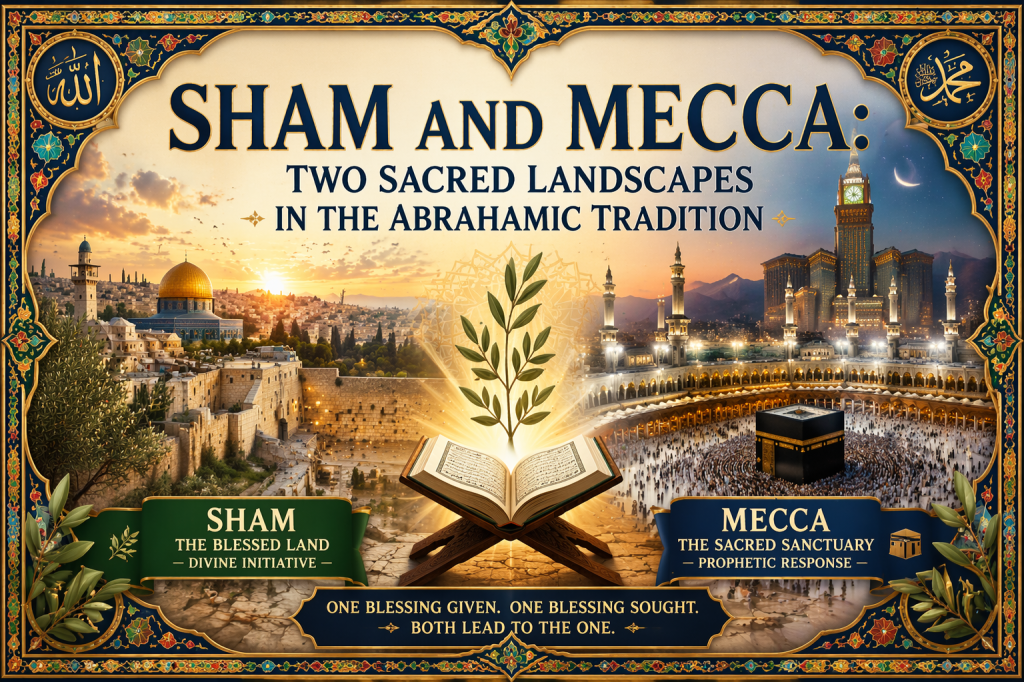
🌍 Sham and Mecca: Two Sacred Landscapes in the Abrahamic Tradition
Sham (الـشـام) refers to the blessed region of the Levant—including Palestine, Syria, Jordan, and parts of Lebanon
✨ Across the sacred history of the Abrahamic religions, two regions stand out with profound spiritual significance: Sham (the Holy Land) and Mecca (Makkah). While both are deeply revered, their sanctity emerges through distinct theological pathways—one through direct divine declaration, and the other through prophetic supplication and fulfillment.
⸻
📜 Source of Blessing: Declaration vs. Supplication
🌿 The land of Sham (the Holy Land) is described in the Qur’an as a region directly blessed by God Himself. In Surah 21:71, it is referred to as “the land We have blessed for all nations”, indicating an immediate and universal divine designation.
🕋 In contrast, Mecca (Makkah) becomes a blessed sanctuary through the prayer of Prophet Ibrahim (Abraham). As recorded in Surah 2:126 and 14:35–37, Ibrahim دعا (supplicated) for the land to be made secure and provided with sustenance. Thus, Mecca’s blessing is not initially declared, but invoked and realized through prophetic intercession.
⸻
⏳ Timing of Blessing: Pre-existing vs. Emergent
🌄 The Holy Land was already blessed when prophets like Abraham and Lot arrived. Its sanctity precedes their presence, suggesting a primordial sacredness embedded within the land itself.
🏜️ Mecca, however, becomes blessed after Abraham’s settlement and prayer. The transformation of a barren valley into a sacred sanctuary reflects a historical unfolding of sanctity, tied directly to prophetic action and divine response.
⸻
🕊️ Nature of Sanctity: Inherent vs. Earned
🌍 The sanctity of Sham is inherent and universal. It is portrayed as a land blessed “for all nations,” indicating a natural, all-encompassing holiness that transcends a single people or ritual.
🕋 Mecca’s sanctity, on the other hand, is earned and cultivated. It arises through prophetic devotion, the establishment of the Kaʿbah (House of God), and the development of sacred rites such as Hajj. Its holiness is thus ritual-centered and covenantal, deeply tied to acts of worship and obedience.
⸻
📖 Historical Role: A Land of Many Prophets vs. Final Fulfillment
🌿 Sham serves as the historical stage for numerous prophets, including Moses, Jesus, and Abraham. It is a continuum of revelation, where divine messages were repeatedly delivered to different communities.
🕋 Mecca, however, holds a unique place as the site of the Kaʿbah and the mission of the final prophet, Muhammad ﷺ. It represents the culmination of prophetic history, where the final revelation of the Qur’an was delivered.
⸻
🔍 A Theological Reflection: Complementary, Not Contradictory
🧭 Rather than viewing Sham and Mecca in competition, a deeper theological reading suggests that they are complementary expressions of divine wisdom:
• 🌿 Sham represents divine initiative—a land chosen and blessed from the outset.
• 🕋 Mecca represents prophetic response—a land transformed through faith, prayer, and obedience.
Together, they illustrate a profound truth: God’s blessing can be both given and sought, both inherent and realized through human devotion.
⸻
✨ Conclusion
🌙 The distinction between Sham and Mecca enriches our understanding of sacred geography in Islam. One is a land of ancient, universal blessing, while the other is a sanctuary of fulfilled prayer and final revelation. Both, however, ultimately point to the same divine source—guiding humanity across time through lands, prophets, and sacred acts.
A Qur’an-Only Analysis: What Is the Status of Sham Compared to Medina Without Hadith?
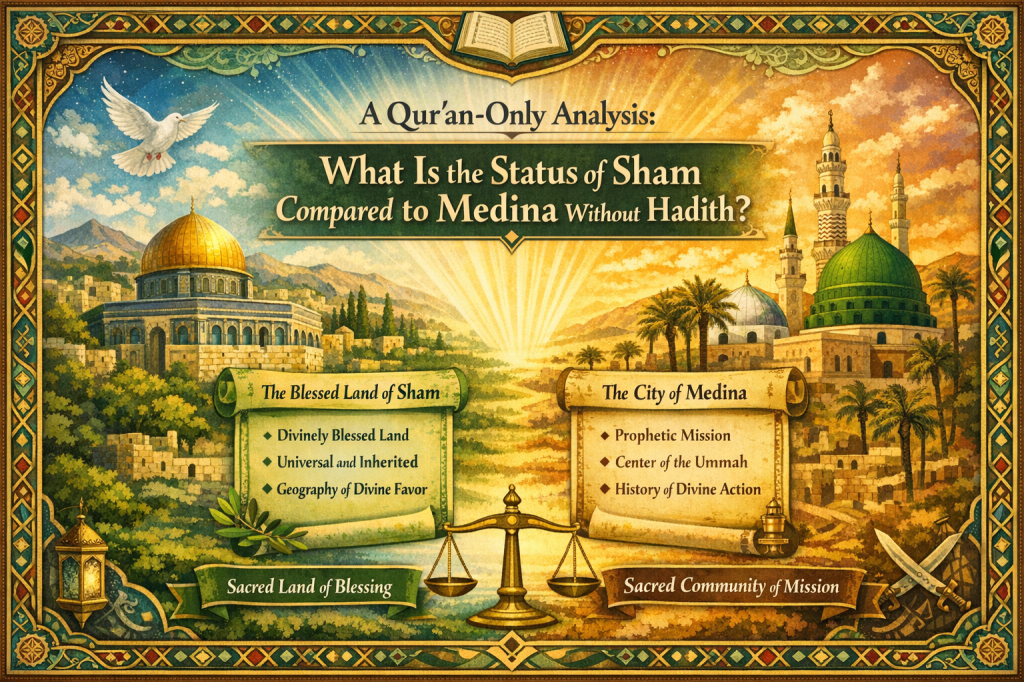
A Qur’an-Only Analysis: What Is the Status of Sham Compared to Medina Without Hadith?
Sham (الـشـام) refers to the blessed region of the Levant—including Palestine, Syria, Jordan, and parts of Lebanon
🌍 The Blessed Land of Sham and Its Relation to Medina — A Qur’anic Perspective
To answer this properly based solely on the Qur’an (without reference to Hadith), we must distinguish between:
• 🌿 Sham (the Blessed Land) — explicitly described and repeatedly emphasized
• 🕌 Medina — not named directly, but indirectly referenced in context (as the city of the Prophet)
⸻
🌿 1. Sham: A Land Explicitly Declared Blessed
The Qur’an clearly and repeatedly identifies Sham as a blessed region:
• Surah 21:71 — “the land We have blessed for all nations”
• Surah 21:81 — “…to the land which We had blessed…” (referring to the destination of Prophet Solomon’s wind)
• Surah 7:137 — inheritance of “the eastern and western parts of the land which We have blessed”
• Surah 17:1 — surroundings of Al-Aqsa Mosque described as “blessed”
• Surah 34:18 — blessed towns placed in continuity
✨ Key Qur’anic Features of Sham:
• 🌍 Universally blessed (for all nations, not one people)
• 🕊️ A land of prophetic history (Abraham, Moses, Jesus)
• 🌱 A place of settlement, inheritance, and continuity
• 🔄 A recurring stage of divine activity
👉 In Qur’anic terms, Sham is a divinely designated sacred geography—its blessedness is direct, inherent, and repeatedly affirmed.
⸻
🕌 2. Medina: A City of Mission, Not Declared Blessed by Name
Unlike Sham, Medina is not explicitly named in the Qur’an as a “blessed land.”
Instead, it appears indirectly as:
• “al-Madinah” (the City) — Surah 9:101, 9:120
• The place of Hijrah (migration)
• The center of the Prophet’s community and governance
✨ Key Qur’anic Features of Medina:
• 🧭 A place of struggle (jihad, trials, hypocrisy, sincerity)
• 🏛️ A political and spiritual center of the early Muslim community
• 📖 A location of revelation and law (many Medinan surahs)
• ⚖️ A testing ground for faith
👉 Medina is functionally central, but its sanctity is not described in the Qur’an in the same explicit, geographical, or universal terms as Sham.
⸻
⚖️ 3. The Qur’anic Relationship: Sacred Land vs. Sacred Mission
From a strictly Qur’anic lens:
🌿 Sham
• Divine initiative
• Blessed in itself
• A land of inheritance and prophecy
• Universal in scope
🕌 Medina
• Prophetic mission
• Not described as inherently blessed land
• A center of struggle, law, and community formation
• Historical rather than geographical sanctity
⸻
🔍 4. A Deeper Theological Insight
The Qur’an seems to present two complementary dimensions of sacred history:
• 🌍 Sham → The Geography of Divine Blessing
• 🕌 Medina → The History of Divine Implementation
In other words:
🌿 Sham represents where God’s blessing is placed
🕌 Medina represents where God’s message is established and lived
⸻
✨ Conclusion
📖 Based on the Qur’an alone:
• Sham holds a higher status in terms of explicit, inherent, and universal blessing
• Medina holds a central role in the unfolding of the final prophetic mission, but without the same explicit geographical designation of “blessed land”
🧭 Thus, the distinction is not one of superiority in faith, but of different divine functions:
• 🌿 Sham = Sacred Land (Blessed by God directly)
• 🕌 Medina = Sacred Community (Shaped through prophetic mission)
Sham, Sacred Trust, and the Identity of Gog: Rethinking Ezekiel 38–39 Beyond Modern Muslim Nations
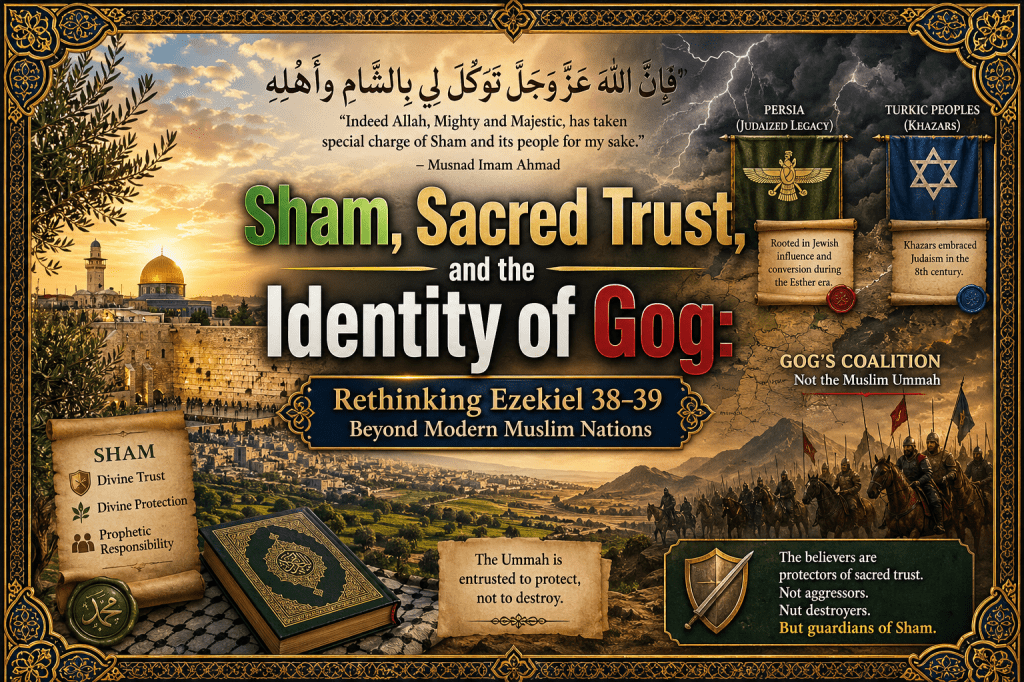
🕊️ Sham, Sacred Trust, and the Identity of Gog: Rethinking Ezekiel 38–39 Beyond Modern Muslim Nations
The prophetic geography of both Biblical and Islamic eschatology repeatedly converges upon one sacred region: Sham—the blessed land of the Levant, the land of prophets, revelation, and sacred history.
The Prophet Muhammad ﷺ said:
فَإِنَّ اللَّهَ عَزَّ وَجَلَّ تَوَكَّلَ لِي بِالشَّامِ وَأَهْلِهِ
“Indeed Allah, Mighty and Majestic, has taken special charge of Sham and its people for my sake.”
This narration, found in the Musnad of Ahmad ibn Hanbal, establishes a theological principle:
Sham is not merely land.
It is divine trust.
And its people are under divine concern.
This presents a serious challenge to a popular modern interpretation of Ezekiel 38–39: the claim that Gog’s coalition refers to Muslim nations such as modern Iran and Turkey.
That identification becomes deeply problematic when viewed through both historical and theological lenses.
📜 The Problem of Modern Geopolitical Mapping
Many contemporary interpreters identify Ezekiel’s “Persia” with modern Iran and “Meshech” and “Tubal” with modern Turkey.
At first glance, this seems straightforward.
But history complicates the matter.
Ancient prophetic geography is not always identical to modern national or religious identity.
More importantly:
religious identity changes.
ethnic identity changes.
civilizational identity changes.
Thus, “Persia” in Ezekiel need not mean Islamic Persia.
Nor must Anatolian/Turkic regions mean Muslim Turks.
👑 Persia and the Jewish Conversion Factor
The Book of Esther takes place in the Persian Empire under Xerxes I. Following the Jews’ salvation, Esther 8:17 notes that numerous Persians adopted Judaism and aligned themselves with the Jewish community.
This is crucial.
Persia was not merely a political empire hosting Jews—it became a realm of Jewish influence and conversion.
Thus, Ezekiel’s “Persia” need not point to Islamic Iran.
It may preserve the memory of a Persian sphere partly absorbed into Jewish identity long before Islam existed.
In that sense, the “Persia” of Gog could reflect a Judaized Persian legacy, not Muslim Persia.
🏹 Turkey and the Khazar Question
Likewise, identifying Ezekiel’s northern coalition with Muslim Turkey ignores another historical layer:
the Khazar conversion to Judaism.
The Khazars were a Turkic polity whose ruling elite embraced Judaism in the 8th century.
This matters because it introduces a Judaized Turkic historical stream into Eurasian history.
If Turkic peoples are part of Gog’s coalition, their religious identity in prophetic memory may not be Islamic at all.
It could reflect post-conversion Judaized Turkic elements.
This makes simplistic “Turkey = Muslim Gog” readings historically weak.
🕌 The Islamic Position Toward Sham
Islamic prophecy consistently frames Sham as sacred and protected.
The Qur’an repeatedly blesses the surrounding land:
“the land We blessed for all peoples”
(Qur’an 21:71)
And the Prophet ﷺ repeatedly directed the believers toward Sham in the final age.
This is not incidental.
It is structural.
The ummah’s relationship to Sham is custodial.
Not destructive.
To identify Muslim nations as Gog would mean identifying the Prophet’s own community as violators of the very land entrusted to them.
That creates theological contradiction.
⚔️ Gog Invades — The Ummah Protects
Ezekiel’s Gog comes as aggressor.
Islam’s believers come as protectors of sacred trust.
These are opposite prophetic functions.
The Gog coalition seeks invasion.
The believers seek preservation.
Thus the Muslim ummah cannot coherently be Gog.
🔥 A More Coherent Alternative
A stronger reading emerges:
- Ezekiel’s Persia may refer to a Persian-Judaic imperial memory shaped by mass Jewish conversion in the Esther era, rather than Islamic Iran.
- Ezekiel’s northern Turkic elements may reflect Judaized Khazar heritage, not Muslim Turks.
- The Muslim ummah, by Prophetic mandate, stands on the side of preserving Sham.
This removes the contradiction.
And it better aligns Biblical geography with Islamic sacred responsibility.
🧭 Final Reflection
Prophecy should not be read through headlines.
It must be read through sacred history.
When the Prophet of Islam places Sham under divine trust, that creates a theological boundary.
The guardians of Sham cannot be its apocalyptic destroyers.
And if Ezekiel’s Gog includes Persia and northern Turkic powers, their prophetic identities may belong to older Judaized civilizational streams—not the Muslim nations of today.
That distinction changes everything.
Iran, Palestine, and the Children of the Land: History, Theology, and the Cyrus Parallel
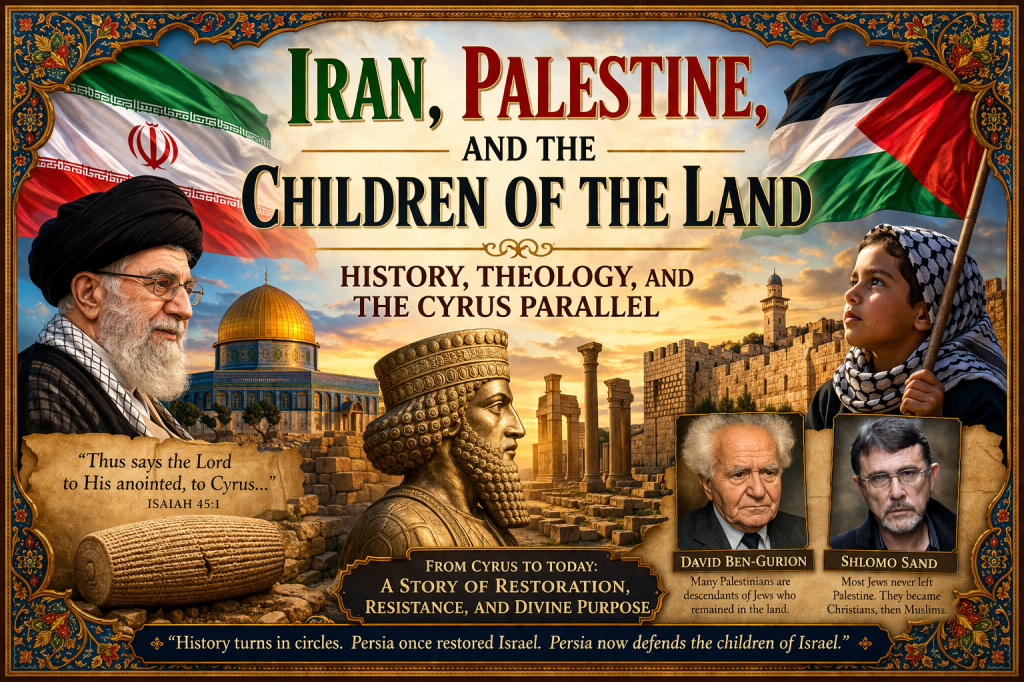
🏛️🇮🇷🇵🇸 Iran, Palestine, and the Children of the Land: History, Theology, and the Cyrus Parallel
🌍 The relationship between Iran and the Palestinians is often explained in political language: resistance, geopolitics, anti-Zionism, and regional influence. But beneath modern politics lies a much deeper historical and theological layer—one that stretches back to ancient Persia, the Bible, and even the ancestry of the Palestinian people themselves.
Could there be an ancient pattern repeating itself?
Could modern Persia (Iran) be doing for Palestinians what ancient Persia once did for the Jews?
And what if many Palestinians are themselves descendants of the biblical Israelites?
These questions have been raised not only by theologians, but by historians—including David Ben-Gurion and Shlomo Sand.
🔥 Why Does Iran Support the Palestinians?
🕌 Since the 1979 Islamic Revolution led by Ruhollah Khomeini, Iran transformed the Palestinian cause into a religious and revolutionary duty.
For Iran, Palestine represents:
- the struggle of the oppressed against occupiers
- resistance against Western domination
- the defense of Jerusalem (Al-Quds)
- the preservation of Islamic sanctity
This is not merely foreign policy.
It is part of Iran’s revolutionary identity.
Iran frames Palestine as the symbol of global injustice.
📖 Ancient Persia and the Biblical Rescue of Israel
👑 Long before modern Iran, ancient Persia under Cyrus the Great became the savior of the Jews after the Babylonian exile.
In the Book of Isaiah, Cyrus is called God’s “anointed” (messiah):
“Thus says the Lord to His anointed, to Cyrus…” (Isaiah 45:1)
This is extraordinary.
Cyrus is the only non-Israelite explicitly called God’s anointed in scripture.
He liberated the Jews.
He restored them to Jerusalem.
He allowed the rebuilding of the Temple.
Persia became the hand of restoration.
🔍 Are Palestinians Descendants of Biblical Jews?
🏺 This question has become one of the most fascinating historical debates.
Early Zionist leaders—including David Ben-Gurion and Yitzhak Ben-Zvi—argued that many Palestinian peasants (fellahin) were descendants of ancient Jews who never left the land.
Their argument was straightforward:
The Roman destruction of Jerusalem in 70 CE did not empty the land.
Many Jews remained.
Over centuries they adopted Christianity under Byzantine rule.
Later, after the Islamic conquest, many embraced Islam.
But their roots remained tied to the land.
This means:
Many Palestinians may carry the biological continuity of ancient Israelites.
📚 Shlomo Sand and the Myth of Exile
🧠 Israeli historian Shlomo Sand pushed this argument even further.
In his influential book The Invention of the Jewish People, Sand challenges one of Zionism’s foundational assumptions:
that the Romans expelled the Jews and scattered them across the world.
Sand argues:
❗ There was no massive Roman exile of the entire Jewish population.
Instead:
- most Jews remained in Palestine
- they continued agricultural life
- they later converted to Christianity
- and later many embraced Islam after Arab rule
According to Sand, the “diaspora” was not primarily the result of mass deportation—but a gradual historical evolution.
This makes Palestinians, in Sand’s view, among the most authentic descendants of ancient Judeans.
This is one of the great historical reversals.
Modern Israelis often trace themselves to diaspora communities.
But Palestinians may preserve direct territorial continuity.
⚔️ A Great Historical Irony
🔄 If Ben-Gurion and Sand are correct—even partially—the irony is astonishing:
Ancient Persia under Cyrus saved the Jews.
Modern Persia (Iran) supports Palestinians.
And many Palestinians may descend from those very Jews.
History turns in circles.
Persia may have stood twice beside the heirs of biblical Israel:
first as Jews,
now as Palestinians.
🕊️ Theology Beyond Nationalism
📜 The story of Cyrus teaches something profound:
God’s purposes often move through unexpected people.
A Persian king became Israel’s liberator.
Today, a Persian state claims to defend the dispossessed people of Jerusalem.
Whether one agrees politically or not, the theological symmetry is striking.
It forces difficult questions:
Who are the true heirs of the land?
Is identity only religion?
Or is ancestry and continuity also part of the story?
🌟 Conclusion
🏛️ Iran’s support for Palestine is not just politics.
It exists at the intersection of:
- revolutionary Islam
- anti-colonial resistance
- Persian historical memory
- biblical echoes of Cyrus
- and the contested ancestry of Palestinians
If historians like Ben-Gurion and Shlomo Sand are even partly right, then one of history’s greatest ironies emerges:
Persia once restored Israel.
Persia now defends a people who may themselves be the surviving children of ancient Israel.
History, theology, and politics have collided—
and the result is one of the most complex stories in the modern Middle East.

