Abraham, His Sons, and the House of God: A Comparative Study of the Bible and the Qur’an

Azahari Hassim

📜 Abraham, His Sons, and the House of God: A Comparative Study of the Bible and the Qur’an

🌟 Introduction

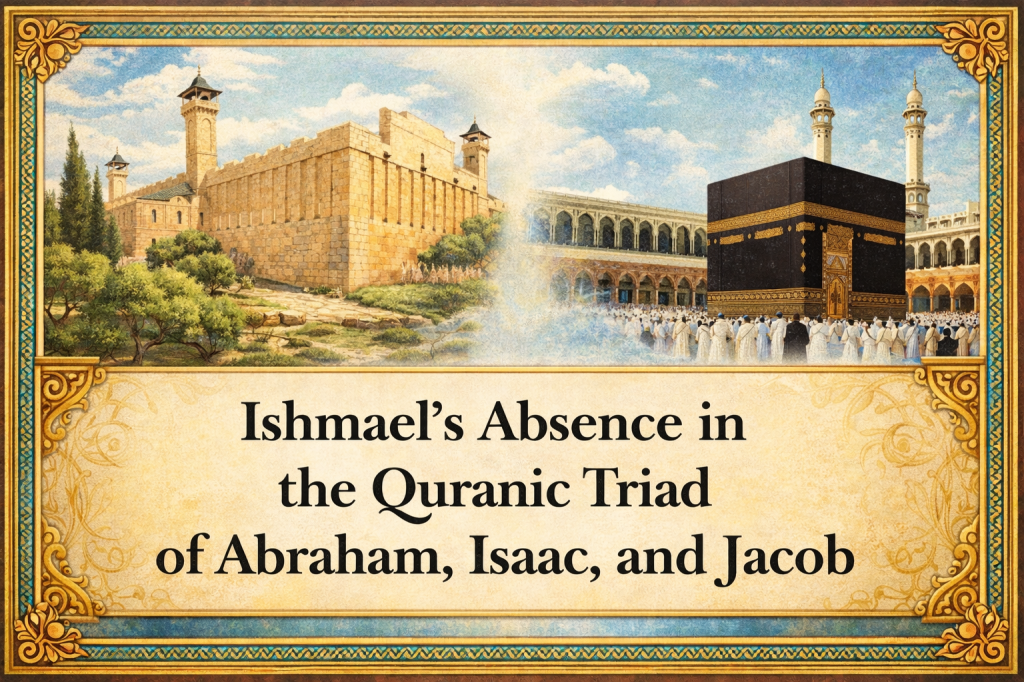
Across the Abrahamic traditions, the figure of Abraham stands as a foundational patriarch whose life, trials, and descendants shape the theological identity of Judaism, Christianity, and Islam. Yet the way these scriptures portray Abraham’s relationship to sacred places differs significantly. The Qur’an presents Abraham and his firstborn son Ishmael as the physical builders and consecrators of the Kaaba in Mecca. The Bible, in contrast, links Abraham and Isaac to the future Temple Mount through narrative association rather than construction. This distinction reveals how each tradition frames the origins of sacred space and the covenantal roles of Abraham’s sons.

♦️ 1. The Qur’an: Abraham, Ishmael, and the Kaaba

The Qur’anic narrative places Abraham (Ibrāhīm) and Ishmael (Ismāʿīl) at the centre of the establishment of the Kaaba, the primordial sanctuary in Mecca.

1.1 Building the Kaaba

The Qur’an explicitly describes Abraham and Ishmael raising the foundations of the Kaaba:

“And when Abraham raised the foundations of the House, and [with him] Ishmael, [saying], ‘Our Lord, accept this from us…’” (Qur’an 2:127)

This verse identifies them not only as worshippers but as architects of the House of God.

1.2 Dedication and Purification of the Sacred Space

Abraham and Ishmael are commanded to cleanse the House for those who perform worship, circumambulation, and devotion (Qur’an 2:125). Another passage speaks of Abraham leaving Ishmael’s descendants in the valley near the House to establish true worship (Qur’an 14:37), reinforcing their custodial role.

1.3 Universality of the Kaaba

The Qur’an describes the Kaaba as “the first House established for mankind” (Qur’an 3:96), giving it a universal, primordial character. Abraham and Ishmael thus appear not merely as historical figures but as founders of a sacred centre for all humanity.

In Islamic tradition, Abraham and Ishmael are understood as active constructors, purifiers, and guardians of the Kaaba — the earliest sanctuary dedicated to monotheistic worship.

♦️ 2. The Bible: Abraham, Isaac, and the Temple Mount

While the Hebrew Bible (Tanakh/Old Testament) also portrays Abraham as central to God’s covenantal plan, it does not attribute to him or to Isaac the establishment of a physical sanctuary.

2.1 Abraham and Isaac at Mount Moriah

Genesis 22 recounts the “Akedah,” or Binding of Isaac. God commands Abraham to offer Isaac as a sacrifice “on one of the mountains in the land of Moriah” (Genesis 22:2).

Centuries later, 2 Chronicles 3:1 identifies this same region as the site of Solomon’s Temple:

“Then Solomon began to build the house of the Lord in Jerusalem on Mount Moriah, where the Lord had appeared to David his father…”

This connection retroactively links the Akedah to the future Temple Mount. Yet the link is narrative and theological rather than architectural; Abraham and Isaac do not participate in constructing the sanctuary.

2.2 David and Solomon as Temple Builders

In the biblical tradition, the idea of a permanent sanctuary arises not with Abraham or Isaac but with King David. The Temple itself is built by Solomon (1 Kings 6), fulfilling David’s aspiration as narrated in 2 Samuel 7. Thus, temple-building is royal, not patriarchal.

♦️ 3. Key Difference: Builder vs. Symbol

A clear contrast emerges between the two scriptural traditions:

3.1 Qur’anic Perspective

• Abraham and Ishmael are direct builders and consecrators of the Kaaba.
• The sanctuary originates in their hands and through their supplication.
• The Kaaba becomes the focal point of monotheistic worship for all humanity.

3.2 Biblical Perspective

• Abraham and Isaac are linked to the site of the future Temple (Mount Moriah), but only symbolically.
• They do not build or establish a sanctuary.
• Temple-building is attributed to the Davidic-Solomonic monarchy.

3.3 Associative vs. Foundational

• The Bible connects Abraham and Isaac to the Temple through memory and location: the Akedah becomes part of Jerusalem’s sacred geography.
• The Qur’an connects Abraham and Ishmael to the Kaaba through construction and divine command: they physically establish the House of God.

♦️ Conclusion

Both the Bible and the Qur’an situate Abraham at the heart of sacred history, yet they portray his relationship to holy places in distinct ways. In the Qur’an, Abraham and Ishmael lay the physical and spiritual foundations of the Kaaba, making them architects of a universal sanctuary. In the Bible, Abraham and Isaac are remembered for their obedience at Moriah, a site later reinterpreted as the location of the Temple, but they do not build it.

These contrasting narratives shape how each tradition understands sacred space, lineage, and the enduring legacy of Abraham and his sons.

The Silence on Isaac: Semantic Tension and Narrative Discontinuity in the Hebrew Bible

🕊️ Introduction

The Akedah—traditionally known as the “Binding of Isaac” in Genesis 22—stands among the most pivotal and unsettling narratives in the Hebrew Bible. In this account, Abraham is commanded by God to offer his son Isaac as a burnt offering, a command that has shaped centuries of theological, ethical, and literary reflection. Yet beyond this single chapter, the Hebrew Bible is remarkably silent about Isaac as the intended sacrificial son.

This silence is not trivial. Given the gravity of the episode and its perceived centrality to Abrahamic faith, the absence of any further reference to Isaac’s near-sacrifice generates a profound semantic and theological tension within the canon. For many scholars, this tension raises questions about the narrative’s coherence, compositional history, and theological positioning.

🔥 Genesis 22 and the Unique Naming of Isaac

Genesis 22 opens with striking directness:

“Take your son, your only son, whom you love—Isaac…” (Gen. 22:2)

The command unfolds in a layered identification: your son, your only son, whom you love, culminating—almost belatedly—in the name Isaac. The rhetorical progression heightens emotional intensity while simultaneously raising semantic difficulty. At the narrative level, Abraham already has another living son. At the canonical level, this is the only instance in the entire Hebrew Bible where God explicitly names Isaac as the subject of a sacrificial command.

This uniqueness is conspicuous. No other passage in the Hebrew Bible or Tanakh, apart from Genesis 22, reiterates, interprets, or even recalls Isaac as the child placed upon the altar. The Akedah stands alone, self-contained, and curiously unreferenced.

📖 Canonical Silence Beyond Genesis 22

Elsewhere in the Hebrew Bible, Abraham is repeatedly celebrated as a model of faith and covenantal loyalty. Texts such as Nehemiah 9:7–8, Isaiah 41:8, and Psalm 105:9–10 recall God’s covenant with Abraham, yet none allude to the near-sacrifice of Isaac.

Equally striking is the portrayal of Isaac himself. He is never remembered as a near-martyr, never described as sanctified by suffering, and never associated with the climactic trial that supposedly defined his father’s faith. Instead, following Genesis 22, Isaac recedes into the background of the narrative, emerging as a largely passive patriarch.

If the Akedah were as foundational as later tradition assumes, its absence from Israel’s collective memory—as preserved in scripture—demands explanation.

🧩 Semantic Tension and Narrative Disruption

The isolation of Genesis 22 creates a deep semantic fracture. If Abraham’s willingness to sacrifice Isaac represents the apex of faith and obedience, why is this episode never integrated into the broader theological discourse of the Hebrew Bible? In other words, how can an event presented as the supreme test of Abraham’s faith remain canonically isolated, unreferenced, and theologically underdeveloped elsewhere in the Hebrew Scriptures?

Many scholars have noted that Genesis 22 reads as abrupt and self-contained, almost detached from its narrative surroundings. This has led to several interpretive proposals. Some suggest that the story functions as a theological parable rather than a historical memory. Others argue that it represents a late literary insertion, preserved but not fully assimilated into Israel’s evolving theological framework.

Still others propose that the silence is deliberate—a narrative strategy that forces readers to grapple with the disturbing implications of divine testing without offering interpretive closure.

👥 Reconsidering the Identity of the Intended Son

A more controversial line of inquiry questions whether Isaac was originally the son intended for sacrifice. Prior to Isaac’s birth, Ishmael was Abraham’s only son for nearly fourteen years. Within that earlier historical horizon, the phrase “your son, your only son” would have referred unambiguously to Ishmael.

This observation has led some scholars to suggest that Genesis 22 may preserve traces of an earlier tradition in which Ishmael occupied the central role. The ambiguity of the opening command—before Isaac’s name is specified—may reflect this older narrative stratum. According to this view, the later insertion or emphasis of Isaac’s name would align the story with a developing Israelite theology that privileged the Isaacic line of descent.

Support for this hypothesis is often drawn from the immediate literary context. Genesis 21 portrays Ishmael not as an adolescent, but as a dependent infant or very young child, carried by Hagar and laid beneath a shrub in the wilderness, with divine reassurance that he will yet become a great nation. Genesis 22, which follows immediately, again centers on the threatened loss of a son—but now one who is old enough to walk, speak, and participate in ritual action, as the child is led toward sacrifice rather than cast out in exile.

This deliberate narrative contrast—from infancy to maturity, from abandonment to offering—suggests a literary progression rather than a random juxtaposition. The proximity and thematic overlap of these chapters raise the possibility that they preserve parallel or developmentally staged traditions centered on the testing of Abraham through the loss of a beloved son, traditions that were later differentiated and theologically reoriented to privilege one lineage over another.

🤫 Isaac’s Silence and Narrative Aftermath

Perhaps most unsettling is Isaac’s own silence. After asking, “Where is the lamb for the burnt offering?” (Gen. 22:7), Isaac never speaks again in the episode. He offers no resistance, no lament, and no reflection. More striking still, the narrative records no meaningful interaction between Abraham and Isaac after the event.

Sarah’s death follows immediately in Genesis 23, and father and son are never depicted together again. This narrative void has prompted some scholars to suggest suppressed trauma or unresolved rupture—an interpretive shadow that lingers precisely because the text refuses to address it.

Later rabbinic traditions attempted to fill this silence, proposing that Isaac was permanently altered by the experience, or even that he briefly died and was resurrected. Such interpretations, however, underscore rather than resolve the absence within the biblical text itself.

⚖️ Scholarly Doubt and Theological Limits

The fact that Isaac’s intended sacrifice is never mentioned again in the Tanakh (Hebrew Bible) has led modern scholars to question whether Genesis 22 was ever meant to function as a cornerstone of covenantal theology. Some interpret it instead as a polemic against child sacrifice, marking a transition toward animal substitution. Others see it as a theological experiment preserved precisely because it was too powerful—and too troubling—to repeat.

In either case, the narrative’s isolation suggests editorial hesitation. The moral stakes of the story may have been too severe to integrate comfortably into Israel’s broader depiction of a just and compassionate God.

🧠 Conclusion: A Story Remembered Once—and No More

Genesis 22 endures as one of the most scrutinized passages in the Hebrew Bible, not only for what it proclaims, but for what follows in its wake—namely, silence. The absence of any subsequent reference to Isaac as the intended sacrificial son introduces a lasting semantic tension into the biblical canon.

Whether this silence reflects literary strategy, theological discomfort, or the vestiges of an earlier tradition centered on Ishmael, it demands serious attention. The Binding of Isaac may be a story too sacred—or too unsettling—for repetition. Or it may stand as a palimpsest, preserving echoes of an earlier narrative in which Ishmael, not Isaac, stood at the center of Abraham’s supreme test.

In the Hebrew Bible, silence is never empty. Here, it speaks volumes. 🕯️

Abraham, History, and Identity: Why Judaism and Islam Relate Differently to the Patriarch

Azahari Hassim

📜 Abraham, History, and Identity: Why Judaism and Islam Relate Differently to the Patriarch

💫 Introduction

Among the three great Abrahamic religions, all trace their spiritual lineage to Abraham. Yet the way each tradition relates to Abraham differs profoundly. A recurring argument — especially in comparative theological discourse — claims that Judaism is more connected to its historical experience, whereas Islam is more directly connected to the person and legacy of Abraham. This distinction becomes evident when comparing the centrality of the Exodus and Sinai in Judaism with the centrality of Hajj and the Abraham–Ishmael narrative in Islam.

This article explores the theological framework behind this argument, demonstrating how sacred history, covenantal identity, and ritual practices shape the role of Abraham in each tradition.

♦️ 1. Judaism: A Religion Rooted in Communal History and Covenant

1.1 Abraham as the Patriarch, but Sinai as the Core

Judaism undeniably venerates Abraham as the patriarch (Genesis 12–25). However, Jewish religious identity is shaped less by Abraham personally and more by Israel’s collective historical journey, particularly:

• The Exodus from Egypt
• The Giving of the Torah at Mount Sinai
• The Sinai Covenant (Brit Sinai)
• The formation of Israel as a holy nation (Exodus 19:6)

Judaism’s primary self-definition is not “the children of Abraham,” but rather “the people who stood at Sinai.”

The Rabbis famously state:

“Our covenant is not through Abraham alone, but through the Torah given to all Israel at Sinai.”

This is why the central liturgical memory in Judaism is not Abraham’s tests but the Exodus:

• The Passover (Pesach) festival
• The Sabbath (a memorial of liberation)
• Daily prayers constantly invoking “the God who brought you out of Egypt”

1.2 Covenant Through Isaac and Jacob

Judaism’s theological architecture rests on the Sinai Covenant and the ancestral chain:

Abraham → Isaac → Jacob → the Twelve Tribes of Israel.

Thus, covenantal continuity is traced ethnically and historically, not ritually through reenactments of Abraham’s life. Abraham is a revered ancestor — but the religion’s heart is the law (Torah) and the national history of Israel.

♦️ 2. Islam: Abraham as the Living Ritual and Spiritual Model

2.1 Islam Calls Itself “The Religion of Abraham” (Millat Ibrāhīm)

The Qur’an repeatedly emphasizes Abraham more than any other patriarch:

• “Follow the religion of Abraham” (Qur’an 3:95)
• Abraham is called ḥanīf, a pure monotheist (Qur’an 16:120)

Abraham is not just a historical patriarch — he is the archetype of submission (islām).

2.2 Abraham and Ishmael in the Kaaba and Hajj

Islam intricately weaves the story of Abraham into the lives of its believers through the rituals performed during Hajj.

Pilgrims reenact key events, such as the ṭawāf around the Kaaba, which honors the moment Abraham and Ishmael established its foundations (Qur’an 2:127). The sa‘y between Ṣafā and Marwah represents Hajar’s search for water, while drinking from Zamzam recalls the miracle provided for baby Ishmael.

Standing at ‘Arafah signifies Abraham’s devotion, and the sacrifice during ‘Eid al-Adha commemorates his willingness to obey God by offering his firstborn son. Lastly, the stoning of the Jamarāt symbolizes Abraham’s rejection of Satan’s temptations.

Thus, while Judaism remembers Abraham theologically, Islam reenacts Abraham ritually.

2.3 Ishmael’s Role Restored

In the Islamic narrative, Ishmael is not marginal but central:

• He helps Abraham build the Kaaba.
• He is linked to the sacred sanctuary (Q 2:125–129).
• He is believed to be the son whom Abraham was commanded to sacrifice, demonstrating ultimate submission to God.
• He is part of the prophetic lineage leading to Muhammad ﷺ.

Thus, Islam’s living rituals restore Abraham and Ishmael to the center of religious consciousness.

♦️ 3. Why the Two Traditions Differ

3.1 Judaism: History as Identity

Judaism emerged as a national–historical covenant. Its sacred memory is:

• Liberation from Egypt
• Revelation at Sinai
• Life under the Torah
• The historical survival of Israel

Thus, Jewish identity is shaped by collective memory, not primarily by reenacting the life of Abraham.

3.2 Islam: Abraham as the Universal Prototype

Islam presents itself as:

the restoration of Abraham’s original monotheism
(Qur’an 3:67)

Islam views Abraham as:

• the spiritual father of all who submit to God,
• the builder of the Kaaba (house of God),
• the model for rituals of pilgrimage, sacrifice, and prayer.

Therefore, Islam sees Abraham as the living foundation of its religious practice.

3.3 Two Different Theological Trajectories

• Judaism: A religion of a people and their historical covenant
• Islam: A religion of a prophet and his universal monotheism

Both honor Abraham, but the mechanisms of memory differ:
• Judaism emphasizes the journey of Israel.
• Islam emphasizes the journey of Abraham.

🌟 4. Conclusion

The claim that Judaism is more connected to its history while Islam is more connected to the person of Abraham reflects deep theological truths:

• Judaism’s heart is Sinai, the covenant of the Torah and the historical identity of Israel.
• Islam’s heart is Abraham, whose life is woven into its rituals, theology, and annual pilgrimage.

Both traditions preserve Abraham’s legacy — but Islam experiences Abraham through ritual reenactment, while Judaism remembers him through narrative and covenantal ancestry.

Thus, the argument is not about superiority, but about different religious architectures:
one built on historical memory, the other on prophetic example and ritual continuity.

📜 Isaiah 41:8 and the Meaning of ’Ohavī: Abraham as the Lover of God in the Hebrew Covenant Framework

Abstract

Isaiah 41:8 is frequently translated in English as referring to Abraham as the “friend of God.” However, a philological analysis of the Hebrew term employed—’ohavī (אֹהֲבִי)—indicates that this translation does not fully capture its theological significance.

This article argues that ’ohavī does not denote “friend” in a social sense, but rather “one who loves God,” a covenantal term that emphasizes active love, fidelity, and obedience. By examining the linguistic form, literary structure, and theological implications of the verse, this study demonstrates that Abraham is portrayed in Isaiah not as a passive recipient of divine favor, but as an active subject who establishes covenantal relationship through love manifested in obedience and sacrifice.

🪷 1. Introduction

Isaiah 41:8 is one of the key biblical texts affirming Abraham’s unique status in the history of divine covenant:

“But you, Israel, my servant, Jacob whom I have chosen,
the offspring of Abraham my friend.”

In Jewish and Christian traditions, this verse is often cited as evidence of Abraham’s special personal relationship with God. However, the common English rendering “my friend” raises an important interpretive question: does the Hebrew term used here truly signify friendship in the ordinary sense, or does it convey a deeper covenantal concept?

This article seeks to demonstrate that the English word “friend” fails to convey the full semantic and theological depth of the original Hebrew expression, and that the underlying term carries significant implications for understanding the nature of the Abrahamic covenant.

🥀 2. Philological Analysis: The Term ’Ohavī (אֹהֲבִי)

The Hebrew text of Isaiah 41:8 reads:

זֶרַע אַבְרָהָם אֹהֲבִי
zeraʿ Avraham ’ohavī

The key term in this phrase is ’ohavī, derived from the Hebrew root א־ה־ב (ʾ–h–v), meaning “to love.” Grammatically, ’ohavī is an active participle with a first-person singular possessive suffix, yielding the literal meaning:

“the one who loves Me.”

From a linguistic standpoint, this construction places emphasis on Abraham as the acting subject—the one who loves God. This is markedly different from other Hebrew words that can denote “friend” or “companion,” such as re‘a (רֵעַ) or ḥaver (חָבֵר), neither of which appears in this verse.

The deliberate choice of a love-based participle indicates that Abraham’s relationship with God is framed in terms of covenantal fidelity rather than social familiarity.

🌱 3. Abraham as an Active Subject in the Covenant Relationship

The literal meaning of ’ohavī carries significant theological implications. It portrays Abraham not merely as someone “loved by God,” but as one who actively responds to God through love expressed in obedience.

This portrayal is consistent with the broader Abrahamic narrative in Genesis, where Abraham’s identity is shaped by a sequence of radical acts of obedience, including:

  1. His departure from homeland and kinship ties (Genesis 12),
  2. His trust in divine promises without immediate material assurance (Genesis 15),
  3. His acceptance of circumcision as a physical and symbolic sign of covenant (Genesis 17),
  4. His willingness to surrender his son in the climactic test of sacrifice (Genesis 22).

Within this narrative framework, ’ohavī functions as a theological summary of Abraham’s life orientation—an existence defined by obedience as an expression of love.

🌼 4. The Foundation of Covenant: Love Preceding Lineage

The internal structure of Isaiah 41:8 further reinforces this theological reading:

• Israel is designated as “servant,”
• Jacob as “chosen,”
• Abraham as ’ohavī.

This sequence suggests that Israel’s covenantal identity is grounded in Abraham’s relationship with God, and that this relationship is defined by love and fidelity rather than by ethnic identity alone. Lineage inherits the covenant, but the covenant itself is established through the love-driven obedience of Abraham.

Accordingly, the Abrahamic covenant is presented as pre-national and pre-institutional, not fully reducible to later political or ethnic formations associated with Israel.

🎋 5. The Translation Issue: “Friend” as Theological Softening

Most English translations opt for the word “friend” when rendering ’ohavī, largely for stylistic and cultural reasons. The term “lover” can sound awkward or misleading in modern English usage. Nevertheless, this translation choice carries theological consequences:

  1. It softens the covenantal notion of love into a general sense of friendship,
  2. It obscures the element of active obedience inherent in the original term,
  3. It risks portraying Abraham as a passive recipient of divine affection rather than as a moral agent whose actions shape the covenant.

A more precise translation, faithful to both philology and theology, would read:

the offspring of Abraham, the one who loved Me.”

🪻 6. Broader Theological Implications

Understanding ’ohavī as “one who loves God” has significant implications for covenant theology. It underscores that divine covenant is not grounded solely in ethnic election, but in moral fidelity and obedience arising from love.

This principle explains why Abraham is depicted as a universal figure: he precedes the Sinai legislation, transcends national boundaries, and serves as a paradigmatic model of faith for subsequent generations.

🌴 7. Conclusion

A close examination of the term ’ohavī in Isaiah 41:8 reveals that Abraham is portrayed not merely as the “friend of God,” but as the “lover of God” in a covenantal sense. His relationship with God is defined by love demonstrated through obedience and sacrifice, rather than by ethnic privilege or social intimacy.

When read with philological precision, Isaiah 41:8 emerges as a foundational theological statement affirming that the Abrahamic covenant rests upon individual fidelity expressed through love—a principle that undergirds covenantal thought across the broader Abrahamic tradition.

Hagar’s Elevated Status in Islam Through the Hajj Pilgrimage

Azahari Hassim

🕋 Hagar’s Elevated Status in Islam Through the Hajj Pilgrimage

Understanding Her Role as a Matriarch and Mother of Many Nations

📜 Covenantal Roots: Abraham, Hagar, and the Promise

In the Torah, God established a covenant with Abraham (Ibrahim عليه السلام), promising that he would be:

• 🌍 A blessing to all nations
• 👑 A father of many nations—both biologically and spiritually

Yet, Hagar, the Egyptian woman who bore him Ishmael (Isma’il عليه السلام), is notably absent from the list of Jewish matriarchs. In the Qur’an, her name is never mentioned directly, and even the miraculous well linked to her—Zamzam—is not cited by name, though its legacy is deeply woven into Islamic ritual.

🏜 The Desert Trial: Faith in the Face of Desperation

According to Islamic tradition, Abraham was commanded by God to leave Hagar and the infant Ishmael in the barren valley of Makkah. With no water and no vegetation, Hagar’s maternal desperation turned into an act of enduring faith:

• She ran 🏃‍♀️ seven times between the hills of Safa and Marwa searching for water.
• In her struggle, an angel appeared, striking the ground and causing the Zamzam well to gush forth.

This was not merely survival—it was the divine establishment of a new spiritual legacy through Ishmael, from whom Prophet Muhammad ﷺ would later descend.

🕋 The Sa’i Ritual: Immortalizing a Mother’s Struggle

One of the central pillars of the Hajj pilgrimage is Sa’i, the reenactment of Hagar’s search for water:

• Pilgrims walk or run seven times between Safa and Marwa, just as Hagar once did.
• This act is not symbolic alone—it is an obligatory rite for completing Hajj and ‘Umrah.

By making her desperate search a permanent part of Islamic worship, Islam does what the Torah and Jewish tradition do not—it elevates Hagar to the rank of a spiritual matriarch.

🌟 Hagar: The Matriarch of Many Nations

Through the Hajj, Hagar’s status is transformed:

• 📖 From obscurity in the Qur’an’s text → to central remembrance in Islamic practice.
• 🏛 From marginalization in Judeo-Christian tradition → to being honored as a mother of the Muslim ummah.
• ❤️ From a desperate mother in the desert → to a symbol of resilience, faith, and divine providence.

Her story teaches that:

Faith under trial can create legacies that outlive generations.

Why This Matters Today

In every Hajj season, millions of Muslims—men and women—trace Hagar’s footsteps, physically placing themselves in her journey. Her endurance is not merely remembered; it is experienced.

She is thus not only Ishmael’s mother but also:

• 🌍 Mother of many nations through Abraham’s covenant
• 🕊 Embodiment of trust in God’s plan
• 🏅 A spiritual role model for all believers

📌 Conclusion:

In Islamic tradition, the desert story of Hagar is not a footnote—it is a foundational narrative. The Sa’i ritual immortalizes her courage, transforming her from a historical figure into a living symbol of faith. In this way, the Hajj pilgrimage enshrines Hagar as a matriarch in the spiritual lineage of Islam, fulfilling God’s promise to make her and her son a great nation.

Reassessing Genesis 15:4: Does the Promise of a “Son from Your Own Body” Refer to Ishmael?

Azahari Hassim

📜 Reassessing Genesis 15:4: Does the Promise of a “Son from Your Own Body” Refer to Ishmael?

Abstract

Genesis 15:4 contains God’s foundational promise to Abraham that his heir will be “a son from your own body.” While Jewish and Christian tradition identifies this promised son as Isaac, an examination of the narrative order, the literal Hebrew wording, and source-critical insights suggests that the earliest and most natural fulfillment of this promise is Ishmael, Abraham’s firstborn. This article re-evaluates Genesis 15:4 through textual, historical, and Islamic perspectives to explore whether the promise originally referred to Ishmael before later priestly reinterpretation.

📘 1. Introduction

In Genesis 15, Abraham expresses deep concern about his lack of a biological heir and assumes his servant Eliezer will inherit his estate. God responds decisively:

“This one shall not be your heir, but one who will come from your own body shall be your heir.”
(Genesis 15:4)

At this point in the narrative:

• Sarah has not yet given birth,
• Isaac has not yet been announced, and
• Ishmael has not yet been conceived.

The promise is therefore open and unnamed. The very next chapter, Genesis 16, introduces Hagar and narrates the birth of Ishmael—Abraham’s first biological son, who literally fulfills the condition of Genesis 15:4.

This raises a critical theological and textual question:

If Genesis 15:4 does not refer to Ishmael, then whose son is Ishmael, and why does Ishmael perfectly fulfill the verse?

📘 2. The Wording of Genesis 15:4

The Hebrew phrase “yēṣēʾ mimmeʿêkā” (יֵצֵ֣א מִמֵּעֶ֔יךָ ) translates:

One who comes forth from your own body/loins.”

Three observations are decisive:

  1. The promise does not mention Sarah — only Abraham’s biological paternity is required.
  2. The child is not named — the reader is left waiting for a son born to Abraham.
  3. The promise precedes the Isaac announcement — Isaac appears only two chapters later.

Therefore, the literal sense of the verse is broad enough to include any biological son of Abraham, and chronologically, Ishmael is the first and only son who fulfills it.

📘 3. Narrative Logic: Ishmael as Immediate Fulfillment

If Genesis 15:4 is interpreted as not referring to Ishmael, the text becomes internally incoherent.

The promise requires:

• a biological son,
• born after the promise,
• replacing Eliezer as heir.

Ishmael meets all three criteria:

• He is Abraham’s biological son.
• He is born immediately after the promise (Genesis 16).
• He becomes Abraham’s heir prior to the Isaac narrative.

Thus, if the verse does not refer to Ishmael, one must logically deny Ishmael’s biological connection to Abraham—a contradiction of the text.

Therefore:

Ishmael is the natural and immediate fulfillment of Genesis 15:4.

Isaac’s role emerges much later, within a new covenantal framework introduced in Genesis 17.

📘 4. Canonical vs. Text-Critical Interpretations

4.1 The Canonical Interpretation (Jewish & Christian)

According to the narrative order of Genesis as preserved in the Bible:

• Genesis 16 records the birth of Ishmael—the first son born after the promise of a “son from your own body.”
• Genesis 17 follows, when Ishmael is already 13 years old; here God announces Isaac for the first time and assigns the covenant to him.
• Genesis 21 narrates the birth of Isaac.

Because Isaac’s covenantal role is introduced only after Ishmael’s birth, Jewish and Christian tradition retroactively reads Genesis 15:4 as referring to Isaac—even though Ishmael is the first and literal fulfillment of that promise.

4.2 The Pre-Priestly Source (J/E) Interpretation

Historical-critical scholarship proposes that Genesis 15 belongs to an earlier narrative layer in which Ishmael played the role of Abraham’s primary heir.

Key scholars (Friedman, Sarna, Westermann) have observed:

• Genesis 15 is older, J/E (non-priestly) material.
• Genesis 17 is priestly (P) and reflects later theological concerns.
• The priestly layer shifts privilege from Ishmael to Isaac.

Thus:

In the earlier narrative tradition, Ishmael appears to be the intended heir of Genesis 15.
The priestly editor later reinterpreted this promise toward Isaac.

This aligns seamlessly with the Islamic view, where Ishmael is the firstborn heir prior to Isaac’s later covenantal role.

📘 5. The Islamic Perspective

Islam teaches that Ishmael is Abraham’s firstborn and rightful heir. The Qur’an positions Ishmael and Abraham together in key covenantal acts—building the Kaaba, dedicating it to God, and establishing the monotheistic legacy continued by Muhammad ﷺ.

Within this framework, Genesis 15:4 is perfectly consistent with Ishmael’s role:

• He is Abraham’s first biological son,
• the heir “from your own body,”
• and the son through whom Abraham’s first trials occur (desert episode, near-sacrifice in Islamic tradition).

Therefore:

From an Islamic view, Genesis 15:4 is a clear anticipation of Ishmael’s birth.

🌟 6. Conclusion

📝 Genesis 15:4 promises that Abraham’s heir will be a son “from your own body.” When read in its chronological context, this promise applies directly to Ishmael, whose birth is recorded in Genesis 16, the only son born after the promise and before the later covenantal reinterpretation of Genesis 17.

🔔 Therefore, on narrative, chronological, and source-critical grounds, Genesis 15:4 is best understood as originally referring to Ishmael—Abraham’s firstborn son. Only later, through priestly redaction in Genesis 17, is Isaac elevated to the center of the covenantal narrative, reshaping the earlier storyline.

This reading harmonizes the biblical narrative with Islamic tradition and offers a compelling reinterpretation of the Abrahamic story grounded in textual coherence and historical analysis.

📜 Who Wrote the Book of Genesis?

Tradition, Scholarship, and the Ongoing Debate

The question of authorship of Book of Genesis has long occupied both religious tradition and modern biblical scholarship. Unlike many ancient texts, Genesis does not identify its author within its own pages. Nor does any other book of the Bible explicitly name who wrote it. This absence has created a fertile ground for interpretation, debate, and evolving theories across centuries.

🕊️ The Traditional Attribution to Moses

Within Jewish and Christian tradition, Genesis has historically been attributed to Moses. This view did not arise arbitrarily. The remaining books of the Torah (or Pentateuch), such as Exodus, Leviticus, Numbers, and Deuteronomy, explicitly associate Moses with their composition, and biblical literature consistently treats the Torah as a unified body of sacred law and narrative. As a result, it was natural for ancient interpreters to regard Moses as the author of the entire collection, including Genesis.

There is also a compelling symbolic logic to this attribution. Moses, as the lawgiver and central prophetic figure of Israel’s formative period, seemed the most fitting individual to compile the book that narrates the origins of creation, humanity, and Israel itself. As has often been remarked, who better to write the book of beginnings?

🔍 The Limits of Tradition and the Rise of Critical Inquiry

Yet when tradition is set aside and the question is approached through historical and textual analysis, the evidence linking Moses directly to the writing of Genesis proves difficult to substantiate. The text of Genesis itself offers no explicit claim of Mosaic authorship, and internal features—such as shifts in style, vocabulary, and theological emphasis—have raised questions among scholars.

Over the past century, much academic scholarship has gravitated toward source criticism, a method that proposes Genesis is composed of multiple literary sources rather than a single author. These sources are often dated to the late pre-exilic and early post-exilic periods, long after the time traditionally associated with Moses. According to this view, Genesis reflects layers of tradition shaped and preserved over generations before being compiled into its present form.

🧠 Challenges to Source Criticism

Despite its influence, source criticism has not gone unchallenged. Advances in computer-assisted linguistic analysis have questioned whether the stylistic criteria used to separate sources are as reliable as once assumed. These studies suggest that variations in language may not necessarily indicate multiple authors, but could instead reflect genre, subject matter, or editorial purpose.

At the same time, alternative approaches such as redaction criticism have gained prominence. Rather than focusing primarily on identifying hypothetical sources, redaction criticism examines how the book was edited, arranged, and shaped into a coherent narrative. This perspective shifts attention from who wrote Genesis to how Genesis was formed and why it was structured in its final form.

📚 An Open Question Without a Final Answer

What emerges from this long history of debate is not a definitive conclusion, but a recognition of complexity. There is no shortage of theories regarding the authorship and composition of Genesis, and no single model has achieved universal acceptance. Tradition offers coherence and continuity; critical scholarship offers analytical depth and historical sensitivity. Each approach highlights different dimensions of this foundational text.

In the end, the authorship of Genesis remains an open and evolving question—one that continues to invite dialogue between faith, history, and literary study. Far from diminishing the book’s significance, this ongoing inquiry underscores its richness and enduring power as a text that has shaped religious thought for millennia.

Between Two Covenants: Islam, Ishmael, and the Biblical Promise of the Nile–Euphrates Territory

Azahari Hassim

📜 Between Two Covenants: Islam, Ishmael, and the Biblical Promise of the Nile–Euphrates Territory

🌟 Introduction

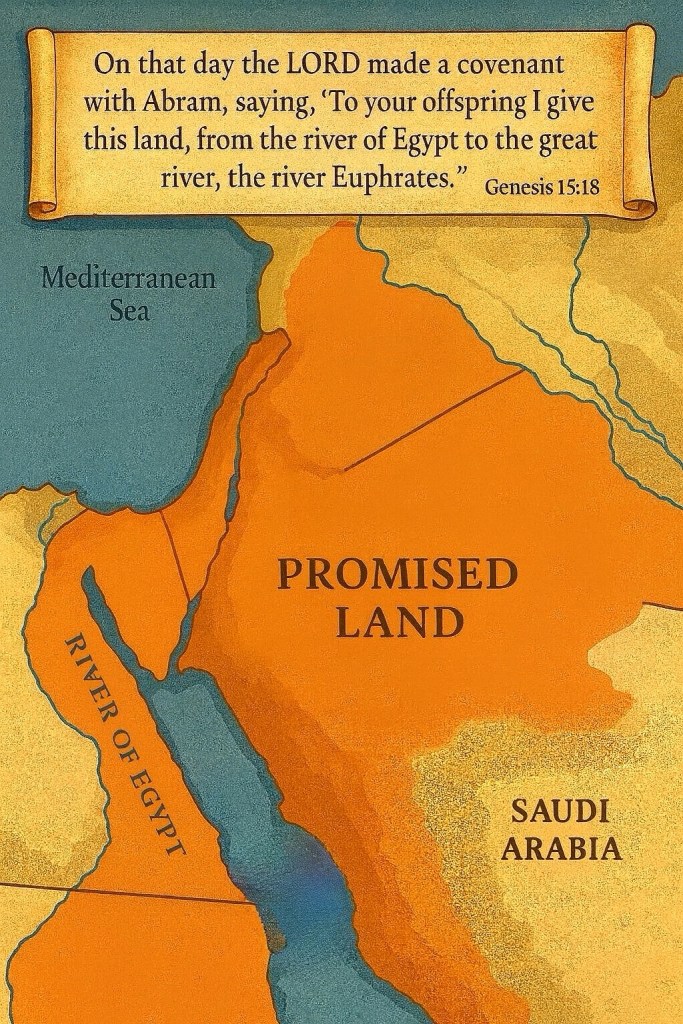
Among the most enduring debates in Abrahamic theology is the meaning and scope of the land promised to Abraham in the Book of Genesis. Genesis 15:18 describes a vast territorial grant—from the River of Egypt (Nile) to the Great River, the Euphrates. Within Jewish and Christian tradition, this land is associated with the Israelites through Isaac and Jacob, forming the territorial core of the Sinai Covenant.

From an Islamic perspective, however, the Sinai Covenant is distinct from—and secondary to—the universal and primordial Abrahamic Covenant (Qur’an 2:124). While the Abrahamic Covenant is universal, the Sinai Covenant is conditional. Islamic tradition maintains that although the Israelites were indeed granted the land of Canaan, their right to remain in it was contingent upon obedience to God’s commandments.

Their repeated breaches of the covenant led to divine withdrawal of protection, and the rise of Islam brought a new community that inherited the broader Abrahamic mission, eventually including the territories of Canaan itself.

This article presents the Islamic position that:

• The Sinai Covenant grants the Israelites a conditional territorial inheritance: the land of Canaan.

• The Abrahamic Covenant, broader and older, grants Ishmael’s descendants a civilizational inheritance extending across the region historically described as from the Nile to the Euphrates—fulfilled through the rise of Islam.

• Canaan itself falls under the wider Abrahamic Covenant and, due to covenantal breach, eventually passed from Israelite control during the expansion of Islam.

♦️ 1. Two Distinct Covenants: Abrahamic vs. Sinai

1.1 The Abrahamic Covenant (Universal and Primordial)

In Qur’anic theology, God promises Abraham:

“I will make you a leader for all nations.”
— Qur’an 2:124

In Genesis, the parallel promise reads:

“I will make you the father of a multitude of nations.”
— Genesis 17:4–5

Crucially, this covenant predates both Isaac and Jacob, meaning it encompasses all of Abraham’s descendants—including Ishmael.

Furthermore, Qur’anic theology affirms that all lands granted to Abraham fall under this universal covenant (e.g., Qur’an 21:71, 21:105). Thus, Islam maintains that Canaan is originally Abrahamic land, entrusted temporarily to the Israelites under a conditional covenant.

1.2 The Sinai Covenant (Particular, Conditional, and Territorial)

The Sinai Covenant is:

• Made with Moses and the Children of Israel
• Condition-based: obedience secures blessing; disobedience invites expulsion
• Rooted in Torah law
• Focused specifically on Canaan

This conditionality is repeatedly emphasized in the Bible:

“If you obey… you will live long in the land.”
“But if you turn away… you will perish from the land.”
— Deuteronomy 4, 28, 30

From an Islamic viewpoint, this fragility of the covenant explains why:

• The Israelites repeatedly lost sovereignty over Canaan in Biblical history.
• The land eventually passed into Muslim control during the 7th century, consistent with divine withdrawal of Israelite privilege.

♦️ 2. The Nile–Euphrates Promise in Genesis 15:18

Genesis states:

“To your descendants I give this land, from the River of Egypt to the great river, the Euphrates.”
— Genesis 15:18

Three observations support the Islamic interpretation:

2.1 The promise predates Isaac

Genesis 15 is earlier than:

• The covenant of circumcision (Genesis 17)
• The announcement of Isaac’s birth (Genesis 17:16–21)

Thus, the promise must concern Abraham’s immediate offspring—Ishmael.

2.2 The scope includes Canaan as well

Canaan is not excluded from Genesis 15; it lies inside the promised zone.
Hence, Islam views:

• Canaan as Abrahamic land
• Temporarily entrusted to the Israelites
• Ultimately reverting under the wider Abrahamic destiny when the covenant is broken

2.3 Historical fulfillment through Ishmael’s descendants

From the 7th century:

• Egypt
• Arabia
• Levant
• Iraq
• Syria
• Canaan/Palestine

became part of a unified Islamic civilization—precisely the geographical arc described in Genesis 15.

♦️ 3. Ishmael’s Descendants and the Fulfillment of the Wider Covenant

3.1 Muhammad ﷺ as the culmination of the Abraham–Ishmael prayer

Abraham and Ishmael pray:

“Raise up among our descendants a Messenger from among them.”
— Qur’an 2:129

Islam sees Muhammad ﷺ as the fulfillment of this invocation, bringing monotheism across the territories promised to Abraham.

3.2 A non-political fulfillment of a territorial metaphor

The spread of Islam was not merely conquest—it was:

• Monotheistic renewal
• Abrahamic restoration
• Civilizational unity

Thus, the “Nile to Euphrates” becomes a symbol of Ishmael’s civilizational legacy.

♦️ 4. Isaac’s Descendants, Canaan, and the Conditional Sinai Covenant

4.1 The Qur’an affirms that God granted Canaan to the Israelites

“O my people, enter the Holy Land which Allah has written for you.”
— Qur’an 5:21

Islam acknowledges:

• The Israelites had a legitimate, God-given claim to Canaan
• But it was conditioned on righteousness

4.2 Forfeiture through covenant breach

Both Bible and Qur’an describe recurring Israelite disobedience:

• Idolatry
• Rejecting prophets
• Breaking the Sabbath
• Ethical corruption

As a result:

• The Sinai Covenant was repeatedly violated
• God withdrew His protection (Qur’an 5:12–14)
• The land passed to new communities, culminating in Muslim rule

Thus, Canaan’s integration into the Islamic world is seen as:
• Not a contradiction of scripture
• But the very consequence that scripture predicted would follow covenantal breach

♦️ 5. A Dual-Inheritance Framework in Islamic Thought

5.1 The Sinai Covenant (Isaac → Israel)

• Territory: Canaan
• Condition: obedience
• Status: forfeited after repeated breaches
• Outcome: loss of sovereignty, fulfilled historically through Islamic expansion

5.2 The Abrahamic Covenant (Ishmael → Muhammad → Ummah)

• Territory: Nile to Euphrates (including Canaan)
• Nature: universal, unconditional, civilizational
• Fulfillment: spread of Islam from the 7th century onward
• Outcome: Ishmael’s descendants inherit the broader Abrahamic mandate

Thus Islam affirms:

• The Israelites’ original right to Canaan
• Their subsequent loss of this right
• The Ummah’s inheritance of Abraham’s universal covenant, including Canaan
• All without negating scripture

❇️ Conclusion

From an Islamic theological standpoint:

• The Abrahamic Covenant includes the entire region from the Nile to the Euphrates—including Canaan.
• The Israelites were granted Canaan under the conditional Sinai Covenant, which they eventually forfeited through covenantal violations.
• The rise of Islam represents the fulfillment of the broader, unconditional Abrahamic Covenant through Ishmael’s lineage.
• Consequently, the historical integration of Canaan into the Islamic world is seen as a continuation—not a contradiction—of sacred history.

This yields a unified covenantal model:

  1. Canaan for Isaac’s descendants under a conditional covenant—later forfeited.
  2. Nile-to-Euphrates civilization for Ishmael’s descendants under the universal Abrahamic Covenant—fulfilled through Islam.

In this way, Islamic theology harmonizes the Biblical and Qur’anic narratives, affirming Abraham as the father of a global monotheistic mission, completed through Muhammad ﷺ and the Ummah.

The Silent Trial: Abraham, Ishmael, and the Desert of Genesis 21

Azahari Hassim

📕 The Silent Trial: Abraham, Ishmael, and the Desert of Genesis 21

🌟 Genesis 21:14–20 may be interpreted as an early formative test in the Abraham narrative, one that precedes and anticipates the more dramatic trial presented in Genesis 22. Within the canonical sequence, the expulsion of Hagar and Ishmael occurs after the announcement of Isaac’s birth; however, the internal literary features of the passage introduce significant chronological tensions that have invited reinterpretation within various non-canonical frameworks.

The pericope begins with Abraham sending Hagar and Ishmael into the wilderness in compliance with Sarah’s demand. Although the text offers no explicit commentary on Abraham’s emotional state, the brevity and austerity of the description suggest an episode of considerable internal conflict, particularly given Ishmael’s status as Abraham’s firstborn and long-expected son.

The narrative then depicts Ishmael in terms that evoke the vulnerability of an infant or small child. Hagar is described as carrying him, and when the water supply is exhausted, she places him under a bush, distancing herself so as not to witness his anticipated death. These details align closely with portrayals of Ishmael in later Islamic tradition, where he is understood to be a young child during the desert episode associated with the origins of Mecca, occurring long before Isaac’s birth.

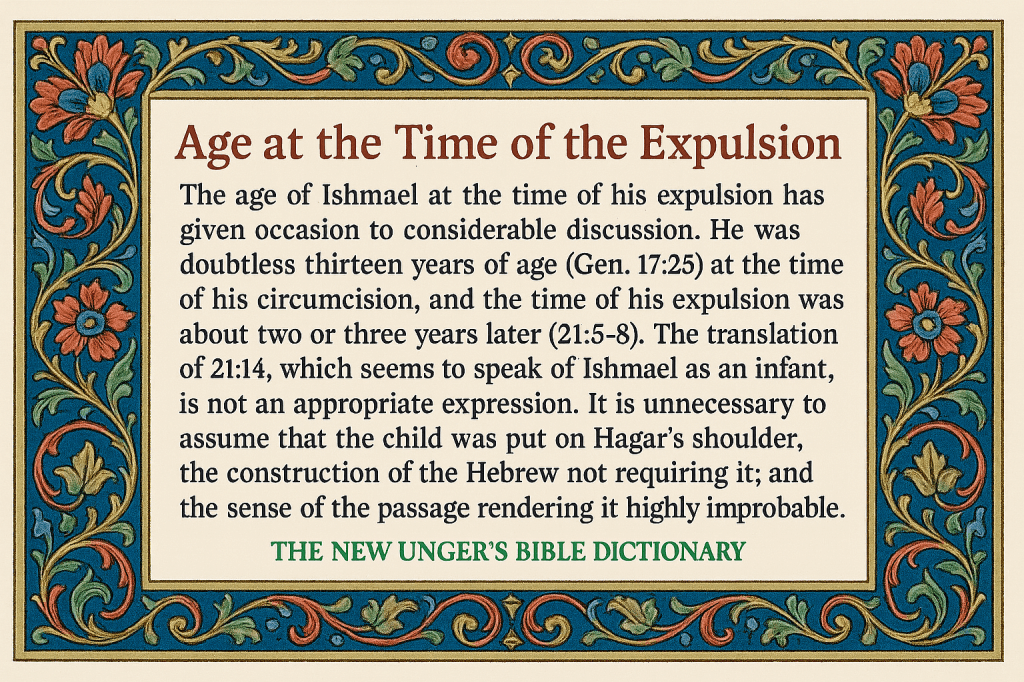
Yet, this depiction stands in tension with the chronological markers provided elsewhere in the text. Genesis 16:16 notes that Abraham was eighty-six years old when Ishmael was born, and Genesis 21:5 states that Abraham was one hundred years old when Isaac was born.

If the canonical order is maintained, Ishmael would therefore be approximately sixteen or seventeen years old at the time of his expulsion—an age inconsistent with the image of a helpless toddler conveyed in Genesis 21:14–20. The incongruity between the chronological data and the narrative presentation is significant enough that it cannot be dismissed as a merely stylistic or symbolic embellishment.

Therefore, several non-canonical interpretations propose a reordering of the Genesis chronology. Within these readings, the desert episode of Genesis 21:14–20 is situated before the birth of Isaac and the covenantal discourse in Genesis 17. Such a rearrangement renders Ishmael’s portrayal as a young child linguistically and historically coherent, resolving the otherwise unavoidable age contradiction.

In this reconstructed timeline, the sequence becomes: an early test involving Ishmael and Hagar in the wilderness; the subsequent and more severe test of Genesis 22; and finally, the covenantal ratification of Abraham’s faith in Genesis 17, which introduces the promise of Isaac.

This reordered narrative structure produces a more internally consistent developmental arc within the Abraham cycle. It portrays the expulsion of Ishmael not as a late-stage family dispute but as an initial test of Abraham’s obedience and trust, one that foreshadows the later Moriah episode (sacrificial event) and contextualizes the covenantal developments (Genesis 17) that follow.

In doing so, it situates Ishmael’s role more prominently in the early formation of Abraham’s covenantal identity, offering a coherent theological and literary framework that bridges the biblical text with later interpretive traditions.

Reassessing the Claim: Who was Abraham’s true “only son” in Genesis 22 — Isaac or Ishmael?

Azahari Hassim

📜 Reassessing the Claim: Who was Abraham’s true “only son” in Genesis 22 — Isaac or Ishmael?

A Textual-Critical and Theological Investigation Into the Identity of Abraham’s “Only Son

Abstract

This study examines the theological coherence and logical consistency of the proposal that Genesis 22—the near-sacrifice narrative—chronologically precedes Genesis 17, despite its later placement in the canonical text.

Through a combination of source criticism, internal narrative analysis, and comparative tradition, the article evaluates whether this reordered sequence renders Ishmael—not Isaac—the son described as Abraham’s “only son” in Genesis 22.

While such a reading conflicts with canonical Jewish and Christian chronology, it demonstrates internal validity within a reconstructed textual framework and aligns with Islamic tradition. The analysis suggests that the episode may reflect an older Ishmaelite tradition preserved within the E source, later subordinated by priestly redaction.

❇️ 1. Introduction

The Akedah (Genesis 22:1–19) is one of the most influential and contested narratives within the Abrahamic tradition. Judaism and Christianity historically identify Isaac as the sacrificial son, based on the canonical order of Genesis in which Isaac is born in Genesis 21 and offered in Genesis 22. Islamic tradition, however, identifies Ishmael as the son of sacrifice — a position paralleled by certain textual-critical reconstructions.

This article evaluates the academic argument that:

Genesis 22 originally preceded Genesis 17 — the chapter that introduces the promise of Isaac — and therefore the ‘only son’ offered in the earlier version of the narrative would have been Ishmael, Abraham’s firstborn.

The analysis draws upon biblical scholarship, internal narrative assessment, and comparative theology.

❇️ 2. Logical Structure of the Argument

The central claim is based on a clear and internally consistent sequence of reasoning:

  1. Genesis 17 contains the first announcement of Isaac’s forthcoming birth.
  2. Before Genesis 17, Isaac does not yet exist.
  3. In Genesis 22, Abraham is commanded to sacrifice his “only son.”
  4. If Genesis 22 originally preceded Genesis 17 in the narrative chronology, then only Ishmael could have been Abraham’s “only son” at that time.
  5. Therefore, under this reconstructed order, the son intended for sacrifice in Genesis 22 must be Ishmael.

This challenges the traditional view—held in both Judaism and Christianity—that Isaac is the son in Genesis 22. That view introduces a logical tension: Why would God promise a covenant and future lineage through Isaac in Genesis 17, only to command his near-destruction in Genesis 22?

The argument becomes logically sound if one accepts the possibility of textual reordering as proposed by source-critical scholarship. In that context, the sequence aligns more consistently with narrative logic and internal chronology.

❇️ 3. The Composite Nature of Genesis and the Case for Reordering

Modern biblical scholarship widely recognizes Genesis as a composite work, formed through the integration of multiple literary sources. These include:

• E (Elohist): Originating in the northern kingdom of Israel, this tradition is marked by prophetic themes and a strong emphasis on divine communication.

• J (Yahwist): Developed in the southern kingdom of Judah, the Yahwist source is known for its vivid narrative style and anthropomorphic depiction of God.

• P (Priestly): Composed later—likely during or after the Babylonian exile—the Priestly source is characterized by formal structure, genealogies, and a distinct theological agenda centered on covenant, ritual, and Israelite identity.

Within this compositional framework:

• Genesis 22 is generally attributed to the Elohist source. It preserves older sacrificial and covenantal themes that function largely independently of the more systematic theology found in the Priestly tradition.

• Genesis 17 is assigned to the Priestly source. It reflects a later stage of theological development in which Israel’s identity is more sharply defined, and Isaac is explicitly designated as the sole covenantal heir. This creates a degree of tension with earlier, more inclusive or open-ended traditions.

Text-critical analysis suggests that certain references to Isaac—particularly those that appear abrupt or misaligned with the surrounding narrative—may be later Priestly insertions. These additions likely served to reshape earlier traditions by emphasizing Isaac’s centrality in the covenant, in alignment with the Priestly author’s theological objectives.

Given these distinct sources and layers of editorial activity, it is both structurally coherent and historically plausible to propose a non-canonical chronological sequence in which Genesis 22 precedes Genesis 17. This reconstruction implies that a later redactor reorganized and integrated independent traditions to develop a unified covenantal theology centered on Isaac and the formation of Israel’s identity.

❇️ 4. The Meaning of “Only Son” in Genesis 22

The phrase “your son, your only son, whom you love” (Hebrew: yeḥidkha) creates an interpretive difficulty if Isaac is intended:

• Abraham had two sons at the canonical time of Genesis 22.
• Isaac was not literally his “only” son.

Jewish and Christian interpreters resolve this by redefining “only son” to mean “unique son of promise,” but this requires theological inference.

Under the reconstructed chronology, however:

• Isaac has not yet been promised or born,
• Ishmael is Abraham’s only biological son for nearly 14 years,
• The phrase regains its literal meaning without theological reinterpretation.
• That is, the expression “your only son” becomes literal rather than theological.

Thus, the textual and semantic fit is stronger with Ishmael under the reordered sequence.

❇️ 5. Narrative Coherence: Isaac’s Name Contradicts a Sacrificial Role

One of the most compelling internal arguments for the Ishmael reading emerges from the meaning of Isaac’s name. The Hebrew name Yitzḥaq (“he laughs,” “he brings joy”) encapsulates Isaac’s identity as the child of joy and miraculous fulfillment:

• Sarah laughs at the promise (Genesis 18:12).
• Abraham laughs in wonder (Genesis 17:17).
• Sarah celebrates the birth with laughter and delight (Genesis 21:6).
• Isaac is explicitly framed as the child of comfort, hope, and divine blessing.

Isaac’s narrative role is therefore constructed around themes of:

• joy,
• promise,
• celebration,
• continuity.

This stands in stark contradiction to the role of a child destined for trial, burden, or death.

A child named for laughter and joy is theologically incongruent with the archetype of a sacrificial son. Nothing in Isaac’s narrative arc suggests impending crisis or divine testing. His story is one of assurance, not ordeal.

By contrast, Ishmael’s life is consistently shaped by:

• wilderness trials (Genesis 16; 21),
• existential fear,
• near-death experience,
• divine intervention,
• themes of testing and endurance.

Ishmael’s identity aligns naturally with the Akedah’s motifs of danger, trial, and divine rescue. Thus:

Isaac’s joyful identity contradicts the sacrificial profile of Genesis 22, while Ishmael’s narrative fully embodies it.

This provides strong internal support for the view that Genesis 22 originally concerned Ishmael.

❇️ 6. Canonical Jewish and Christian Chronology

The canonical sequence upheld by rabbinic and Christian tradition is:

  1. Genesis 16 — Ishmael’s birth
  2. Genesis 17 — covenant + Isaac’s first announcement
  3. Genesis 21 — Isaac’s birth
  4. Genesis 22 — near-sacrifice of Isaac

Within this framework:

• “Only son” becomes “only covenantal son,
• Isaac becomes the heir of promise,
• Ishmael is excluded from the covenantal lineage.

Thus, canonical tradition remains coherent only by reinterpreting “only” to mean “unique heir,” not “sole child.”

This differs from the textual-critical reading, which seeks chronological and narrative coherence rather than theological harmonization.

❇️ 7. Historical-Critical Support

Multiple scholars note features that suggest Genesis 22 may have originally been an Ishmael narrative:

• The “only son” designation fits Ishmael literally.
• The structure resembles ancient Near Eastern “trial of the firstborn” motifs.
• The E source may contain pro-Ishmaelite or non-Isaac traditions.
• The Qur’anic narrative preserves a memory of Ishmael as the sacrificial son.
• Genesis 17 (P) introduces Isaac in a way that appears to supersede earlier traditions.

Thus, while the Isaac reading is canonical, the Ishmael reading is historically and textually plausible.

❇️ 8. General Evaluation

Logical Consistency:

The reconstructed chronology produces a fully coherent and logically airtight reading of Genesis 22.

Theological Coherence:

The Ishmael reading aligns with:

• the textual structure of E traditions,
• the narrative identity of Ishmael,
• the meaning of Isaac’s name,
• the thematic profile of divine testing.

Canonical Compatibility:

No, it remains incompatible with Jewish and Christian canonical order but fits comfortably within:

• Islamic tradition,
• source-critical reconstructions,
• non-canonical chronological models.

❇️ 9. Conclusion

The proposal that Genesis 22 originally preceded Genesis 17 and that Ishmael was the original referent of “your only son” demonstrates:

• internal logical strength,
• narrative coherence,
• textual-critical plausibility,
• alignment with Ishmael’s life themes,
• and deep theological resonance.

Isaac’s identity as the child of joy makes him an unlikely candidate for a narrative of trial and near-sacrifice, whereas Ishmael’s life is defined by the very motifs reflected in the Akedah (The Near-Sacrifice Story). While the Isaac interpretation remains normative in Jewish and Christian tradition, the Ishmael interpretation is academically viable and theologically consistent within a reconstructed pre-canonical framework.

This also resolves a major tension:
It appears contradictory that God would guarantee a covenant and future descendants through Isaac in Genesis 17, only to instruct his near-destruction in Genesis 22.

This contradiction dissolves entirely under the reconstructed chronology.

Reassessing the Claim: Does Genesis 21:14–20 Depict Ishmael as an Infant?

Azahari Hassim

📜 Reassessing the Claim: Does Genesis 21:14–20 Depict Ishmael as an Infant?

The assertion that Genesis 21:14–20 portrays Ishmael as an infant—in contrast to Genesis 17, which fixes his age at thirteen—stems from a textual and narrative inconsistency that has long been noted by scholars. Here is a balanced reassessment of that claim.

❇️ 1. The Firm Age Reference in Genesis 17

In Genesis 17:23–25, the text explicitly states that:

• Abraham was 99 years old.
• Ishmael was 13 years old when circumcised.
• This event takes place before Isaac’s birth is even announced.

Therefore, by the time of Genesis 21, Ishmael must be at least 16–17 years old.

❇️ 2. The Problematic Portrayal in Genesis 21:14–20

Yet, Genesis 21:14–20 describes Ishmael in ways that do not fit a teenager, including:

• Abraham placing “the child” on Hagar’s shoulder (v.14) — physically impossible with a 16–17-year-old.
• The narrative treating him as helpless, unable to walk or survive without being “carried.”
• His crying is described with the Hebrew term yeled, which often means a small child or infant, not a youth.
• Hagar distances herself “so as not to see the boy die” (v.16), implying physical fragility inconsistent with a strong adolescent.

❇️ 3. Scholarly Explanations for the Contradiction

Most commentators propose one of the following:

A. Two Separate Traditions Woven Together (Documentary Hypothesis)

The style of Genesis 21:14–20 aligns with the Elohist or Jahwist tradition, where Ishmael is originally portrayed as a little boy during the desert episode.

Genesis 17, however, belongs to the Priestly tradition, which reorders or reframes events to highlight Isaac’s covenantal line.

Thus, the “infant-Ishmael” tradition and the “teenage-Ishmael” tradition were later combined, creating the age contradiction.

B. The Narrative Originally Occurred Before Genesis 17

Some interpreters—especially within Islamic-leaning or alternative chronological readings—argue:

• Therefore, Genesis 21:14–20 must reflect an earlier stage in the Abraham story,
• before Genesis 17,
• before Ishmael was 13,
• which aligns naturally with the portrayal of him as an infant or small child.

This non-canonical reconstruction restores internal coherence by removing the contradiction.

C. Literary Dramatization

A minority of scholars argue that the infant-like portrayal is symbolic or dramatic, but this view is weaker because:

• The physical descriptions are concrete.
• The narrative requires the child to be too weak to walk.
• No clear literary device explains why a teenager is treated as a toddler.

❇️ 4. Conclusion

Yes — Genesis 21:14–20 does depict Ishmael as if he were an infant or very small child, which directly contradicts the chronological age established in Genesis 17 (13 years old). This tension has led scholars to propose either:

• multiple traditions spliced together,
or
• a non-canonical chronological reordering in which the desert episode (Genesis 21:14–20) originally belonged to an earlier phase of Abraham’s life — before Genesis 17.

This reassessment confirms that the “infant Ishmael” portrayal is real, textually evident, and central to the debate about chronological coherence in the Abraham narrative.

Isaiah 60:7 and the Kaaba: A Prophetic Connection Between the Bible and the Qur’an

Azahari Hassim

📜 Isaiah 60:7 and the Kaaba: A Prophetic Connection Between the Bible and the Qur’an

Introduction: A Meeting Point of Scriptures

The prophetic poetry of Isaiah 60 envisions a time when distant nations will turn toward the worship of the One God. Among its vivid images stands a verse that has drawn the attention of both biblical scholars and Islamic interpreters alike:

“All the flocks of Kedar shall be gathered to you; the rams of Nebaioth shall serve you; they shall come up with acceptance on My altar, and I will glorify the house of My glory.”
— Isaiah 60:7

While Christian commentators such as Albert Barnes (1834) and the Wycliffe Bible Commentary traditionally view this as symbolic of future conversion to God, others have proposed a remarkable possibility: that this prophecy refers specifically to the Kaaba in Mecca — the “House of God” associated with Abraham and Ishmael.

☪️ 1. The Arabian Lineage of Kedar and Nebaioth

Isaiah’s imagery centers on Kedar and Nebaioth, two tribes descended from Ishmael (Genesis 25:13). Their mention situates the prophecy firmly within the Arabian context.

The Wycliffe Bible Commentary notes that the treasures mentioned in Isaiah 60 are “preponderantly Arabian,” and even suggests a future turning of Islam “to the Cross,” signaling an openness among some Christian commentators to interfaith prophetic fulfillments.

Similarly, Albert Barnes, writing in 1834, observed that Arabia, with its descendants of Abraham and its deeply spiritual traditions, would eventually be “converted to God.” Though Barnes wrote from a Christian missionary perspective, his acknowledgment of Arabia’s religious importance ties into the broader idea that Ishmael’s lineage has a divine role.

Yet from an Islamic perspective, this “turning” may rather represent a return — a reorientation of the descendants of Ishmael toward the pure monotheism of Abraham, centered on the Kaaba.

🕋 2. “The Glorious House”: Identified with the Kaaba

Many Muslim scholars interpret the phrase “the house of My glory” as referring to the Kaaba (Baytullāh) — the sacred House of God in Mecca.
According to the Qur’an (2:125–127), Abraham and Ishmael were commanded to raise its foundations:

“And when We designated for Abraham the site of the House, saying, ‘Do not associate anything with Me and purify My House for those who circumambulate it and those who stand, bow, and prostrate [in prayer].’”
— Surah al-Ḥajj 22:26; cf. al-Baqarah 2:125–127

If Isaiah foresaw a time when the descendants of Kedar and Nebaioth would bring offerings to the altar of the “glorious house,” then this could signify the Hajj pilgrimage, where animals are sacrificed in devotion to God — a living ritual traceable to Abraham himself.

🌟 3. “God Was with the Lad”: The Presence of God with Ishmael

The book of Genesis provides another link to this prophetic vision. When Hagar and Ishmael were cast out, the text affirms:

“And God was with the lad; and he grew, and dwelt in the wilderness, and became an archer.”
— Genesis 21:20

Traditional Islamic exegesis understands this “wilderness” to be the valley of Bakkah (Mecca). The phrase “God was with the lad” is thus interpreted not only as divine protection but as a declaration of God’s presence in a sacred location — a site where His worship would endure through Ishmael’s lineage.

This understanding aligns perfectly with the Qur’anic narrative, in which Abraham’s prayer identifies that same location as the “Sacred House”.

📜 4. Surah 14:37 — Abraham’s Prayer and the Sacred House

The Qur’an preserves Abraham’s moving invocation:

“O our Lord! I have settled some of my offspring in an uncultivated valley near Your Sacred House, our Lord, so that they may establish prayer. So make hearts among the people incline toward them, and provide for them fruits that they might be grateful.”
— Surah Ibrāhīm 14:37

Here, Abraham explicitly locates Ishmael and Hagar beside the Sacred House (al-Bayt al-Muḥarram), implying that the Kaaba already existed as a holy site, later rebuilt by Abraham and his son. His prayer anticipates Mecca becoming a spiritual center to which human hearts would turn — precisely what Isaiah 60 envisions when nations stream toward God’s glorified house.

🌟 5. Theological Implications: Fulfillment through Ishmael’s Descendants

Interpreters who draw this connection propose that Isaiah 60:7 prophesies Mecca’s role as the universal center of monotheistic worship.
The flocks of Kedar and Nebaioth symbolize the submission of Ishmael’s descendants to God, as visibly fulfilled in the Islamic rites of Hajj and Eid al-Adha. The sacrificial offerings at the Kaaba — echoing Abraham’s own devotion — mirror Isaiah’s vision of accepted sacrifices on God’s altar.

In this interpretation:

• Isaiah 60:7 anticipates the revival of Abrahamic worship among the Ishmaelites.
• Genesis 21:20 foreshadows divine favor upon Ishmael’s descendants in a specific sacred region.
• Surah 14:37 confirms that sacred geography: the barren valley of Mecca, chosen for divine worship.

Together, they form a triadic continuity — a prophetic, historical, and theological alignment linking the Bible and the Qur’an through Abraham and Ishmael.

Conclusion: The House of God Revisited

The convergence of these scriptural strands suggests a profound harmony: that both the Bible and the Qur’an point toward a future restoration of Abrahamic monotheism centered on God’s “House of Glory.”

For believers who see the Kaaba as this very House, Isaiah’s vision is not merely about the distant conversion of nations, but about the universal return to the pure worship of the One God first established by Abraham and his son Ishmael.

References:

• Albert Barnes, Notes on the Bible (1834), on Isaiah 60:7
• The Wycliffe Bible Commentary, on Isaiah 60:4–7
• Genesis 21:18–20; Isaiah 60:7
• Qur’an 2:125–127; 14:37; 22:26

Abraham Between Scriptures: Reconstructing the Ishmael Narrative

Azahari Hassim

Abraham Between Scriptures: Reconstructing the Ishmael Narrative

Introduction

📜 The Abraham narrative in Genesis remains one of the most theologically charged and textually complex portions of the Hebrew Bible. Traditionally, the canonical order—Genesis 17 (covenant and promise of Isaac), Genesis 21 (Ishmael’s expulsion), and Genesis 22 (the near-sacrifice)—forms the backbone of Jewish and Christian interpretations of Abraham’s faith.

📘 However, alternative readings, often emerging from comparative Islamic–Biblical studies and internal textual analysis, propose a different chronological sequence: Genesis 21 → Genesis 22 → Genesis 17.

📗 This reordered sequence offers a fresh interpretive lens that centers Ishmael in the formative stages of Abraham’s spiritual development. It also addresses several longstanding textual tensions—particularly the age contradiction in Genesis 21 and the reference to the “only son” in Genesis 22—while creating an integrative bridge between Biblical and Qur’anic portrayals of Abraham.

  1. Genesis 21:14–20 — The First Test: Ishmael’s Separation

🌿 In the canonical reading, Genesis 21 recounts the expulsion of Hagar and Ishmael after Isaac’s birth. Ishmael should be approximately 16–17 years old at this point (Gen 16:16; 21:5). However, the narrative describes him as if he were a helpless infant carried by Hagar, unable even to stand or walk (Gen 21:14–20). This tension is one of the most noted inconsistencies in the Abraham narrative.

🌤️ In non-canonical interpretations, this episode is repositioned earlier in Abraham’s life—before Genesis 17, when Ishmael would indeed still be a small child. This re-sequencing not only resolves the age contradiction but also aligns closely with the Islamic tradition, where Ishmael is still an infant during the desert episode (associated with the origins of Mecca).

🌾 Viewed this way, Genesis 21 becomes Abraham’s first great test: releasing Ishmael into the wilderness in trust that God will preserve him and fulfill the promise, “I will make him a great nation” (Gen 21:18). This trial tests Abraham’s emotional endurance and his willingness to surrender Ishmael into divine care.

  1. Genesis 22 — The Second and Climactic Test: The Near-Sacrifice

🔥 Genesis 22, the story of the near-sacrifice, is considered the apex of Abraham’s trials in Jewish and Christian traditions. Yet the description of the son as ‘your only son’ presents a theological challenge if Isaac has an older brother. Ishmael, alive and older, remains Abraham’s son; thus Isaac cannot be described as the “only son” in any literal or historical sense.

🕊️ By placing Genesis 22 before Genesis 17, this difficulty vanishes: Isaac has not yet been promised; Ishmael is truly Abraham’s only son; and the command makes perfect narrative and emotional sense.

🗡️ In this alternative chronology, the near-sacrifice becomes the second and supreme test concerning Ishmael. Abraham’s willingness to sacrifice his only heir and the bearer of the divine promise forms the climactic demonstration of his faith.

🌙 This view also naturally resonates with Islamic tradition, where the sacrificial son is widely understood to be Ishmael, not Isaac.

  1. Genesis 17 — Covenant Ratification After the Trials

🌟 In the canonical sequence, Genesis 17 precedes the trials of Genesis 21 and 22. But in the reordered interpretation, Genesis 17 becomes the divine ratification of Abraham’s faith after he has passed the two Ishmael-centered tests.

📜 In this reading, the promise of numerous descendants, the covenant of circumcision, the changing of Abraham’s name, and the announcement of Isaac’s future birth all occur after Abraham’s faith has already been tested and proven through his obedience concerning Ishmael.

👑 Genesis 17 thus becomes the culminating divine affirmation that Abraham is now fit to be “the father of many nations” (Gen 17:4–5).

  1. A Coherent Theological and Narrative Progression

🔎 The sequence Genesis 21 → Genesis 22 → Genesis 17 creates a remarkably coherent theological and literary framework.

📖 First, it resolves textual contradictions, such as Ishmael’s apparent infancy in Genesis 21 and the use of “your only son” in Genesis 22.

🕊️ Second, it highlights Ishmael’s covenantal significance by placing him at the center of Abraham’s formative spiritual testing rather than as a marginal figure displaced by Isaac.

🤲 Third, it aligns with the Qur’anic portrayal, which emphasizes Ishmael’s foundational role in Abraham’s obedience, making this sequence a natural bridge between the two traditions.

🌄 Fourth, it creates a natural developmental arc in which Abraham’s spiritual journey unfolds as Test 1: Surrender Ishmael (Genesis 21), Test 2: Sacrifice Ishmael (Genesis 22), and finally Covenant: God ratifies Abraham’s faith (Genesis 17).

🌱 Abraham’s journey becomes one of emotional surrender leading to ultimate obedience, culminating in divine covenant.

Conclusion

🌐 Although this reconstruction diverges from the canonical Jewish and Christian chronology, it offers a compelling alternative grounded in textual observations, theological coherence, and comparative Abrahamic studies.

🌙 It gives Ishmael a restored centrality in Abraham’s early faith narrative and provides an interpretive bridge between Biblical and Islamic traditions.

📚 By situating Genesis 21 and 22 prior to Genesis 17, this reading presents a unified, coherent, and theologically rich portrait of Abraham—one in which Ishmael’s role is not marginal but foundational to the covenantal story.