Azahari Hassim
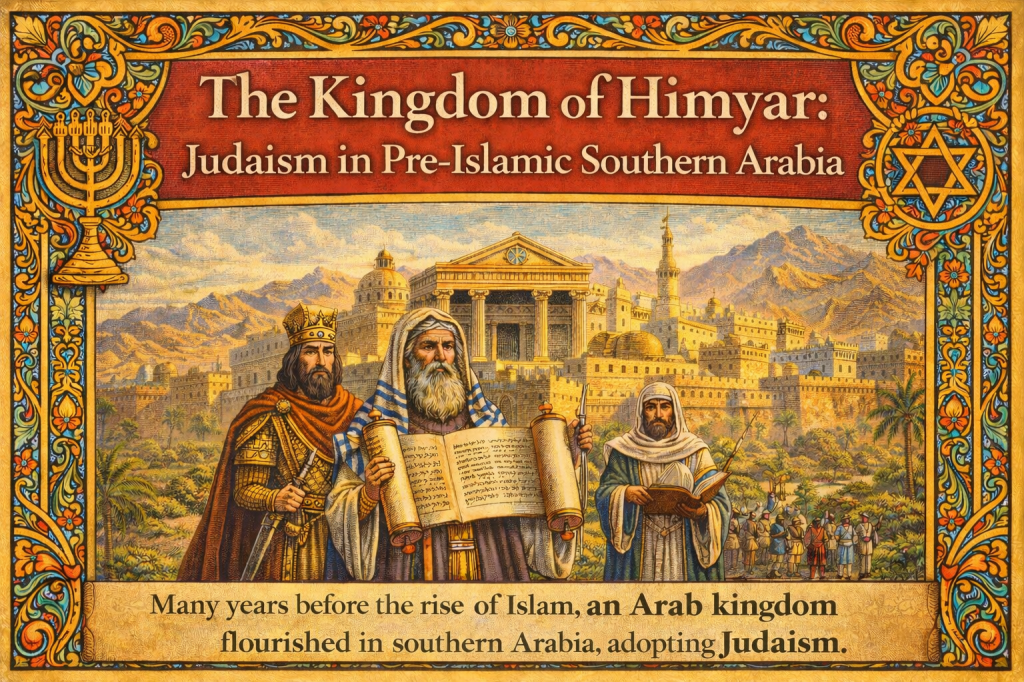
🏺 The Kingdom of Himyar: Judaism in Pre-Islamic Southern Arabia
📜 Introduction
The Kingdom of Himyar stands as one of the most intriguing civilizations of pre-Islamic Arabia. Flourishing in southern Arabia—primarily in what is now 🇾🇪 Yemen—Himyar is historically remarkable for a rare phenomenon in the ancient Near East: the large-scale adoption of Judaism ✡️ by a ruling Arab kingdom centuries before the rise of Islam ☪️.
This development challenges simplistic assumptions about Arabia’s religious landscape and reveals a region deeply entangled with biblical 📖, imperial 🏛️, and monotheistic currents.
⸻
🗺️ 1. Geographic and Historical Background
Himyar emerged around the late 2nd century CE, succeeding earlier South Arabian polities such as Sabaʾ and Qataban. Its heartland lay in the Yemeni highlands, with Zafar as its political and cultural center 🏞️.
Strategically positioned along incense and maritime trade routes linking:
- 🌍 East Africa
- 🌄 The Levant
- 🏺 Mesopotamia
- 🌊 The Indian Ocean world
Himyar prospered economically 💰 while absorbing diverse cultural and religious influences 🌐.
⸻
🕯️ 2. From Polytheism to Monotheism
Early Himyarite religion followed traditional South Arabian polytheism, worshipping deities such as ʿAthtar and Almaqah 🐪🌞.
However, from the 4th century CE, inscriptions begin to reflect a profound religious shift:
- ❌ Pagan deities disappear from official texts
- 🙏 Inscriptions invoke a single, transcendent God
- 🕊️ Titles such as Raḥmānān (“the Merciful”) become prominent
This transition marks not just ethical monotheism, but a distinctly Jewish theological framework ✡️, including:
- 📆 Sabbath observance
- 🗣️ Biblical idioms
- 🛑 Rejection of idols
- 🤝 Covenantal language
⸻
🤔 3. Why Did Himyar Adopt Judaism?
a. 🛡️ Geopolitical Strategy
Himyar existed between two powerful Christian empires:
- 🏛️ The Byzantine Empire to the north
- ⛪ The Christian Kingdom of Aksum (Ethiopia) to the west
Judaism offered a third monotheistic path, enabling Himyar to assert religious independence in a region dominated by two Christian powers: the Byzantine Empire 🏛️ in the north and the Kingdom of Aksum 🌄 in the west.
b. ✡️ Jewish Presence in Arabia
Jewish communities had long existed in Arabia—especially in Yemen and the Hijaz—facilitating theological exchange 🤝 and conversion at elite levels 👑.
c. 📜 Covenant Theology
Judaism’s emphasis on law ⚖️, kingship 👑, and divine justice ⚡ resonated with Himyarite rulers seeking ideological legitimacy and centralized authority.
⸻
👑 4. King Dhu Nuwas and the Najran Crisis
The most famous Jewish ruler of Himyar was Dhu Nuwas (r. c. 517–525 CE), who openly championed Judaism ✡️ and opposed Christian influence ❌⛪.
His reign culminated in the tragic persecution of Christians in Najran, an event remembered in:
- ✍️ Syriac Christian sources
- 🏛️ Byzantine chronicles
- 📖 The Qur’an (Surah al-Burūj 85:4–8, “People of the Ditch” 🔥)
This episode provoked military intervention ⚔️ by the Christian Kingdom of Aksum, leading to Himyar’s defeat 🏴 and the end of Jewish political dominance in Yemen.
⸻
🌅 5. Himyar and the Religious Prelude to Islam
Although Himyar collapsed in the 6th century CE, its legacy endured:
- 🕊️ It normalized monotheism in Arabia before Islam
- 🧬 It showed that Arabs could embrace biblical religion without ethnic boundaries
- 📘 It contributed vocabulary and theological concepts (like law, mercy, and covenant) echoed later in the Qur’an
The Qur’anic environment of late antique Arabia — where Jews, Christians, and monotheistic seekers (ḥanīfs) already existed — cannot be understood without Himyar’s example.
⸻
🏺 6. Historical Significance
The Kingdom of Himyar forces a reassessment of pre-Islamic Arabia as:
- 🧠 Religiously sophisticated
- 🌐 Politically integrated into Near Eastern history
- ✡️ Capable of adopting scriptural monotheism independently
Himyar was not an anomaly — it was a bridge 🛤️ between biblical tradition and the Islamic world that followed.
⸻
📚 Conclusion
The story of Himyar is a powerful reminder that Judaism, Christianity, and Islam did not develop in isolation 🏜️, but through dynamic interaction across Arabia and beyond.
Long before Islam, an Arab kingdom ruled in the name of the God of Israel ✡️, reshaping the religious map 🗺️ of the peninsula.
In this sense, Himyar represents not a forgotten footnote, but a critical chapter 📖 in the prehistory of Abrahamic monotheism in Arabia.
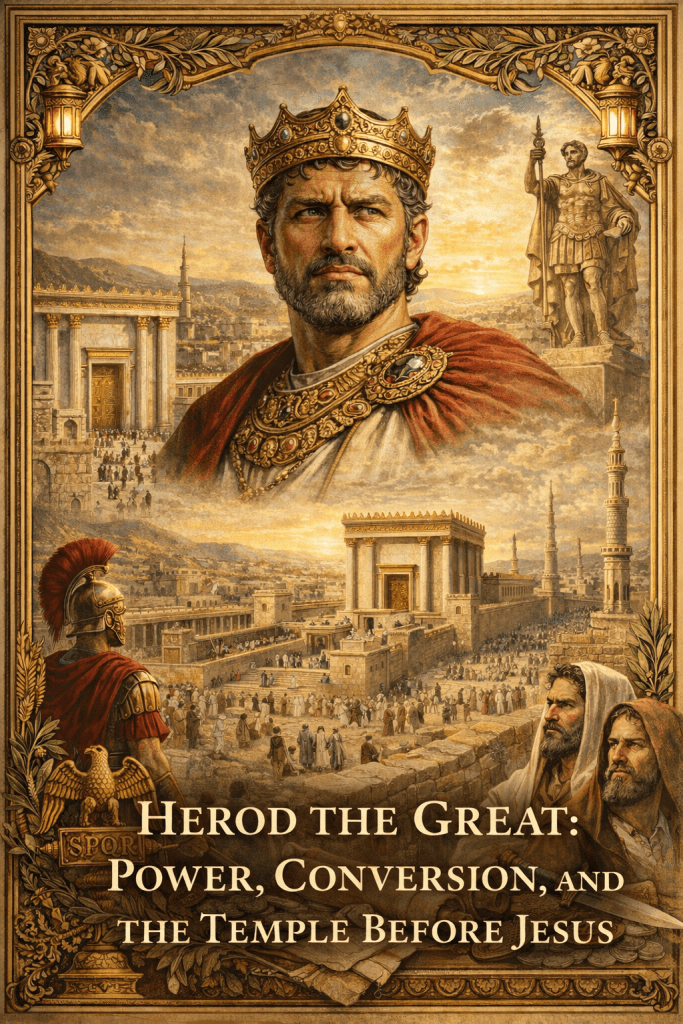
Herod the Great: Power, Conversion, and the Temple Before Jesus
❓How did Herod the Great, originally a Gentile by ancestry, come to be recognized as King of the Jews, and what were his major contributions to Jewish society?
📜 Herod the Great: Power, Conversion, and the Temple Before Jesus
Herod the Great (c. 73–4 BCE), a fascinating and controversial figure in Jewish history, was appointed “King of the Jews” by the Roman Senate in 40 BCE and ruled Judea under Roman authority until his death. Though not ethnically Jewish by traditional standards, he played a central role in shaping Second Temple Judaism and the region of Judea in the decades before the birth of Jesus.
Let’s explore the complex layers of his identity, conversion, and contributions:
⸻
🧬 1. Was Herod a Jew? A Gentile? A Convert?
Herod was not born a Jew in the tribal or genealogical sense, but his family practiced Judaism, and he ruled as the “King of the Jews.”
🔸 Herod’s Ancestry:
• Father: Antipater the Idumaean — from the region of Idumea (Edom) south of Judea. The Idumaeans were descendants of Esau and had been forcibly converted to Judaism by the Hasmonean ruler John Hyrcanus around 125 BCE.
• Mother: Cyprus, a Nabatean (from modern-day Jordan/Arabia).
So, Herod was a second-generation Jew by conversion, not by birth or tribe. To many in Judea, he was still considered a foreigner or half-Jew, which affected how he was viewed — especially by Pharisees, Essenes, and the Hasmonean (priestly) elite.
⸻
🏛️ 2. How Did Herod Become King?
• Herod rose to power through his father’s alliance with Julius Caesar and later supported Mark Antony.
• In 40 BCE, the Roman Senate declared Herod “King of the Jews” — even though he was not from the Davidic line, nor a Hasmonean.
• He took Judea by force with Roman military backing in 37 BCE.
Thus, his rule was seen by many Jews as illegitimate and imposed by Rome, despite his nominal Judaism.
⸻
🏗️ 3. Herod’s Contributions to the Jewish People
Despite his reputation for cruelty and paranoia (even executing some of his own sons and his wife), Herod left an immense architectural and administrative legacy.
🕍 A. Rebuilding the Second Temple (Herod’s Temple)
• Perhaps Herod’s greatest contribution was the massive expansion and beautification of the Second Temple in Jerusalem (starting around 20 BCE).
• He doubled the size of the Temple Mount, built marble porticoes, a grand courtyard, and lavishly adorned the sanctuary.
• Though controversial, the Temple became a symbol of Jewish pride and national identity, even earning admiration from some later rabbis.
🛐 It was this Temple that Jesus and his disciples visited, and it stood until its destruction by the Romans in 70 CE.
🏙️ B. Urban and Architectural Projects
Herod modernized Judea with Roman-style architecture, bringing economic development, jobs, and prestige.
• Built Caesarea Maritima — a port city with a Roman amphitheater, aqueducts, and a palace.
• Constructed fortresses like Masada, Herodium, and Machaerus, often used for defense and royal retreats.
• Developed roads, water systems, and cities that helped integrate Judea into the Roman world.
🛡️ C. Political Stabilization (Temporarily)
Herod’s reign brought a period of relative peace and prosperity after the chaos of Hasmonean infighting and Roman conquest. He skillfully navigated Roman politics, shifting loyalties between Antony and Octavian (Augustus), always ensuring his survival — and by extension, Judea’s stability.
⸻
⚔️ 4. Tensions and Tyranny
While Herod left behind monumental achievements, he was also deeply distrusted by his subjects.
• He heavily taxed the people to fund his massive projects and Roman tributes.
• Executed members of the Hasmonean royal family, including Mariamme, his Jewish wife — leading to widespread resentment.
• Suppressed religious dissent and was viewed as a Roman puppet, especially by the Pharisees and zealots.
• His reign was marked by brutality, paranoia, and cruelty — including the infamous “Massacre of the Innocents” (recorded in the Gospel of Matthew, though not in other sources).
⸻
🧭 Conclusion: A Complex Legacy
Herod the Great remains one of the most complex and polarizing figures in Jewish history.
✅ His contributions:
• Rebuilt the Jerusalem Temple, making it a center of Jewish life.
• Developed Judea’s economy and infrastructure.
• Brought temporary political stability.
❌ His contradictions:
• A convert king ruling a people who didn’t fully accept him.
• Architect of Jewish grandeur — but also seen as brutal, impious, and pro-Roman.
• His reign foreshadowed the deep tensions that would later erupt in the Great Jewish Revolt against Rome.
Herod may not have been “fully Jewish” by lineage, but his rule forever shaped Jewish religious and cultural life. He is a reminder that identity, power, and faith were deeply intertwined and contested in the last century before the rise of Rabbinic Judaism and Christianity.

