Azahari Hassim
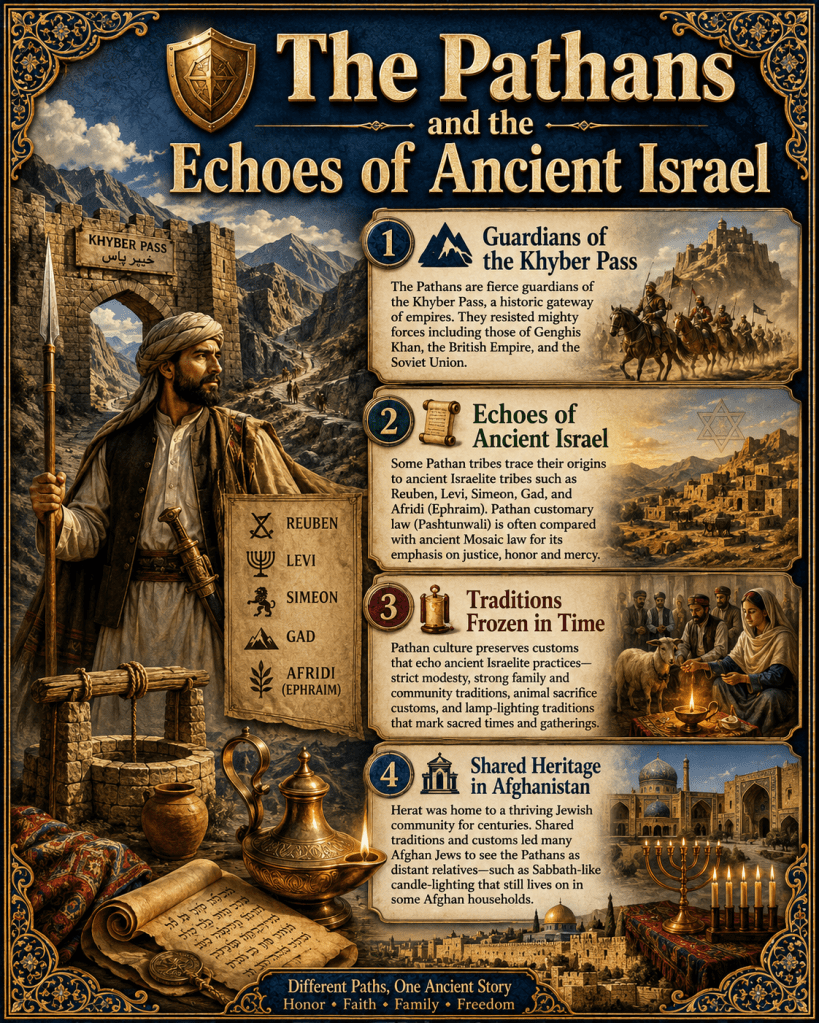
🛡️ The Pathans and the Echoes of Ancient Israel
🏔️ Guardians of the Khyber Pass
For over two millennia, the Pathans have stood as fierce guardians of the Khyber Pass. They have defended their mountainous homeland against some of history’s most powerful empires, resisting forces associated with Genghis Khan, the British Empire, and the Soviet Union.
Yet beyond their legendary military resilience, the Pathans preserve a fascinating cultural mystery: several of their ancient traditions appear to resemble customs linked to ancient Israel, predating many later developments of modern rabbinical Judaism.
📜 Echoes of Ancient Israel
The suggested connections between the Pathans and the ancient Israelites begin with tribal identity. Some Pathan traditions associate certain tribes with names resembling biblical tribes, including Reuben, Levi, Simeon, and Gad. The prominent Afridi tribe has also been linked by some writers to Ephraim, one of the major tribes of ancient Israel.
Beyond tribal names, Pathan customary law has sometimes been compared with ancient Mosaic law. While Jewish legal practice later developed through centuries of rabbinical interpretation, Pathan tribal codes are often described as preserving older forms of justice. These include concepts resembling refuge for manslaughter cases, strict compensation or retaliation principles, and severe moral codes concerning adultery.
🕯️ Traditions Frozen in Time
Everyday life among the Pathans also preserves customs that resemble ancient Middle Eastern patterns. Pathan women traditionally observe strong modesty codes, and in some rural settings, social life has historically centered around wells. This recalls biblical scenes in which important encounters take place at wells, such as Moses and Zipporah, Jacob and Rachel, and the servant of Abraham meeting Rebecca.
Their ritual practices add another layer to this historical mystery. Some Pathan communities are said to have preserved animal-sacrifice customs, such as the Musa’hel, and lamp-lighting traditions seeking divine blessing. These practices have been compared to ancient Israelite temple rituals rather than the later post-Temple practices of rabbinical Judaism.
🕍 Shared Heritage in Afghanistan
The possible connection becomes even more intriguing when considering the Jewish communities that once lived in Afghanistan. In Herat, where Jewish presence is often traced back many centuries, some Afghan Jews reportedly viewed the Pathans as distant relatives or as people who were “not quite Jewish.”
Perhaps the most striking tradition is a quiet Friday evening practice: some Pathans are said to light Sabbath-like candles while concealing the flames under baskets. According to this interpretation, they continue an ancient ritual without necessarily knowing its possible Jewish origin.
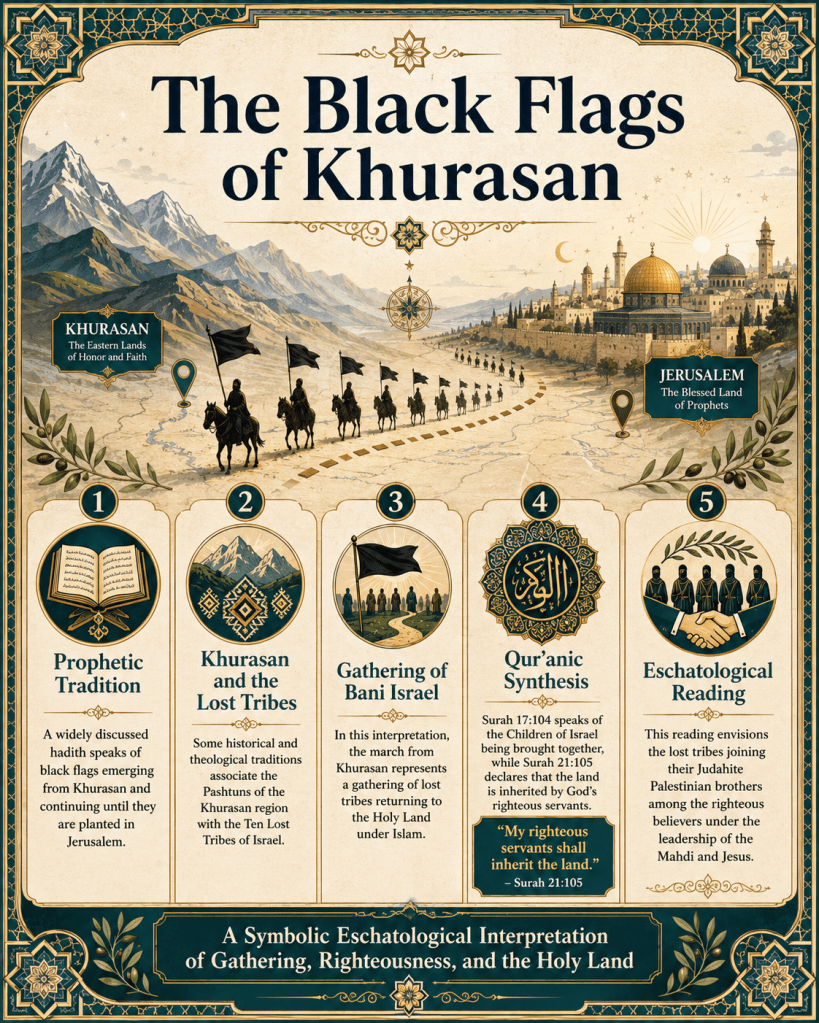
The Black Flags of Khurasan
📜 This reading should be introduced as an interpretive approach to end-time prophecy rather than a fixed doctrinal claim. Some eschatological narrations mention black flags emerging from Khurasan and reaching Jerusalem, though the authenticity of these reports is debated because some chains contain weak narrators such as Rasyidin bin Sa‘ad.
🧭 Hadith criticism distinguishes between weakness and dishonesty. A narrator may be graded weak because of memory, accuracy, or reliability concerns, without being accused of intentionally inventing hadith. Therefore, while narrations through Rishydin bin Sa‘ad should not be relied upon independently, his weakness does not necessarily imply that he was guilty of lying or fabrication.
🧬 The claim that Pashtuns/Pathans descend from the Lost Tribes of Israel is also a known but debated theory, with historical and anecdotal arguments on one side and lack of firm genetic proof on the other. Qur’an 17:104 speaks of the Children of Israel being gathered after Pharaoh, while Qur’an 21:105 states that God’s righteous servants will inherit the land/earth.
🏴 The Black Flags from Khurasan, the Pathans, and the End-Time Return to the Holy Land
📖 A famous eschatological narration attributed to Abu Hurairah states that the Messenger of Allah ﷺ said:
“Black flags will come from Khurasan; nothing shall turn them back until they are planted in Jerusalem.”
🌙 This report has long captured the imagination of Muslims who reflect on the end times, the coming of Imam al-Mahdi, the return of Jesus son of Mary, and the final struggle between truth and deception. Although scholars differ over the authenticity of the black-flag narrations, the symbolism of Khurasan, Jerusalem, and the final victory of righteousness remains powerful within Islamic eschatological reflection.
🗺️ In this interpretive reading, the hadith may allude to a future movement arising from the eastern lands historically associated with Khurasan — a vast region that included parts of modern Afghanistan, northeastern Iran, Central Asia, and surrounding areas. Within this region live the Pashtuns, also known historically as Pathans, a people whom some writers and oral traditions have linked to the Lost Tribes of Israel.
👥 According to this view, the Pathans may represent a hidden or preserved remnant of ancient Israelite lineage, later Islamized and absorbed into the wider Muslim ummah. Their possible connection to the Lost Tribes is not accepted as proven by all historians, but it remains a significant tradition in discussions about Afghanistan, Khurasan, and biblical-Islamic eschatology.
🕋 From this perspective, the black flags from Khurasan are not merely a military image. They symbolize the awakening of a people from the East who may carry both Abrahamic memory and Islamic faith. Their movement toward Jerusalem would therefore represent more than a geopolitical event. It would be a return of a hidden branch of Israel’s descendants into the service of divine truth, not through ethnic supremacy, but through submission to Allah.
📜 This interpretation connects naturally with the Qur’anic prophecy in Surah al-Isra’ 17:104:
“And after him We said to the Children of Israel: Dwell in the land. Then when the promise of the Hereafter comes, We will bring you all together.”
🔎 The verse may be read as pointing to a final gathering connected to the Children of Israel at the end of history. While many interpretations understand this in relation to the ancient Israelites and their historical settlement, an eschatological reading may see it as referring to a future convergence of Israelite remnants, righteous believers, and the final divine promise concerning the Holy Land.
🤝 If the Pathans are understood as descendants of the Lost Tribes of Israel, their end-time emergence from Khurasan and movement toward Jerusalem may be interpreted as part of a final Israelite gathering, joining their Judahite Palestinian brothers in the Holy Land.
⚔️ They would not return as a separate ethnic nation claiming privilege over others, but as Muslims joining the army of Imam al-Mahdi and Jesus son of Mary in the struggle against the forces of deception, oppression, and false messianism.
📖 This also relates to Surah al-Anbiya’ 21:105:
“And We have already written in the Psalms, after the Reminder, that the land shall be inherited by My righteous servants.”
⚖️ The Qur’an does not say that the final inheritance belongs simply to one ethnicity, race, or political movement. It belongs to the righteous servants of Allah. This is a crucial distinction. In the Qur’anic worldview, inheritance of the sacred land is not based merely on bloodline, ancestry, or nationalist ideology, but on righteousness, faith, justice, and obedience to God.
🌅 Therefore, the possible role of the Pathans or people of Khurasan should not be interpreted as ethnic triumphalism. Rather, within this eschatological framework, it may represent the participation of a righteous eastern remnant alongside their Judahite Palestinian brothers in the final restoration of justice in the Holy Land.
🕊️ In Islamic eschatology, the final period is marked by the appearance of Imam al-Mahdi, the descent of Jesus son of Mary, the trial of the Dajjal, and the release of Gog and Magog. These events are not merely political; they represent the climax of the struggle between truth and falsehood. The Dajjal symbolizes the greatest deception, while Gog and Magog represent overwhelming forces of corruption, chaos, and destructive power.
⚠️ Some interpreters connect these end-time forces with false claims to divine chosenness, political domination, and religiously justified oppression. In this reading, “pseudo-messianic Zionism” refers not to Jews as a people, nor to Judaism as a faith, but to an ideology that weaponizes sacred history and religious language in support of occupation, supremacy, and injustice. The critique is therefore aimed at falsehood, oppression, and extremist political ideology — not at an entire ethnic or religious community.
🏛️ The struggle in Palestine at the end of time, according to this interpretation, becomes the arena where false messianism is exposed and divine justice is restored. Imam al-Mahdi leads the believers, Jesus son of Mary confirms the truth, and the righteous servants of Allah inherit the land as promised in the Qur’an.
🏴 Seen through this lens, the black flags from Khurasan may represent a final eastern support for the people of truth. If the Pathans are indeed connected to the Lost Tribes of Israel, their participation would carry deep symbolic meaning: a lost Israelite remnant, purified through Islam, returning not under the banner of racial privilege, but under the banner of tawhid.
🌍 This would also reframe the meaning of Israelite restoration. The Qur’an does not present the final promise as unconditional ethnic possession. Rather, it repeatedly links divine inheritance to righteousness. Those who uphold justice, worship Allah alone, and stand with truth are the true heirs of the sacred promise.
📚 Thus, the hadith of the black flags from Khurasan, Surah al-Isra’ 17:104, and Surah al-Anbiya’ 21:105 may be read together as part of a wider Abrahamic eschatological vision: the gathering of hidden remnants, the defeat of deception, the fall of oppressive power, and the inheritance of the land by Allah’s righteous servants.
🕌 In this interpretation, the end-time army of Mahdi and Jesus is not a nationalist army, nor an ethnic movement. It is a movement of divine justice. Its purpose is not revenge, racial supremacy, or hatred of any people, but the restoration of truth after an age of deception. Jerusalem becomes the symbolic center of this final transformation — the place where false claims collapse and the promise of Allah is fulfilled.
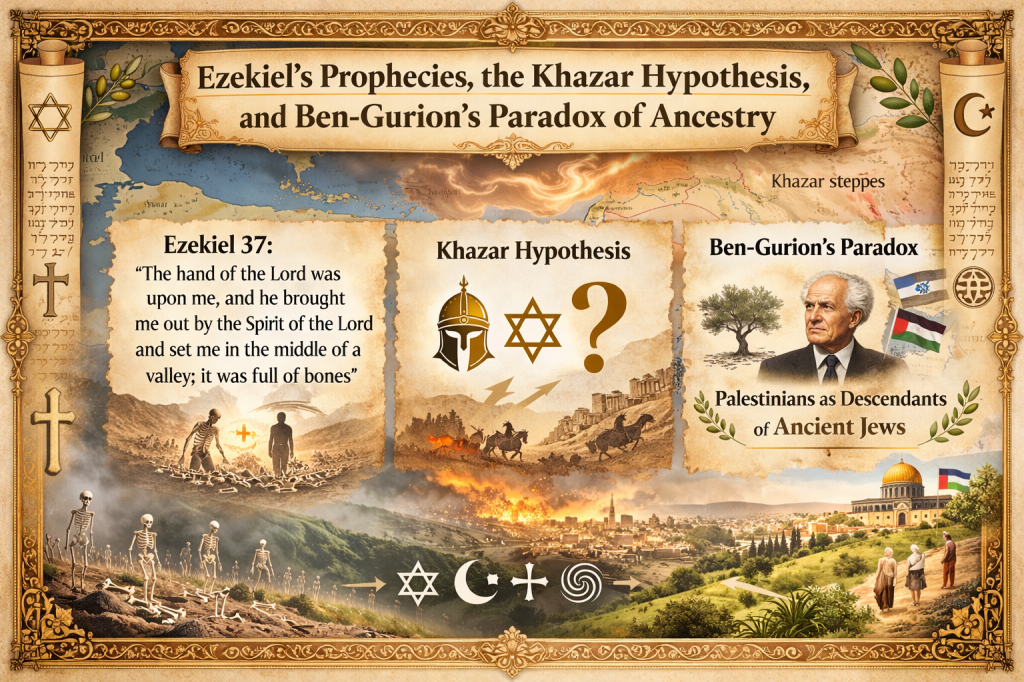
Ezekiel’s Prophecies, the Khazar Hypothesis, and Ben-Gurion’s Paradox of Ancestry
📜 Introduction
The establishment of the modern State of Israel in 1948 has often been framed as the fulfillment of biblical prophecy. Many point to Ezekiel 37—the “valley of dry bones”—as the divine foretelling of Israel’s national resurrection. Yet competing perspectives challenge this narrative. Some scholars argue that the prophecy of Ezekiel 37 remains unfulfilled and that the events surrounding the modern state may instead align with Ezekiel 38–39, where Gog and Magog ⚔️ rise against the land. This interpretive debate is further complicated by the Khazar hypothesis 🏹 regarding Ashkenazi origins and by a paradoxical statement from David Ben-Gurion 🇮🇱, Israel’s first Prime Minister, who acknowledged that many Palestinians may be direct descendants of the ancient Jews.
⸻
The Khazar Hypothesis and Ashkenazi Identity 🏰✡️
The “Khazar hypothesis” proposes that Ashkenazi Jews largely descend from the Khazars, a Turkic people whose ruling class converted to Judaism in the 8th–9th centuries. While contested and not universally accepted, this theory has influenced theological interpretations, especially among those who question the legitimacy of modern Zionism in biblical terms.
If modern Ashkenazim descend primarily from converts rather than the exiled tribes of Israel, then the biblical framework of “return” to the land becomes less clear. Critics argue that in such a scenario, the establishment of Israel would not represent Ezekiel’s vision of restored Israel, but rather a foreign incursion ⚔️ upon it.
⸻
Ezekiel 37: The Vision of Restoration 🌄✡️
Ezekiel 37 presents a powerful vision of dry bones coming to life 💀➡️🌱, symbolizing not only physical restoration to the land but also spiritual renewal:
“I will put My Spirit in you, and you shall live, and I will place you in your own land” (Ezek. 37:14).
Proponents of Zionism often point to Israel’s rebirth after the Holocaust 🕯️ as a miraculous fulfillment of this passage. Yet critics note that the modern state is largely secular and political, lacking the covenantal transformation envisioned in the text. For them, the true restoration of Israel described by Ezekiel 37 has not yet taken place ⏳.
⸻
Ezekiel 38–39: Gog and Magog in the Holy Land ⚔️🌍
Ezekiel 38–39 describes the invasion of the holy land by Gog of Magog and his allies, leading to a climactic confrontation in which God Himself intervenes ✡️🔥.
Some interpreters argue that modern Israel, rather than fulfilling Ezekiel 37, fits more closely with this apocalyptic scenario 📖. By this reasoning, the presence of Khazar-descended Jews 🏹 in the land could correspond to the role of Gog and Magog—outsiders whose settlement sparks the eschatological conflict.
⸻
Ben-Gurion’s Paradox: Palestinians as Descendants of Ancient Jews 🌿☪️
David Ben-Gurion himself complicated the Zionist narrative. He acknowledged the belief that many Palestinians 🇵🇸 were descendants of the ancient Jews who had remained in the land after the Roman expulsions of 70 CE and 135 CE. Over time, these communities converted—first to Christianity ✝️ and later to Islam ☪️—while retaining cultural and agricultural continuities with their ancestors.
Ben-Gurion’s rationale rested on several perspectives:
- Historical Continuity 🕰️: Not all Jews were exiled; many remained and gradually assimilated into the local population.
- Sociological Evidence 🌾: Palestinian fellahin (peasants) preserved agricultural practices and customs resembling those of ancient Israelites.
- Ideological Reflection 💭: If Palestinians were indeed descendants of ancient Jews, then the paradox arises that those seen as “strangers” by Zionism might actually be the truer heirs 🌿✡️ of the land promised in scripture.
⸻
Theological and Political Implications ⚖️
This paradox destabilizes the neat narrative of prophecy fulfillment. If Ashkenazim are linked to Khazars 🏹, while Palestinians carry Israelite ancestry 🌿, then the lines between “restoration” and “intrusion” blur.
Ezekiel 37 may then point toward a future yet to come ⏳—a spiritual return of covenant fidelity—while Ezekiel 38–39 foreshadows the current geopolitical struggle involving outsiders in the land.
⸻
Conclusion 🔍
The convergence of the Khazar hypothesis 🏹, Ezekiel’s prophecy 📖, and Ben-Gurion’s reflections 🇮🇱 highlights the complexities of modern Israel’s identity.
Is the state a fulfillment of the valley of dry bones 💀➡️🌱, or is it the stage for Gog and Magog ⚔️🌍? Is the true Israelite heritage found in the Jewish immigrants of Europe ✡️, or in the Palestinians ☪️🌿 who never left the land?
These questions reveal not only theological tensions but also the paradox at the heart of Israel’s national story: prophecy, history, and identity remain contested and unresolved 🔄.
The Matrix of Gog: https://azahari.blog/2024/08/18/the-matrix-of-gog/

