Azahari Hassim
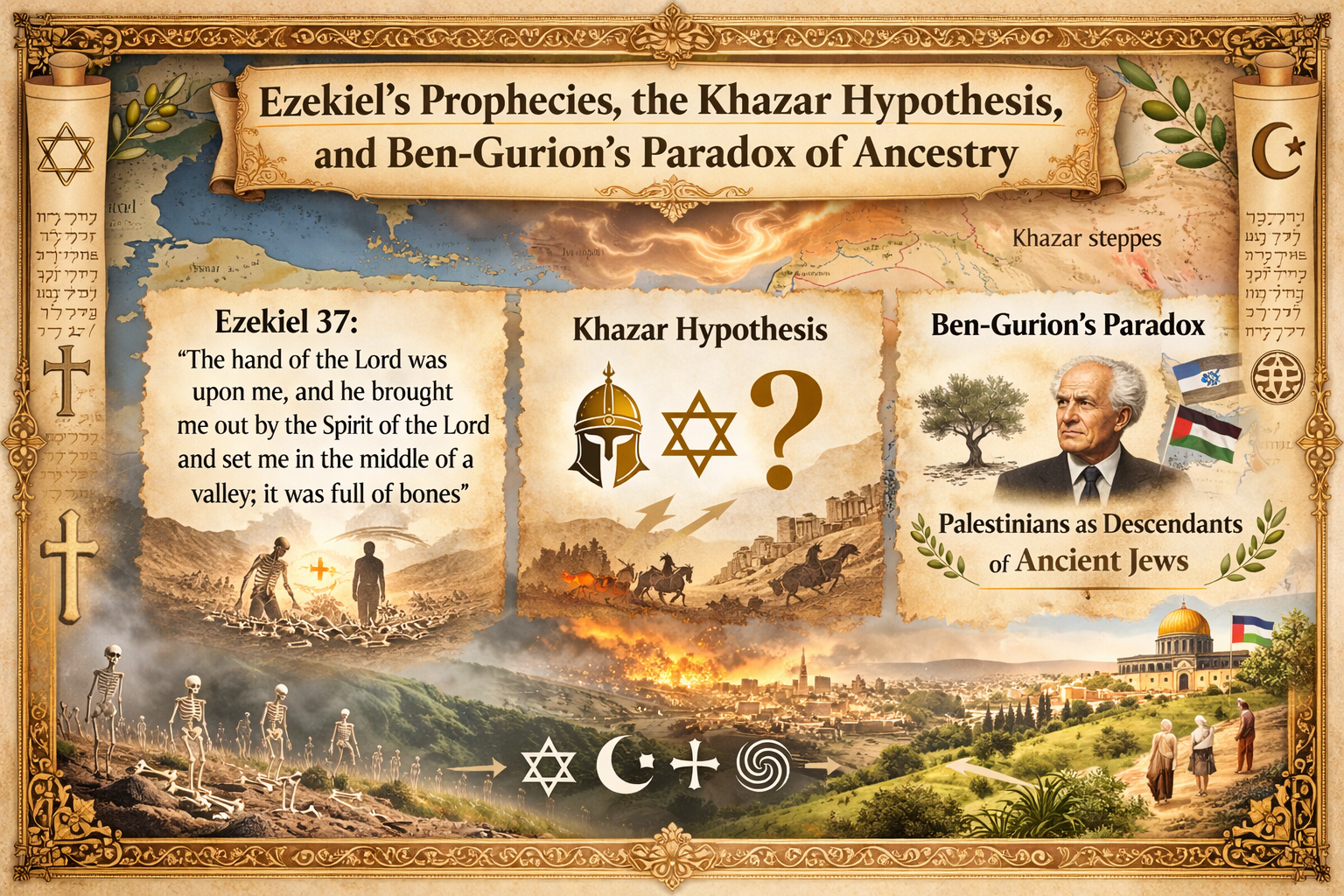
Ezekiel’s Prophecies, the Khazar Hypothesis, and Ben-Gurion’s Paradox of Ancestry
📜 Introduction
The establishment of the modern State of Israel in 1948 has often been framed as the fulfillment of biblical prophecy. Many point to Ezekiel 37—the “valley of dry bones”—as the divine foretelling of Israel’s national resurrection. Yet competing perspectives challenge this narrative. Some scholars argue that the prophecy of Ezekiel 37 remains unfulfilled and that the events surrounding the modern state may instead align with Ezekiel 38–39, where Gog and Magog rise against the land. This interpretive debate is further complicated by the Khazar hypothesis regarding Ashkenazi origins and by a paradoxical statement from David Ben-Gurion, Israel’s first Prime Minister, who acknowledged that many Palestinians may be direct descendants of the ancient Jews.
⸻
The Khazar Hypothesis and Ashkenazi Identity 🏰✡️
The “Khazar hypothesis” proposes that Ashkenazi Jews largely descend from the Khazars, a Turkic people whose ruling class converted to Judaism in the 8th–9th centuries. While contested and not universally accepted, this theory has influenced theological interpretations, especially among those who question the legitimacy of modern Zionism in biblical terms.
If modern Ashkenazim descend primarily from converts rather than the exiled tribes of Israel, then the biblical framework of “return” to the land becomes less clear. Critics argue that in such a scenario, the establishment of Israel would not represent Ezekiel’s vision of restored Israel, but rather a foreign incursion upon it.
⸻
Ezekiel 37: The Vision of Restoration 🌄✡️
Ezekiel 37 presents a powerful vision of dry bones coming to life, symbolizing not only physical restoration to the land but also spiritual renewal:
“I will put My Spirit in you, and you shall live, and I will place you in your own land” (Ezek. 37:14).
Proponents of Zionism often point to Israel’s rebirth after the Holocaust as a miraculous fulfillment of this passage. Yet critics note that the modern state is largely secular and political, lacking the covenantal transformation envisioned in the text. For them, the true restoration of Israel described by Ezekiel 37 has not yet taken place .
⸻
Ezekiel 38–39: Gog and Magog in the Holy Land ⚔️🌍
Ezekiel 38–39 describes the invasion of the holy land by Gog of Magog and his allies, leading to a climactic confrontation in which God Himself intervenes.
Some interpreters argue that modern Israel, rather than fulfilling Ezekiel 37, fits more closely with this apocalyptic scenario. By this reasoning, the presence of Khazar-descended Jews in the land could correspond to the role of Gog and Magog—outsiders whose settlement sparks the eschatological conflict.
⸻
Ben-Gurion’s Paradox: Palestinians as Descendants of Ancient Jews 🌿☪️
David Ben-Gurion himself complicated the Zionist narrative. He acknowledged the belief that many Palestinians were descendants of the ancient Jews who had remained in the land after the Roman expulsions of 70 CE and 135 CE. Over time, these communities converted—first to Christianity and later to Islam—while retaining cultural and agricultural continuities with their ancestors.
Ben-Gurion’s rationale rested on several perspectives:
1. Historical Continuity: Not all Jews were exiled; many remained and gradually assimilated into the local population.
2. Sociological Evidence: Palestinian fellahin (peasants) preserved agricultural practices and customs resembling those of ancient Israelites.
3. Ideological Reflection: If Palestinians were indeed descendants of ancient Jews, then the paradox arises that those seen as “strangers” by Zionism might actually be the truer heirs of the land promised in scripture.
⸻
Theological and Political Implications ⚖️
This paradox destabilizes the neat narrative of prophecy fulfillment. If Ashkenazim are linked to Khazars, while Palestinians carry Israelite ancestry, then the lines between “restoration” and “intrusion” blur.
Ezekiel 37 may then point toward a future yet to come—a spiritual return of covenant fidelity—while Ezekiel 38–39 foreshadows the current geopolitical struggle involving outsiders in the land.
⸻
Conclusion
The convergence of the Khazar hypothesis, Ezekiel’s prophecy, and Ben-Gurion’s reflections highlights the complexities of modern Israel’s identity.
Is the state a fulfillment of the valley of dry bones, or is it the stage for Gog and Magog? Is the true Israelite heritage found in the Jewish immigrants of Europe, or in the Palestinians who never left the land?
These questions reveal not only theological tensions but also the paradox at the heart of Israel’s national story: prophecy, history, and identity remain contested and unresolved.
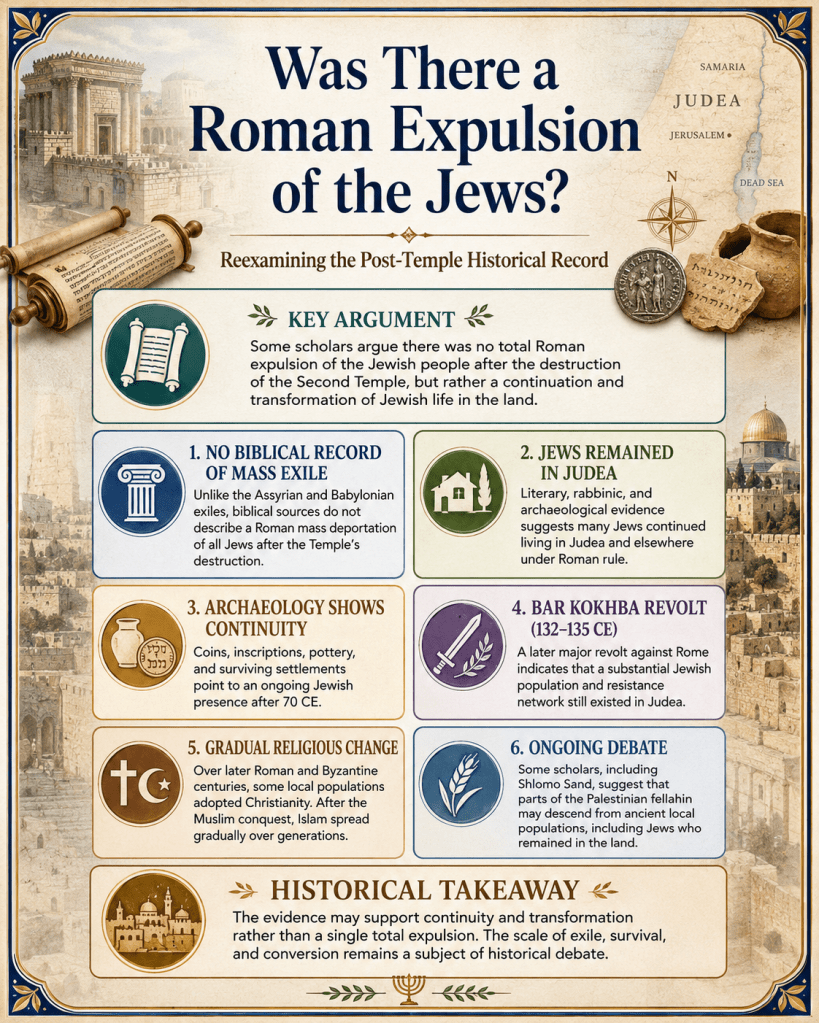
Was There a Roman Expulsion of the Jews?
🏛️ Reexamining the Post-Temple Historical Record
📜 The argument that there was no expulsion of the Jewish people after the destruction of the Second Temple by the Romans is based on several points:
📖 The biblical sources do not mention any Roman mass deportation or exile of the Jewish people after the destruction of the Second Temple, unlike the Assyrian captivity of the northern Kingdom of Israel and the Babylonian captivity of Judah, both of which are described in detail in the Hebrew Bible.
🏡 Many Jews continued to live in Judea and other parts of Palestine under Roman rule, as evidenced by archaeological finds, literary sources, and rabbinic traditions. Some of these Jews participated in later revolts against the Romans, such as the Bar Kokhba revolt of 132–135 CE, which resulted in further devastation and repression.
🏺 The archaeological evidence does not support the idea of a large-scale expulsion or depopulation of Judea by the Romans. On the contrary, many Jewish settlements continued to exist and flourish in the region after 70 CE, as attested by coins, inscriptions, pottery, and other artifacts. Some of these settlements were even fortified and rebelled against the Romans again in the Bar Kokhba revolt of 132–135 CE, which shows that there was still a significant Jewish presence and resistance in Judea.
🏛️ The historical evidence indicates that many Jews remained in Judea under Roman rule, either as farmers, artisans, merchants, or soldiers. Some of them even attained high positions in the Roman administration, such as Tiberius Julius Alexander, who was the governor of Egypt and a close friend of Titus, the destroyer of Jerusalem.
✝️ During the later Roman and Byzantine periods, however, the religious landscape of the Holy Land changed significantly. As Christianity became increasingly dominant within the empire, especially after the fourth century CE, many inhabitants of the region — including some people of Jewish background and related local populations — gradually adopted Christianity. Conversion occurred through a variety of social, economic, political, and religious processes, though the scale and extent remain debated among historians.
☪️ Following the Muslim conquest of the Holy Land in the seventh century CE, another major transformation took place. Over subsequent centuries, Islam spread gradually throughout the region. Some local populations, including some with Jewish and Christian ancestry, eventually converted to Islam through complex processes involving social integration, taxation structures, intermarriage, cultural interaction, and changing political realities. Conversion was generally a gradual process extending across generations rather than a single sudden event.
🧭 Therefore, based on these points, some scholars argue that there was no expulsion of the Jewish people after the destruction of the Second Temple by the Romans, but rather a continuation and transformation of Jewish life in Judea and elsewhere.
🌾 In this context, some Israeli scholars, including Shlomo Sand, have argued that some Palestinian fellahin, or rural farming communities, may be descendants of ancient local populations of the land, including biblical Jews who remained in Palestine rather than being exiled.
According to this view, over many centuries, some of these communities gradually adopted Christianity and later Islam, while continuing to live on the same land. This interpretation challenges the simple idea that the ancient Jewish population disappeared entirely from the region after the Roman destruction of Jerusalem.
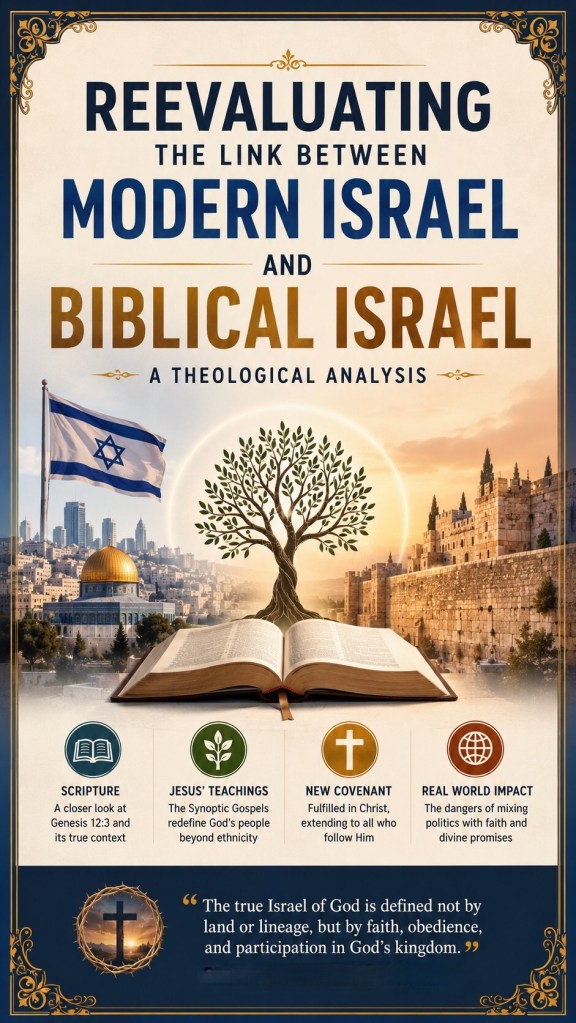
Reevaluating the Link Between Modern Israel and Biblical Israel: A Theological Analysis
In recent years, certain theological interpretations—particularly within Christian Zionism—have claimed a direct and unbroken continuity between the modern State of Israel and the Israel of the Bible. A central tenet of this belief is that divine blessing is contingent upon supporting the current nation-state of Israel, often based on Genesis 12:3: “I will bless those who bless you, and whoever curses you I will curse.” However, a deeper examination of the relevant scriptures, both in the Hebrew Bible and the New Testament, challenges the theological foundation of this view.
📖 The Misapplication of Genesis 12:3
Genesis 12:3 refers specifically to Abraham and his descendants, not to a political entity known as “Israel.” In fact, the term “Israel” does not appear in this verse at all. The promise is made to Abraham’s lineage, which, according to both the Torah and the Qur’an, is defined by righteousness and obedience, not merely by ethnic or genetic descent. The notion that supporting a modern political state guarantees divine favor lacks direct biblical substantiation when examined in its original context.
📚 The Role of the Scofield Reference Bible
The widespread acceptance of this interpretation in Western Christianity is often traced to the 1909 Scofield Reference Bible. Financed and promoted by American Zionist interests, this annotated Bible interpreted Genesis 12:3 as a divine command to unconditionally bless and support the Jewish people and, by extension, the modern State of Israel. This reading has heavily influenced Christian Zionist theology, despite its relatively recent origin and its selective use of Scripture.
✝️ Redefining Israel in the Synoptic Gospels
The Synoptic Gospels present covenant identity as something defined not merely by ethnic descent, but by faithfulness, obedience, repentance, and response to God’s kingdom.
In Matthew 3:9, John the Baptist warns that physical descent from Abraham is not enough to guarantee covenant status. In Matthew 8:11–12, Jesus teaches that many from “east and west” will enter the kingdom, while some presumed heirs (including some within covenant Israel) may be excluded. This shifts the focus from ancestry to faith and response to God.
Jesus deepens this idea in Matthew 12:46–50, where he defines his true family as those who do the will of the Father. The clearest expression appears in Matthew 21:33–43, where Jesus says the kingdom of God will be taken away from the unfaithful tenants—often understood as the religious leadership of Israel—and given to a people who produce its fruits.
Thus, the Synoptic Gospels portray Jesus as reshaping the meaning of God’s covenant people. Israel is no longer understood only through lineage or national identity, but through spiritual fruitfulness, obedience, and participation in God’s kingdom.
📜 The New Covenant and the End of the Old
The New Testament echoes the prophecy of Jeremiah 31:31, speaking of a “new covenant” that redefines the terms of God’s relationship with His people. This covenant, centered on Jesus, supersedes the old covenant tied to ethnicity and geography. The destruction of the Second Temple in 70 CE is often interpreted in Christian theology as the end of a distinct covenantal relationship with ethnic Israel, particularly in light of widespread rejection of Jesus as Messiah.
⚠️ Concerns About Christian Zionism
The theological and political implications of Christian Zionism raise serious concerns. The movement is often marked by what critics describe as “eodolatry”—the idolization of a specific ethnic group—and “fedism,” an unquestioning reliance on faith divorced from reason and scriptural context. This blind allegiance to a secular state, often at odds with core Christian values, undermines the central message of the New Testament.
Some prominent figures within strands of Christian Zionism have made controversial theological claims that critics argue diminish or redefine Christ’s messianic role. For instance, John Hagee made contentious remarks regarding Jesus’ messianic mission, which critics viewed as downplaying Jesus’ self-identification as the Messiah to the Jewish community. Many evangelical Christians argued that such wording appeared to conflict with the Gospel portrayal of Jesus as the promised Messiah.
🌍 Geopolitical Implications
The misinterpretation of Genesis 12:3 within a theological context cannot be considered in isolation. It has significant real-world consequences, particularly in justifying geopolitical actions, including war and occupation, under the guise of fulfilling divine prophecy. By conflating spiritual promises with political agendas, Christian Zionism risks endorsing injustice while claiming divine sanction.
✅ Conclusion
The belief that supporting the modern State of Israel is a biblical mandate is built upon a selective and decontextualized reading of Scripture. When examined through the broader lens of both Old and New Testament theology, it becomes clear that the promises to Abraham were ultimately fulfilled in Christ and extended to all who follow Him. Within this reading of the New Testament, covenant identity becomes increasingly associated with faith, obedience, and participation in God’s kingdom rather than solely with ethnic descent or political nationhood.
Christians are called not to adhere to politicized interpretations of Scripture, but to ground their faith in the teachings of Jesus and the apostles, who redefined what it means to be God’s people. Any theology that places a political state above the gospel risks distorting the heart of the Christian message.
The Synagogue of Satan, Gog and Magog, and a Hijacked Identity
The Synagogue of Satan, Gog and Magog, and a Hijacked Identity
In plain terms, this is an argument that has been around for centuries, and it goes like this:
Not everyone who claims to be part of a faith is actually faithful to it.
The phrase “Synagogue of Satan” comes from the New Testament, Revelation 2:9 and 3:9. It says: “I know the blasphemy of them which say they are Jews, and are not, but are the synagogue of Satan.” In this reading, it does not describe all Jewish people. It describes a specific group who adopt the name and identity of Judaism, but use it for a different purpose.
That is where the Gog and Magog idea comes in.
In Ezekiel 38 and 39, Gog and Magog are not from Israel. They are outsiders from the north who come down against Israel in the last days. They form a coalition, they claim a right to the land, and they surround God’s people. According to this interpretation, Gog and Magog are not defined by blood, but by behavior – they are invaders who convert to the identity, hijack the covenant, and then rebel against the God of that covenant.
The argument is that this is a pattern: conversion without obedience. You take the label “Judaism,” you take the institutions, the land, the political power that comes with it, but you reject the core of the Torah – justice, mercy, humility before God. You keep the name but reverse the mission. That, in this view, is what makes it a Synagogue of Satan. It looks like a synagogue, but it works against God.
For argument’s sake, two prophecies are linked to make this point.
Ezekiel 39:17-20 describes what happens to Gog and his army after the invasion fails. God says to the birds and beasts: “Assemble and come… gather from all sides to my sacrifice that I sacrifice for you, a great sacrifice upon the mountains of Israel; that ye may eat flesh and drink blood. Ye shall eat the flesh of the mighty, and drink the blood of the princes of the earth… And ye shall be filled at my table with horses and chariots, with mighty men, and with all men of war.”
It is a picture of total defeat. An invading army that came to take is itself taken. It becomes food.
Deuteronomy 28:26 is part of the curses for disobedience to the covenant. If Israel breaks faith with God, Moses warns: “And thy carcase shall be meat unto all fowls of the air, and unto the beasts of the earth, and no man shall fray them away.”
The connection people draw is direct.
Deuteronomy says: if you claim the covenant and then rebel against God, your end will be exposed, unburied, eaten by birds.
Ezekiel says: when Gog and Magog, the outsiders who attach themselves to Israel and then rebel, are judged, their end is exactly the same – their bodies left on the mountains of Israel as meat for birds.
In this reading, Ezekiel 39 is the fulfillment of the curse in Deuteronomy 28. The same punishment falls. Why? Because it is the same crime. Claiming to be God’s people while living in rebellion to God.
So the final argument is this: Gog and Magog are not defeated because they are foreign. They are defeated because, having taken on the identity of Judaism, they use it to oppose God. They convert, they hijack the name and the institutions, and they turn it into a political project of power rather than obedience. And the prophetic warning is that God judges that hijacking the same way He warned He would from the beginning.
 ABRAHAMIC THEOLOGY