Azahari Hassim
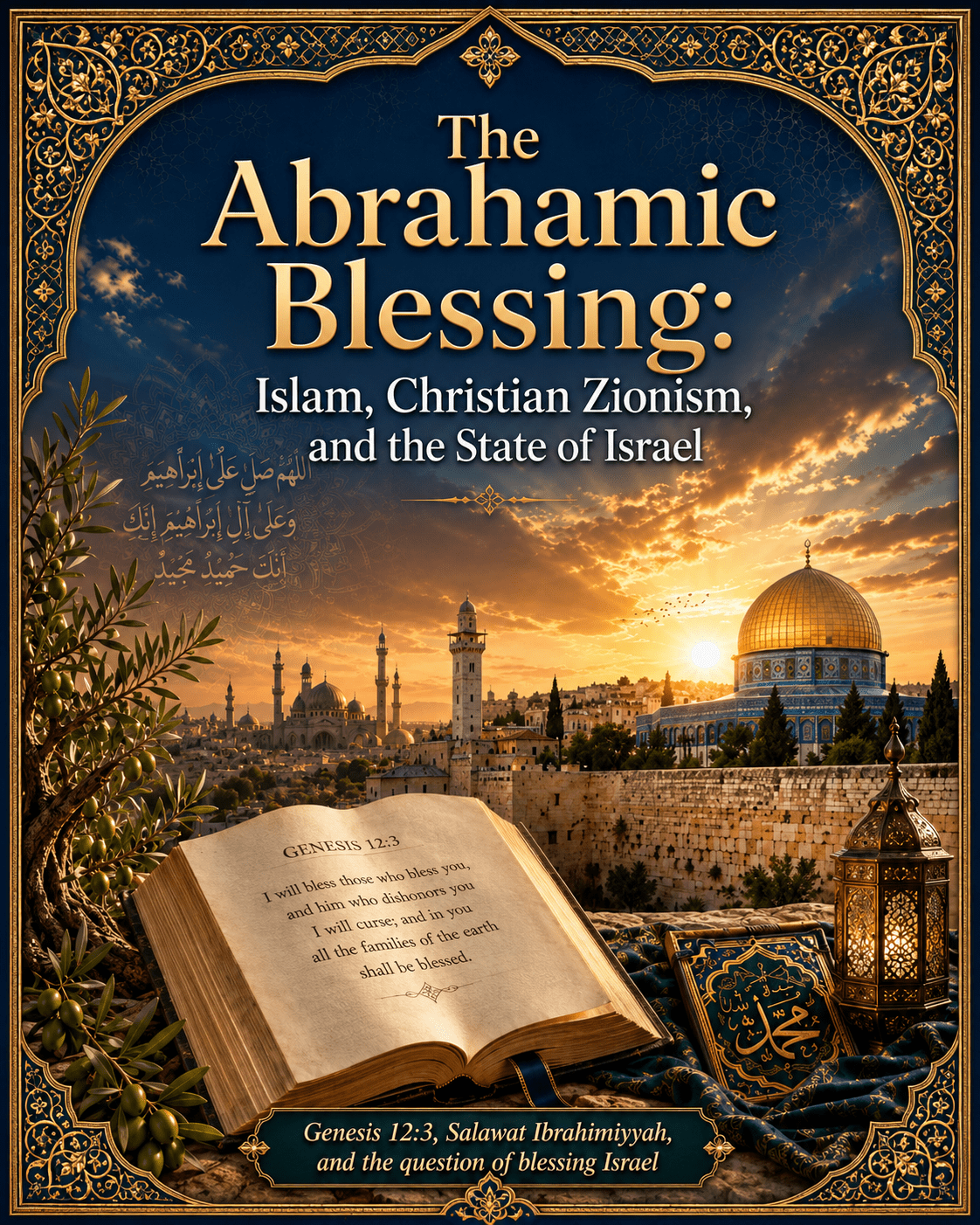
The Abrahamic Blessing: Islam, Christian Zionism, and the State of Israel
📖 Genesis 12:3 is one of the most important verses in the Abrahamic tradition. In this verse, God says to Abraham:
“I will bless those who bless you, and whoever curses you I will curse; and all peoples on earth will be blessed through you.”
The verse contains two major ideas: first, that Abraham carries a special divine blessing; second, that this blessing is ultimately meant to reach all nations, not remain limited to one ethnic group alone. (biblehub.com)
🕋 From an Islamic standpoint, Abraham is not viewed merely as the ancestor of one nation. He is viewed as a universal prophet of tawḥīd, the pure worship of the One God. The Qur’an presents Abraham as neither Jew nor Christian, but as a ḥanīf, a true monotheist who submitted himself to Allah. Therefore, the blessing of Abraham is understood as a spiritual and prophetic blessing rooted in faith, obedience, righteousness, and submission to God.
🤲 This is where Ṣalawāt Ibrāhīmiyyah becomes deeply meaningful. In the prayer taught by Prophet Muhammad ﷺ, Muslims say:
“O Allah, send Your blessings upon Muhammad and the family of Muhammad, as You sent Your blessings upon Abraham and the family of Abraham.”
This wording appears in authentic hadith collections, including Ṣaḥīḥ al-Bukhārī. (sunnah.com)
🌙 Theologically, this prayer connects the mission of Prophet Muhammad ﷺ to the Abrahamic line of blessing. Muslims are not asking for a separate blessing disconnected from Abraham. Rather, they are asking Allah to bless Muhammad ﷺ and his family in continuity with the blessing already given to Abraham and his family. This means that, in Islamic theology, the Abrahamic blessing reaches its universal expression through the final prophethood of Muhammad ﷺ.
🧭 From this perspective, Genesis 12:3 is not about political loyalty to a modern state. It is about alignment with the divine mission of Abraham: worship of the One God, rejection of idolatry, moral responsibility, and guidance for all peoples. To “bless Abraham” means to honour his true religion, his prophetic legacy, and the universal message of submission to God.
✝️ Christian Zionism often reads Genesis 12:3 differently. Many Christian Zionists interpret the verse as a continuing divine command to support the Jewish people and, by extension, the modern State of Israel. The International Christian Embassy Jerusalem, for example, describes Genesis 12:3 as one of the most frequently cited biblical mandates for Christians to “stand with Israel” and bless the Jewish people. (ICEJ)
🇮🇱 In this Christian Zionist reading, blessing Israel is not merely a private spiritual attitude. It can become political, financial, diplomatic, and even military support for the State of Israel. Some Christian Zionist arguments claim that nations which support Israel receive divine favour, while those that oppose Israel risk divine judgment. Recent reporting on evangelical support for Israel notes that Genesis 12 is frequently used as a foundation for this belief. (Houston Chronicle)
⚖️ However, not all Christians accept this interpretation. Some Christian theologians argue that Genesis 12:3 should not be used as a direct theological justification for supporting every policy of the modern State of Israel. Ligonier Ministries, for example, argues that there may be political reasons for supporting some Israeli policies, but Genesis 12:3 itself does not provide a theological reason to support the modern nation-state unconditionally. (Ligonier Ministries)
🌿 The key difference is this: Christian Zionism often links Abraham’s blessing to ethnic Israel and the modern State of Israel, while the Islamic perspective links Abraham’s blessing to tawḥīd, prophethood, righteousness, and the continuation of Abraham’s spiritual legacy through Muhammad ﷺ. In Islam, Abraham’s blessing is not cancelled, but universalized. It flows through the family of Abraham, includes the line of Ishmael, and reaches the nations through the final Messenger.
🕌 Therefore, Ṣalawāt Ibrāhīmiyyah can be seen as a powerful Islamic response to Genesis 12:3. Every time Muslims send blessings upon Muhammad ﷺ and his family “as” Allah blessed Abraham and his family, they are affirming that the Abrahamic promise is alive — not as a narrow ethnic nationalism, but as a living spiritual covenant centred on worship, mercy, guidance, and submission to Allah.
🌍 In conclusion, Genesis 12:3 can be understood in two very different ways. Christian Zionism often reads it as a mandate to bless and support the State of Israel. Islam reads the Abrahamic blessing through the lens of tawḥīd and prophethood, fulfilled in the universal mission of Muhammad ﷺ and remembered daily through Ṣalawāt Ibrāhīmiyyah. The real blessing of Abraham, from the Islamic standpoint, is not the domination of one nation over another, but the spread of divine guidance to all families of the earth.
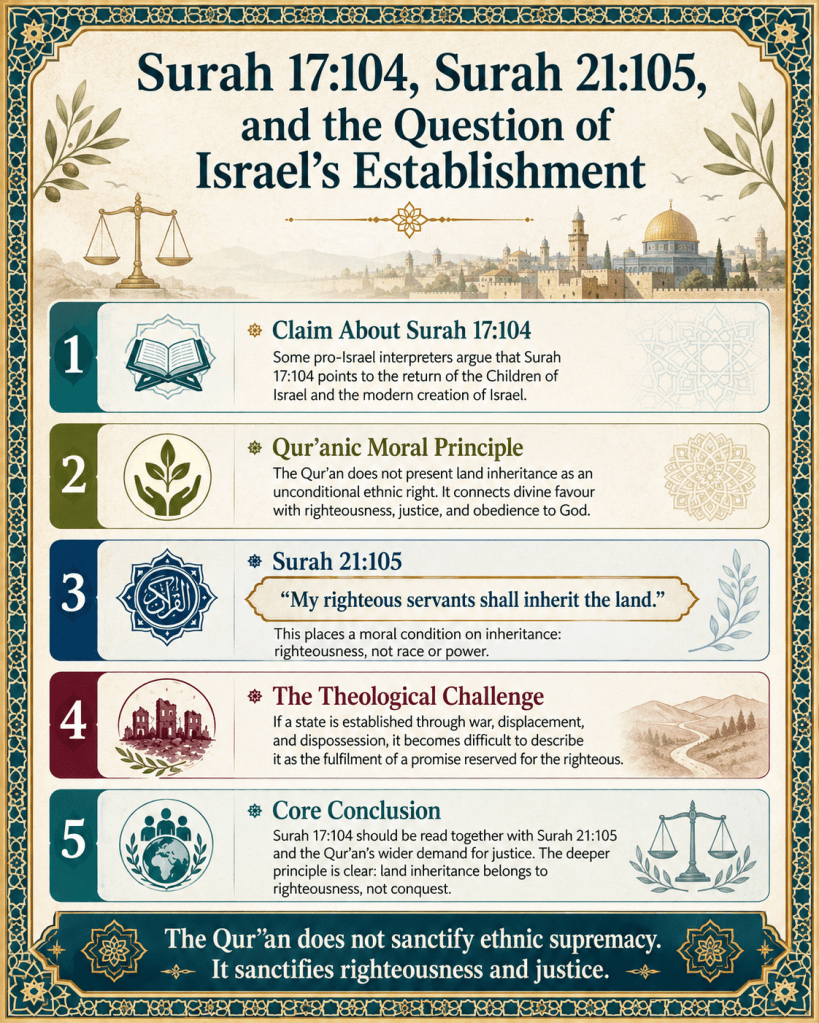
Surah 17:104, Surah 21:105, and the Question of Israel’s Establishment
🔹 Some pro-Israel and Zionist-leaning interpreters claim that Surah 17:104 is a prophecy about the modern establishment of the State of Israel.
📜 The verse says that after Pharaoh, God told the Children of Israel to live in the land. It also says that when the final promise comes, God will bring them together in one gathering.
🕍 Because of this, Zionists argue that the return of Jews to Palestine and the creation of Israel in 1948 fulfilled this Qur’anic verse.
⚖️ However, this reading is not complete.
🌿 The Qur’an does not give land inheritance as an unconditional ethnic right. It repeatedly connects inheritance, authority, and divine favour with righteousness, justice, and obedience to God.
📖 This is where Surah 21:105 becomes very important. It says:
“My righteous servants shall inherit the land.”
🧭 This verse gives a moral condition. The land is not simply inherited by race, tribe, nation, or political power. It is inherited by the righteous.
🚫 Therefore, if a state is established through military conquest, mass displacement, and the destruction of another people’s society, it becomes difficult to present that event as a fulfilment of a righteous divine promise.
🏚️ The State of Israel was not established peacefully on empty land. Its creation was connected to the 1948 war, the mass displacement of Palestinians, the destruction or depopulation of many villages, and what Palestinians remember as the Nakba.
🕊️ For Palestinians, the Nakba was not merely a political event. It was the loss of homes, land, villages, family memory, and national life.
❗ This creates a serious theological problem for the Zionist reading of Surah 17:104. If the return mentioned in that verse is interpreted as a divine gathering, then it must still be judged by the wider Qur’anic principle of justice.
📌 Surah 21:105 does not say that the land belongs automatically to one ethnic group. It says the land is inherited by God’s righteous servants.
🌱 In Qur’anic terms, righteousness is not proven by military victory. It is proven by justice, mercy, faithfulness to God, and respect for the rights of others.
⚠️ A state built through displacement and dispossession cannot easily be described as the fulfilment of a promise reserved for the righteous.
🕯️ This does not mean the Qur’an denies the historical connection of the Children of Israel to the Holy Land. The Qur’an clearly recognizes their history, prophets, trials, and covenantal past.
⚖️ But recognition of history is not the same as approval of injustice. Additionally, Ashkenazi Jews are thought to be the offspring of Khazars who underwent conversion and were not indigenous to the sacred territory.
📚 The Qur’an honours the Children of Israel when they obey God, but it also criticizes them when they fall into arrogance, corruption, or oppression. This is consistent with the Qur’an’s wider moral message: no community is above divine accountability.
🧩 From this perspective, Surah 17:104 cannot be used alone as a simple proof-text for modern political Zionism. It must be read together with Surah 21:105 and the Qur’an’s broader demand for justice.
🌾 The deeper Qur’anic principle is clear: land inheritance belongs to righteousness, not conquest.
🚧 If the land is gained through oppression, then the claim of divine fulfilment becomes morally weak. If the land is inherited through justice, humility, and obedience to God, then it aligns with the Qur’anic vision.
🔎 In the end, Surah 21:105 challenges any political movement that claims sacred land while ignoring the rights of the people already living there.
✨ The Qur’an does not sanctify ethnic supremacy. It sanctifies righteousness.
🤲 And righteousness cannot be separated from justice.
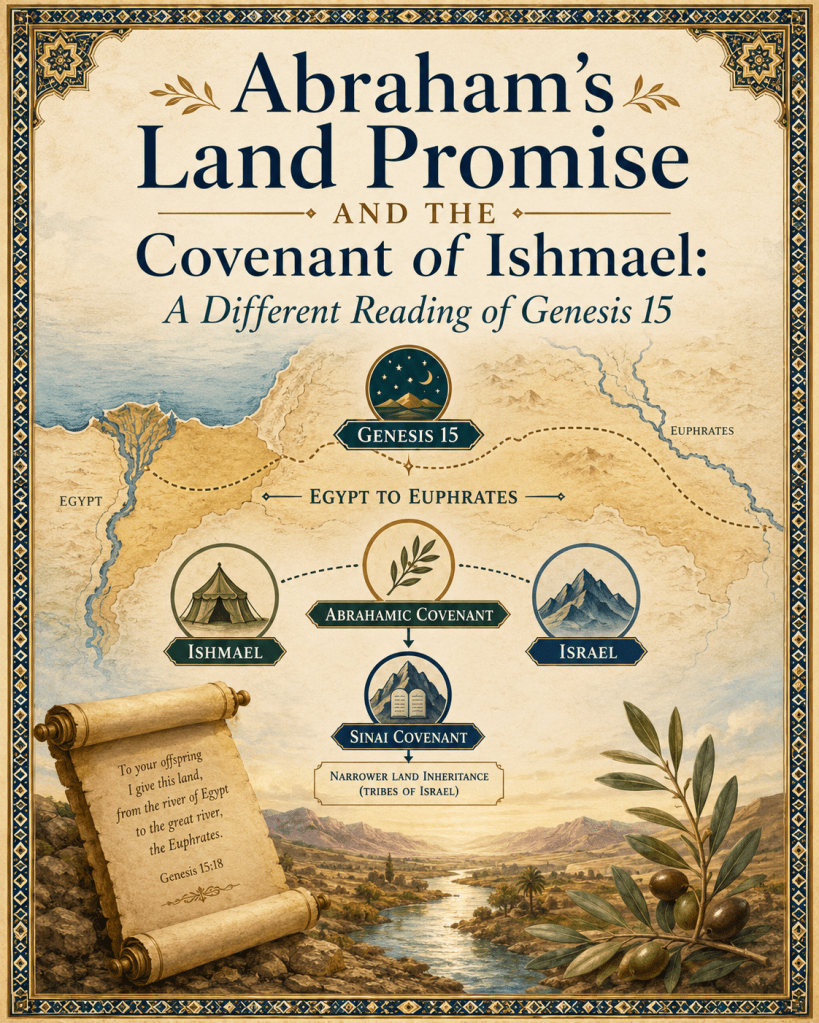
Abraham’s Land Promise and the Covenant of Ishmael: A Different Reading of Genesis 15
📖 The land promise in Genesis 15 remains one of the most debated passages in Abrahamic theology. In this text, God promises Abraham’s “seed” a vast territory stretching from the River of Egypt to the Euphrates.
🗺️ While many Christian Zionists and Messianic Jews interpret this as a divine mandate for a “Greater Israel” belonging exclusively to the descendants of Jacob, a closer look at the biblical timeline suggests an alternative reading.
👶 When the promise was made, neither Isaac nor Jacob had been born or named. The immediate successor in the biblical sequence is Ishmael, Abraham’s firstborn.
🌙 This timing implies that the foundational Abrahamic covenant was initially attached to Abraham’s broader lineage, with Ishmael as Abraham’s firstborn standing naturally within that covenantal horizon before the distinct Israelite nation emerged.
📜 Recognizing the theological distinction between the original Abrahamic covenant and the later Sinai covenant completely reframes the territorial narrative. The Sinai covenant, established much later through Moses, granted the Israelites a specific, narrower territory in Canaan, while the broader Abrahamic promise — from the River of Egypt to the Euphrates — may be understood as fulfilled through Abraham’s wider lineage, especially Ishmael and his descendants.
⚖️ Crucially, as outlined in texts like Leviticus 26, this Sinai inheritance was highly conditional, tied directly to Israel’s obedience, justice, and faithfulness to God’s Law.
🏛️ The Israelites historically realized this inheritance during the pre-Islamic period through leaders like Joshua, David, and Solomon. However, conflating this conditional, geographically limited covenant with the expansive, unconditional promise of Genesis 15 creates significant theological friction.
🕌 From a comparative theological perspective, the broader Genesis 15 promise finds its historical fulfillment in the descendants of Ishmael rather than in a modern political project. The subsequent spread of Islam and Arab civilizations across the very lands described — from Egypt to the Euphrates — serves as a realization of God’s initial promise to Abraham’s firstborn.
🕊️ By separating the conditional Sinai covenant from the broader Abrahamic legacy, the modern pursuit of territorial expansion becomes theologically unnecessary. Acknowledging that both lineages received their respective historical inheritances invites a paradigm shift away from conquest, urging a renewed focus on humility, justice, and peace among all who trace their roots to Abraham.
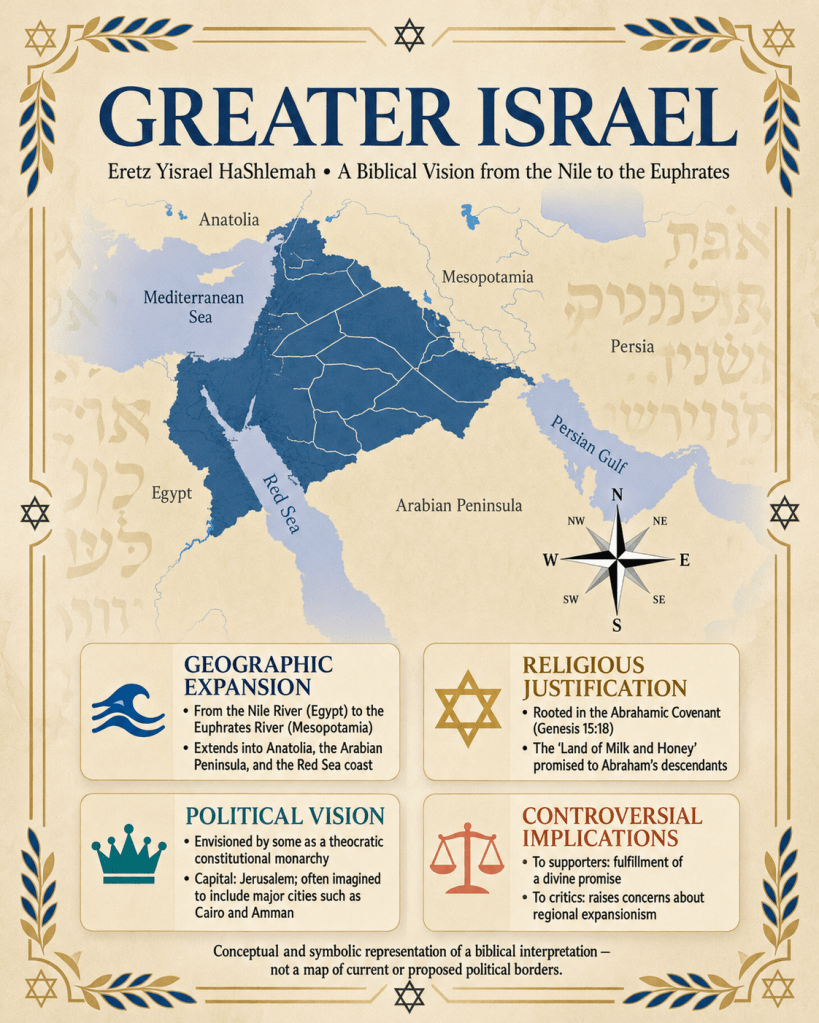
Greater Israel: A Controversial Biblical and Political Idea
🗺️ The poster presents the idea of “Greater Israel,” also known in Hebrew as Eretz Yisrael HaShlemah. It shows a symbolic map stretching from Egypt and the Nile region toward Mesopotamia and the Euphrates. The image makes clear that this is not a map of current borders, but a political and religious concept based on a particular reading of biblical land promises.
📜 At the center of this idea is Genesis 15:18, where God is described as promising Abraham’s descendants land “from the river of Egypt to the great river, the Euphrates.” Supporters of the Greater Israel concept interpret this verse as a divine promise that could include lands far beyond the modern State of Israel.
🏛️ The poster also connects this vision to religious justification. It refers to the Abrahamic covenant and the phrase “land of milk and honey,” which is often associated with biblical descriptions of the promised land. For religious supporters, the map represents not only geography, but sacred destiny.
⚖️ However, this interpretation is highly controversial. Critics argue that using ancient scripture to justify modern territorial expansion can encourage regional conflict and political extremism. They also warn that such ideas may ignore the rights, histories, and lives of the people already living in those lands.
👑 The poster describes a possible political vision linked to this idea, including Jerusalem as the capital and an imagined state reaching major cities such as Cairo and Amman. This reflects a maximalist ideological vision rather than a recognized international political reality.
🌊 Geographically, the map covers a vast area, including parts of Egypt, the Levant, Mesopotamia, Anatolia, the Arabian Peninsula, and the Red Sea coast. This broad scope is one reason the concept raises serious concerns among neighboring peoples and states.
🔥 To supporters, Greater Israel may be seen as the fulfillment of a divine promise. To critics, it appears as a dangerous form of territorial ambition that could legitimize conquest, displacement, and permanent conflict.
🧭 The deeper issue is not only what the ancient text says, but how it is used today. A religious promise interpreted without moral limits can become a political weapon. Any serious discussion of sacred land must also address justice, human dignity, and the rights of all communities who live there.
📌 In the end, the poster portrays Greater Israel as a symbolic and ideological vision, not as an accepted political map. It is best understood as a contested interpretation of scripture with major religious, political, and ethical consequences.
🌙 From an Islamic theological perspective, the broader divine promise to Abraham is understood not as a mandate for ethnic domination or endless territorial expansion, but as a promise fulfilled through faith, righteousness, and the spread of tawḥīd (the uncompromising oneness of God, free from any association of partners).
In this reading, the rise of Islam and its civilization across the lands between the Nile, the Levant, Arabia, and Mesopotamia fulfilled the divine promise in a deeper and more universal sense. It was not fulfilled through political borders or ethnic supremacy, but through the establishment of Abrahamic monotheism, the worship of the One God, and a civilization rooted in revelation, law, knowledge, justice, and moral responsibility.

