Azahari Hassim
🌙 The Coming Kingdom: From John and Jesus to Muhammad
From an Islamic theological perspective, the missions of John the Baptist (Yaḥyā) and Jesus (ʿĪsā) occupy an important transitional position in sacred history. Both were Israelite prophets ministering among the Children of Israel within the religious world shaped by the Sinai covenant. Yet their preaching repeatedly looked forward—to the approaching Kingdom of God.
An Islamic comparative reading can understand this coming kingdom not simply as another stage of Israelite national history, but as the restoration and universalisation of the primordial religion of Abraham: Islam, submission to the One God.
Within this interpretation, the message moves from Sinai back to Abraham, and ultimately toward the universal prophetic mission of Muhammad.
✡️ Jesus and John Within the Sinai Covenant
In the Islamic tradition, Jesus (known as Isa in Arabic) is viewed as a significant prophet within the lineage of Israel’s prophetic history. The Qur’an emphasizes this connection clearly:
Qur’an 3:49:
“A messenger to the children of Israel. (Jesus declares): Indeed, I have come to you with a sign from your Lord…”
Here, Jesus identifies himself specifically as a messenger to the “children of Israel,” indicating that his mission is deeply rooted in addressing the spiritual and ethical concerns of this community.
Further emphasizing his role, Qur’an 5:46 states:
Qur’an 5:46:
“And We sent, following in their footsteps, Jesus, the son of Mary, confirming that which came before him in the Torah…”
This verse reinforces that Jesus’ mission was not to create a new religion but to affirm the teachings of the Torah (the first five books of the Hebrew Bible) and build upon the foundation laid by previous prophets.
📖 Correspondence with the New Testament
These Islamic perspectives find parallels in Christian scripture. In the Gospel of Matthew, Jesus speaks to his mission similarly:
Matthew 15:24:
“I was sent only to the lost sheep of the house of Israel.”
This statement underscores Jesus’ focus on the Jewish people and his role in reconnecting them with their spiritual heritage.
Additionally, Jesus states in Matthew 5:17:
“Do not think that I have come to abolish the Law or the Prophets; I have not come to abolish them but to fulfill them.”
This proclamation highlights that Jesus saw himself not as a disruptive force but as one who came to fulfill and realize the prophetic words and laws that were already established in Jewish tradition.
📔 The Role of John the Baptist
John the Baptist (Yahya in Arabic) also plays a crucial role in this narrative. His ministry was centered around calling the Jewish people to repentance in anticipation of Jesus’ coming. His focus was on preparing the hearts and minds of Israel for the new covenant that Jesus would establish.
From an Islamic perspective, both John and Jesus operate within the framework of the Sinai Covenant, which stands as a pivotal moment in the relationship between God and the Israelites, articulated through figures such as Moses. This means that rather than establishing separate religions, both prophets were acting as divine agents, urging Israel back to a faithful relationship with God while forecasting a new divine order.
🔥 Matthew 3:9–12 — Abrahamic Descent Is Not Enough
One of John’s most significant declarations appears in Matthew 3:9:
“And do not think you can say to yourselves, ‘We have Abraham as our father.’”
John then makes the extraordinary statement that:
“I tell you that out of these stones God can raise up children for Abraham..”
Immediately afterward comes the warning:
“The ax is already at the root of the trees, and every tree that does not produce good fruit will be cut down and thrown into the fire.”
— Matthew 3:10
The imagery becomes still stronger in verses 11–12, where John announces someone coming after him and describes judgment through the separation of wheat from chaff.
From an Islamic prophetic perspective, John’s words,
“He who is coming after me” (Matthew 3:11),
can be understood as future-oriented, pointing beyond John’s own generation toward a later messenger. Jesus was John’s contemporary, whereas Muhammad came centuries after both John and Jesus. On this reading, the expression anticipates Muhammad, whose universal mission restored the Abrahamic religion of submission to the One God—Islam. This interpretation can further be connected with Jesus’ proclamation of the coming Kingdom of God and, within the same Islamic prophetic framework, Daniel 7:13–14’s vision of a coming figure associated with universal dominion.
Contextually, Matthew 3:9–12 presents a significant progression: John first challenges reliance on physical descent from Abraham—“We have Abraham as our father”—then warns of approaching judgment, and finally announces “the one coming after me.”
Structurally, the passage therefore moves from Abrahamic ancestry → judgment and purification → a coming figure → a new divine order. Within an Islamic prophetic reading, this sequence can be understood as pointing beyond inherited Israelite identity toward the universal Abrahamic faith ultimately proclaimed by Muhammad: Islam, submission to the One God.
This principle closely resembles the Qur’anic understanding of Abraham.
🕋 Abraham Was Neither Jew Nor Christian
The Qur’an deliberately takes Abraham behind the later religious divisions:
“Abraham was neither a Jew nor a Christian, but he was a ḥanīf, a Muslim, and he was not of the polytheists.”
— Qur’an 3:67
The word muslim fundamentally means one who submits himself to God.
The Qur’an then declares:
“Indeed, the people most worthy of Abraham are those who followed him, and this Prophet, and those who believe.”
— Qur’an 3:68
Thus, Abrahamic inheritance is fundamentally connected with following Abraham’s monotheistic faith rather than merely claiming biological descent from him. In Qur’an 3:68, “this Prophet” refers to Prophet Muhammad, placing him and those who believe with him within the Qur’an’s presentation of continuity with the faith of Abraham.
Matthew 3:9 becomes particularly interesting when viewed through this Islamic lens.
“And do not think you can say to yourselves, ‘We have Abraham as our father.’ I tell you that out of these stones God can raise up children for Abraham.”
John warns against confidence based simply upon Abrahamic ancestry, while the Qur’an centuries later declares that those closest to Abraham are those who actually follow his faith.
👑 Jesus and the Coming Kingdom of God
John’s message was:
“Repent, for the kingdom of heaven is at hand.”
— Matthew 3:2
Jesus subsequently proclaimed the same message:
“Repent, for the kingdom of heaven is at hand.”
— Matthew 4:17
What exactly was this approaching Kingdom?
Christian theology generally interprets the Kingdom through Jesus himself—his ministry, death, resurrection, present spiritual reign and/or future return.
An Islamic reading may approach the language differently.
Islam means submission to God, and the Qur’an presents this submission as the religion of Abraham and, in a broader theological sense, of all God’s prophets.
Consequently, the coming Kingdom may be interpreted within Islamic comparative theology as pointing toward the universal establishment of Abrahamic monotheism: worship of the one God transcending the national boundaries of the Sinai covenant.
This reaches its universal historical expression in the mission of Muhammad. Therefore, Islam can indeed be considered the Kingdom proclaimed by John and Jesus.
🌌 Daniel 7:13 — The Mysterious Figure in the Night Vision
Another passage becomes especially intriguing within this interpretation.
Daniel says:
“I saw in the night visions, and behold, one like a son of man came with the clouds of heaven…”
— Daniel 7:13
The figure approaches the Ancient of Days and subsequently receives:
“dominion and glory and a kingdom, that all peoples, nations, and languages should serve him.”
— Daniel 7:14
The kingdom described here is strikingly universal.
It encompasses peoples, nations and languages.
Traditional Jewish interpretations have often related Daniel’s humanlike figure collectively to the holy people represented later in the chapter, while Christian interpretation has characteristically identified the “Son of Man” with Jesus, especially because Jesus repeatedly uses Son-of-Man language in the Gospels.
An Islamic polemical interpretation, however, can propose another possibility: the figure ultimately points to Muhammad.
🌙 The “Night Visions” and Muhammad’s Night Journey
Daniel specifically introduces the vision with the words:
“I saw in the night visions…”
From an Islamic typological perspective, this language can be compared with the extraordinary Night Journey (al-Isrāʾ) and Ascension (al-Miʿrāj) of Muhammad.
The Qur’an declares:
“Glory be to Him who took His servant by night from the Sacred Mosque to the Farthest Mosque, whose surroundings We have blessed…”
— Qur’an 17:1
Islamic tradition understands this as Muhammad’s miraculous nighttime journey from Mecca to Jerusalem, followed by his heavenly ascension.
The parallel proposed by this Islamic interpretation is therefore striking:
Daniel: a night vision → a human figure → heavenly/cloud imagery → approach to the divine court → universal dominion.
Islamic tradition: Muhammad travels by night → reaches Jerusalem → ascends through the heavens → encounters the heavenly realm → his prophetic mission ultimately reaches peoples and nations far beyond Israel.
Structurally, Daniel 7:13–14 presents a striking parallel: a night vision → a human figure → heavenly/cloud imagery → entrance into the divine heavenly court → universal dominion embracing peoples, nations, and languages.
From an Islamic prophetic perspective, this structure can be understood as corresponding to Muhammad’s Isrāʾ and Miʿrāj—the Night Journey and Ascension—followed by the universal expansion of his prophetic mission. Thus, Daniel’s “night vision” may be read as a prophetic foreshadowing of Muhammad’s later Night Journey and heavenly ascent.
🏛️ Daniel 7:25 — The Little Horn and Constantine
Daniel 7:25 describes a “little horn” that would speak against the Most High and seek to “change times and law.”
Historical Context
Constantine the Great was Roman emperor during a major turning point in Christian history. He convened the Council of Nicaea in AD 325, where the controversy concerning the relationship between the Father and the Son was formally debated. Constantine’s reign significantly increased imperial involvement in Christian affairs, including the theological disputes that led to the Nicene settlement.
Islamic Interpretation
Within the Islamic interpretation presented here, the “little horn” may be understood as pointing to Constantine. The phrase “change times and law” is interpreted as corresponding to the broader transformation of Christian doctrine and religious practice during the Constantinian era.
From this perspective, these developments represent a movement away from the original tawḥīd—the absolute oneness of God—preached by the prophets, including Jesus.
This remains an alternative Islamic interpretation. Many modern scholars identify Daniel’s “little horn” with Antiochus IV Epiphanes, while some Christian interpretations associate it with a future Antichrist.
☁️ What Did Jesus Mean by the “Coming Son of Man”?
Jesus repeatedly speaks about the coming of the Son of Man, and some Gospel passages clearly draw their imagery from Daniel 7.
For example:
“They will see the Son of Man coming on the clouds of heaven with power and great glory.”
— Matthew 24:30
Christianity naturally understands these statements as Jesus speaking about himself and his future manifestation.
Certain New Testament scholars have argued that when Jesus spoke in the third person of the coming “Son of Man,” he was referring to a future figure distinct from himself. Rudolf Bultmann, Heinz Eduard Tödt, R. H. Fuller, A. J. B. Higgins, and H. J. de Jonge have been associated, with important differences, with versions of this interpretation.
On this reading, Jesus was not necessarily identifying himself with every future Son-of-Man saying but was anticipating an eschatological figure who was still to come.
From an Islamic prophetic perspective, this opens an intriguing possibility: the coming figure associated with Daniel 7:13–14 may be interpreted as Muhammad, whose mission arose centuries after Jesus and ultimately reached peoples, nations, and languages far beyond Israel.
🌍 From a National Covenant to a Universal Mission
Here the distinction between the Sinai covenant and the Abrahamic covenant becomes crucial.
The Sinai covenant was given specifically to Israel through Moses.
The Abrahamic promise, reiterated after Abraham’s great trial concerning the sacrifice of his son—identified as Ishmael in Islamic tradition—extends far beyond a single nation and carries a universal horizon:
“In your offspring shall all the nations of the earth be blessed.”
— Genesis 22:18
From an Islamic perspective, this universal Abrahamic promise is especially significant. Muhammad belongs to the Abrahamic line through Ishmael and is understood in Islam as restoring and universalizing the primordial religion of Abraham—submission to the One God.
The Qur’an explicitly connects Abraham and Ishmael with the Sacred House in Mecca and records their remarkable prayer:
“Our Lord, raise from among them a messenger from themselves who will recite to them Your revelations, teach them the Book and wisdom, and purify them.”
— Qur’an 2:129
Islamic tradition understands this promised messenger from among their descendants as Muhammad, whose mission was not limited to Israel but carried the Abrahamic message to the wider world.
Islamic tradition identifies the fulfilment of this prayer with Muhammad.
Muhammad’s mission is consequently not presented as restricted to one nation:
“We have not sent you except as a mercy to the worlds.”
— Qur’an 21:107
This universalism provides the basis for an Islamic comparison with Daniel 7:14 and its extraordinary vision of a kingdom extending across peoples, nations and languages.
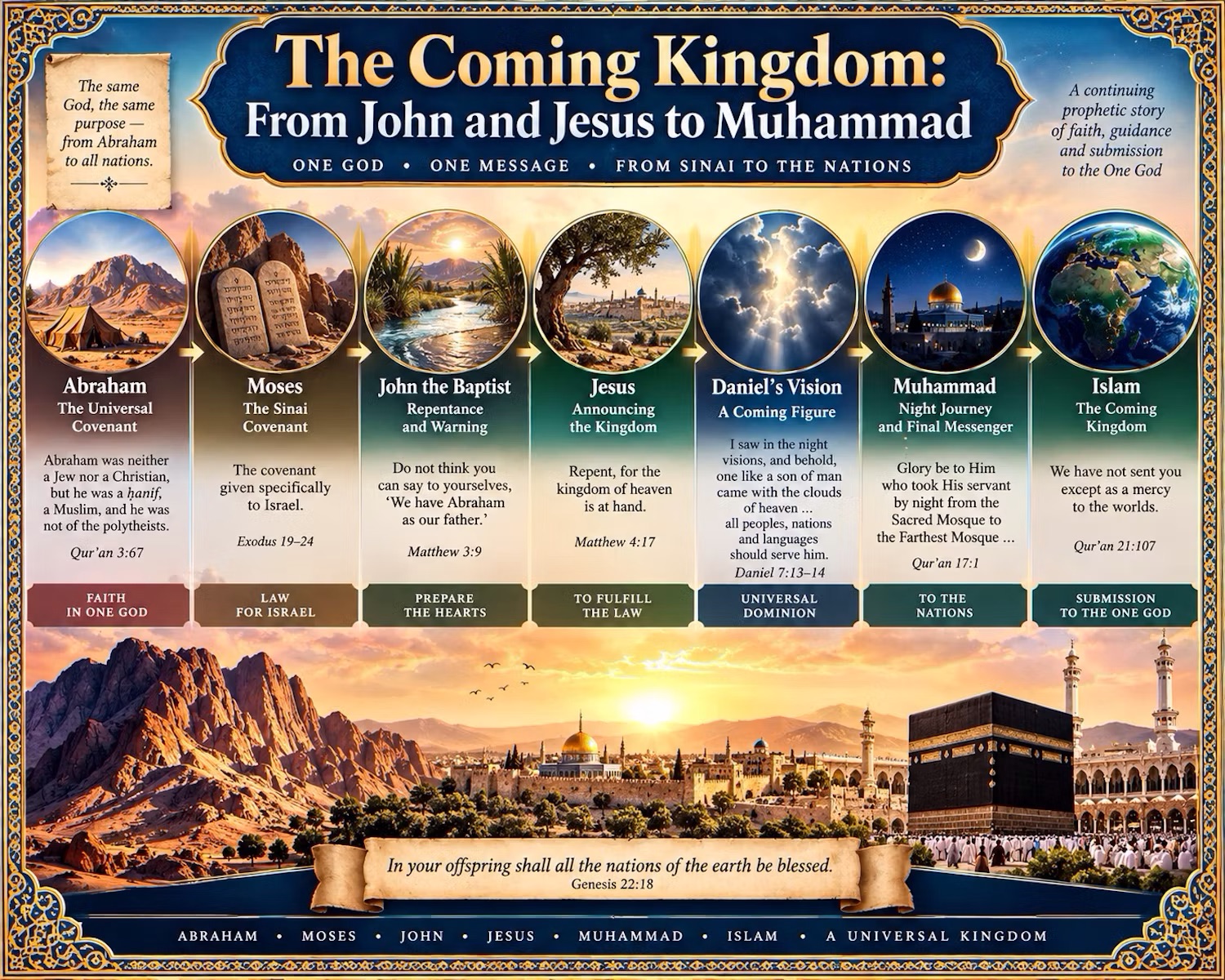
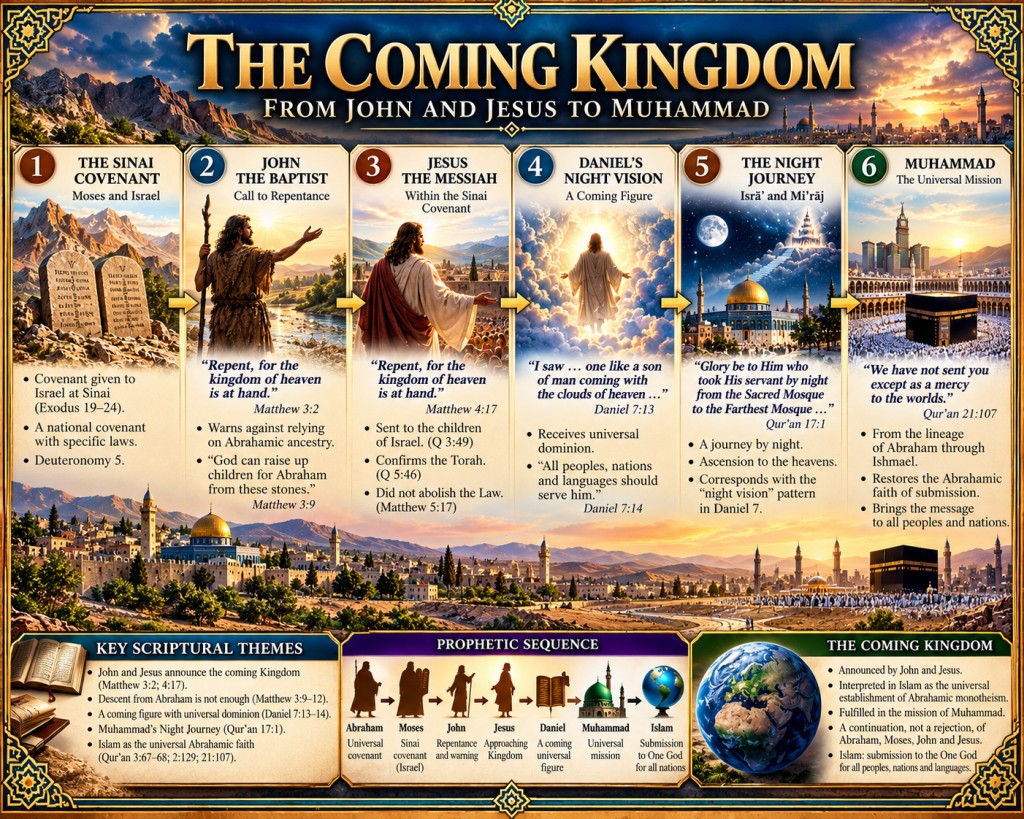
🔗 The Prophetic Sequence
Viewed through this Islamic theological framework, a broad prophetic sequence emerges:
Abraham → the universal covenant of submission to God
⬇️
Moses → the Sinai covenant given specifically to Israel
⬇️
John the Baptist → repentance and warning against reliance upon Abrahamic ancestry
⬇️
Jesus → Israelite Messiah and prophet announcing the approaching Kingdom
⬇️
Daniel’s “one like a son of man” → interpreted typologically as anticipating Muhammad
⬇️
Isrāʾ and Miʿrāj → Muhammad’s extraordinary journey by night and heavenly ascent
⬇️
Muhammad → universal restoration of Abrahamic monotheism
⬇️
Islam → submission to the God of Abraham extended among nations and languages
⚠️ An Important Interpretive Distinction
These connections should not be presented as though they were uncontested readings of the Bible.
Daniel 7:13 does not explicitly name Muhammad, nor does Daniel explicitly identify his “night visions” with a future Night Journey. Likewise, the Gospel texts strongly associate Jesus with Danielic Son-of-Man imagery, which explains why Christianity identifies Daniel’s figure with Christ.
The Islamic argument is therefore best presented as a comparative and typological interpretation.
Its case rests upon an accumulation of themes: the movement from Israel toward universality, John’s rejection of confidence in physical Abrahamic descent, Jesus’ proclamation of an approaching Kingdom, Daniel’s universal kingdom, Muhammad’s Night Journey and heavenly ascent, and the Qur’an’s presentation of Islam as the restoration of Abraham’s primordial monotheism.
A particularly striking structural correspondence is the night setting. Daniel introduces the scene by saying, “I saw in the night visions” (Daniel 7:13), while the Qur’an explicitly describes Muhammad’s Isrāʾ as a journey undertaken “by night” (Qur’an 17:1), traditionally associated with his subsequent heavenly ascent.
Thus, within an Islamic prophetic reading, Daniel’s night vision → heavenly/cloud imagery → human figure approaching the divine presence → universal dominion can be compared structurally with Muhammad’s Night Journey → heavenly ascent → encounter with the heavenly realm → universal prophetic mission.
Significantly, although the New Testament describes Jesus ascending into heaven and being received by a cloud, Luke 24:50–51 and Acts 1:9 do not state that his ascension occurred at night. This night-to-night correspondence therefore provides an additional element in the Islamic typological case for relating Daniel’s vision to Muhammad’s Isrāʾ and Miʿrāj.
🕋 Conclusion: From Sinai to the Coming Kingdom
Taken together, these passages form a coherent pattern within an Islamic prophetic reading. Contextually, John and Jesus stand within the Sinai covenant while announcing an approaching Kingdom, with John warning that physical descent from Abraham alone is insufficient. Islam understands Muhammad as bringing the universal Abrahamic message of submission to the One God beyond Israel to the nations.
Within this Islamic interpretation, the coming Kingdom announced by both John and Jesus is understood as none other than Islam—the universal submission to the One God that Muhammad would later proclaim. John and Jesus announced that the Kingdom was approaching; Muhammad’s later mission brought the Abrahamic call beyond the national framework of Israel and established it among diverse peoples and nations. Islam therefore understands this Kingdom not as a rejection of Abraham, Moses, John, or Jesus, but as the universal continuation and restoration of the monotheistic faith of Abraham.
Structurally, Daniel 7:13–14 presents a striking sequence: night vision → human figure → heavenly/cloud imagery → divine presence → universal dominion. This parallels Muhammad’s Isrāʾ and Miʿrāj: Night Journey → heavenly ascent → heavenly encounter → universal prophetic mission. Significantly, Daniel and Qur’an 17:1 explicitly share the night setting, whereas the New Testament accounts of Jesus’ ascension do not specify that it occurred at night.
Thus, the argument is cumulative: from Sinai to Abraham, from Israel to the nations, and from the announcement of the coming Kingdom by John and Jesus to its proposed universal expression in the Abrahamic mission of Muhammad and Islam.

