Azahari Hassim
📜 Allah and Yahweh: The Living Semitic Name of God and the Mystery of the Lost Pronunciation
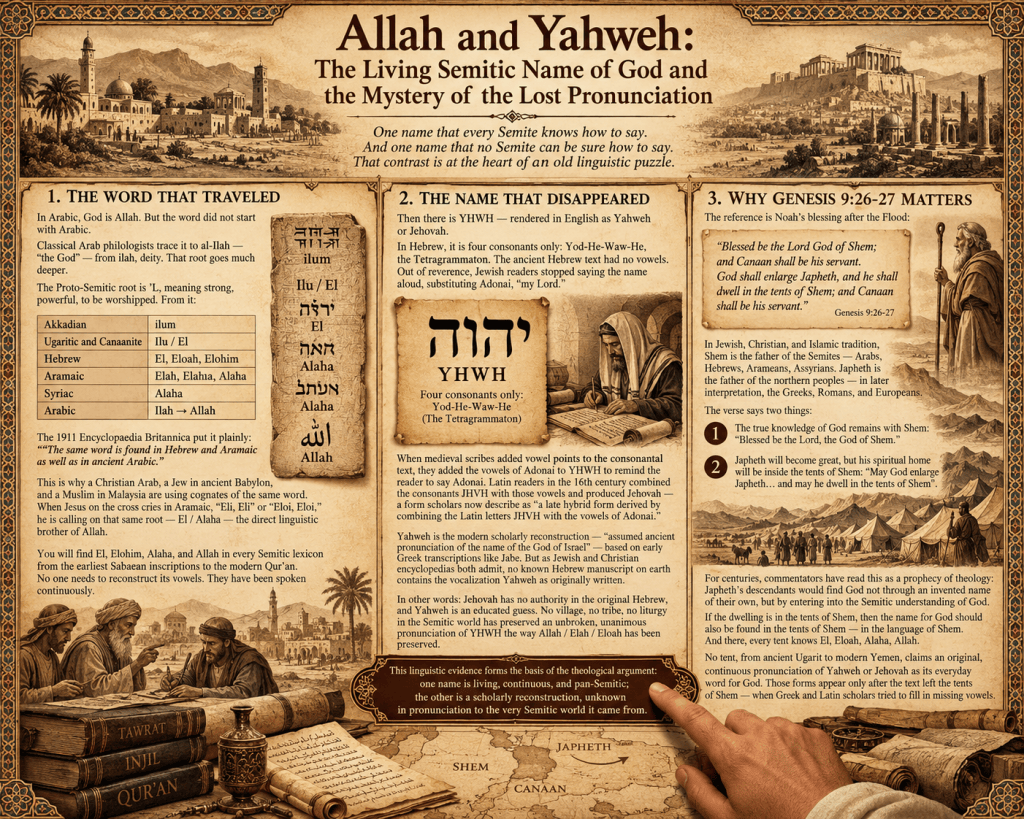
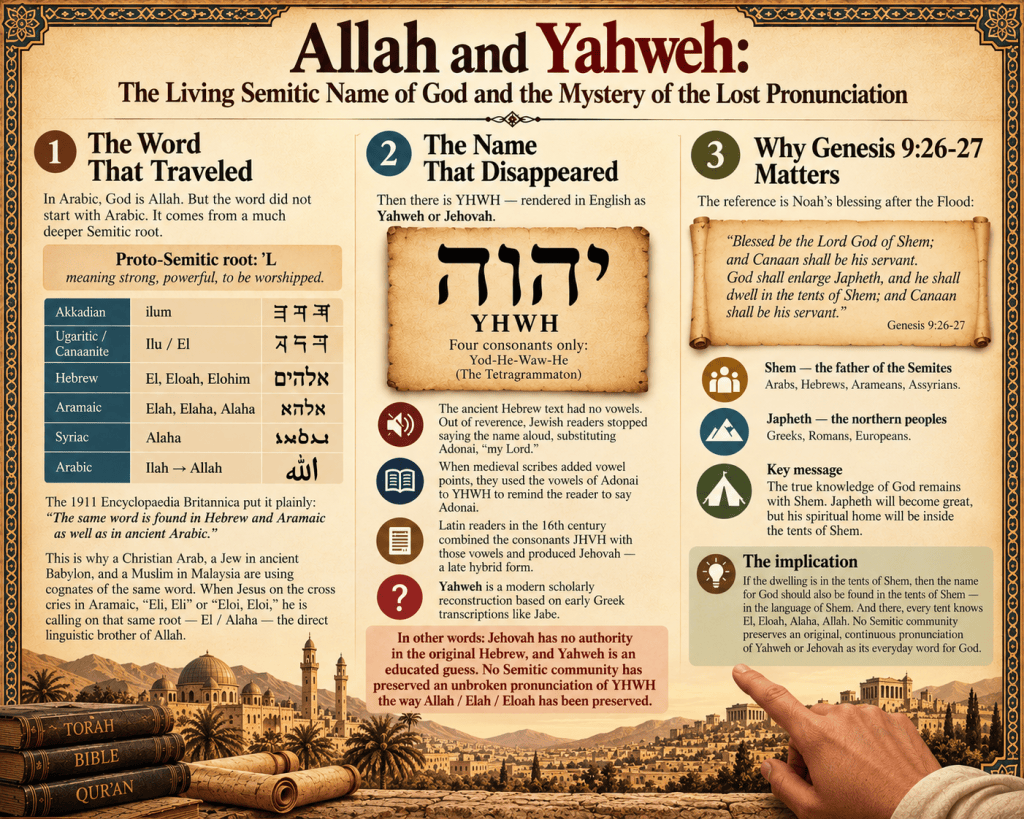
One name that every Semite knows how to say. And one name that no Semite can be sure how to say. That contrast is at the heart of an old linguistic puzzle.
📕The word that traveled
In Arabic, God is Allah. But the word did not start with Arabic.
Classical Arab philologists trace it to al-Ilah — “the God” — from ilah, deity. That root goes much deeper.
The Proto-Semitic root is ’L, meaning strong, powerful, to be worshipped. From it:
- Akkadian: ilum
- Ugaritic and Canaanite: Ilu / El
- Hebrew: El, Eloah, Elohim
- Aramaic: Elah, Elaha, Alaha
- Syriac: Alaha
- Arabic: Ilah -> Allah
The 1911 Encyclopaedia Britannica put it plainly: “The same word is found in Hebrew and Aramaic as well as in ancient Arabic”.
This is why a Christian Arab, a Jew in ancient Babylon, and a Muslim in Malaysia are using cognates of the same word. When Jesus on the cross cries in Aramaic, “Eli, Eli” or “Eloi, Eloi,” he is calling on that same root — El / Alaha — the direct linguistic brother of Allah.
You will find El, Elohim, Alaha, and Allah in every Semitic lexicon from the earliest Sabaean inscriptions to the modern Qur’an. No one needs to reconstruct its vowels. They have been spoken continuously.
📚The name that disappeared
Then there is YHWH — rendered in English as Yahweh or Jehovah.
In Hebrew, it is four consonants only: Yod-He-Waw-He, the Tetragrammaton. The ancient Hebrew text had no vowels. Out of reverence, Jewish readers stopped saying the name aloud, substituting Adonai, “my Lord.”
When medieval scribes added vowel points to the consonantal text, they added the vowels of Adonai to YHWH to remind the reader to say Adonai. Latin readers in the 16th century combined the consonants JHVH with those vowels and produced Jehovah — a form scholars now describe as “a late hybrid form derived by combining the Latin letters JHVH with the vowels of Adonai”.
Yahweh is the modern scholarly reconstruction — “assumed ancient pronunciation of the name of the God of Israel” — based on early Greek transcriptions like Jabe. But as Jewish and Christian encyclopedias both admit, no known Hebrew manuscript on earth contains the vocalization Yahweh as originally written.
In other words: Jehovah has no authority in the original Hebrew, and Yahweh is an educated guess. No village, no tribe, no liturgy in the Semitic world has preserved an unbroken, unanimous pronunciation of YHWH the way Allah / Elah / Eloah has been preserved.
🌟 Why Genesis 9:26-27 matters
The reference is Noah’s blessing after the Flood:
“Blessed be the Lord God of Shem; and Canaan shall be his servant. God shall enlarge Japheth, and he shall dwell in the tents of Shem; and Canaan shall be his servant.”
In Jewish, Christian, and Islamic tradition, Shem is the father of the Semites — Arabs, Hebrews, Arameans, Assyrians. Japheth is the father of the northern peoples — in later interpretation, the Greeks, Romans, and Europeans.
The verse says two things:
- The true knowledge of God remains with Shem: “Blessed be the Lord, the God of Shem.”
- Japheth will become great, but his spiritual home will be inside the tents of Shem: “May God enlarge Japheth… and may he dwell in the tents of Shem”.
For centuries, commentators have read this as a prophecy of theology: Japheth’s descendants would find God not through an invented name of their own, but by entering into the Semitic understanding of God.
If the dwelling is in the tents of Shem, then the name for God should also be found in the tents of Shem — in the language of Shem. And there, every tent knows El, Eloah, Alaha, Allah.
No tent, from ancient Ugarit to modern Yemen, claims an original, continuous pronunciation of Yahweh or Jehovah as its everyday word for God. Those forms appear only after the text left the tents of Shem — when Greek and Latin scholars tried to fill in missing vowels.
This linguistic evidence forms the basis of the theological argument: one name is living, continuous, and pan-Semitic; the other is a scholarly reconstruction, unknown in pronunciation to the very Semitic world it came from.