Azahari Hassim
🌿 The Blessing of Shem: Genesis 9:26–27, Islam, and the Civilizations of the Middle East
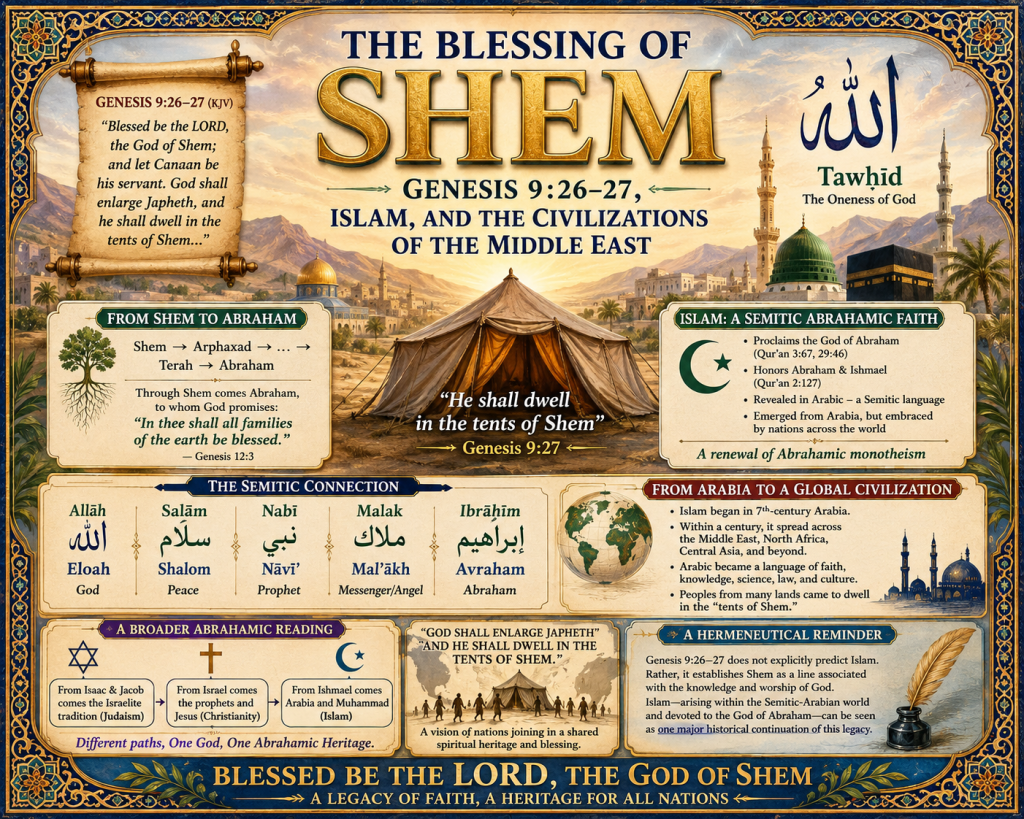
Genesis 9:26–27 contains one of the Bible’s earliest statements about the descendants of Noah after the Flood. Although the passage is brief, it later became important in Jewish and Christian reflections on the nations descended from Noah.
Read through a comparative Abrahamic lens, the passage also raises an intriguing hermeneutical question: could the blessing associated with Shem be understood as having a wider historical fulfillment in the religious civilizations that later arose among the Semitic peoples of the Middle East—including Islam?
Such an interpretation is not the standard Jewish or Christian reading of Genesis 9, nor does the Qur’an explicitly connect Islam with Genesis 9:26–27. Nevertheless, it offers an interesting framework for comparative Abrahamic theology.
📖 Noah’s Blessing of Shem
After the episode involving Noah and his sons, Genesis records Noah saying:
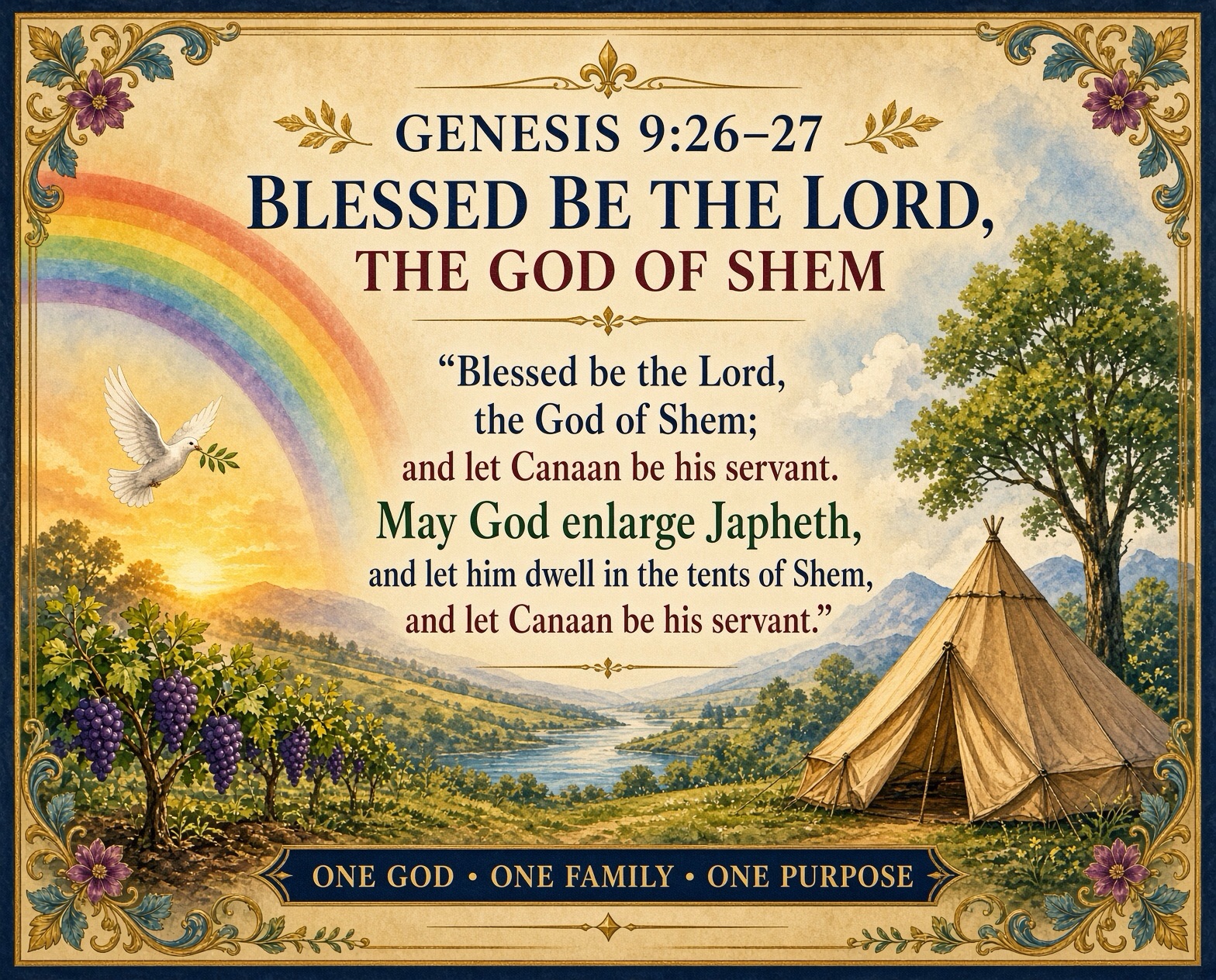
“Blessed be the LORD, the God of Shem; and let Canaan be his servant. God shall enlarge Japheth, and he shall dwell in the tents of Shem…”
— Genesis 9:26–27, KJV
What is striking is the wording of Noah’s blessing. Noah does not simply say, “Blessed be Shem.” Instead, he declares:
“Blessed be the LORD, the God of Shem.”
The blessing therefore possesses an explicitly theological character. Shem is distinguished through his relationship with God.
This becomes particularly significant when Genesis is read as a continuous narrative.
🌳 From Shem to Abraham
Genesis 10 presents the descendants of Noah, while Genesis 11 develops the genealogy of Shem in greater detail.
The line proceeds eventually from:
Shem → Arphaxad → … → Terah → Abraham
Abraham therefore emerges within Genesis itself as a descendant of Shem.
This literary sequence is important. Genesis 9 introduces the special association between God and Shem; Genesis 10–11 traces Shem’s descendants; and Genesis 12 suddenly introduces Abraham, to whom God gives a universal mission:
“In thee shall all families of the earth be blessed.”
— Genesis 12:3
From a canonical perspective, one can therefore see a theological progression:
Noah → Shem → Abraham → blessing for the nations.
The blessing of Shem becomes part of the narrative background against which the Abrahamic story unfolds.
🏜️ Shem and the Semitic World
The traditional expression “Semitic” itself ultimately derives from the name Shem, although modern linguistics uses Semitic primarily as a linguistic category rather than as proof that every Semitic-speaking population descends genealogically from the biblical Shem.
The Semitic language family includes Hebrew, Aramaic, Arabic, Akkadian, Syriac, and several other ancient and modern languages.
Geographically, these languages developed principally across the Middle East—the very region that became the heartland of the Abrahamic religious traditions.
This creates an interesting historical pattern. Judaism emerged among Hebrew-speaking Israelites. Christianity began among Jews in the Semitic environment of Roman Palestine, with Aramaic playing an important role in the world of Jesus. Centuries later, Islam arose among Arabic-speaking peoples of Arabia.
Thus, three religious traditions that came to dominate Abrahamic religious history all emerged from the broader Semitic cultural world.
🕋 Islam as a Semitic Abrahamic Religion
Islam presents itself not as an entirely new religion disconnected from biblical history, but as the restoration and continuation of the monotheistic religion of Abraham.
The Qur’an declares:
“Abraham was neither a Jew nor a Christian, but he was one inclining toward truth, a Muslim [one submitting to God].”
— Qur’an 3:67
Within Islamic theology, islām fundamentally means submission to the one God. Abraham (Ibrāhīm) therefore occupies a central position as the model of pure monotheism.
Islam also places itself within the Abrahamic family through Ishmael (Ismāʿīl), whom Islamic tradition associates particularly with Arabia and with Abraham’s sanctuary at Mecca.
The Qur’an portrays Abraham and Ishmael raising the foundations of the Kaʿbah together:
“And when Abraham and Ishmael raised the foundations of the House…”
— Qur’an 2:127
Consequently, from an Islamic theological perspective, the emergence of Islam in Arabia represents the renewal of Abrahamic monotheism within another major branch of the Semitic world.
🗣️ Arabic and the Semitic Continuity
There is also a striking linguistic dimension.
The Qur’an appeared in Arabic, one of the major Semitic languages. Its theological vocabulary consequently shares numerous cognates with biblical Hebrew and Aramaic.
Examples include:
Arabic Allāh / Hebrew Eloah — God
Arabic salām / Hebrew shalom — peace
Arabic nabī / Hebrew nāvīʾ — prophet
Arabic malak / Hebrew malʾākh — messenger/angel
Arabic Ibrāhīm / Hebrew Avraham — Abraham
These similarities do not demonstrate a supernatural fulfillment of Genesis 9 by themselves. They arise because Arabic and Hebrew belong to related branches of the Semitic language family.
Hermeneutically, however, they emphasize something significant: Islam emerged from essentially the same broad linguistic-cultural world in which much of biblical revelation had previously appeared.
🌍 From Arabia to a Semitic-Led Civilization
The historical development becomes even more interesting when Genesis 9:26 is considered alongside the rise of Islamic civilization.
Islam began in seventh-century Arabia through the preaching of Prophet Muhammad. Within little more than a century, the civilization established by his followers stretched far beyond Arabia.
Damascus became the capital of the Umayyad Caliphate. Baghdad became the intellectual center of the Abbasid world. Jerusalem became one of Islam’s sacred cities. Cairo later developed into another major center of Islamic scholarship.
Arabic consequently expanded from Arabia into an international language of religion, administration, philosophy, science, law, literature, and theology.
Muslim civilization was certainly not ethnically Semitic in its entirety. Persians, Berbers, Turks, Kurds, Africans, Central Asians, Indians, Southeast Asians, Europeans, and many others became essential contributors to Islamic civilization.
Nevertheless, its religious nucleus remained profoundly connected to the Semitic Middle East: an Arabic Qur’an, an Arabian prophet, an Abrahamic sacred history, and sacred centers at Mecca, Medina, and Jerusalem.
Islam therefore represents one of history’s most consequential civilizations to emerge initially from the Semitic cultural sphere.
🕌 “The God of Shem” and Islamic Tawḥīd
This provides the most interesting theological connection with Genesis 9:26:
“Blessed be the LORD, the God of Shem.”
From an Islamic interpretive perspective, the defining doctrine of Islam is tawḥīd—the absolute oneness of God.
The Qur’an repeatedly identifies the God worshipped by Muhammad with the God of Abraham and the biblical prophets:
“We believe in that which has been revealed to us and revealed to you; our God and your God is One.”
— Qur’an 29:46
Islamic theology therefore understands Muhammad’s proclamation not as introducing another deity, but as calling humanity back to the God worshipped by Abraham, Ishmael, Isaac, Jacob, Moses, David, and Jesus.
Within this comparative reading, Noah’s expression “the God of Shem” acquires particular resonance. From the descendants and cultural world traditionally associated with Shem arose religious movements that carried Abrahamic monotheism far beyond the Middle East.
Islam became one of the largest manifestations of that historical development.
⛺ What Does “Japheth Shall Dwell in the Tents of Shem” Mean?
Genesis 9:27 adds another enigmatic statement:
“God shall enlarge Japheth, and he shall dwell in the tents of Shem.”
Its precise meaning has long been debated. Some interpretations understand it as describing peaceful coexistence, territorial expansion, cultural participation, or Japheth sharing in Shem’s blessing.
Christian interpreters have sometimes given the passage a theological interpretation in which Gentile peoples symbolically enter the spiritual heritage associated with Shem.
A comparative Islamic interpretation could extend the imagery differently.
Islam originated among Semitic-speaking Arabs but rapidly became a universal civilization incorporating peoples far beyond Arabia. Persians, Turks, Africans, Europeans, Central Asians, South Asians, and eventually Southeast Asians entered an originally Arabic-speaking religious tradition.
In that metaphorical sense, enormous non-Semitic populations came to “dwell in the tents of Shem”—not necessarily through ancestry, but by participating in a religious civilization whose scripture, prophetic origins, sacred geography, and foundational vocabulary emerged from the Semitic Middle East.
This should be understood as a hermeneutical analogy, rather than a claim that Genesis explicitly predicts the Islamic conquests or identifies particular modern ethnic groups with Japheth.
✡️✝️☪️ A Broader Abrahamic Reading
Genesis 9:26–27 can therefore be viewed as the opening of a much larger biblical trajectory.
From Shem comes Abraham. From Abraham emerge the Israelite tradition through Isaac and Jacob and the Ishmaelite tradition associated in Islam with Arabia. From the Israelite world emerge Moses, David, the Hebrew prophets, and Jesus. From the Arabian Abrahamic tradition eventually emerges Muhammad and the Qur’anic proclamation of tawḥīd.
The historical picture is therefore larger than any single civilization.
Judaism, Christianity, and Islam each developed differently and make competing theological claims. Yet all three are historically connected with the Semitic Middle East and all three place Abraham near the center of sacred history.
The “tents of Shem,” read symbolically, could therefore represent an extraordinarily influential religious inheritance extending far beyond Shem’s geographical homeland.
⚖️ An Important Hermeneutical Qualification
Care is necessary here.
Genesis 9:26–27 does not explicitly predict Islam or Prophet Muhammad, and mainstream Jewish and Christian exegesis does not normally interpret the passage that way. Nor can modern peoples be mapped neatly onto Noah’s three sons using contemporary genetics or linguistics.
Therefore, it would be too strong to claim:
“Genesis 9 directly prophesied Islam.”
A more defensible comparative formulation would be:
Genesis 9:26–27 establishes Shem as a line particularly associated with the knowledge and worship of God. Because the biblical narrative subsequently traces Abraham through Shem, and because Islam later arose within the Semitic-Arabian world claiming to restore the monotheism of Abraham, Islamic civilization can be interpreted—within a comparative Abrahamic hermeneutic—as one major historical continuation of the religious legacy symbolically associated with the “tents of Shem.”
That distinction allows the theological parallel to be explored without presenting a later interpretation as the explicit original meaning of Genesis.
🌅 Conclusion: The Expanding Tents of Shem
Genesis begins its post-Flood history with humanity divided into the families of Noah, but its narrative soon narrows toward Shem, then Abraham, before expanding once again toward “all families of the earth.”
Seen through this broader Abrahamic lens, the history is remarkable.
A religious heritage originating in the ancient Semitic Middle East eventually crossed ethnic, linguistic, and geographical boundaries. Judaism preserved the ancient Israelite covenantal tradition. Christianity carried belief in the God of Israel throughout much of the Gentile world. Islam arose in Arabia proclaiming the restoration of Abrahamic monotheism and subsequently created a civilization encompassing peoples from the Atlantic to Southeast Asia.
Thus Genesis 9:26—“Blessed be the LORD, the God of Shem”—can acquire a wider significance in comparative theology.
Rather than treating Shem merely as the ancestor of one isolated people, the passage can be read as the beginning of a theological trajectory whose influence would eventually reach far beyond the Middle East.
And within an Islamic hermeneutical reading, the rise of Islam among an Arabic-speaking people, its devotion to the God of Abraham, and its transformation into a multiethnic global civilization can be viewed as one remarkable chapter in the continuing historical legacy of the tents of Shem.
The God of Shem: Why “Allah” Remains the Semitic Name for God
🌍 The God of Shem: Why “Allah” Remains the Semitic Name for God
👤 Who Was Shem?
Shem was one of Noah’s three sons and, according to Genesis 10–11, an ancestor of several ancient Near Eastern peoples. Most importantly, Abraham is traced through the lineage of Shem (Genesis 11:10–26).
When English Bibles say “God,” they are using a word with no Semitic history at all. The word God is Germanic in origin, from Old English god, related to German Gott. It entered the biblical text only through translation. Among the Semitic peoples themselves – the descendants of Shem – a very different name has endured for millennia.
That name is Allah.
🔤 The Linguistic Continuity
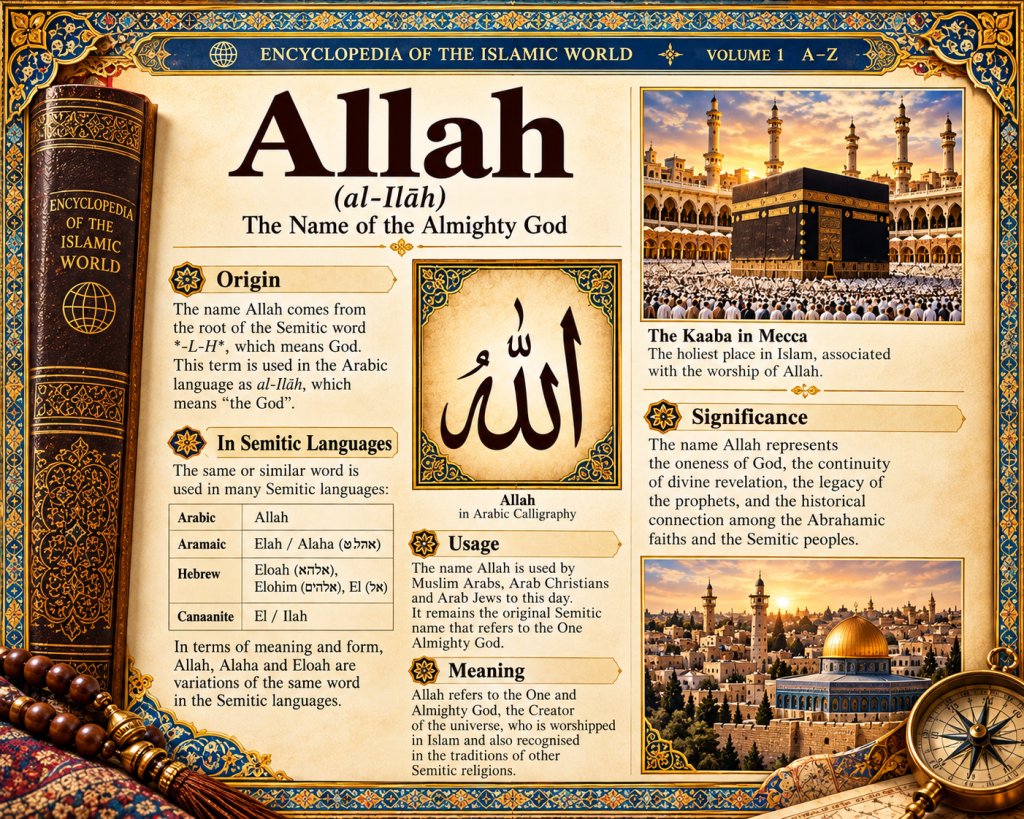
All Semitic languages share a common root for the Deity: ʔ-L-H.
* In Arabic: Allah (الله) – from al-Ilah, literally “The God” – is the standard name. It is used by Arab Muslims, Arab Christians, and Arab Jews alike to this day.
* In Aramaic, the language Jesus spoke: Elah or Alaha (ܐܠܗܐ). This is the word found in the Peshitta and in Daniel and Ezra.
* In Biblical Hebrew: Eloah (אלוה) in singular, Elohim (אלוהים) in plural of majesty, and El (אל).
* In Canaanite and ancient Semitic inscriptions: El and Ilah.
Phonetically and morphologically, Allah, Alaha, and Eloah are the same word pronounced through the dialects of sister languages. They are cognates, not different names.
God, by contrast, has no cognate in any Semitic language. It cannot be found in Hebrew, Aramaic, or Arabic scripture in the original. It is a Northern European replacement word that translators adopted for an English audience.
This is why today, from Morocco to Iraq, from Syria to Yemen, whether in a mosque or an Arab Christian church in Nazareth or Beirut, you will hear Allah. It is the living, indigenous Semitic name. “God” is only heard when those same peoples speak English.
📖 The Theological Anchor: Genesis 9:26
This linguistic fact was given a theological framework at the very beginning of the Bible:
“And he said, Blessed be the LORD, the God of Shem…” – Genesis 9:26 (KJV)
This verse is foundational. After the Flood, Noah blesses two figures specifically: YHWH and Shem.
The text does not say YHWH is the God of Japheth (the Indo-European peoples, from whom English speakers descend) or the God of Ham. It explicitly identifies Him as the God of Shem – Elohei Shem.
Shem is the father of the Semites: Elamites, Assyrians, Chaldeans, Hebrews, Arameans, and Arabs. Genesis 10’s Table of Nations traces all these peoples back to him.
Theologically, the verse establishes three principles:
1️⃣ 1. Divine Self-Identification: The covenant Name YHWH (rendered LORD) chooses to associate Himself permanently with the lineage of Shem. He is not a generic Indo-European deity; He is the tribal and covenantal God of the Semitic family.
2️⃣ 2. Preservation of the Name: If He is the God of Shem, we should expect His true name to be preserved among Shem’s descendants. And it has been. The Semitic root ʔ-L-H has survived intact in Hebrew scripture, in Aramaic as spoken by Jesus, and most widely today in Arabic as Allah. The preservation is not in the Germanic world, but in the Semitic world.
3️⃣ 3. The Blessing of Shem is the Preservation of Pure Monotheism: Noah’s blessing was that the knowledge of the One True God would remain with Shem. The fact that 2,000 years after Jesus, over 400 million Arabs – including 15+ million Arab Christians – still pray to Allah and not to a word derived from Norse or Germanic paganism, is the fulfillment of that blessing. The name did not need to be translated because it was never lost.
In short, Genesis 9:26 explains why the linguistic continuity exists. God promised to be the God of Shem, and so the name for God that belongs to Shem’s children – El / Eloah / Alaha / Allah – is the name that has endured.
When an Arab Christian says Allah, and a Hebrew prophet said Eloah, they are invoking the God of Shem by the name Shem’s children have always used. The English word “God” is a later translation for the children of Japheth, so that they too could understand who the God of Shem is.
From Ezekiel’s “Desire” to Muhammad’s Night Journey: An Islamic Typological Reading of Jerusalem’s Sacred Site
🕌 From Ezekiel’s “Desire” to Muhammad’s Night Journey: An Islamic Typological Reading of Jerusalem’s Sacred Site
One of the more intriguing passages in the Book of Ezekiel appears in Ezekiel 24:15–27, where the prophet experiences a devastating personal loss that becomes a symbol of the coming destruction of Jerusalem.
God tells Ezekiel:
“Son of man, behold, I am about to take the desire of your eyes away from you at a stroke; yet you shall not mourn or weep…”
That evening, Ezekiel’s wife dies.
Yet the expression used for her—“the desire of your eyes”—soon appears again in the same chapter. This time it describes not a person, but the sanctuary in Jerusalem.
When this biblical language is placed alongside the later Islamic history of Jerusalem, an intriguing theological pattern emerges—one involving the Hebrew word maḥmad, the Temple sanctuary, the Prophet Muhammad ﷺ, and the sacred precinct where the Dome of the Rock now stands.
This connection should not be presented as a straightforward linguistic prophecy of Muhammad. Rather, it can be explored as an Islamic typological reading of sacred history.
⸻
❤️ Ezekiel’s Wife: “The Desire of Your Eyes”
In Ezekiel 24:16, the prophet’s wife is described by the Hebrew expression:
מַחְמַד עֵינֶיךָ
maḥmad ʿeineikha
meaning approximately:
“the desire of your eyes,” “the delight of your eyes,” or “that which is precious to your eyes.”
The Hebrew noun מַחְמַד (maḥmad) denotes something desirable, precious, cherished, or delightful.
Ezekiel’s wife is never named in the biblical account. Nevertheless, this brief description tells us something profound about their relationship.
She was precious to him.
Her death therefore becomes more than an abstract prophetic symbol. Ezekiel loses someone whom he deeply loves.
But the story does not end there.
⸻
🏛️ The Temple Was Also Called Maḥmad
Only a few verses later, God explains the meaning of Ezekiel’s personal tragedy.
In Ezekiel 24:21, God declares that the sanctuary itself will be profaned—the sanctuary described as:
מַחְמַד עֵינֵיכֶם
maḥmad ʿeineikhem
“the desire/delight of your eyes.”
The parallel is unmistakable.
For Ezekiel:
his wife = maḥmad, the delight of his eyes.
For Israel:
the sanctuary = maḥmad, the delight of their eyes.
Ezekiel’s private tragedy therefore anticipates Jerusalem’s national tragedy.
Just as Ezekiel suddenly loses what is most precious to him, the inhabitants of Jerusalem will lose what is precious to them—the sanctuary, their city, and even their sons and daughters.
⸻
🔥 The Destruction of Jerusalem
Ezekiel 24 is situated against the Babylonian siege of Jerusalem.
The Temple that represented Israel’s religious life would eventually be destroyed by the Babylonians in the sixth century BCE.
A Second Temple would later arise in Jerusalem, only to be destroyed by the Romans in 70 CE.
The sacred location, however, did not disappear from religious history.
Jerusalem remained sacred to Jews and Christians, and centuries later it acquired extraordinary significance within Islam.
This is where the story takes an unexpected historical turn.
⸻
🌙 Muhammad ﷺ and Jerusalem
According to the Qur’an, God took His servant on an extraordinary nocturnal journey:
“Glory be to Him who took His servant by night from the Sacred Mosque to the Farthest Mosque, whose surroundings We have blessed…”
— Qur’an 17:1
Islamic tradition identifies the journey as al-Isrāʾ, the miraculous Night Journey of the Prophet Muhammad ﷺ from Mecca to Jerusalem.
This was followed, according to Islamic tradition, by al-Miʿrāj, Muhammad’s heavenly ascent.
Jerusalem consequently became intimately connected with Muhammad’s prophetic mission.
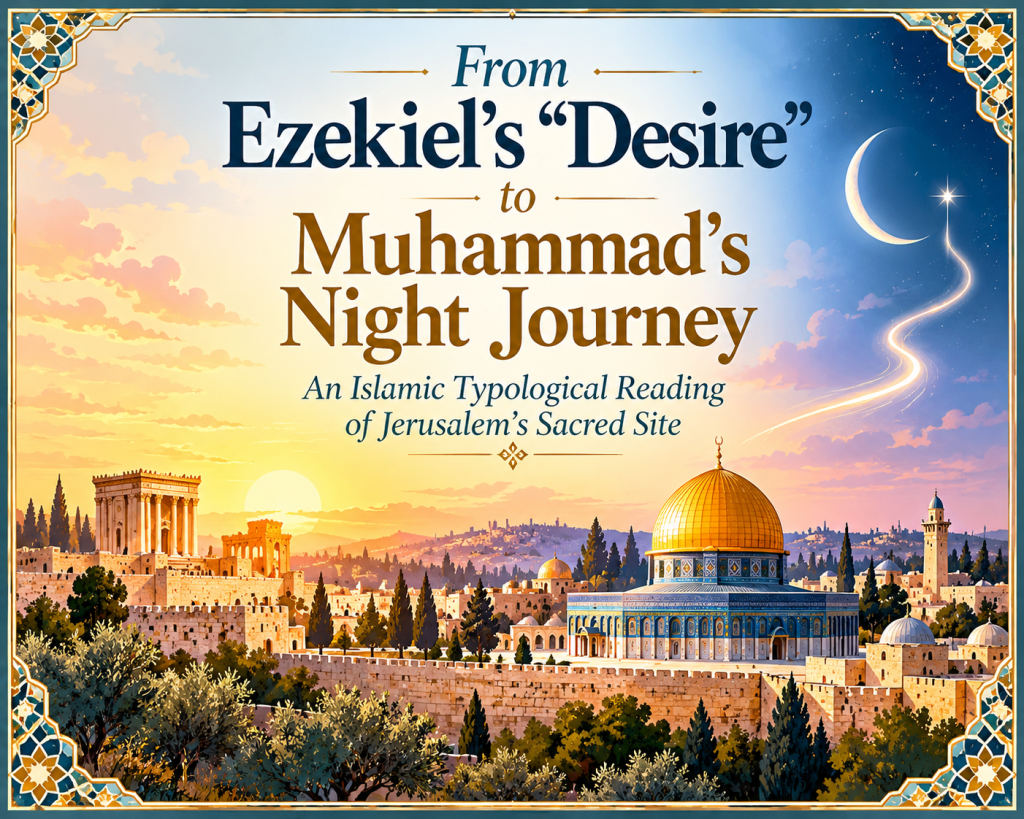
The sacred precinct known to Muslims as al-Ḥaram al-Sharīf and associated with al-Masjid al-Aqṣā occupies the same broader elevated sacred precinct traditionally identified with the location of the ancient Jewish Temples.
Centuries after Ezekiel spoke about the sanctuary as the maḥmad—the “delight of your eyes”—Jerusalem’s sacred precinct became associated with the Prophet Muhammad ﷺ.
⸻
🔤 Maḥmad and Muhammad: A Fascinating Resemblance
Here an interesting linguistic observation arises.
The Hebrew word appearing in Ezekiel is:
מַחְמַד — maḥmad
The Arabic name of the Islamic prophet is:
مُحَمَّد — Muḥammad
At first sight, the resemblance is striking.
However, linguistic precision is essential.
The Hebrew maḥmad derives from the Hebrew root ח־מ־ד (Ḥ-M-D), associated with desire, delight, preciousness, or something desirable.
The Arabic Muḥammad derives from Arabic root ح־م־د (Ḥ-M-D), associated with praise. The name Muḥammad means approximately “the much-praised” or “the repeatedly praised one.”
Therefore, it would be linguistically misleading to argue that Ezekiel simply wrote the personal name “Muhammad.”
He did not.
The words have different meanings and are derived from distinct Semitic roots despite their phonetic resemblance.
Yet from an Islamic theological perspective, their resemblance becomes interesting because of what subsequently happened at the Jerusalem sanctuary itself.
⸻
🕌 The Dome of the Rock
Today one of the most recognizable monuments occupying Jerusalem’s sacred precinct is the magnificent Dome of the Rock.
The present structure was constructed under the Umayyad caliph ʿAbd al-Malik, conventionally dated to 691–692 CE.
At its center lies the famous Rock.
In later and well-established Islamic tradition, this Rock became strongly associated with Muhammad’s Miʿrāj, his ascent toward heaven following the Night Journey.
Historical caution is again important. It would be too simplistic to claim that historians universally regard the Dome of the Rock as having been constructed solely to commemorate Muhammad’s ascension. The monument’s original political, theological, architectural, and religious meanings are complex.
Nevertheless, within Islamic sacred tradition, the association between the Rock, Jerusalem, and Muhammad’s Night Journey and Ascension became extremely important.
This produces a remarkable juxtaposition across sacred history.
⸻
🔗 From Maḥmad to Muhammad?
Consider the sequence from an Islamic typological perspective:
Ezekiel’s wife
↓
called maḥmad — “the delight of your eyes”
The Jerusalem sanctuary
↓
also called maḥmad — “the delight of your eyes”
The sanctuary is destroyed
↓
Jerusalem passes through centuries of religious and political transformation
Muhammad ﷺ undertakes the Night Journey
↓
Jerusalem becomes connected with his prophetic mission
The Dome of the Rock arises
↓
the sacred Rock becomes associated in Islamic tradition with Muhammad’s Miʿrāj.
This does not prove linguistically that Ezekiel predicted Muhammad through the word maḥmad.
But as a retrospective Islamic theological reading, the convergence is striking.
A place described through the Hebrew word maḥmad eventually becomes intimately associated with the man named Muḥammad.
⸻
🕊️ Jerusalem as a Meeting Place of Abrahamic Revelation
There is an even deeper Islamic interpretation available.
The Night Journey does not detach Muhammad ﷺ from the biblical prophetic tradition. Islamic tradition does precisely the opposite.
At Jerusalem, Muhammad is traditionally understood to have encountered and led earlier prophets in prayer.
Abraham, Moses, Jesus, and the other prophets are therefore not portrayed as belonging to competing religions in the Qur’anic worldview. They belong to a single history of revelation culminating, from the Islamic perspective, in Muhammad ﷺ.
Jerusalem becomes a geographical symbol of this continuity.
The ancient Israelites worshipped God there.
Solomon’s Temple stood there according to biblical tradition.
Jesus was connected with the Temple and Jerusalem.
And Muhammad’s Night Journey brought the Islamic prophetic tradition into direct relationship with the same sacred landscape.
The location therefore becomes a remarkable geographical intersection of Judaism, Christianity, and Islam.
⸻
📖 Ezekiel’s Maḥmad and Haggai’s “Desire”
The comparison becomes even more interesting because Ezekiel is not the only biblical book containing Hebrew vocabulary derived from ḥ-m-d.
Haggai 2:7 famously declares:
“And I will shake all nations, and the desire of all nations shall come…”
The Hebrew expression traditionally rendered “the desire of all nations” contains the related noun חֶמְדַּת (ḥemdat).
Historically, Christian interpreters have sometimes read this passage messianically and connected it with Jesus Christ.
Some Muslim apologists, however, have noticed the resemblance between Hebrew ḥ-m-d vocabulary and the name Muhammad and proposed an Islamic reading.
Again, linguistic resemblance by itself cannot establish that the Hebrew text contains Muhammad’s personal name.
But within comparative Abrahamic theology, Ezekiel 24 and Haggai 2 create an interesting field of investigation concerning desire, sacred space, prophetic expectation, and the later Islamic role of Jerusalem.
⸻
⚖️ Prophecy or Typology?
The distinction is crucial.
A strong historical interpretation should not claim:
“Ezekiel 24 explicitly predicts Muhammad.”
The immediate biblical context does not support that conclusion.
Ezekiel explicitly explains what maḥmad represents: first his beloved wife and then Israel’s beloved sanctuary.
A more defensible Islamic interpretation would say:
Ezekiel’s language acquires an intriguing retrospective resonance when read in light of Jerusalem’s later Islamic history.
This is typology rather than direct lexical prophecy.
Typological interpretation looks for meaningful correspondences across sacred history without claiming that every correspondence represents the original grammatical meaning of the earlier text.
This allows the linguistic evidence and the theological interpretation to remain distinct.
⸻
🌍 A Remarkable Transformation of Sacred Space
Seen across nearly two millennia, Jerusalem presents an extraordinary religious history.
Ezekiel mourned the coming destruction of the sanctuary called the “delight of your eyes.”
The First Temple disappeared.
The Second Temple eventually disappeared.
Yet the sacred precinct remained.
Centuries later, Islam entered Jerusalem.
Muhammad ﷺ became associated with the city through the Night Journey.
The Dome of the Rock eventually rose over its sacred landscape.
And the place once described in Ezekiel through the word maḥmad became one of the places most strongly associated in Islamic sacred memory with Muhammad ﷺ.
For Muslim readers interested in biblical interpretation, this does not need to become an argument that Hebrew secretly contains Muhammad’s name.
The historical and theological juxtaposition is interesting enough on its own.
⸻
✨ Conclusion: From the “Delight of the Eyes” to the Night Journey
Ezekiel 24 begins with something profoundly human: a husband losing the woman who was the “delight of his eyes.”
That tragedy becomes a symbol.
Ezekiel’s wife was his maḥmad.
The sanctuary was Israel’s maḥmad.
The sanctuary was destroyed.
Yet the sacred location continued to occupy a central position in Abrahamic history.
Centuries later, according to Islamic tradition, Muhammad ﷺ was brought to Jerusalem during al-Isrāʾ and ascended through the heavens in al-Miʿrāj. The sacred precinct subsequently became monumentalized by Islamic civilization, most spectacularly through the Dome of the Rock.
The phonetic similarity between Hebrew maḥmad and Arabic Muḥammad should therefore not be confused with linguistic identity. Nevertheless, within an Islamic typological interpretation, it creates a thought-provoking historical correspondence:
the sanctuary described as maḥmad eventually became a sacred landscape associated with Muhammad ﷺ.
Whether one understands this simply as a remarkable coincidence of language and history or sees within it a deeper providential pattern depends ultimately upon one’s theological perspective.
But as an exercise in Abrahamic interpretation, it illustrates something larger:
Jerusalem has repeatedly served as a meeting point between sacred place, prophetic history, destruction, renewal, and the continuing claims of the Abrahamic traditions.
Maḥmad and Ḥemdat/Hemed: Desire, Sacred Space, and Prophetic Expectation in Ezekiel 24, Haggai 2:7, and Comparative Abrahamic Readings
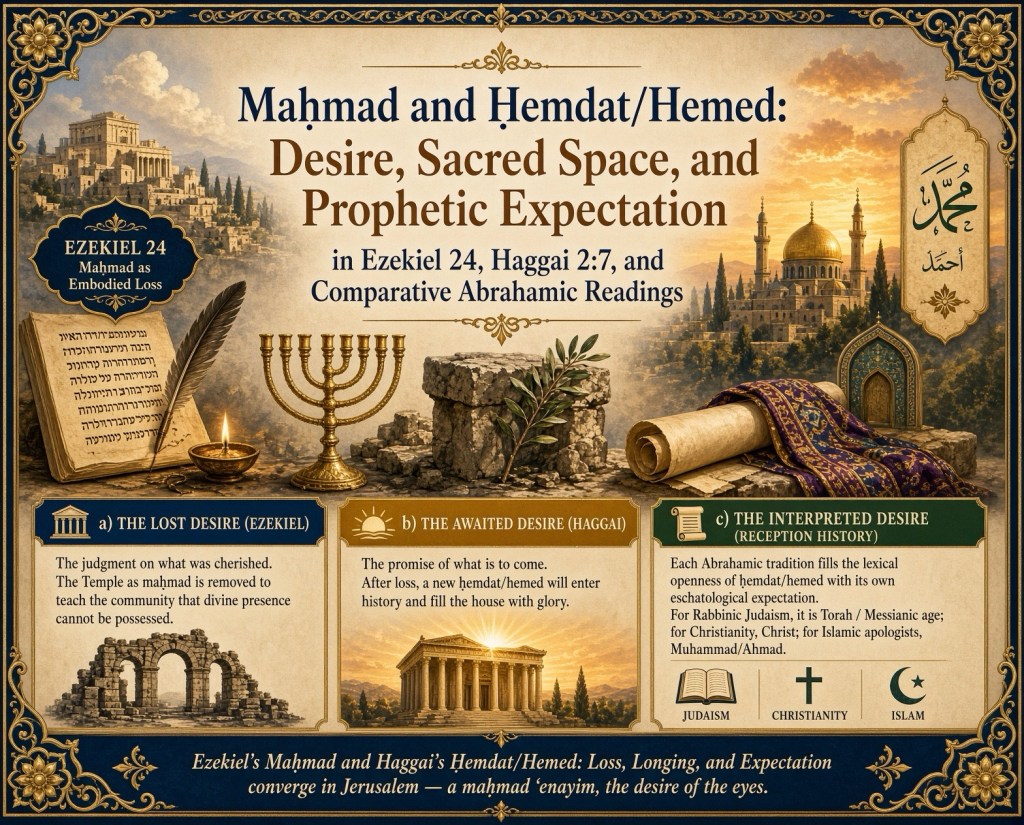
📖 Maḥmad and Ḥemdat/Hemed: Desire, Sacred Space, and Prophetic Expectation in Ezekiel 24, Haggai 2:7, and Comparative Abrahamic Readings
🌿 1. Introduction: The Root Ḥ-M-D
The Hebrew root ḥ-m-d (ח-מ-ד) carries the semantic field of desire, delight, preciousness, and that which is coveted or cherished. Its nominal forms appear throughout the Hebrew Bible in diverse contexts, from the prohibited coveting of Exodus 20:17 lo taḥmod, to the desirable trees of Genesis, to prophetic oracles of loss and restoration.
Two prophetic texts have become a focal point for comparative hermeneutics because of this root: Ezekiel 24 and Haggai 2:7. Both use ḥ-m-d vocabulary in relation to sacred space and eschatological expectation, and both have been read in Jewish, Christian, and later Islamic interpretive traditions.
🏛️ 2. Ezekiel 24: Maḥmad as Embodied Loss
Ezekiel 24:16 and 24:21 contain the phrase:
hinneni loqeah mimmeḵa et-maḥmad ‘enekha
“Behold, I am taking from you the desire of your eyes” (Ezek 24:16)hinneni meḥallel et-miqdashi… maḥmad ‘enekhem
“Behold, I am profaning my sanctuary… the desire of your eyes” (Ezek 24:21)
The prophet’s own wife and the Jerusalem Temple are placed in parallel. Both are maḥmad, the beloved, delightful object. The hermeneutic function here is not predictive but parabolic. The sudden, divinely announced death of Ezekiel’s wife becomes a living sign (mofet) for the coming destruction of the Temple, which the exilic community still cherished as the desire of their eyes.
In Ezekiel’s theology, maḥmad denotes:
- Affective attachment: What the heart values most.
- Sacred vulnerability: Even the most cherished sacred space can be removed as an act of divine judgment.
- Prophetic embodiment: The prophet’s body becomes the text.
There is no messianic figure named in this maḥmad. The term is an epithet for a person and a place already present.
🌍 3. Haggai 2:7: Ḥemdat/Hemed and Eschatological Shaking
Haggai, writing to the post-exilic community rebuilding the Second Temple, proclaims:
vehir‘ashti et-kol-hagoyim uva’u ḥemdat kol-hagoyim
“And I will shake all nations, and the desire / desirable things / precious things of all nations shall come” (Hag 2:7)
The noun ḥemdat (חֶמְדַּת) is the feminine construct of ḥemed, from the same root. The syntactic ambiguity of this verse is central to its reception history.
Two major interpretations of Haggai 2:7 have developed:
📚 A) Abstract / Collective Reading
The Hebrew ḥemdat (חֶמְדַּת), the construct form of ḥemdāh (חֶמְדָּה), is lexically an abstract noun derived from the Hebrew root ḥ-m-d (ח־מ־ד), associated with desire, delight, preciousness, and desirability.
In context, however, an abstract noun can be used concretely or collectively for “desirable things,” “precious things,” or “treasures.” Accordingly, many modern translations understand ḥemdat kol-haggoyim as referring to the valuable possessions or wealth of the nations that will be brought to the restored Temple.
This interpretation receives grammatical support from the plural verb ūḇāʾū (וּבָאוּ), “and they shall come,” and contextual support from the following verse:
“The silver is mine, and the gold is mine, saith the LORD of hosts.”
— Haggai 2:8, KJV
Thus, the expression may be understood collectively: “the precious things of all the nations shall come.”
✝️ 😎 Traditional Personal / Messianic Reading
A second, historically influential interpretation takes ḥemdat kol-haggoyim in a personalized sense: “the Desire of all nations.” The King James Version famously renders Haggai 2:7:
“And I will shake all nations, and the desire of all nations shall come.”
Within traditional Christian exegesis, this “Desire” was often interpreted messianically as referring to Jesus Christ. On this reading, the shaking of the nations anticipates the coming of the Messiah, whose presence ultimately gives the Second Temple a greater glory. This interpretation was consequently associated with Haggai 2:9:
“The glory of this latter house shall be greater than of the former.”
Both readings have interpretive histories, but the collective reading—“the precious things of all nations”—is better supported by the plural verb ūḇāʾū (“they shall come”) and mentions of silver and gold in Haggai 2:8. The personal reading—“the Desire of all nations”—is mainly a traditional Christian messianic interpretation.
🕋 4. The Comparative Abrahamic Extension
The comparative interest arises because the Semitic root Ḥ-M-D is cognate across Hebrew and Arabic.
In Arabic: ḥ-m-d (ح-م-د) = to praise, commend. From it derive:
- Muhammad (مُحَمَّد) = “highly praised one”
- Ahmad (أَحْمَد) = “more praiseworthy”
Surah As-Saff 61:6 presents Jesus (’Isa) saying:
…mubashshiran birasulin ya’ti min ba’di ismuhu Ahmad…
“…bringing good tidings of a messenger to come after me, whose name shall be Ahmad.”
Some Muslim apologists have proposed a typological linkage:
- Haggai 2:7’s ḥemdat / ḥemed is lexically related to Ahmad/Muhammad.
- Therefore, within an Islamic typological reading, Haggai’s “desire of all nations” can be read as a cryptic prophecy of Muhammad, the Prophet of Islam, whose Night Journey (al-Isrāʾ) would bring him to the sacred sanctuary in Jerusalem, the very city at the center of Haggai’s Temple prophecy.
- This reading is then placed alongside Ezekiel 24’s theology of sacred space: just as Ezekiel’s maḥmad points to the loss and later re-consecration of Jerusalem’s sanctuary, Haggai’s ḥemdat points to a future figure who will have a central role concerning that sacred space, Jerusalem, which becomes Islam’s first qibla and site of al-Isra’.
From a critical linguistic perspective, the argument rests on root consonantal resemblance, not on direct lexical identity. Hebrew ḥ-m-d means “to desire, covet” while Arabic ḥ-m-d means “to praise”. They are distinct though historically related West Semitic roots, and the Hebrew ḥemdat/hemed is not a proper name in its context. Jewish and Christian critical scholarship generally treats the Islamic reading as a retrospective intertextual re-reading (midrashic / ta’wil) rather than a philological translation.
🔎 5. A Hermeneutic Synthesis: Three Levels of Desire
When Ezekiel 24 and Haggai 2 are read together, they create a three-fold hermeneutic of desire and sacred space:
🏚️ a) The Lost Desire (Ezekiel)
The judgment on what was cherished. The Temple as maḥmad is removed to teach the community that divine presence cannot be possessed.
🌅 b) The Awaited Desire (Haggai)
The promise of what is to come. After loss, a new ḥemdat/hemed will enter history and fill the house with glory.
📜 c) The Interpreted Desire (Reception History)
Each Abrahamic tradition fills the lexical openness of ḥemdat/hemed with its own eschatological expectation. For Rabbinic Judaism, it is Torah / Messianic age; for Christianity, Christ; for Islamic apologists, Muhammad/Ahmad.
This is not a question of one meaning replacing another, but of how a single, semantically rich root, desire, functions as a theological placeholder. The prophet creates a vacuum of desire (Ezekiel), then promises its fulfillment (Haggai), and later communities identify that fulfillment within their own sacred narrative.
In that sense, Ezekiel’s Maḥmad and Haggai’s Ḥemdat/Hemed together offer a productive field for comparative Abrahamic theology: they show how loss of sacred center, longing for restoration, and expectation of a praiseworthy / desirable figure all converge around Jerusalem, a city that remains itself a maḥmad ‘enayim, the desire of the eyes, for all three traditions.

