Azahari Hassim
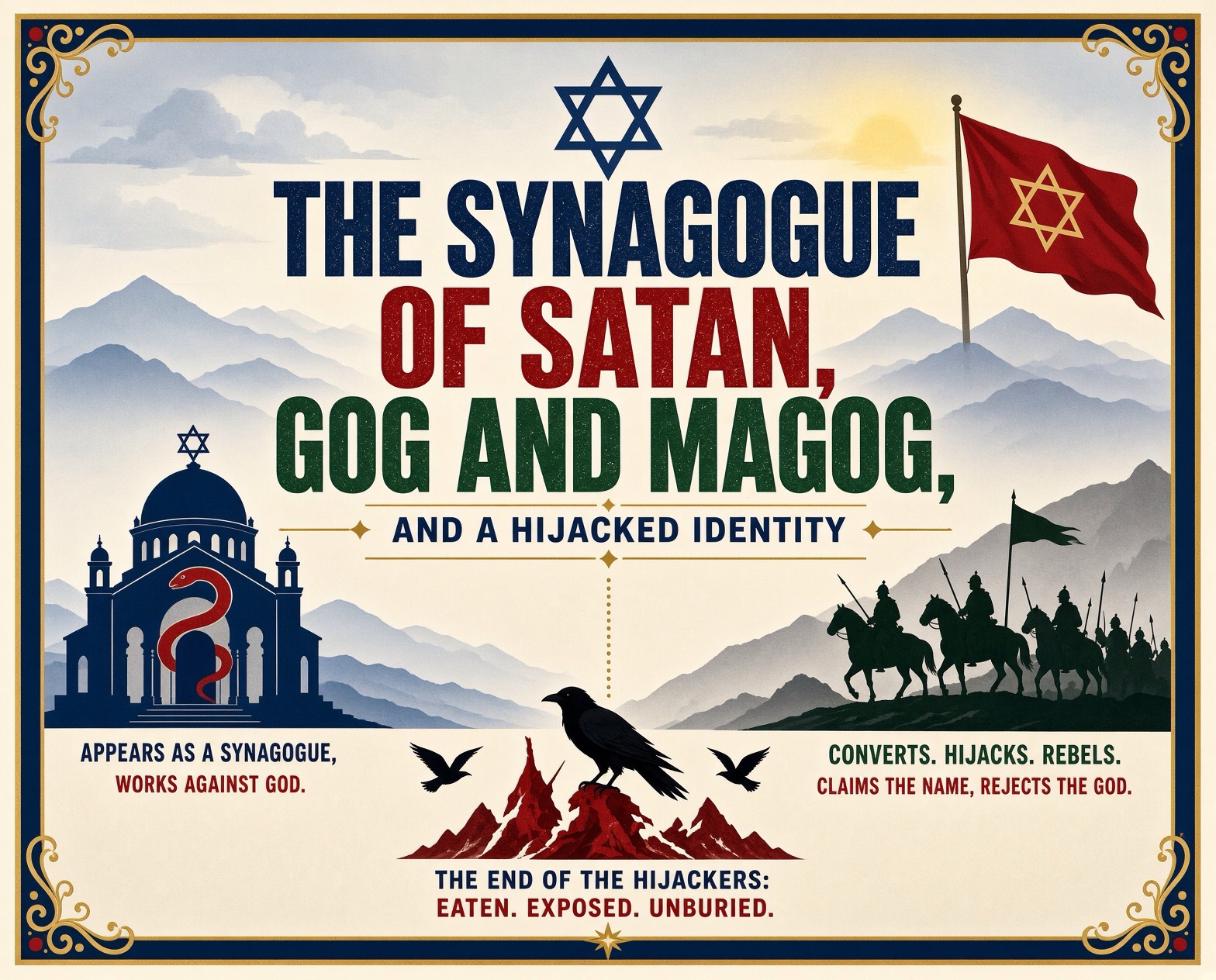
The Synagogue of Satan, Gog and Magog, and a Hijacked Identity
In plain terms, this is an argument that has been around for centuries, and it goes like this:
Not everyone who claims to be part of a faith is actually faithful to it.
The phrase “Synagogue of Satan” comes from the New Testament, Revelation 2:9 and 3:9. It says: “I know the blasphemy of them which say they are Jews, and are not, but are the synagogue of Satan.” In this reading, it does not describe all Jewish people. It describes a specific group who adopt the name and identity of Judaism, but use it for a different purpose.
That is where the Gog and Magog idea comes in.
In Ezekiel 38 and 39, Gog and Magog are not from Israel. They are outsiders from the north who come down against Israel in the last days. They form a coalition, they claim a right to the land, and they surround God’s people. According to this interpretation, Gog and Magog are not defined by blood, but by behavior – they are invaders who convert to the identity, hijack the covenant, and then rebel against the God of that covenant.
The argument is that this is a pattern: conversion without obedience. You take the label “Judaism,” you take the institutions, the land, the political power that comes with it, but you reject the core of the Torah – justice, mercy, humility before God. You keep the name but reverse the mission. That, in this view, is what makes it a Synagogue of Satan. It looks like a synagogue, but it works against God.
For argument’s sake, two prophecies are linked to make this point.
Ezekiel 39:17-20 describes what happens to Gog and his army after the invasion fails. God says to the birds and beasts:
“Assemble and come… gather from all sides to my sacrifice that I sacrifice for you, a great sacrifice upon the mountains of Israel; that ye may eat flesh and drink blood. Ye shall eat the flesh of the mighty, and drink the blood of the princes of the earth… And ye shall be filled at my table with horses and chariots, with mighty men, and with all men of war.”
It is a picture of total defeat. An invading army that came to take is itself taken. It becomes food.
Deuteronomy 28:26 is part of the curses for disobedience to the covenant. If Israel breaks faith with God, Moses warns:
“And thy carcase shall be meat unto all fowls of the air, and unto the beasts of the earth, and no man shall fray them away.”
The connection people draw is direct.
Deuteronomy says: if you claim the covenant and then rebel against God, your end will be exposed, unburied, eaten by birds.
Ezekiel says: when Gog and Magog, the outsiders who attach themselves to Israel and then rebel, are judged, their end is exactly the same – their bodies left on the mountains of Israel as meat for birds.
In this reading, Ezekiel 39 is the fulfillment of the curse in Deuteronomy 28. The same punishment falls. Why? Because it is the same crime. Claiming to be God’s people while living in rebellion to God.
So the final argument is this: Gog and Magog are not defeated because they are foreign. They are defeated because, having taken on the identity of Judaism, they use it to oppose God. They convert, they hijack the name and the institutions, and they turn it into a political project of power rather than obedience. And the prophetic warning is that God judges that hijacking the same way He warned He would from the beginning.
Is Modern Israel Really the Fulfillment of Biblical Prophecy?
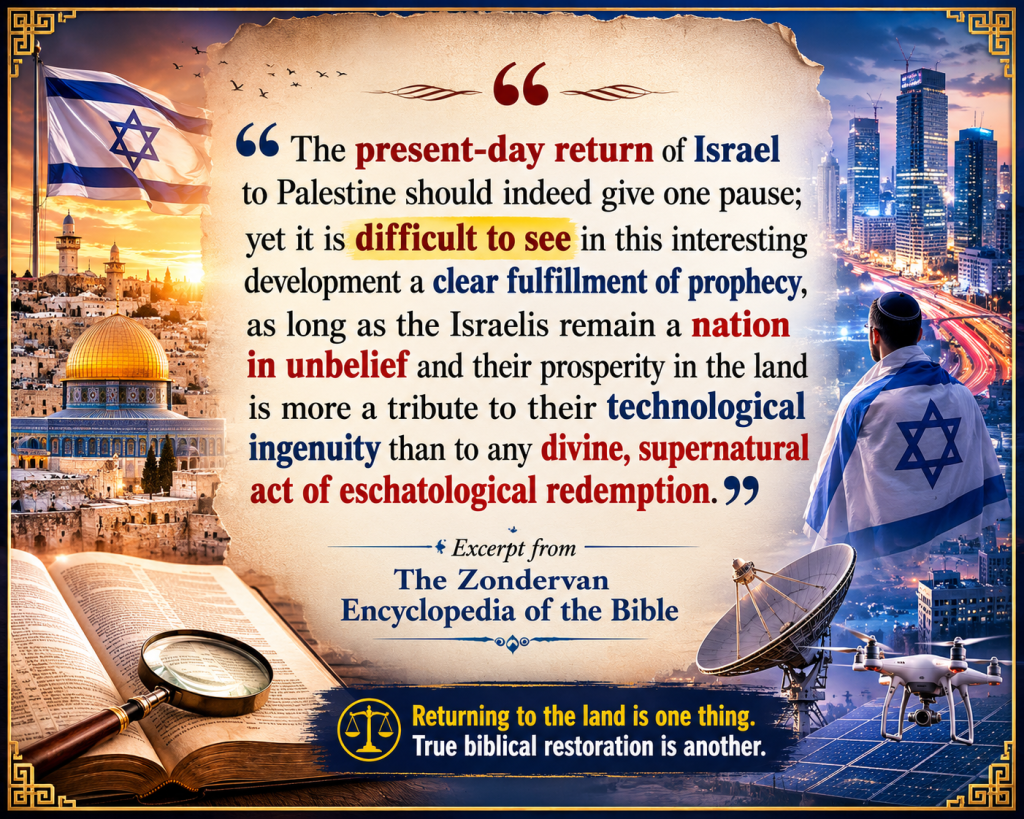
🇮🇱 Is Modern Israel Really the Fulfillment of Biblical Prophecy?
“The present-day return of Israel to Palestine should indeed give one pause; yet it is difficult to see in this interesting development a clear fulfillment of prophecy, as long as the Israelis remain a nation in unbelief and their prosperity in the land is more a tribute to their technological ingenuity than to any divine, supernatural act of eschatological redemption.”
— Quoted from The Zondervan Encyclopedia of the Bible
The modern Jewish return to Palestine is certainly remarkable—but remarkable history is not automatically fulfilled prophecy.
📖 The Zondervan Encyclopedia of the Bible raises an important problem: biblical restoration involves far more than simply returning to the land. In Ezekiel 36:24–28, Israel is gathered from the nations, but this is accompanied by cleansing, a new heart, a new spirit, and renewed obedience to God.
✡️ This is why the phrase “a nation in unbelief” is so important. From the Christian theological perspective reflected in the quotation, Israel’s physical return to the land has occurred without the corresponding national spiritual restoration anticipated in biblical prophecy. The modern State of Israel remains religiously diverse and substantially secular, while Judaism as a whole does not accept Jesus as the Messiah. Therefore, for Christians who understand Israel’s ultimate restoration as involving spiritual renewal and recognition of the Messiah, territorial return alone cannot constitute the complete fulfillment of those prophecies.
⚠️ This challenges the popular claim that the establishment of Israel in 1948 automatically fulfilled biblical prophecy.
Modern Israel’s military strength, technological advancement, agriculture, and economic success may be impressive—but human achievement is not the same thing as supernatural, eschatological redemption.
🔥 So the critical question remains:
If modern Israel is the restored Israel of biblical prophecy, where is the national spiritual restoration described by the prophets?
Where is the new heart?
Where is the covenantal renewal?
Where is the promised transformation?
Modern Israel may have prophetic significance. But simply pointing to Jewish immigration, political sovereignty, and national prosperity does not prove that biblical restoration has been fulfilled.
Returning to the land is one thing. Becoming the restored Israel described by the prophets is another.
Pastors Question Jewish Ancestry and Claim Palestinians Have Ancient Ties to Israel
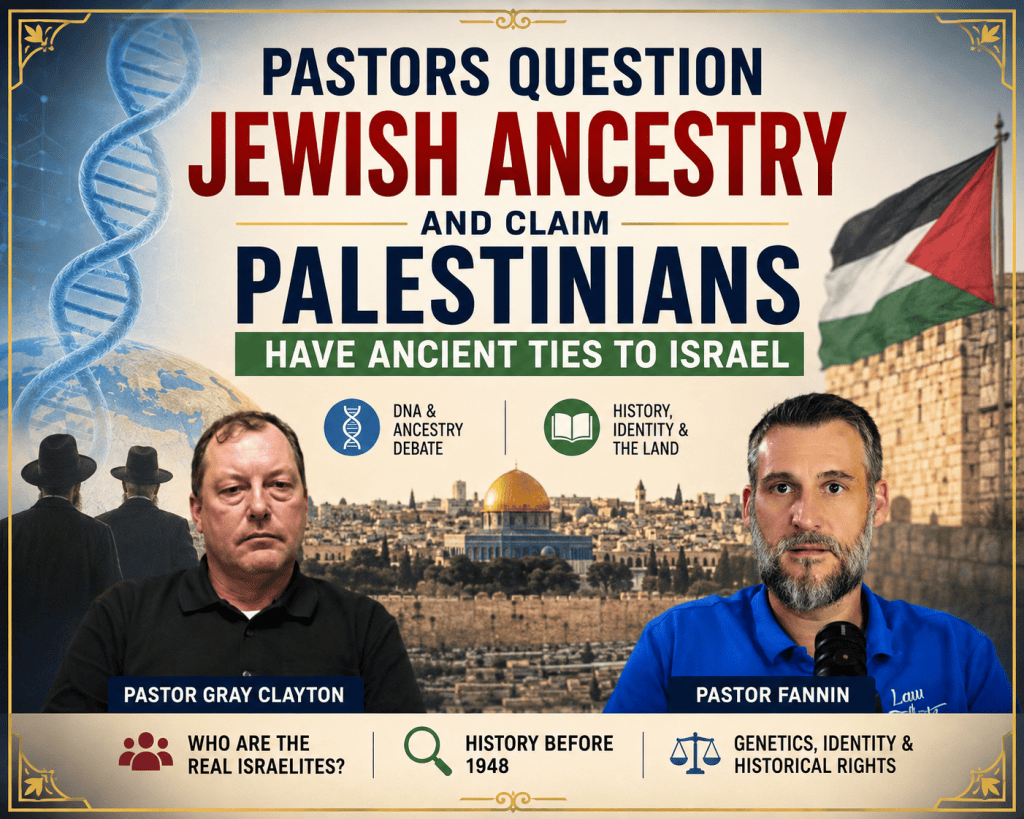
Pastors Question Jewish Ancestry and Claim Palestinians Have Ancient Ties to Israel
In a recent online stream, two pastors sparked controversy by questioning the heritage of modern Israelis while claiming that Palestinians hold stronger genetic ties to the ancient Israelites.
During the broadcast, Pastor Fannin brought up a comment from a viewer stating that “Palestinians are Israelites”. Fannin responded by claiming that regional DNA testing shows Palestinians possess Semitic ancestry linked to the ancient 12 tribes of Israel.
In contrast, Fannin claimed that many European Jews who moved to the region from countries like Poland, Germany, Russia, and Ukraine lack Semitic DNA and traditional religious faith. He questioned whether these groups claiming to be the restored 12 tribes are actually “impostors”.
Pastor Gray Clayton agreed with Fannin’s statements, concurring that they are “impostors” and citing historical research regarding regional demographics prior to 1948.
The comments draw on long-standing and controversial debates surrounding genetics, identity, and historical rights to the land in the Middle East.
Islamic Apologetic Arguments Linking Jesus’ Kingdom and Revelation’s Millennium to Islam
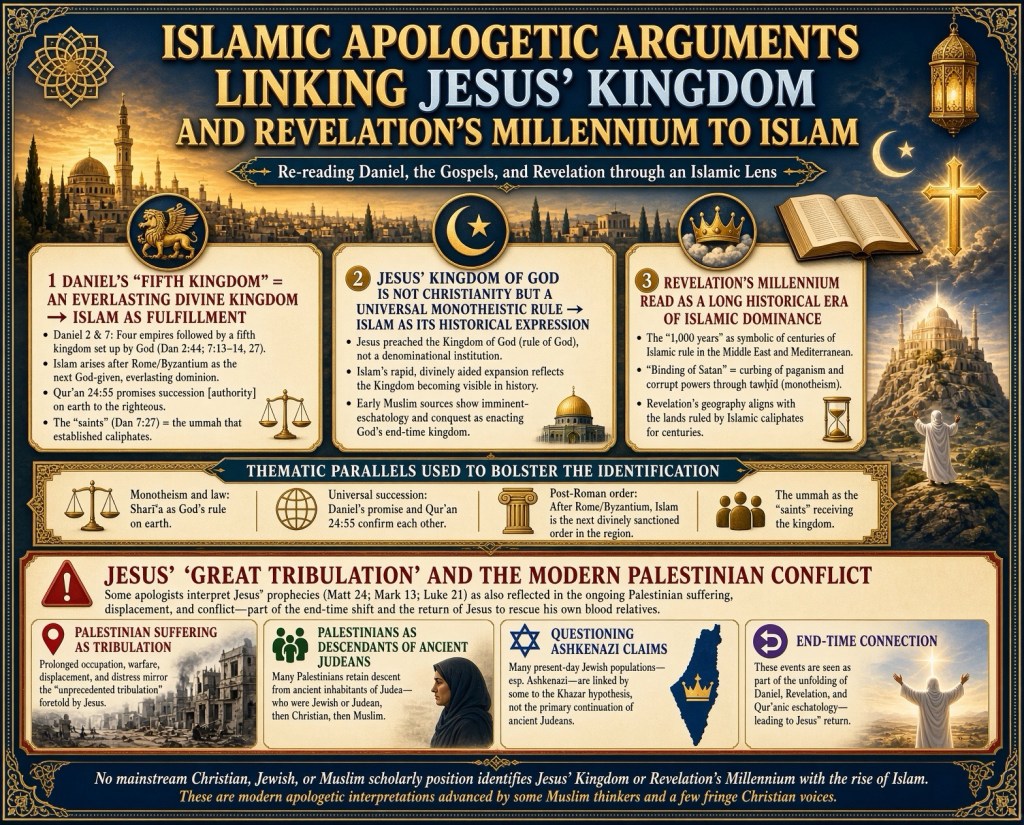
Islamic Apologetic Arguments Linking Jesus’ Kingdom and Revelation’s Millennium to Islam
📌 There is no mainstream scholarly or orthodox theological position—Christian, Jewish, or Muslim—that identifies the Kingdom of God proclaimed by Jesus in the Gospels or the Millennium in Revelation with the historical spread of Islam in the Middle East.
However, certain modern Islamic apologetic arguments (and a few fringe Christian interpretive schemes) do advance this claim, usually by re-reading Daniel’s “fifth kingdom,” Jesus’ “kingdom” sayings, and Revelation’s millennium through an Islamic lens. Below are the main lines of argument used to make this case, followed by key problems scholars raise against them.
📖 Core apologetic arguments used to link Jesus’ Kingdom and Revelation’s Millennium to Islam
1️⃣ Daniel’s “fifth kingdom” = an everlasting divine kingdom → Islam as fulfillment
Sequential empire schema: Daniel 2 and 7 describe four successive empires (commonly taken as Babylon, Medo-Persia, Greece, Rome). A “fifth kingdom,” set up by God, will never be destroyed and will fill the earth (Dan 2:44; 7:13–14, 27).
Historical placement after Rome/Byzantium: Some argue the fourth empire is the Roman/Byzantine world, and since Islam arose and conquered much of the former Byzantine and Persian territories in the 7th century, it fits as the next dominant, God-given kingdom.
Quranic confirmation: Surah 24:55 is cited: “Allah has promised those who have believed among you and done righteous deeds that He will surely grant them succession [to authority] upon the earth…” This is presented as a divine promise mirroring Daniel’s “everlasting kingdom.”
“Saints” receiving the kingdom: Daniel 7:27 says “the kingdom… shall be given to the people of the saints of the Most High.” Apologists identify these “saints” with the Muslim community (ummah) that established caliphates.
✝️ Jesus’ “Kingdom of God” is not Christianity but a universal monotheistic rule → Islam as its historical expression
Jesus did not found “Christianity” as an institution: It is argued that Jesus preached the Kingdom of God (rule of God), not a later denominational system. Therefore, the true “kingdom movement” could be realized in a later monotheistic community that upholds God’s oneness and law.
Islam’s rapid, divinely aided expansion: The swift Arab-Muslim conquests (Levant, Persia, Egypt, North Africa) are presented as the concrete, geopolitical “spread of God’s rule” in the Middle East—i.e., the Kingdom becoming visible in history.
Eschatology plus empire: Some scholars of early Islam note that early Muslim sources show strong imminent-eschatology alongside conquest ideology; apologists use this to argue that the early community saw itself as enacting God’s end-time kingdom.
🕌 Revelation’s Millennium read as a long historical era of Islamic dominance
Symbolic “1,000 years”: Instead of a literal future reign, the millennium is treated as a symbolic long period. Some propose this corresponds to centuries of Islamic political and cultural dominance in the Middle East and Mediterranean after the fall of Rome/Byzantium.
“Binding of Satan” and the decline of paganism/idolatry: The binding of Satan (Rev 20:1–3) is reinterpreted as the curbing of polytheism and “corrupt” religious power through the rise of strict monotheism (tawḥīd) under Islam.
Geographical focus: Because Revelation’s symbolic geography centers on the Eastern Mediterranean and “the nations,” apologists sometimes align the “millennial” order with the Islamic caliphates that ruled those lands for centuries.
🔗 Thematic parallels used to bolster the identification
Monotheism and law: The Kingdom’s emphasis on God’s rule is linked to Islam’s comprehensive legal-theological order (Sharīʿa) as a tangible “kingdom on earth.”
Universal succession promise: Daniel’s “dominion given to the saints” and the Quranic promise of succession on earth are treated as mutually confirming.
Post-Roman order: Since the fourth beast is Rome/Byzantium, the next major, divinely sanctioned order in the region is argued to be Islamic, not a later Western Christian one.
⏳ Jesus’ “Great Tribulation” and the Modern Palestinian Conflict
Some contemporary Islamic apologists extend this interpretive framework by arguing that the “great tribulation” described by Jesus (e.g., Matthew 24; Mark 13; Luke 21) is not primarily a future global catastrophe, nor solely a reference to the Roman destruction of Jerusalem in AD 70, but is also reflected in the modern conflict in Palestine.
According to this interpretation, the prolonged displacement, occupation, warfare, and suffering experienced by Palestinians are viewed as part of the tribulation foretold by Jesus. Within this framework, some proponents contend that many Palestinians today retain significant descent from the ancient inhabitants of Judea, including communities that formerly identified as Jews or Judeans before subsequently embracing Christianity and, later, Islam.
Based on this understanding, they question whether many present-day Jewish populations—particularly Ashkenazi Jews, whom some proponents associate in part with the disputed Khazar hypothesis—constitute the primary ethnic or covenantal continuation of the ancient Judeans.
Building on this premise, these writers interpret the violence, displacement, and alleged ethnic cleansing of Palestinians as evidence that Jesus’ warnings about unprecedented distress are being fulfilled in the Holy Land.
They also connect these events with their broader reading of Daniel, Revelation, and Qur’anic eschatology, arguing that the current crisis is a component of the shift towards the End time and the return of Jesus to rescue his own blood relatives.

