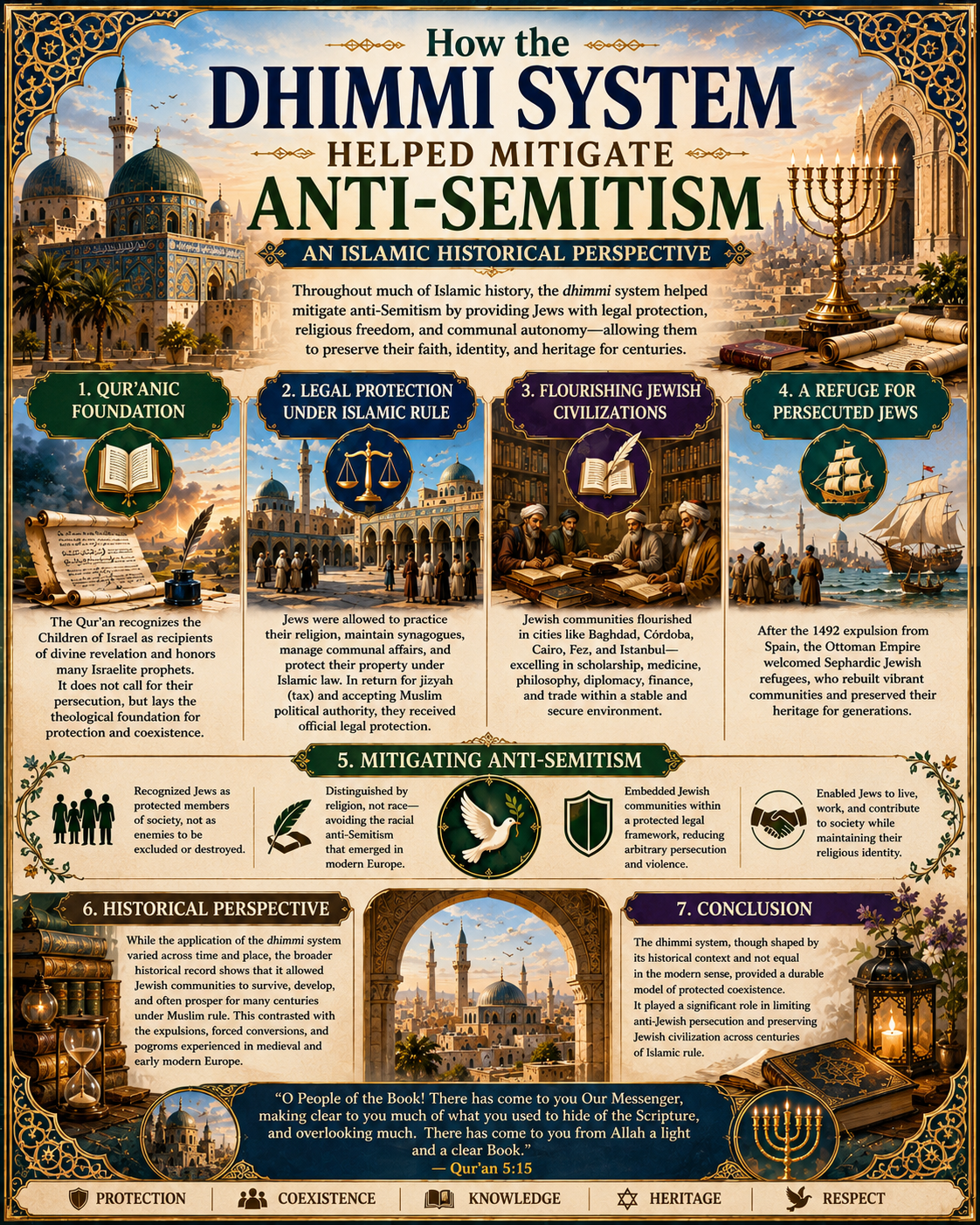
Throughout much of Islamic history, the dhimmi system helped mitigate anti-Semitism by providing Jewish communities with a recognized legal status, religious protection, and communal autonomy. Although it did not establish complete legal equality between Muslims and non-Muslims, it created a framework in which Jews could preserve their faith, institutions, and identity for centuries.
Unlike many societies where Jews periodically faced expulsion, forced conversion, or extermination, Islamic civilization generally recognized Jews as Ahl al-Kitāb (“People of the Book”) and incorporated them into society under the protection of Islamic law.
📖 The Qur’anic Foundation
The Qur’an provides the theological basis for this relationship. It recognizes the Children of Israel as recipients of divine revelation and honours many Israelite prophets, including Moses, David, Solomon, Zachariah, John, and Jesus. While the Qur’an criticizes certain individuals or communities for specific acts of disobedience, it does not portray Jews as a people to be persecuted or eliminated.
This theological recognition laid the foundation for a legal system that protected Jewish communities instead of treating them as perpetual enemies.
🕌 Legal Protection Under Islamic Rule
Under the dhimmi system, Jews were permitted to practice Judaism, maintain synagogues according to prevailing legal conditions, administer many of their own communal affairs, and protect their property and families under Islamic governance.
In return for paying the jizyah tax and accepting Muslim political authority, Jewish communities received official legal protection. This institutional recognition significantly reduced the likelihood of arbitrary persecution and enabled Jewish communal life to continue across vast regions of the Muslim world.
Rather than existing merely by tolerance, Jews occupied a recognized place within the Islamic legal order.
🌍 Flourishing Jewish Civilizations
The stability provided by the dhimmi system allowed many Jewish communities to flourish intellectually, economically, and culturally.
Cities such as Baghdad, Córdoba, Cairo, Fez, and later Istanbul became important centres of Jewish scholarship, commerce, medicine, philosophy, diplomacy, and finance. Jewish scholars wrote influential works, physicians served Muslim rulers, and merchants participated in extensive international trade networks.
These achievements were possible because Islamic governance generally offered security and continuity for Jewish communal life.
🚢 A Refuge for Persecuted Jews
One of the clearest demonstrations of this protective framework came after the expulsion of Jews from Spain in 1492.
While Catholic Spain forced large numbers of Jews into exile or conversion, the Ottoman Empire welcomed many Sephardic Jewish refugees. They rebuilt prosperous communities throughout the empire, preserving their religious traditions, language, and culture for generations.
This episode illustrates how Islamic rule often served as a refuge for Jews fleeing persecution elsewhere.
⚖️ Mitigating Anti-Semitism
The dhimmi system helped mitigate anti-Semitism because it recognized Jews as protected members of society rather than as a people to be excluded or destroyed.
Classical Islamic law distinguished communities primarily by religion, not by race. As a result, Jews retained legal recognition and communal rights even though they occupied a distinct legal status.
This differed fundamentally from the racial anti-Semitism that emerged in modern Europe, where Jews were increasingly portrayed as an inherently inferior or dangerous race regardless of their beliefs or conduct.
By embedding Jewish communities within a protected legal framework, Islamic civilization limited many of the conditions that historically fostered widespread anti-Jewish persecution.
📚 Historical Perspective
Like every civilization, the Muslim world experienced periods of injustice, discrimination, and occasional persecution. The application of the dhimmi system varied between rulers, regions, and historical periods.
Nevertheless, the broader historical record shows that the dhimmi framework generally enabled Jewish communities to survive, develop, and often prosper for many centuries under Muslim rule. It provided a durable institutional basis for coexistence that contrasted with the repeated expulsions, forced conversions, inquisitions, and pogroms experienced by many Jewish communities in parts of medieval and early modern Europe.
🕊️ Conclusion
The dhimmi system stands as one of the principal historical mechanisms through which Islamic civilization helped mitigate anti-Semitism. By recognizing Jews as People of the Book, guaranteeing their legal protection, safeguarding their religious life, and integrating them into society, Islamic law created conditions that allowed Jewish communities to endure and flourish across much of the Muslim world.
Although the system reflected the hierarchical norms of its historical context and did not provide modern concepts of equal citizenship, it nevertheless represented a durable model of protected coexistence. In historical terms, it played a significant role in limiting anti-Jewish persecution and preserving Jewish civilization across centuries of Islamic rule.
The Chapel of the Ascension: A Shared Sacred Shrine Under Islamic Custodianship
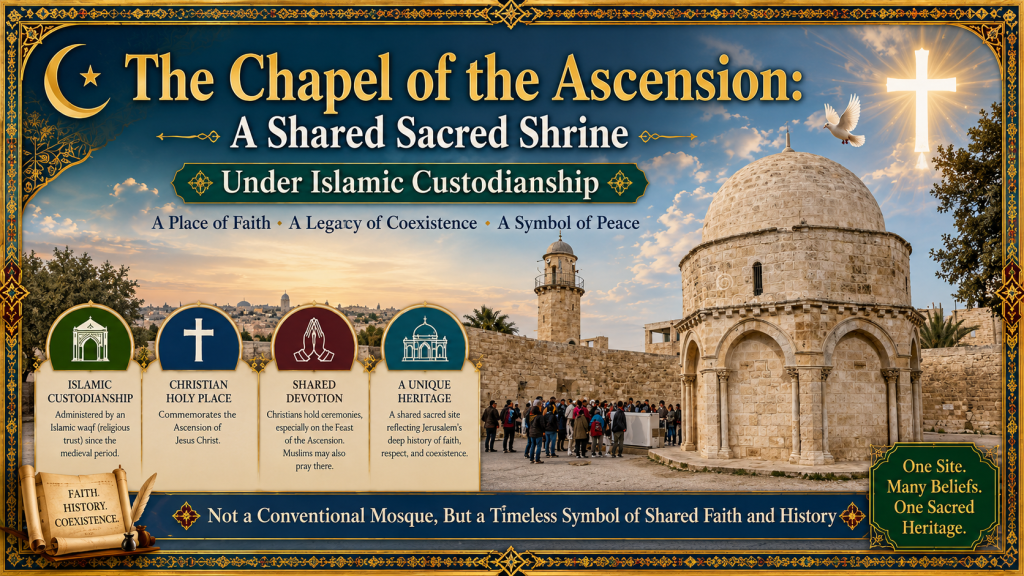
🕌 The Chapel of the Ascension: A Shared Sacred Shrine Under Islamic Custodianship
🕊️ The Chapel of the Ascension on the Mount of Olives occupies a unique and historically layered position.
⛪ It is not generally regarded today as an active mosque in the formal congregational sense, but it has long been under Islamic custodianship and contains Islamic architectural and devotional features.
📜 The site commemorates the Christian belief that Jesus Christ ascended to heaven from the Mount of Olives.
🏛️ Early Christians built churches there beginning in the Byzantine period.
🌙 After the Muslim conquest of Jerusalem in the 7th century, the site continued to be visited by Christians.
⚔️ During the medieval Islamic period — especially under the Ayyubids after Saladin recaptured Jerusalem in 1187 — the structure came under Muslim administration.
🧭 A small mihrab, or prayer niche indicating the direction of Mecca, was added, reflecting Islamic use and guardianship.
🤲 Islamic tradition also reveres Jesus Christ, known as ʿĪsā, so the site retained significance for Muslims as well.
🏷️ Today, the building is usually called the “Chapel of the Ascension” by Christians.
🕌 It is administered by an Islamic waqf, or religious trust.
✝️ Christians are permitted to hold certain ceremonies there, especially on the Feast of the Ascension.
🕋 Muslims may also pray there.
🌍 Architecturally and legally, it has Islamic custodianship, but functionally it is more of a shared sacred shrine than a standard neighborhood mosque.
⚖️ From an Islamic administrative perspective, it has historically functioned partly as a Muslim shrine and prayer site under waqf authority.
⛪ From mainstream Christian usage, it remains a Christian holy place commemorating the Ascension.
🕊️ From a modern functional perspective, it is usually described as a shared sacred site rather than a conventional mosque.
🏙️ This type of layered sacred space is not unusual in Jerusalem, where several holy places have shifted administration or been shared among religious communities across centuries.
“Guardians of the Sacred Key: The Muslim Family Entrusted Since the Time of Saladin”

JERUSALEM — In a world often defined by division, a remarkable and centuries-old tradition in Jerusalem continues to defy expectations—where a Muslim family holds the keys to Christianity’s holiest shrine: the Church of the Holy Sepulchre.
This is not myth. It is history—alive, uninterrupted, and quietly powerful.
⸻
🔑 A Legacy Born in the Age of Saladin
The story begins in 1187, when the great Muslim leader Saladin recaptured Jerusalem from the Crusaders. In a move that stunned both allies and enemies, he chose not revenge—but reconciliation.
Rather than placing the sacred church under exclusive Christian control—risking sectarian conflict among rival denominations—Saladin made a bold decision:
👉 He entrusted the keys of the church to a neutral Muslim family.
A decision not just political—but profoundly symbolic.
⸻
🕌 The Families Who Hold the Trust
For over 800 years, two Muslim families have carried this sacred responsibility:
- The Nuseibeh family – responsible for physically opening and closing the church doors
- The Joudeh family – entrusted with safeguarding the key itself
Every morning, before dawn breaks over Jerusalem, a member of the Nuseibeh family climbs a ladder to unlock the massive wooden doors—watched by representatives of multiple Christian denominations.
Every evening, they return again—to close it.
The ritual is precise. Timeless. Undisputed.
⸻
⚖️ A Solution to Centuries of Conflict
The Church of the Holy Sepulchre is shared by several Christian sects—Greek Orthodox, Armenian Apostolic, Roman Catholic, Coptic, Ethiopian, and Syriac Orthodox.
Historically, tensions between these groups have run deep—even erupting into physical confrontations.
👉 The Muslim custodianship serves as a neutral mechanism—preventing disputes over control of access.
In effect, a Muslim family became the guarantor of peace among Christians.
⸻
🌍 A Living Symbol of Coexistence
In an age of headlines dominated by religious conflict, this quiet tradition tells a different story:
- A Muslim legacy protecting a Christian sanctuary
- A trust passed down generation to generation
- A shared city where faiths intersect—not only in tension, but in trust
As one member of the Nuseibeh family once said:
“We are not just opening a door. We are preserving history.”
⸻
⚡ The Deeper Meaning
What began as a strategic decision by Saladin has become something far greater:
👉 A living covenant of coexistence
👉 A symbol of interfaith balance
👉 A reminder that power can be exercised with restraint—and wisdom
In Jerusalem, where every stone carries memory, one small iron key continues to unlock more than a door.
It unlocks a story the world rarely hears—
a story of trust across faiths, preserved for over eight centuries.

