Azahari Hassim
📖 The Abrahamic covenant and the Sinai covenant are two of the most important themes shared by Judaism, Christianity, and Islam. While both the Apostle Paul and Islam clearly distinguish between these two covenants, they reach very different conclusions about how God’s promises to Abraham were ultimately fulfilled.
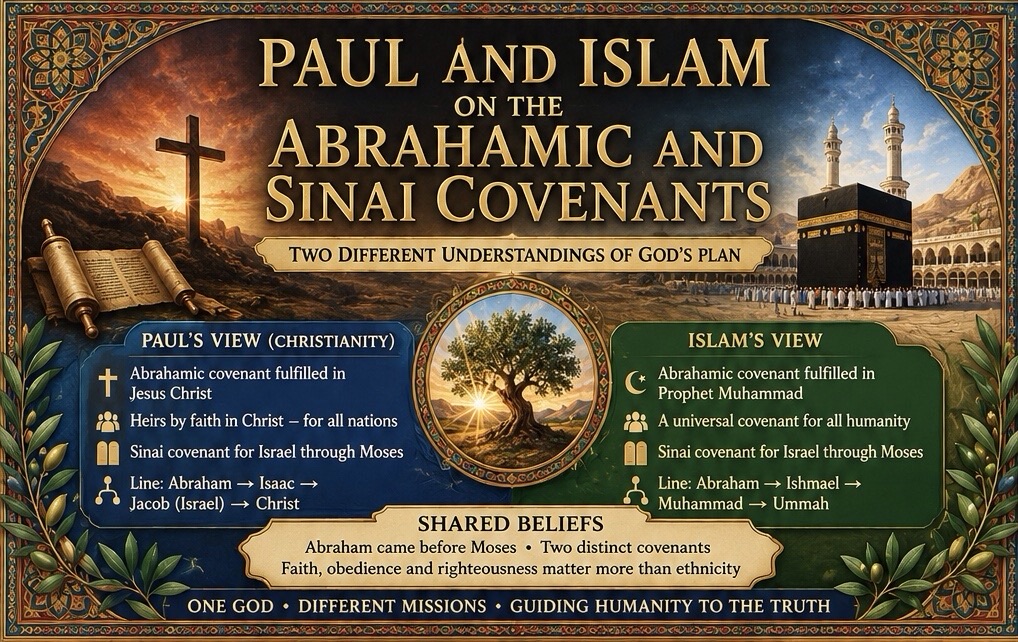
🧭 According to Paul, the covenant God made with Abraham came long before the Law of Moses was given at Mount Sinai. Because of this, Paul argues that God’s promise to Abraham cannot be limited or replaced by the later Mosaic Law. Instead, Christians believe the Abrahamic covenant reaches its fulfillment in Jesus Christ.
✝️ Paul teaches that anyone—Jew or Gentile—can become an heir of Abraham through faith in Christ without first becoming part of the Jewish nation or observing the full Mosaic Law. In this way, Abraham becomes the spiritual father of all believers rather than only the ancestor of Israel.
📜 Paul also explains that the Sinai covenant had a specific purpose. It established Israel as God’s covenant nation and introduced the Torah, priesthood, sacrifices, festivals, and many religious laws. However, Paul says this covenant did not cancel God’s earlier promise to Abraham.
☪️ Islam also distinguishes between the Abrahamic covenant and the Sinai covenant, but its understanding is different. From the Islamic perspective, the Abrahamic covenant belongs to Abraham and his son Ishmael and ultimately reaches its fulfillment through the Prophet Muhammad and the Muslim community (ummah).
🕌 The Qur’an describes Abraham as neither a Jew nor a Christian but as a man who fully submitted himself to God. Muslims therefore see Abraham as the model of pure monotheism that existed before both the Torah and the Gospel.
🌍 Within this Islamic understanding, the Abrahamic covenant is universal. It is seen as a covenant meant for all humanity rather than for one nation alone. By contrast, the Sinai covenant is understood as a separate covenant given specifically to the Children of Israel through the Prophet Moses.
🤝 Muslims point to several key moments in the lives of Abraham and Ishmael as expressions of this covenant. These include Abraham leaving Hagar and the infant Ishmael in the valley of Mecca, Abraham’s willingness to sacrifice his son in obedience to God, the joint construction of the Kaaba (House of God), and their prayer that God would send a future messenger from among their descendants.
🕋 According to Islamic belief, that prayer was fulfilled through the coming of the Prophet Muhammad. Muslims therefore understand Muhammad not as introducing a new religion but as completing the original faith of Abraham.
⚖️ One of the biggest differences between Christianity and Islam concerns the identity of the son connected to Abraham’s covenant.
📖 In the biblical tradition, Genesis identifies Isaac as the son Abraham was commanded to offer. Paul therefore follows the covenantal line from Abraham through Isaac, then Jacob (Israel), and finally to Jesus Christ.
📚 Paul also uses the story of Sarah and Hagar in his Letter to the Galatians as an allegory. In his interpretation, Isaac represents the covenant of promise and freedom, while Hagar represents the covenant associated with the Law.
☪️ Islam presents a different interpretation. The Qur’an does not explicitly name the son in the near-sacrifice story, but classical Islamic scholarship traditionally identifies him as Ishmael, based on the narrative sequence where Abraham first receives news of a son, then faces the sacrificial trial, followed by the announcement of Isaac’s birth.
🧭 From this perspective, the covenantal line is understood as Abraham, Ishmael, Muhammad, and finally the worldwide Muslim community. The Sinai covenant, meanwhile, remains connected specifically to Moses and the Children of Israel.
🛤️ As a result, the two traditions describe two different covenantal paths. Christianity traces the Abrahamic promise through Isaac to Christ, while Islam traces it through Ishmael to Muhammad.
🌎 Despite these major differences, Paul and Islam also share some important similarities. Both agree that Abraham came before Moses and that the Abrahamic covenant should not be confused with the Sinai covenant.
🤲 Both traditions also reject the idea that biological descent from Abraham alone guarantees covenantal status. Paul teaches that faith in Christ is what makes someone a true heir of Abraham. Islam similarly teaches that the true followers of Abraham are those who worship the One God and live according to His guidance.
📖 In both views, faith and obedience are considered more important than ethnicity alone, even though they disagree about how the Abrahamic covenant reaches its fulfillment.
📰 The comparison shows that Christianity and Islam begin with a similar observation—that Abraham’s covenant came before the covenant at Mount Sinai—but they interpret history in different ways. Christians believe the promise finds its fulfillment in Jesus Christ, while Muslims believe it reaches completion through the Prophet Muhammad and the establishment of the universal Muslim community.
🌟 Ultimately, this comparison highlights both the shared heritage and the major theological differences between Christianity and Islam. Both traditions honor Abraham as a central figure of faith, yet each offers a distinct understanding of God’s covenantal plan and its fulfillment in history.
Do the Torah and the Bible contain a divine command to commemorate Isaac’s near-sacrifice?
Do the Torah and the Bible contain a divine command to commemorate Isaac’s near-sacrifice?
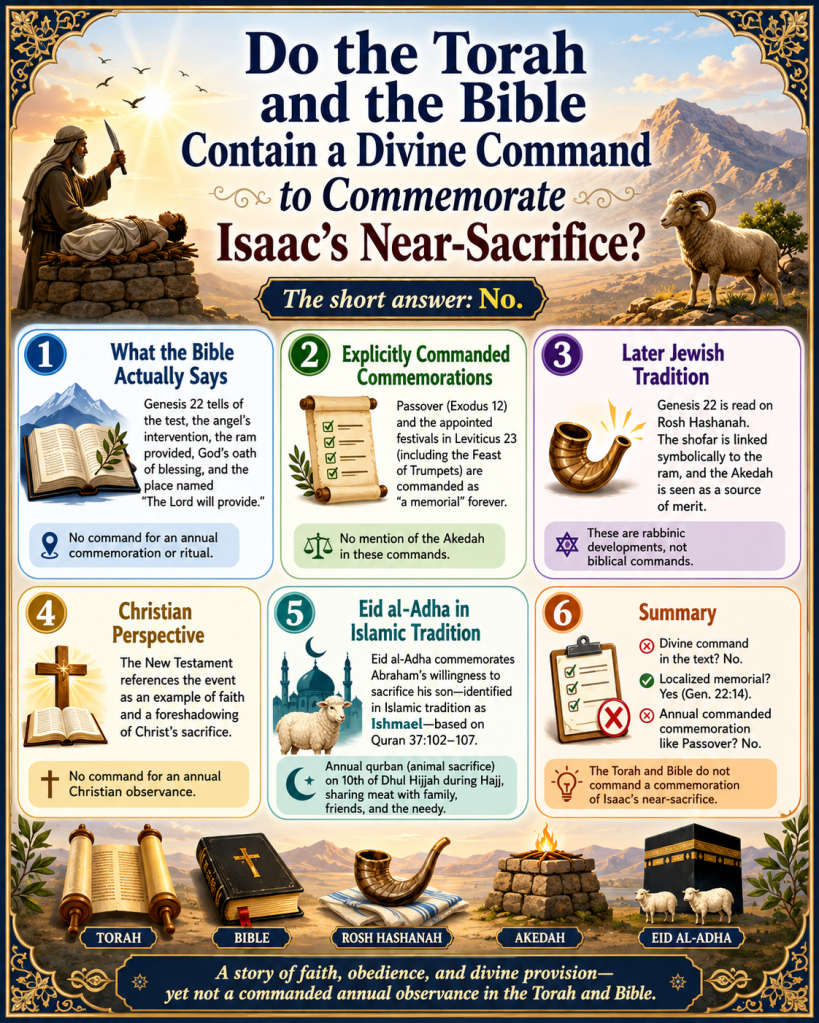
No, the Torah and the Bible do not contain a divine command to commemorate Isaac’s near-sacrifice (the Akedah, or “binding,” in Genesis 22).
📜 What the Text Actually Says
In Genesis 22 (the only detailed account in the Torah/Bible):
• God commands Abraham to perform the sacrifice of Isaac as a test (vv. 1–2).
• Abraham obeys and prepares to do so.
• An angel intervenes at the last moment (vv. 11–12), and a ram is provided as a substitute (v. 13).
• God then swears an oath of blessing and multiplication of descendants because of Abraham’s obedience (vv. 16–18).
• Abraham names the place “The Lord will provide” (YHWH Yireh), and the text notes that people say “On the mount of the Lord it shall be provided” to this day (v. 14). This is a localized proverbial saying about God’s provision, not a commanded ritual or annual observance.
There is no instruction anywhere in Genesis 22 — or elsewhere in the Torah or the rest of the Bible — for the Israelites (or later communities) to institute an annual festival, holiday, sacrifice, reading, or other ritual specifically to commemorate the near-sacrifice itself.
⚖️ Comparison with Explicitly Commanded Commemorations
Contrast this with clear divine commands for remembrance:
• Passover (Exodus 12): God explicitly commands an annual observance with specific rituals (lamb, bitter herbs, unleavened bread, retelling the story) “as a memorial” and “a statute forever.”
• Appointed festivals in Leviticus 23, including the Feast of Trumpets (later associated with Rosh Hashanah): These have direct commands for rest, offerings, and blowing trumpets — with no mention of the Akedah.
The Akedah (binding of Isaac) story has profound theological weight (faith, obedience, divine provision, the covenant oath), but the text itself does not turn it into a mandated annual commemoration.
🕍 Later Jewish Tradition (Not Biblical Command)
In rabbinic Judaism:
• Genesis 22 is read as the Torah portion on the second day of Rosh Hashanah.
• The shofar (ram’s horn) blown on Rosh Hashanah is symbolically linked by later interpreters to the ram that replaced Isaac.
• The Akedah is seen as a source of merit and a reminder for God to show mercy.
These practices are post-biblical rabbinic developments. Multiple Jewish sources acknowledge that “there is nothing in the biblical text that suggests this” association with Rosh Hashanah. The Torah’s command for the day (Leviticus 23:23–25) is simply a “memorial of blowing of trumpets,” with no reference to Isaac or the binding.
✝️ Christian Perspective
The New Testament references the event typologically (e.g., Hebrews 11:17–19 sees it as an example of faith; some see it foreshadowing Christ’s sacrifice), but it issues no command for an annual Christian observance of Isaac’s near-sacrifice.
🕌 Eid al-Adha in Islamic Tradition
In Islamic tradition, Eid al-Adha explicitly commemorates Abraham’s willingness to sacrifice his son — identified in Muslim exegesis as Ishmael — as described in Quran 37:102–107, where a divine vision leads to the son’s willing submission and God’s ransom with a ram.
On the 10th of Dhul Hijjah (coinciding with the Hajj),
Muslims perform the ritual animal sacrifice (qurban), distributing the meat to family, friends, and the needy. This is a divinely ordained annual observance emulating Abraham’s (and his son’s) submission, unlike the Torah and Bible, which contain no mandated ritual commemoration of Isaac’s near-sacrifice.
📌 Summary
• Divine command in the text? No — only the original test/command to Abraham, the intervention, the substitute, and the resulting oath of blessing.
• Localized memorial? Yes — the place name and saying in Genesis 22:14.
• Annual commanded commemoration (like Passover)? No.
This distinction is relevant in Abrahamic theology discussions, as Islamic tradition (Eid al-Adha) does include an explicit ritual commemoration of Abraham’s willingness to sacrifice his son (understood in Muslim tradition as Ishmael), with animal sacrifice as a continuing practice.
The Torah/Bible account of Isaac does not have an equivalent commanded ongoing ritual in the text itself.
📜 Abraham or History? Why Judaism and Islam Remember the Patriarch Differently
📜 Abraham or History? Why Judaism and Islam Remember the Patriarch Differently
Judaism and Islam both look back to Abraham as one of the great figures of faith. Yet the two religions place him within their religious life in noticeably different ways.
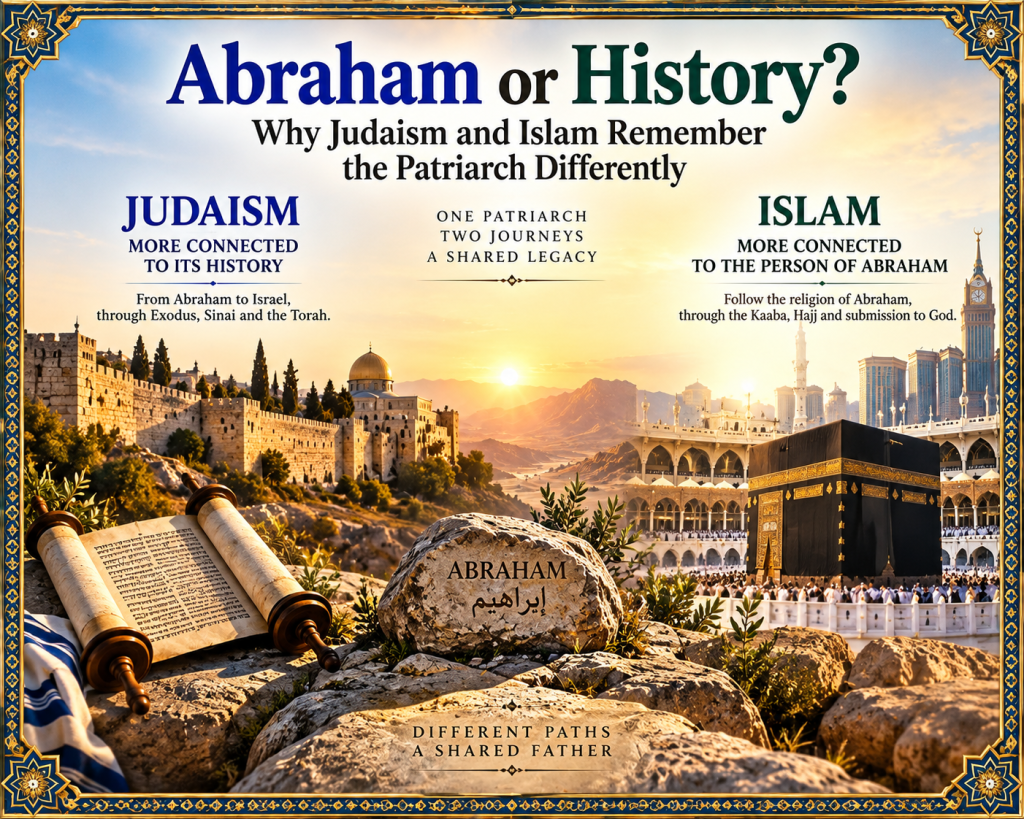
A useful way of describing the contrast is this: Judaism is strongly shaped by the historical experience of Israel, while Islam places unusually strong emphasis on Abraham himself as a model of faith and submission to God.
That distinction can be seen most clearly in the religious stories and rituals at the center of each tradition.
✡️ Judaism: From Abraham to the History of Israel
Abraham is fundamental to Judaism. The Hebrew Bible presents him as the patriarch from whom Israel’s covenantal story begins.
But the story does not stop with Abraham.
The biblical line continues through Isaac, Jacob and the Twelve Tribes of Israel. From there, Jewish identity becomes deeply connected with the collective history of the Israelite people—especially slavery in Egypt, the Exodus, the revelation of the Torah at Mount Sinai and the covenant established through Moses.
These events remain embedded in Jewish religious life.
Passover recalls the Exodus from Egypt. The Torah given through Moses stands at the center of Jewish law and religious practice. Jewish prayers and festivals repeatedly recall God’s relationship with Israel across history.
In this sense, Abraham is the beginning of the story, but Sinai and the historical experience of Israel become central to Jewish communal identity.
☪️ Islam: Returning Directly to Abraham
Islam approaches Abraham—known as Ibrāhīm—somewhat differently.
The Qur’an does not present Abraham merely as an ancestor of a particular people. It repeatedly presents him as a model of pure monotheism who existed before the later religious divisions between Jews and Christians.
The Qur’an declares:
“So follow the religion of Abraham, inclining to truth.”
— Qur’an 3:95
Another particularly important verse is Qur’an 16:123:
“Then We revealed to you: Follow the religion of Abraham, inclining to truth.”
The second is especially significant because it is a direct divine instruction to Prophet Muhammad ﷺ to follow the millah of Abraham.
Muslims are therefore instructed to follow the millat Ibrāhīm—the religion or way of Abraham.
This connection becomes especially visible in Mecca.
According to the Qur’an, Abraham and Ishmael raised the foundations of the Kaaba and prayed that God would raise a messenger among their descendants (Qur’an 2:127–129).
The yearly Hajj pilgrimage, which commemorates Abraham’s near-sacrifice of his son Ishmael, positions this Abrahamic tradition at the core of Muslim religious awareness.
The Kaaba, sacrifice, pilgrimage and other traditions associated with Abraham, Ishmael and Hagar connect Muslims repeatedly with the Abrahamic story.
For Muslims, therefore, Abraham is not simply a figure from sacred history. He is a continuing model of what it means to surrender oneself completely to God.
🕋 Two Ways of Remembering Abraham
The difference should not be exaggerated. Judaism remains profoundly Abrahamic, while Islam also has its own powerful sacred history after Abraham.
But their centers of emphasis are different.
Judaism largely follows the historical trajectory:
Abraham → Isaac → Jacob → Israel → Exodus → Sinai → Torah
Islam places greater emphasis on another trajectory:
Abraham → Ishmael → Kaaba → pure monotheism → Muhammad → restoration of the religion of Abraham
This helps explain why Jewish religious identity is so closely tied to the historical memory of Israel, while Islam presents Abraham as a universal model of monotheism, transcending the religious and national identities that arose after him.
🌍 One Patriarch, Two Religious Memories
The contrast, then, is not that Judaism belongs to history while Islam belongs to Abraham. Both religions have history, covenant, scripture and an Abrahamic inheritance.
The difference is one of religious emphasis.
Judaism remembers Abraham primarily within the unfolding covenantal history of Israel. Islam presents Abraham more directly as a universal spiritual prototype whose faith Muslims are commanded to follow.
Perhaps the distinction can be summarized in one sentence:
For Judaism, Abraham begins the sacred history of Israel; for Islam, Abraham’s way becomes a religious ideal that believers are explicitly called to recover and follow.

