Azahari Hassim
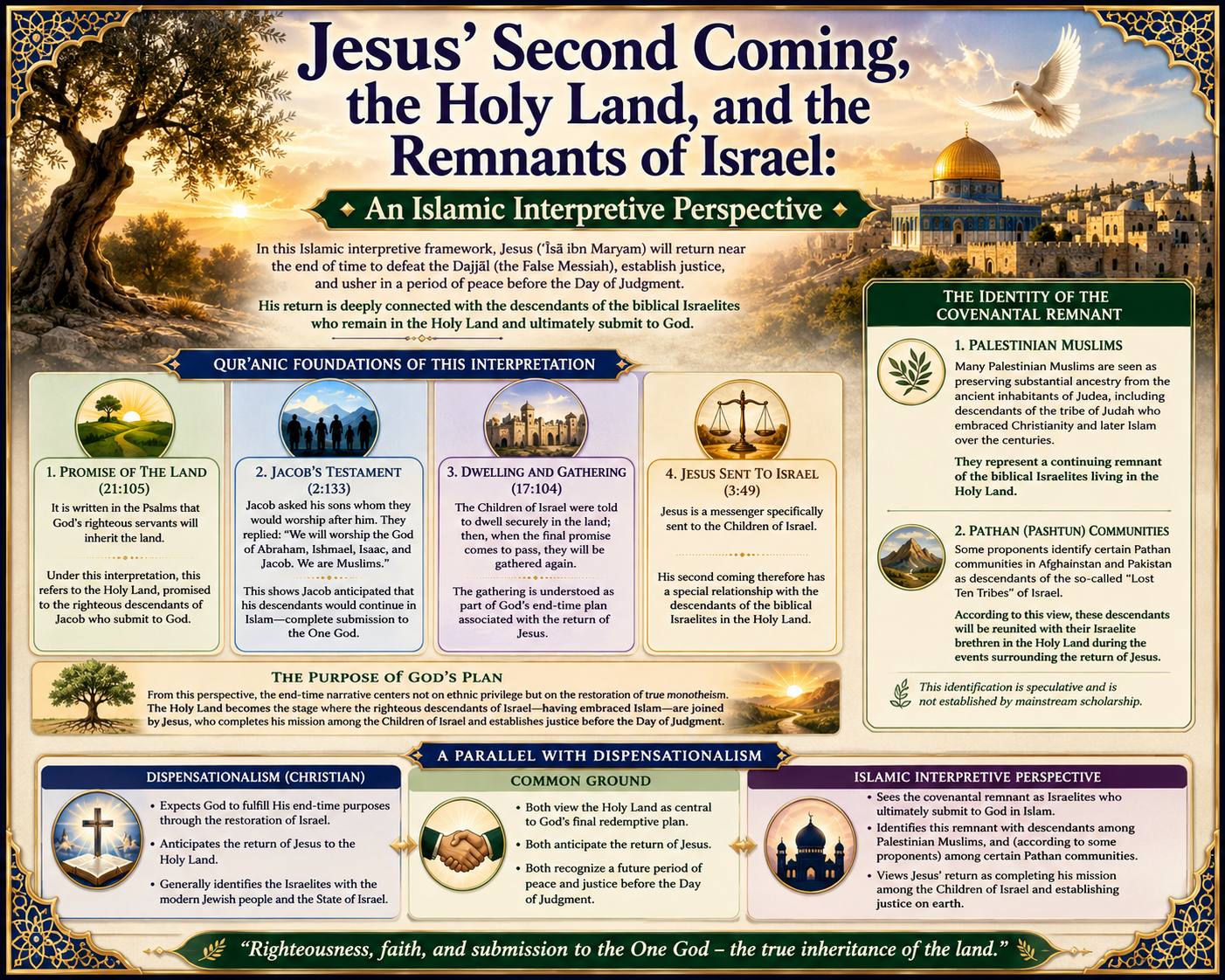
Many Muslims believe that Jesus (ʿĪsā ibn Maryam) will return to the Holy Land near the end of time to fulfill his divinely appointed mission. According to authentic Islamic traditions, he will defeat the Dajjāl (the False Messiah), establish justice, and usher in a period of peace before the Day of Judgment.
Within one contemporary Islamic interpretive framework, Jesus’ return is understood not merely as a universal event but as one deeply connected with the descendants of the biblical Israelites who remain in the Holy Land and ultimately submit to God.
This interpretation draws upon several Qur’anic passages.
📖 Surah al-Anbiyāʾ (21:105) declares:
“Indeed, We have written in the Psalms after the Reminder (Torah) that My righteous servants shall inherit the land.”
Proponents interpret this verse as referring to the Holy Land. They argue that because the promise is said to have been written in the Psalms (Zabūr)—a scripture associated with the biblical Israelites—it points to the descendants of Jacob. Within this interpretive framework, the verse is understood as promising that the righteous among the descendants of Jacob, having submitted to God in true faith, will ultimately inherit the Holy Land.
📖 Surah al-Baqarah (2:133) recalls Jacob’s final words to his sons, asking whom they would worship after him. They replied that they would worship the God of Abraham, Ishmael, Isaac, and Jacob, declaring:
“We are Muslims (those who submit to Him).”
This passage is understood to show that, from a Qur’anic perspective, Jacob anticipated that his descendants would continue in Islam—understood in its Qur’anic sense as complete submission to the One God—and therefore asked them to reaffirm their commitment to that faith before his death.
📖 Surah al-Isrāʾ (17:104) states that the Children of Israel would dwell in the land and later be gathered again:
“Afterward We said to the Children of Israel, ‘Dwell securely in the land; then, when the final promise comes to pass, We will bring you together.’”
Within this interpretive framework, the gathering is understood as part of God’s end-time plan associated with the return of Jesus.
📖 Surah Āl ʿImrān (3:49) identifies Jesus as a messenger specifically sent to the Children of Israel. Accordingly, proponents argue that his second coming also has a special relationship to the descendants of the biblical Israelites living in and connected to the Holy Land.
Some advocates of this interpretation further argue that many Palestinian Muslims preserve substantial ancestry from the ancient inhabitants of Judea, including descendants of the tribe of Judah who embraced Christianity and later Islam over the centuries. In this view, they represent a continuing remnant of the biblical Israelites residing in the Holy Land.
Some proponents additionally identify certain Pathan (Pashtun) communities in Afghanistan and Pakistan with descendants of the so-called “Lost Ten Tribes” of Israel. According to this interpretation, these descendants will be reunited with their Israelite brethren in the Holy Land during the events surrounding the return of Jesus. This identification, however, remains speculative and is not established by mainstream scholarship.
From this perspective, the end-time narrative centers not on ethnic privilege but on the restoration of true monotheism. The Holy Land becomes the stage where the righteous descendants of Israel—having embraced Islam—are joined by Jesus, who completes his mission among the Children of Israel and establishes justice before the Day of Judgment.
🌿 A Parallel with Dispensationalism
Proponents of this interpretation observe an interesting parallel with Christian Dispensationalism.
Dispensationalism expects God to fulfill His end-time purposes through the restoration of Israel and the return of Jesus to the Holy Land. Likewise, this Islamic interpretive model sees the Holy Land, the descendants of the biblical Israelites, and the return of Jesus as central to the unfolding of the last days.
The principal difference lies in the identity of those Israelites. Whereas Dispensationalism generally identifies them with the modern Jewish people and the State of Israel, this Islamic interpretive framework proposes that the covenantal remnant consists of Israelites who ultimately submit to God in Islam, including those whom it identifies as descendants preserved among Palestinian Muslims, with additional Israelite descendants among certain Pathan communities.
Thus, while the theological conclusions differ, both eschatological frameworks assign a central role to the Holy Land, the descendants of Israel, and the return of Jesus in God’s final redemptive plan.

📜 🏞️ Could Palestinians Be Descendants of Biblical Jews?
What happened to the people of Judea after the Roman period? Historian Shlomo Sand offers a different answer to that question in his book, “The Invention of the Jewish People.”
The familiar story says that the modern Jewish people are the direct descendants of those exiled from the Holy Land by the Romans, who then preserved their identity in a single, unbroken line for nearly 2,000 years.
Sand challenges that story. He argues that it is not supported by strong historical evidence.
According to Sand, the Roman authorities did not carry out a full-scale deportation of the entire population of the Holy Land. The region, he says, remained inhabited, and many of its people likely stayed in place.
From that point of view, Sand suggests another possibility. Some of the people who continued to live in the land over many centuries may have been descended from ancient Jews and Judeans.
Over time, he argues, those populations changed their religion and identity. During the Byzantine period, many may have converted to Christianity. Later, with the rise of Islam, some may have become Muslims.
Their descendants, Sand implies, could include today’s Palestinians.
Jesus’ Great Tribulation and the Ethnic Cleansing of Palestinians: A Comparative Eschatological Reflection
🔥 Jesus’ Great Tribulation and the Ethnic Cleansing of Palestinians: A Comparative Eschatological Reflection
In Christian eschatology, the “Great Tribulation” refers to a period of extreme suffering, oppression, deception, displacement, and crisis before divine judgment and final deliverance. The phrase is most famously found in Matthew 24, where Jesus warns of a time of terrifying distress connected with Jerusalem, Judea, false messiahs, desolation, and the urgent flight of civilians: “let those who are in Judea flee to the mountains.” The passage speaks of suffering so severe that, unless the days were shortened, no flesh would be saved. (Bible Gateway)
Although Christians differ on how to interpret this prophecy, the imagery of the Great Tribulation has often been associated with catastrophic historical suffering: siege, war, exile, persecution, and the collapse of ordinary life. Some Christian traditions interpret Matthew 24 primarily in relation to the Roman destruction of Jerusalem in 70 CE. Others see it as a future end-time crisis involving Israel, the nations, and the final return of Christ. Still others read it as a recurring pattern of history: whenever empire, violence, deception, and religious nationalism combine to crush the innocent, the world experiences something that resembles “tribulation.”
When this biblical language is placed beside the modern Palestinian experience, especially the ethnic cleansing associated with Zionist expansion and the creation of the State of Israel, striking parallels appear. This does not mean that the Palestinian catastrophe must be identified dogmatically as the exact fulfillment of Matthew 24. Rather, it means that the Palestinian experience can be examined through the moral and symbolic lens of the Great Tribulation.
- Tribulation as Forced Flight
In Matthew 24, Jesus describes a moment when people in Judea must flee urgently. The image is not abstract. It is the image of civilians escaping danger, leaving homes behind, and running for survival. The warning not to return for one’s belongings emphasizes the suddenness and terror of the crisis.
The Palestinian Nakba of 1948 carries a similar historical pattern. During the war surrounding the creation of Israel, hundreds of thousands of Palestinians lost their homes and became refugees. UNRWA states that when it began operations in 1950, it was responding to the needs of about 750,000 Palestine refugees—people who had lost both home and livelihood as a result of the 1948 conflict. (UNRWA)
For Palestinians, the Nakba was not merely a military defeat. It was a civilizational rupture. Villages were depopulated, families were scattered, and an indigenous Arab society was broken apart. In this sense, the Palestinian experience resembles the biblical language of tribulation: not only suffering, but uprooting; not only war, but exile.
- Desolation and the Loss of Homeland
The Great Tribulation in Matthew 24 is connected to the “abomination of desolation,” a phrase rooted in the book of Daniel and associated with desecration, devastation, and the violation of sacred space. In the immediate Gospel context, the warning concerns Judea and Jerusalem, places heavy with covenantal and historical meaning.
For Palestinians, the desolation of the homeland has been experienced through destroyed villages, confiscated land, settlement expansion, military occupation, home demolitions, and the denial of return. The land itself becomes a site of trauma. A village is not only a collection of houses; it is memory, ancestry, graves, olive trees, mosques, churches, family names, and local history.
Modern human rights organizations have also described Israel’s rule over Palestinians in terms of domination, dispossession, forced transfer, and systematic discrimination. Human Rights Watch concluded in 2021 that Israeli authorities were committing the crimes against humanity of apartheid and persecution, while Amnesty International’s 2022 report described massive seizures of Palestinian land and property, forcible transfer, movement restrictions, and denial of rights as components of a system of apartheid. (Human Rights Watch)
In Christian moral terms, desolation is not merely the destruction of buildings. It is the profaning of human dignity and the turning of a people’s homeland into a place of fear.
- False Messianism and Religious Nationalism
Matthew 24 also warns of false messiahs and false prophets. This is important because the Great Tribulation is not only a political crisis; it is also a spiritual crisis. People are deceived by sacred language. Violence is justified through claims of divine destiny. Power clothes itself in prophecy.
This point is especially relevant when comparing Christian eschatology with Zionist ethnic cleansing. Political Zionism began as a modern nationalist movement, but it has often been supported by religious arguments that treat Jewish control of the land as a divinely mandated necessity. Some Christian Zionist interpretations go even further, viewing the modern State of Israel as a direct fulfillment of biblical prophecy and therefore placing Palestinian suffering outside the center of moral concern.
From a critical theological perspective, this creates a dangerous form of religious nationalism. When a state, army, or ethnic project is treated as untouchable because it is imagined to carry divine authority, the victims of that project can become invisible. Palestinians then appear not as human beings made in the image of God, but as obstacles to prophecy.
This is precisely where the warning of Matthew 24 becomes morally powerful. The text warns believers not to be deceived by spectacular religious claims. A movement can use biblical language and still produce oppression. It can speak of promise while creating exile. It can speak of restoration while destroying another people’s homes.
- The Palestinians as a People Under Tribulation
The Great Tribulation is marked by suffering so severe that survival itself becomes uncertain. This aspect resonates strongly with the Palestinian condition, especially in Gaza. OCHA reported in 2024 that the number of internally displaced people in Gaza had risen to between 1.7 and 1.9 million, with displacement driven by evacuation orders, destruction of infrastructure, lack of services, and fear of hostilities. (UN OCHA OPT)
The Palestinian story therefore contains many features associated with tribulation: mass displacement, siege, hunger, bombardment, humiliation, fear, and the feeling of abandonment by the world. In Gaza, the language of “tribulation” becomes more than metaphor. It describes a people pushed to the edge of existence.
Yet Christian eschatology also insists that tribulation does not have the final word. In the biblical imagination, God hears the cry of the oppressed. The suffering of the innocent is not forgotten. The powers of the world may dominate temporarily, but divine justice stands over history.
- A Reversal of Popular Christian Zionist Readings
Many Christian Zionists read the Great Tribulation as a future period in which Israel suffers before being finally delivered by God. But the Palestinian experience forces a serious theological question: what if modern eschatological readings have misidentified the victims?
If the Bible repeatedly condemns oppression, land theft, bloodshed, and the crushing of the stranger, then Christians cannot interpret prophecy in a way that blesses the displacement of Palestinians. The prophets of Israel did not defend Israel unconditionally. They judged Israel when it oppressed the weak, shed innocent blood, or trusted in political power rather than righteousness.
Therefore, a Christian reading of the Great Tribulation should not begin with loyalty to a modern nation-state. It should begin with the suffering body: the refugee, the child under rubble, the mother searching for shelter, the family expelled from ancestral land, the people told they have no right to return.
In that sense, Palestinians may be seen not as enemies of biblical prophecy, but as among those whose suffering exposes the misuse of prophecy.
- Similarities and Differences
The comparison between the Great Tribulation and the ethnic cleansing of Palestinians is powerful, but it must be made carefully.
The similarities are clear. Both involve fear, flight, desolation, persecution, and the collapse of normal life. Both are connected to the land of Judea/Palestine. Both raise questions about false religious claims, political power, and the suffering of the innocent.
The differences are also important. In Christian doctrine, the Great Tribulation is an eschatological category with different interpretations among premillennialists, amillennialists, postmillennialists, preterists, and historicists. The ethnic cleansing of Palestinians is a historical and political reality documented through refugee records, human rights reports, eyewitness testimony, and international debate. One belongs to theological interpretation; the other belongs to modern history.
Therefore, the strongest argument is not that “Matthew 24 equals Palestine” in a simplistic sense. The stronger argument is that the Palestinian catastrophe resembles the kind of suffering, deception, and desolation that the language of Great Tribulation is meant to reveal.
Conclusion
The Great Tribulation in Christian eschatology is a warning about a time when violence, deception, and desolation overwhelm human life. The ethnic cleansing of Palestinians by Zionist forces, beginning with the Nakba and continuing through occupation, displacement, settlement expansion, and siege, can be read as a modern historical tragedy that echoes this biblical pattern.
For Christians, the lesson should be sobering. Prophecy must never be used to sanctify injustice. The Bible’s eschatological hope is not a license for ethnic cleansing, nor a blessing over the suffering of another people. If the Great Tribulation teaches anything, it is that God sees the oppressed, judges arrogant power, exposes false prophecy, and stands with those whose homes, lands, and lives have been shattered.
The Palestinian people, in this reading, are not outside the moral concern of biblical faith. They stand at the center of one of the great ethical tests of modern Christian eschatology.
This raises one final eschatological question, especially when considered alongside the return of Jesus in Islamic eschatology: if many Palestinians are, at least in part, descendants of the ancient inhabitants of the Holy Land—including Judeans, Samaritans, Israelites, Christians, and other local peoples who remained through successive empires and later became Arabized and Islamized—then how should Christians and Muslims understand their suffering? Could it be that the very people often treated as obstacles to prophecy are themselves living witnesses to the ancient peoples of the land? If so, the Palestinian tragedy becomes even more theologically unsettling: the displaced may not be outsiders to biblical history, but descendants of the ancient inhabitants of the Holy Land during the time of the prophets, Jesus, and the earliest believers.
The Mystery of the Lost Tribes: Could Afghanistan’s Pathans Be Linked to Ancient Israel?
🕵️ The Mystery of the Lost Tribes: Could Afghanistan’s Pathans Be Linked to Ancient Israel?
📚 Short Biography of Grant R. Jeffrey
Grant R. Jeffrey (1948–2012) was a Canadian author, Bible teacher, and researcher best known for writing about biblical prophecy, archaeology, Israel, and end-times theology. He became a popular figure in evangelical Christian prophecy circles and wrote numerous books examining how historical events and archaeological discoveries might relate to biblical predictions.
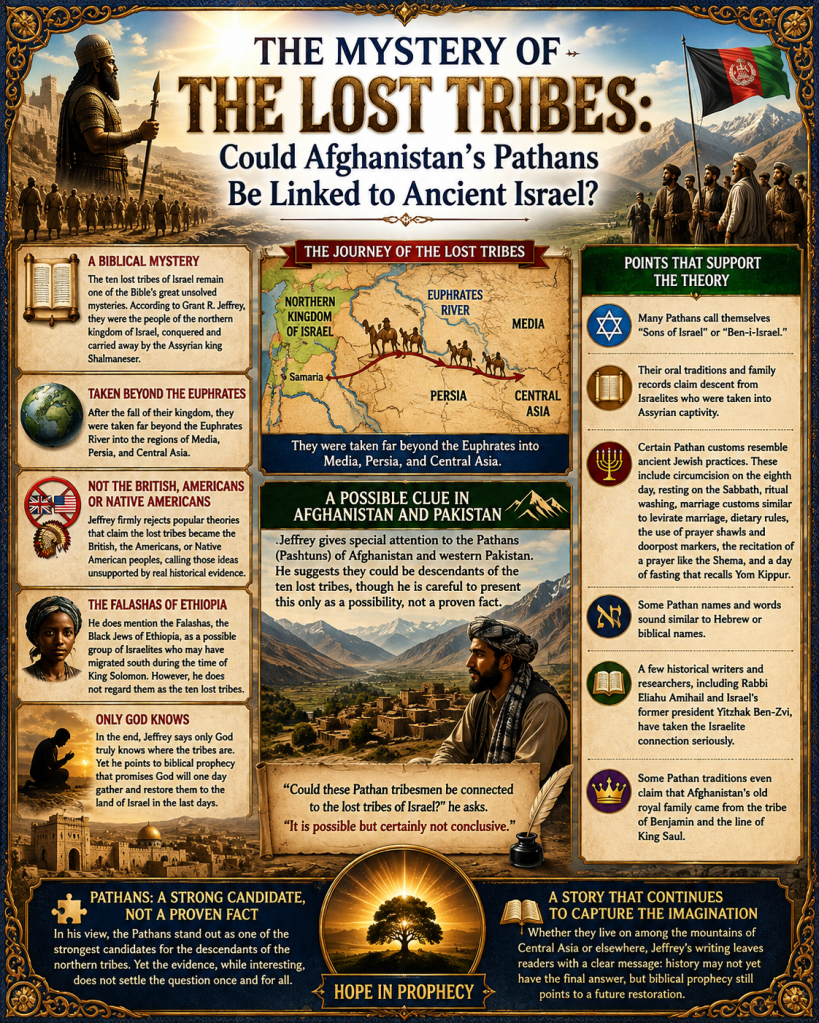
📖 The ten lost tribes of Israel remain one of the Bible’s great unsolved mysteries. According to author Grant R. Jeffrey, these were the people of the northern kingdom of Israel who were conquered and carried away by the Assyrian king Shalmaneser. After the fall of their kingdom, they were taken far beyond the Euphrates River into the regions of Media, Persia, and Central Asia.
🌍 Jeffrey stresses that these tribes did not simply disappear. He believes they remained a large and distinct population for a long time, even though their exact identity and location are unknown today. He firmly rejects popular theories that claim the lost tribes became the British, the Americans, or Native American peoples, calling those ideas unsupported by real historical evidence.
🇪🇹 He does mention the Falashas, the Black Jews of Ethiopia, as a possible group of Israelites who may have migrated south during the time of King Solomon. However, he does not regard them as the ten lost tribes.
🙏 In the end, Jeffrey says only God truly knows where the tribes are. Yet he points to biblical prophecy that promises God will one day gather and restore them to the land of Israel in the last days.
🏔️ A Possible Clue in Afghanistan and Pakistan
🧭 Among the many theories, Jeffrey gives special attention to the Pathans (also known as Pashtuns) of Afghanistan and western Pakistan. He suggests they could be descendants of the ten lost tribes, though he is careful to present this only as a possibility, not a proven fact.
🔎 Several points, he notes, have led researchers to consider the idea:
- 🇮🇱 Many Pathans call themselves “Sons of Israel” or “Ben-i-Israel.”
- 📜 Their oral traditions and family records claim descent from Israelites who were taken into Assyrian captivity.
- 🕯️ Certain Pathan customs resemble ancient Jewish practices. These include circumcision on the eighth day, resting on the Sabbath, ritual washing, marriage customs similar to levirate marriage, dietary rules, the use of prayer shawls and doorpost markers, the recitation of a prayer like the Shema, and a day of fasting that recalls Yom Kippur.
- 🔤 Some Pathan names and words sound similar to Hebrew or biblical names.
- 📚 A few historical writers and researchers, including Rabbi Eliahu Amihail and Israel’s former president Yitzhak Ben-Zvi, have taken the Israelite connection seriously.
- 👑 Some Pathan traditions even claim that Afghanistan’s old royal family came from the tribe of Benjamin and the line of King Saul.
⚖️ Despite these intriguing details, Jeffrey is cautious. “Could these Pathan tribesmen be connected to the lost tribes of Israel?” he asks. “It is possible but certainly not conclusive.”
🧩 In his view, the Pathans stand out as one of the strongest candidates for the descendants of the northern tribes. Yet the evidence, while interesting, does not settle the question once and for all.
🌄 The story of the ten lost tribes continues to capture the imagination. Whether they live on among the mountains of Central Asia or elsewhere, Jeffrey’s writing leaves readers with a clear message: history may not yet have the final answer, but biblical prophecy still points to a future restoration.

