Azahari Hassim
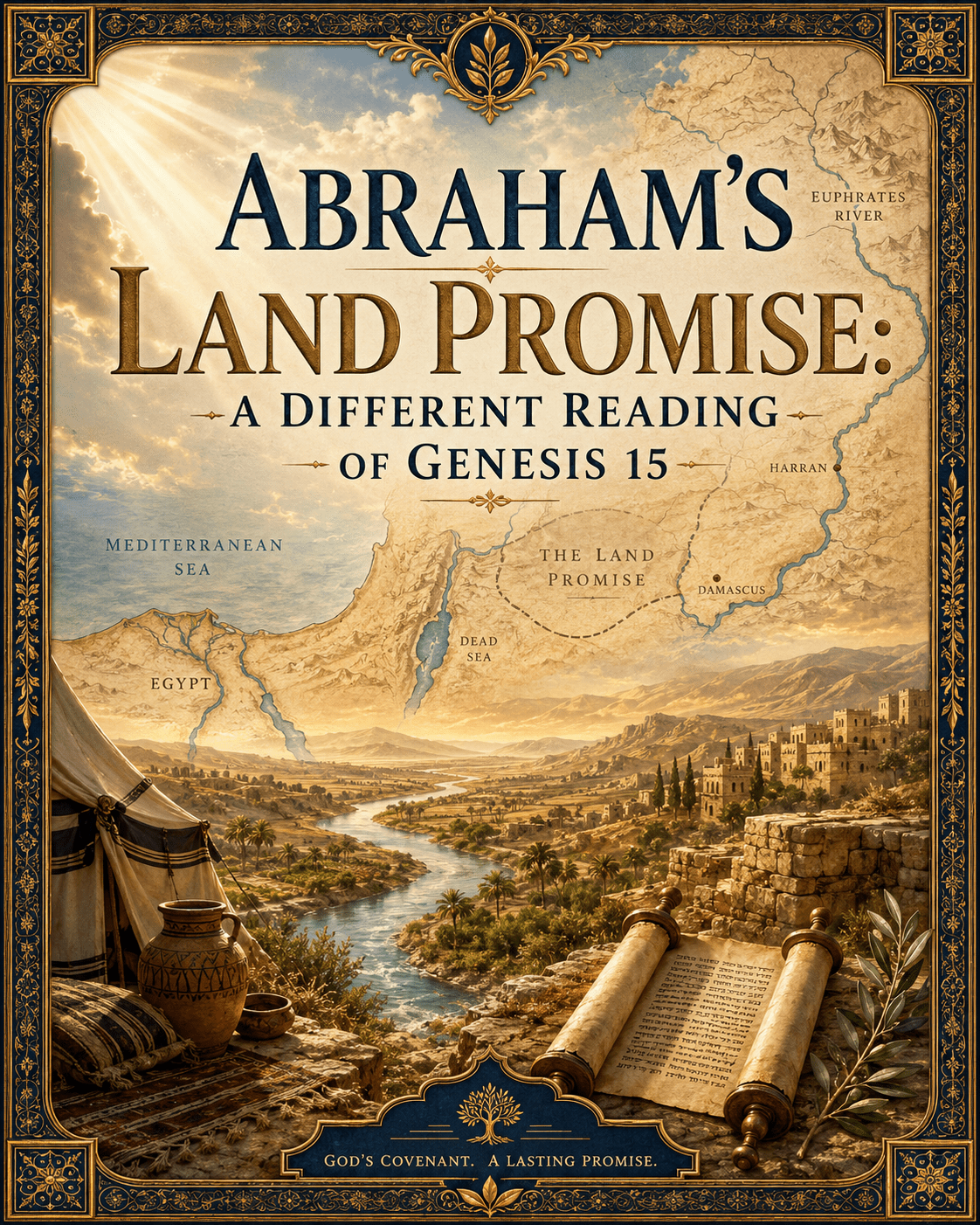
🌍 Abraham’s Land Promise: A Different Reading of Genesis 15
📖 The land promise in Genesis 15 is one of the most debated passages in Abrahamic theology. In that chapter, God tells Abram that his “seed” will be given land stretching “from the River of Egypt unto the great river, the river Euphrates.” For many readers, this verse has become the foundation for major religious and political claims about the land.
🗺️ Many Messianic Jews and Christian Zionists interpret this promise as a divine grant of “Eretz Yisrael,” or Greater Israel, to the Israelites or the Jewish people. In this view, the promise belongs specifically to the descendants of Jacob and continues to support Jewish claims over a wide territory in the modern Middle East.
⚖️ However, another interpretation argues that Genesis 15 should not be read only through the later history of Jacob’s descendants. The passage speaks of Abraham’s “seed,” but it does not yet name Isaac, Jacob, or the Israelite nation. At this point in the biblical story, the promise is still attached directly to Abraham and his wider line of descent.
👶 This detail is important because the next major birth narrative after Genesis 15 is the birth of Ishmael, Abraham’s firstborn son. Ishmael appears before Isaac in the biblical sequence, and he is traditionally understood as the ancestor of many Arab peoples. From this perspective, the timing of the story suggests that Ishmael, as Abraham’s firstborn son, stands within the Abrahamic covenantal legacy before the later Sinai covenant is given to Jacob’s descendants.
🌙 From this perspective, the “seed” of Abraham in Genesis 15 can be understood as referring to Ishmael, Abraham’s firstborn son, who remained under the Abrahamic covenant. By contrast, Isaac’s descendants through Jacob entered a later and more specific covenant: the Sinai covenant, given through Moses and conditioned upon faithfulness to God’s Law.
📜 This distinction between the Abrahamic covenant and the Sinai covenant is central to the argument. The Abrahamic covenant is seen as older, broader, and connected to Abraham’s direct promise. The Sinai covenant, however, came later through Moses and was given specifically to the children of Israel after the Exodus.
⚖️ Under the Sinai covenant, Israel’s blessings in the land were repeatedly linked to obedience, faithfulness, and keeping God’s commandments. Leviticus 26, for example, presents security in the land as conditional. If the Israelites obey God, they receive blessing; if they rebel, they face punishment, exile, and loss.
✝️ From a Christian and Islamic perspective, this raises a serious theological question. If the religious authorities among the Israelites rejected the Messiah when he came, can the land still be claimed unconditionally under the same covenantal terms? This interpretation argues that covenant privilege cannot be separated from covenant responsibility.
📏 The argument also points out that later biblical descriptions of Israel’s land, such as those found in Numbers, Deuteronomy, and Ezekiel, often describe a smaller territory than the vast region mentioned in Genesis 15. This suggests that the wide promise from Egypt to the Euphrates may belong to a broader Abrahamic horizon rather than only to the later national borders of Israel.
🕌 Supporters of this reading argue that the spread of Ishmael’s descendants and the later expansion of Islam across a vast region — including lands between Egypt and the Euphrates and even beyond — may be understood as a historical fulfilment of God’s promise to Abraham through Ishmael. In this view, the promise was not left unfulfilled, nor does it need to be revived through a modern political project of Greater Israel.
🏞️ Under this interpretation, the broad land promise of Genesis 15 was fulfilled through Abraham’s firstborn line, especially through the descendants of Ishmael and the spread of Islam. The later covenant with Israel at Sinai had its own separate land framework, but it was narrower, more specific, and conditional upon obedience to God’s Law.
🕊️ This reading therefore challenges the claim that Genesis 15 automatically supports modern territorial expansion in the name of Greater Israel. It argues that such a claim may confuse two different covenants: the Abrahamic covenant associated with Ishmael, and the Sinai covenant associated with Jacob’s descendants.
📌 The deeper issue is not only geography, but covenant theology. If Ishmael is acknowledged as Abraham’s firstborn and as standing within Abraham’s covenantal legacy, then the promise made to Abraham’s “seed” can be interpreted as applying to Ishmael. At the same time, the descendants of Israel also had their own historical inheritance in the land of Canaan before the coming of Islam, beginning with Joshua and continuing through the kingdoms of David and Solomon.
🧭 In this view, the Israelites did receive and rule the land within their own biblical history. However, that inheritance belonged to the later Sinai covenant, which was given through Moses and tied to obedience, justice, and faithfulness to God’s Law. Therefore, it should not be confused with the broader Abrahamic covenant, which this interpretation connects especially with Ishmael as Abraham’s firstborn, Abraham’s wider covenantal legacy, and the later spread of Islam among Ishmael’s descendants.
🌿 The conclusion of this interpretation is that the struggle for Greater Israel today is theologically unnecessary and may even contradict the will of God. The land of Canaan had already been inherited by the Israelites in the pre-Islamic period through Joshua and later ruled under King David and King Solomon, while the wider Abrahamic promise may be understood as fulfilled through Abraham’s broader family, especially through Ishmael and the spread of Islam. Therefore, the proper response is not conquest or endless territorial expansion, but humility, justice, and peace among the peoples who trace their story back to Abraham.
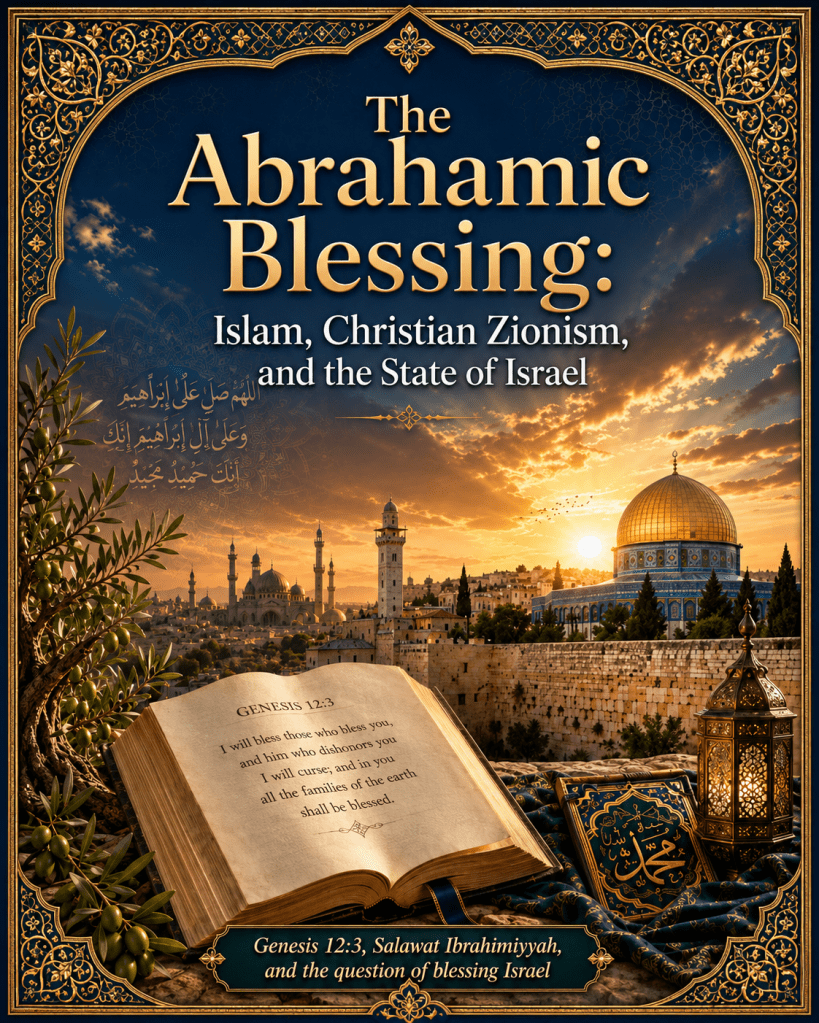
The Abrahamic Blessing: Islam, Christian Zionism, and the State of Israel
📖 Genesis 12:3 is one of the most important verses in the Abrahamic tradition. In this verse, God says to Abraham:
“I will bless those who bless you, and whoever curses you I will curse; and all peoples on earth will be blessed through you.”
The verse contains two major ideas: first, that Abraham carries a special divine blessing; second, that this blessing is ultimately meant to reach all nations, not remain limited to one ethnic group alone. (biblehub.com)
🕋 From an Islamic standpoint, Abraham is not viewed merely as the ancestor of one nation. He is viewed as a universal prophet of tawḥīd, the pure worship of the One God. The Qur’an presents Abraham as neither Jew nor Christian, but as a ḥanīf, a true monotheist who submitted himself to Allah. Therefore, the blessing of Abraham is understood as a spiritual and prophetic blessing rooted in faith, obedience, righteousness, and submission to God.
🤲 This is where Ṣalawāt Ibrāhīmiyyah becomes deeply meaningful. In the prayer taught by Prophet Muhammad ﷺ, Muslims say:
“O Allah, send Your blessings upon Muhammad and the family of Muhammad, as You sent Your blessings upon Abraham and the family of Abraham.”
This wording appears in authentic hadith collections, including Ṣaḥīḥ al-Bukhārī. (sunnah.com)
🌙 Theologically, this prayer connects the mission of Prophet Muhammad ﷺ to the Abrahamic line of blessing. Muslims are not asking for a separate blessing disconnected from Abraham. Rather, they are asking Allah to bless Muhammad ﷺ and his family in continuity with the blessing already given to Abraham and his family. This means that, in Islamic theology, the Abrahamic blessing reaches its universal expression through the final prophethood of Muhammad ﷺ.
🧭 From this perspective, Genesis 12:3 is not about political loyalty to a modern state. It is about alignment with the divine mission of Abraham: worship of the One God, rejection of idolatry, moral responsibility, and guidance for all peoples. To “bless Abraham” means to honour his true religion, his prophetic legacy, and the universal message of submission to God.
✝️ Christian Zionism often reads Genesis 12:3 differently. Many Christian Zionists interpret the verse as a continuing divine command to support the Jewish people and, by extension, the modern State of Israel. The International Christian Embassy Jerusalem, for example, describes Genesis 12:3 as one of the most frequently cited biblical mandates for Christians to “stand with Israel” and bless the Jewish people. (ICEJ)
🇮🇱 In this Christian Zionist reading, blessing Israel is not merely a private spiritual attitude. It can become political, financial, diplomatic, and even military support for the State of Israel. Some Christian Zionist arguments claim that nations which support Israel receive divine favour, while those that oppose Israel risk divine judgment. Recent reporting on evangelical support for Israel notes that Genesis 12 is frequently used as a foundation for this belief. (Houston Chronicle)
⚖️ However, not all Christians accept this interpretation. Some Christian theologians argue that Genesis 12:3 should not be used as a direct theological justification for supporting every policy of the modern State of Israel. Ligonier Ministries, for example, argues that there may be political reasons for supporting some Israeli policies, but Genesis 12:3 itself does not provide a theological reason to support the modern nation-state unconditionally. (Ligonier Ministries)
🌿 The key difference is this: Christian Zionism often links Abraham’s blessing to ethnic Israel and the modern State of Israel, while the Islamic perspective links Abraham’s blessing to tawḥīd, prophethood, righteousness, and the continuation of Abraham’s spiritual legacy through Muhammad ﷺ. In Islam, Abraham’s blessing is not cancelled, but universalized. It flows through the family of Abraham, includes the line of Ishmael, and reaches the nations through the final Messenger.
🕌 Therefore, Ṣalawāt Ibrāhīmiyyah can be seen as a powerful Islamic response to Genesis 12:3. Every time Muslims send blessings upon Muhammad ﷺ and his family “as” Allah blessed Abraham and his family, they are affirming that the Abrahamic promise is alive — not as a narrow ethnic nationalism, but as a living spiritual covenant centred on worship, mercy, guidance, and submission to Allah.
🌍 In conclusion, Genesis 12:3 can be understood in two very different ways. Christian Zionism often reads it as a mandate to bless and support the State of Israel. Islam reads the Abrahamic blessing through the lens of tawḥīd and prophethood, fulfilled in the universal mission of Muhammad ﷺ and remembered daily through Ṣalawāt Ibrāhīmiyyah. The real blessing of Abraham, from the Islamic standpoint, is not the domination of one nation over another, but the spread of divine guidance to all families of the earth.
From Ancient Conquest to Modern Irony: When Scripture Is Used Against the Worshippers of Abraham’s God
📜 In the Hebrew Bible, the ancient Israelites are described as a people chosen to worship the God of Abraham, Isaac, and Jacob. Their identity was built around covenant, law, and loyalty to one God. In the biblical story, they were commanded to enter the land of Canaan and remove its inhabitants because those nations were seen as idolaters who practiced corrupt religion and immoral customs.
⚔️ This command appears most strongly in the books of Deuteronomy and Joshua. The Canaanites are presented as nations whose religious practices threatened Israel’s faith. The Israelites were told not merely to live among them, but to destroy their altars, reject their gods, and in some passages, wipe them out completely. This was known as a holy war or a war of total devotion.
🕊️ Whether one reads these passages as literal history, theological memory, or ancient war language, the message is clear: the biblical conquest was framed as a struggle between monotheism and idolatry. The Israelites were not commanded to remove people simply because they were foreign. They were commanded to resist a religious order that the Bible presents as idolatrous and morally corrupt.
🔍 This creates a deep historical irony in the modern Holy Land.
☪️ Today, many Palestinians in the land are Muslims and Christians. They are not idolaters. They worship the God of Abraham. Muslims honor Abraham as a prophet and see themselves as followers of his pure monotheism. Palestinian Christians also worship the God of Abraham through their own religious tradition. In other words, many of the people now facing displacement, occupation, and violence are themselves believers in the Abrahamic God.
🏛️ Yet some modern Israeli political and settler movements use the Bible to justify domination over the same land. They speak of ancient promises, biblical borders, and divine inheritance. Some use this language to defend settlements, expulsions, or the denial of Palestinian national rights.
⚖️ The irony is sharp: in the ancient biblical story, the Israelites were commanded to remove idolaters from the land. In the modern political story, biblical language is sometimes used against Palestinians who are not idolaters at all, but worshippers of the God of Abraham.
📌 There is another irony. Modern Zionism began largely as a secular nationalist project, rather than a religious movement. Many of its early leaders were atheists and secular nationalists. Even today, a large number of Israeli Jews identify as secular or non-observant, while some also identify as atheist or do not believe in God in a traditional religious sense. Yet biblical claims are still used in political arguments over land, sovereignty, and settlement.
🕍 This does not mean all Jews support such policies. Many Jews, including religious Jews, reject occupation, racism, and violence against Palestinians. Many see the prophetic message of the Bible as a call to justice, humility, and protection of the stranger.
⚠️ The problem is not Judaism itself, but political Zionism when it uses scripture selectively to sanctify power, land control, and the denial of Palestinian rights.
🔥 When ancient scripture is used without moral reflection, it can become dangerous. A text that once condemned idolatry can be turned into a weapon against fellow worshippers of God. A story about covenant can be reduced to a claim of ethnic supremacy. A sacred land can become a battlefield of domination rather than a place of justice.
🌿 The deeper question is not only who has ancient roots in the land. The deeper question is whether people who claim Abraham’s inheritance are living by Abraham’s faith: justice, mercy, hospitality, and submission to the One God.
🏞️ If the Holy Land is truly holy, then holiness cannot be measured only by borders, flags, or ancient conquest stories. It must also be measured by how the weak, the displaced, and the oppressed are treated.
💔 The tragedy of the modern Holy Land is that the language of God is sometimes used to deny the rights of people who worship God. That is not the spirit of Abraham. It is the corruption of his legacy.
Sham vs. Mecca
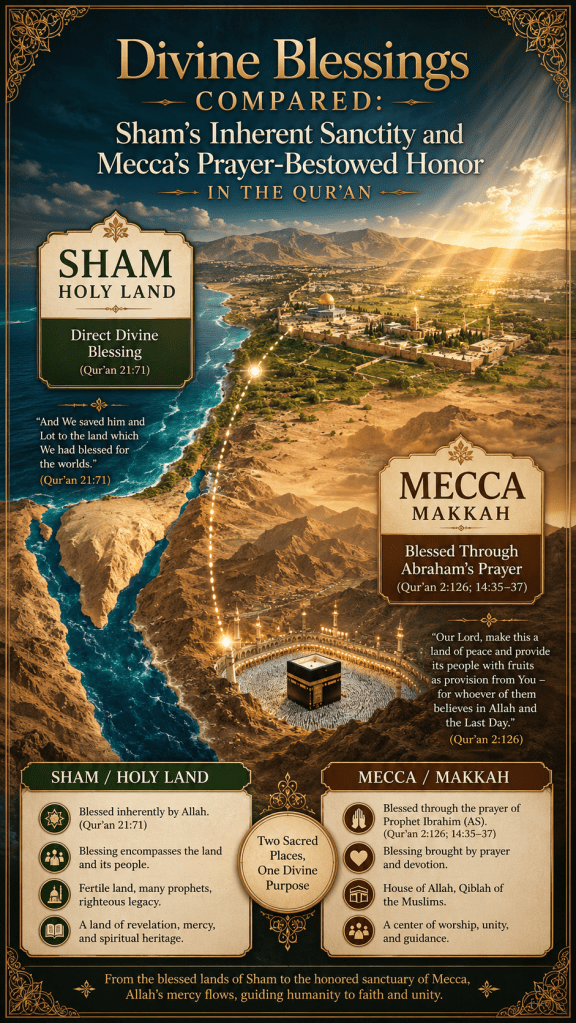
⚖️ Divine Blessings Compared: Sham’s Inherent Sanctity and Mecca’s Prayer-Bestowed Honor in the Qur’an
The difference between the divine blessing of the land of Sham (Greater Syria, including Palestine) as mentioned in Surah 21:71 and the blessing of Mecca (Makkah) in the Qur’an lies in the source and nature of the sanctity attributed to each location.
Here’s a structured comparison:
⸻
📍1. Sham (Greater Syria / Holy Land / Jerusalem) – Direct Divine Blessing
🔹 Qur’anic Reference:
Surah Al-Anbiya’ (21:71):
“And We delivered him [Ibrahim] and Lot to the land which We had blessed for the worlds.”
(وَنَجَّيْنَاهُ وَلُوطًا إِلَى ٱلْأَرْضِ ٱلَّتِى بَـٰرَكْنَا فِيهَا لِلْعَـٰلَمِينَ)
🔸 Key Point:
• The land itself is blessed by Allah directly, without mentioning any human prayer or intervention.
• Classical and modern scholars identify this “blessed land” as Sham, specifically Palestine, including Jerusalem.
• This indicates intrinsic and pre-existing sanctity granted by divine will.
⸻
📍2. Mecca (Makkah) – Blessed Through Prophetic Prayer of Abraham
🔹 Qur’anic References:
• Surah Al-Baqarah (2:126):
“And [remember] when Abraham said, ‘My Lord, make this a safe city and provide its people with fruits…’”
• Surah Ibrahim (14:35–37):
“My Lord, make this city secure and keep me and my sons away from worshipping idols… I have settled some of my descendants in an uncultivated valley near Your sacred House…”
🔸 Key Point:
• Mecca was originally a barren valley (valley of Bakkah) without vegetation.
• Its sanctity and blessings came as a result of Abraham’s prayer and the subsequent building of the Kaʿbah (House of God).
• The Qur’an presents Mecca’s blessing and safety as a response to prophetic supplication.
⸻
⚖️ Summary of the Difference
Source of Blessing:
• Sham / Holy Land: Direct divine declaration — “…the land which We had blessed…” (Surah 21:71).
• Mecca / Makkah: Blessed through Abraham’s prayer (Surah 2:126, 14:35–37).
Timing of Blessing:
• Sham / Holy Land: Already blessed when Ibrahim and Lut arrived.
• Mecca / Makkah: Became blessed due to Abraham’s prayer for the settlement of his offsprings.
Nature of Sanctity:
• Sham / Holy Land: Inherent, natural sanctity as a land for all nations.
• Mecca / Makkah: Earned sanctity through prophetic action and ritual significance.
Historical Role
• Sham / Holy Land: Site of many prophets (e.g., Ibrahim, Musa, Isa).
• Mecca / Makkah: Site of the Kaʿbah and the final prophet Muhammad ﷺ.
⸻
🧭 Theological Implications
• Sham is viewed as a blessed land for all peoples and times, with spiritual, historical, and eschatological significance (e.g., place of Jesus’ return, land of many prophets).
• Mecca stands as the spiritual epicenter of Islam — the qiblah of all Muslims and the destination of the Hajj — yet its blessed status in the Qur’an is portrayed not as an inherent quality from the beginning, but as a divine bestowal granted in response to the supplication and devotion of Prophet Ibrahim عليه السلام.

