Azahari Hassim
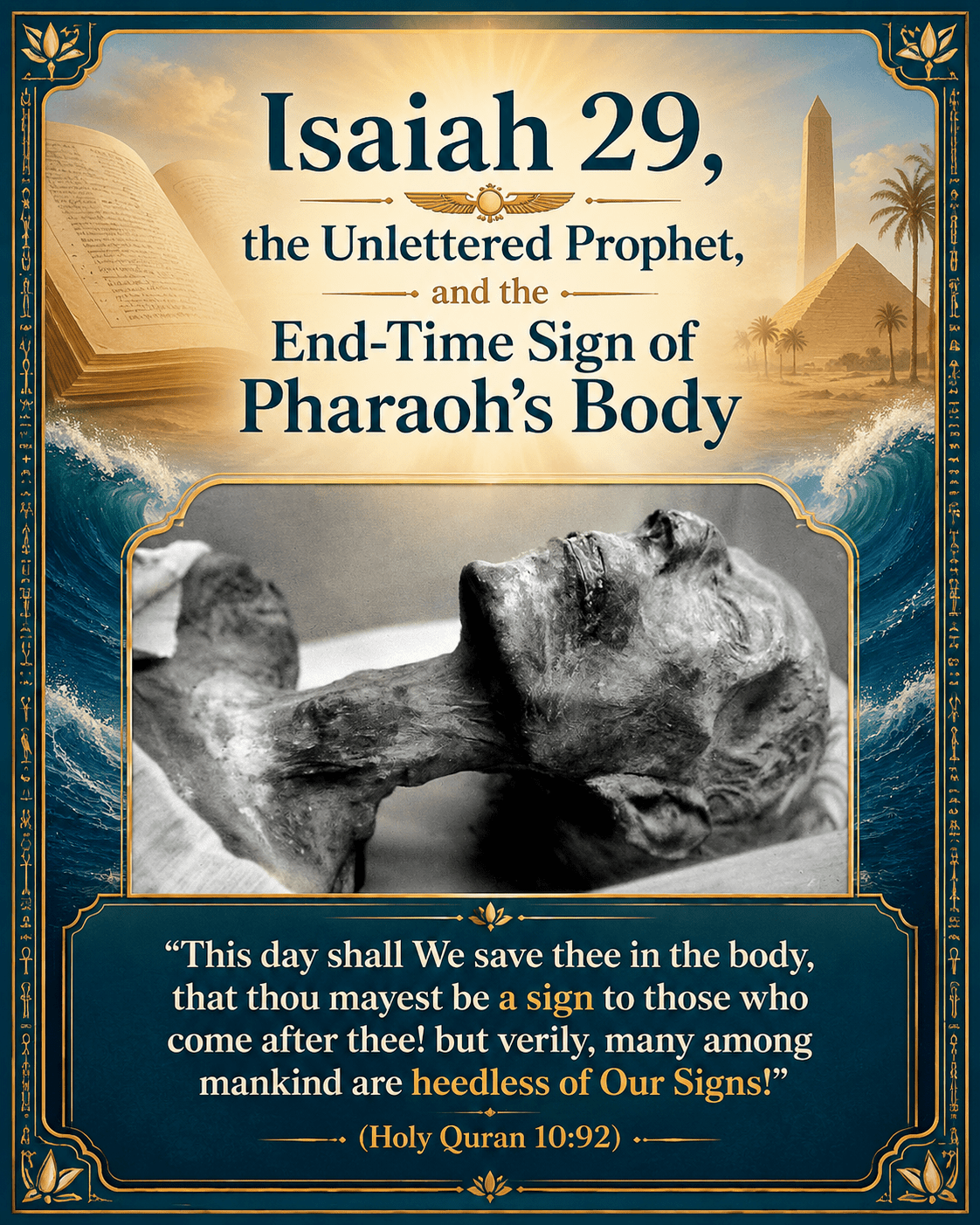
📰 Isaiah 29, the Unlettered Prophet, and the Mummy of Pharaoh: A Sign for the End Times
📖 Isaiah 29 contains one of the most remarkable prophetic echoes in the Bible. It speaks of a book being given to an unlearned man, and it speaks of a “marvelous work and a wonder” that God would bring forth among the people. From an Islamic perspective, these words point directly to two great signs: the revelation of the Qur’an to Prophet Muhammad ﷺ and the preservation of Pharaoh’s body as a warning for later generations.
📜 Isaiah 29:12 says:
“And the book is delivered to him that is not learned, saying, Read this, I pray thee: and he saith, I am not learned.”
For Muslims, this is not a vague statement. It strongly mirrors the first revelation of the Qur’an in the Cave of Ḥirā’, when the angel Jibrīl commanded Prophet Muhammad ﷺ to read, and he replied that he could not read.
🕋 This is why the verse is so powerful. Prophet Muhammad ﷺ was known as al-nabiyy al-ummī, the unlettered Prophet. He did not study scripture under rabbis, priests, philosophers, or scribes. Yet through him came the Qur’an — a book that transformed Arabia, challenged empires, corrected theological corruption, and called humanity back to the pure worship of the One God.
⚡ This is the first miracle in the passage: a divine book delivered through an unlettered man. Human wisdom expected revelation to come through elite scholars or religious institutions. But God chose Muhammad ﷺ, an unlettered Prophet, so that no one could honestly claim that the Qur’an was copied, manufactured, or learned from human teachers.
📖 Then Isaiah 29:14 declares:
“Therefore, behold, I will proceed to do a marvelous work among this people, even a marvelous work and a wonder.”
This verse points to another divine act — not merely a message, but a visible sign. The phrase “I will proceed” suggests that God would again perform a mighty wonder, just as He had done in the past.
🌊 The language naturally recalls the miracle of Moses at the sea. Pharaoh pursued the Children of Israel with arrogance and military power. Moses appeared trapped. The sea stood before him, Pharaoh behind him, and destruction seemed certain. But God split the sea, saved the believers, and drowned the tyrant who had defied Him.
🏺 Yet the Qur’an brings to light a detail that is not clearly disclosed in the biblical account: Pharaoh’s body would be preserved. In Surah Yunus 10:92, Allah declares that Pharaoh’s body would be saved so that he would become a sign for those who came after him. This is not a symbolic statement only. It is a physical, historical, and visible sign.
📜 This detail also finds an important echo in Psalm 136:15, which states that God “overthrew Pharaoh and his host in the Red Sea.” While the Book of Exodus clearly describes the drowning of Pharaoh’s army, chariots, and horsemen, it does not state as explicitly that Pharaoh himself drowned in the same event.
Psalm 136:15, however, makes the matter clearer by placing Pharaoh himself together with his forces in the sea. In this way, the Psalms strengthen the understanding that Pharaoh personally met his end in the waters after pursuing Moses and the Children of Israel.
👑 That Pharaoh was Ramesses II. In this Islamic-apologetic reading, the identity of the Pharaoh of Moses is none other than Ramesses II, the powerful Egyptian ruler remembered for his monuments, military campaigns, royal pride, and association with the age of Moses. The discovery and preservation of his mummy in the modern age stand as a stunning confirmation of the Qur’anic declaration.
🔍 This is the “marvelous work and wonder” of Isaiah 29:14: the body of the drowned tyrant, preserved across thousands of years, brought out in the modern age as a silent witness. The man who claimed power, majesty, and divine-like authority became a lifeless sign for the nations.
⚖️ The irony is profound. Pharaoh tried to erase the believers. Instead, his own body was preserved as evidence against him. He pursued Moses to destroy him, but today it is Pharaoh’s body that reminds the world of Moses’ truth. He stood against revelation, yet his preserved remains now serve the message of revelation.
🌍 This sign speaks powerfully to the modern world. In an age that often trusts only archaeology, science, museums, and material evidence, Allah has made Pharaoh’s body a sign that even the modern eye can see. The mummy of Ramesses II is not merely an ancient corpse. It is a theological witness.
🔥 Isaiah 29:12 and Isaiah 29:14 therefore form a connected pattern. First, the book is given to the unlettered Prophet — the Qur’an revealed to Muhammad ﷺ. Then, God brings forth a marvelous sign — the preserved body of Pharaoh, identified as Ramesses II, confirming the Qur’anic warning in Surah Yunus 10:92.
🕊️ The message is clear: God’s signs do not vanish. They may be hidden for centuries, buried beneath sand, locked inside tombs, or ignored by arrogant nations. But when Allah wills, He brings them back into view.
⏳ For the end times, this sign carries a warning. Pharaoh represents tyranny, arrogance, denial, and the persecution of God’s servants. His preserved body warns every ruler, empire, and civilization that power without submission to God ends in humiliation.
📢 The Qur’an did not merely tell a story about the past. It announced a sign for the future. The mummy of Ramesses II stands as that sign — a “marvelous work and a wonder” — reminding humanity that the God who saved Moses, revealed the Qur’an to the unlettered Prophet, and preserved Pharaoh’s body is the same God who will judge the world at the end of time.
A Fourth Era of Miracles? An Islamic Reading of Isaiah 29
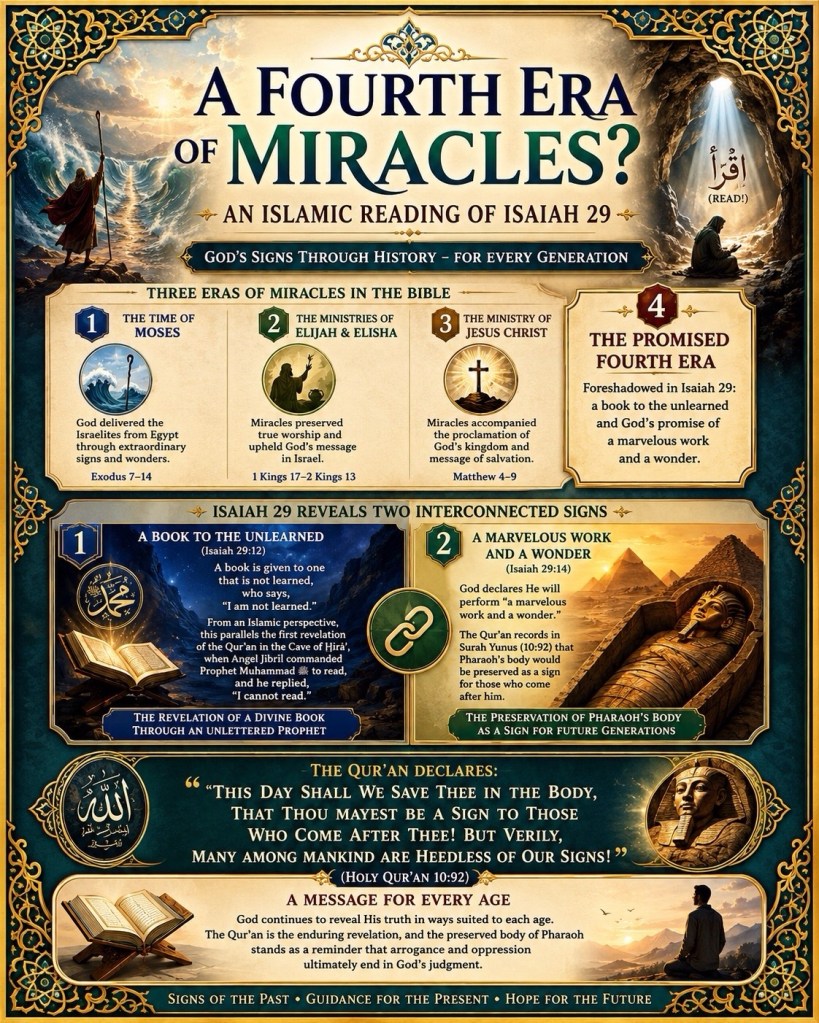
📖 Many Bible scholars observe that miracles are concentrated in three major periods of biblical history. The first was during the time of Moses, when God delivered the Israelites from Egypt through extraordinary signs. The second came during the ministries of Elijah and Elisha, when miracles preserved true worship in Israel. The third was the ministry of Jesus Christ, whose miracles accompanied the proclamation of God’s kingdom.
🔍 Some Muslim scholars and apologists argue that the biblical story points to a fourth and final period of divine signs. They believe this period is foreshadowed in Isaiah 29, where two remarkable events appear side by side: a book being given to an unlearned man and God promising to perform “a marvelous work and a wonder.”
📜 Isaiah 29:12 describes a book being given to someone “that is not learned,” who replies, “I am not learned.” From an Islamic perspective, this closely parallels the first revelation of the Qur’an in the Cave of Ḥirā’, where the Angel Jibrīl commanded Prophet Muhammad ﷺ to read, and he responded that he could not read. Muslims regard this as the beginning of the Qur’anic revelation to the unlettered Prophet.
⚡ Isaiah 29:14 then declares that God will perform “a marvelous work and a wonder.” In this Islamic interpretation, the prophecy extends beyond revelation itself to a visible sign for later generations.
🏺 The Qur’an records in Surah Yunus (10:92) that Pharaoh’s body would be preserved as a sign for those who came after him. Many Muslim apologists identify the Pharaoh of Moses with Ramesses II and view the discovery and preservation of his mummy in the modern age as a striking fulfillment of that Qur’anic statement. This identification, while debated among followers of other faiths, is presented by its proponents as a powerful confirmation of the Qur’an’s message.
🌍 According to this reading, Isaiah 29 presents two interconnected signs: first, the revelation of a divine book through an unlettered prophet, and second, a visible historical witness in the preserved body of Pharaoh. Together, these events are understood as marking a final era of divine signs addressed not only to ancient peoples but also to the modern world.
🕊️ For Muslims who hold this interpretation, the message is clear: God continues to reveal His truth in ways suited to each age. The Qur’an serves as the enduring revelation, while the preserved body of Pharaoh stands as a reminder that arrogance and oppression ultimately end in God’s judgment.
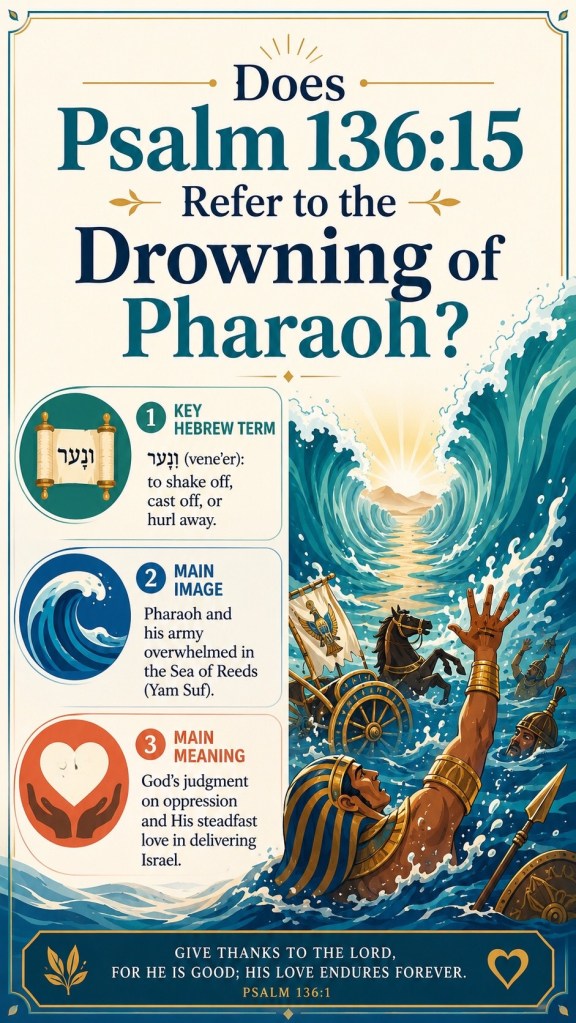
Does Psalm 136:15 Refer to the Drowning of Pharaoh?
📖 Hebrew Text of Psalm 136:15:
וְנִעֵר פַּרְעֹה וְחֵילוֹ בְּיַם־סוּף כִּי לְעוֹלָם חַסְדּוֹ׃
🌍 English Translation
A translation close to the Hebrew text would be:
“And He shook off Pharaoh and all his army into the Sea of Reeds, for His steadfast love endures forever.”
The verb “shook off” seeks to capture the nuance of the Hebrew וְנִעֵר, which literally carries the sense of “to shake, shake loose, or cast off.”
🔍 Word-by-Word Explanation
וְנִעֵר — vene’er
This is a verb meaning “to shake, cast off, or forcefully remove.”
It does not simply mean that Pharaoh was “placed” in the sea. Rather, it describes God’s firm and powerful action, as though He “shook loose” the enemy from their position.
👑 פַּרְעֹה — Par‘oh and וְחֵילוֹ — veḵheiló
“Par‘oh” means Pharaoh, the king of Egypt.
“Ḥeiló” means “his army” or “his military force.”
Therefore, the phrase emphasizes that not only the leader was destroyed, but also the entire military power that supported him.
🌊 בְּיַם־סוּף — beYam Suf
Literally, this means “in the Sea of Reeds,” often traditionally rendered as the Red Sea.
It refers to the sea that was divided and then overwhelmed the Egyptian forces in the Exodus story.
This reminds the reader of Israel’s deliverance and Egypt’s judgment happening at the same time.
💛 כִּי לְעוֹלָם חַסְדּוֹ — ki le‘olam ḥasdó
This means, “for His steadfast love endures forever.”
Here, ḥesed refers to firm covenantal love: a combination of love, mercy, covenant faithfulness, and God’s active goodness toward His people.
This phrase is the repeated refrain in every verse of Psalm 136, stressing that every act of God, including judgment against enemies, flows from His steadfast love for His people.
🧭 Overall Semantic Meaning
Psalm 136:15 semantically points to the drowning of Pharaoh and his army by describing God as “shaking off” or forcefully casting Pharaoh and his military power into the Sea of Reeds. The verse presents this not only as an act of judgment against oppression, but also as an act of deliverance for Israel, flowing from God’s everlasting steadfast love.
Thus, based on the meaning of the Hebrew wording, Pharaoh is portrayed as being overwhelmed and drowned in the sea together with his forces.
 ABRAHAMIC THEOLOGY