Azahari Hassim
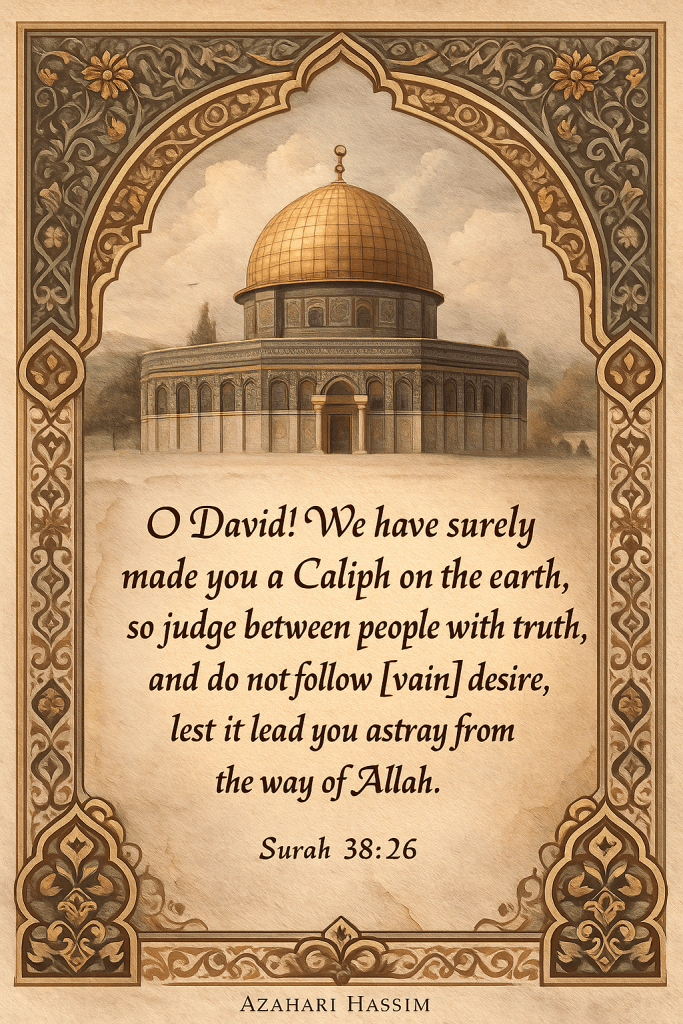
🏰 Surah 38:26 and the Caliphate of David: A Precedent for Muslim Leadership
📖 Divine Appointment of David as Caliph
In Surah Ṣād (38:26), Allah declares:
“O David! We have surely made you a Caliph (successor) on the earth, so judge between people with truth ⚖️, and do not follow [vain] desire, lest it lead you astray from the way of Allah. Indeed, those who go astray from the way of Allah will have a severe punishment 🔥, because they forgot the Day of Reckoning.”
This verse is one of the most direct Qur’ānic affirmations of the concept of Khilāfah (Caliphate) 🕌. Allah not only describes David (Dāwūd عليه السلام) as a prophet and king 👑 but explicitly grants him the title of Caliph (Khalīfah), a divinely appointed successor entrusted with governing the people and upholding justice. This establishes David as the first model Caliph governing from the sacred geography of the Holy Land (al-Arḍ al-Muqaddasah) 🌍.
⸻
🏙️ David as the First Caliph in the Holy Land
Unlike his predecessors, David combined prophethood 📜, kingship 👑, and caliphate 🕌. He ruled from Jerusalem 🕊️, the heart of the Holy Land, where divine authority and sacred geography intersect. His caliphate embodied three principles that later became central to Islamic political theology:
- Divine Appointment ✨ – Authority was conferred by Allah, not by human ambition.
- Justice in Governance ⚖️ – The duty of a Caliph is to judge in truth, resisting personal desire.
- Sacred Geography 🏔️ – David’s seat of rule was Jerusalem, signifying that leadership was bound to the land sanctified by God.
Thus, David’s Caliphate set a paradigm that all future Muslim rulers would look back to for legitimacy.
⸻
👥 The Prophetic Succession and the Caliphs of Islam
When Prophet Muhammad ﷺ passed away, the Muslim community naturally adopted the term Khalīfah (Caliph) 🕌 for his successor, Abu Bakr al-Ṣiddīq. This title directly linked the Islamic Caliphate to David’s precedent in the Qur’an. Just as David was entrusted to govern after divine appointment, so too were the successors of Muhammad entrusted with:
• Safeguarding the community 🛡️
• Enforcing justice ⚖️
• Guiding the people in truth 🌟
From Abu Bakr → Umar → Uthman → Ali (رضي الله عنهم) ✨, and through later dynasties, the Caliphate was understood not merely as political office but as a spiritual trust (amānah) 🤲. Each Caliph inherited the dual responsibility of preserving religion 📖 and administering justice ⚖️, echoing the model given to David.
⸻
🕌 Caliph Umar and Surah 38:26 in Jerusalem
One of the most powerful historical moments connecting David’s Qur’ānic caliphate to the Muslim Caliphate occurred in 638 CE 📅, when Caliph Umar ibn al-Khaṭṭāb entered Jerusalem after its peaceful surrender.
Upon entering the city 🕊️, Umar led the Muslims in prayer 🙏. According to Islamic historical reports, while serving as Imam during his prayer, Umar recited the very verse of Surah 38:26:
“O David! We have surely made you a Caliph on the earth…” 📖
By doing so, Umar deliberately linked his conquest of Jerusalem to David’s legacy. Umar was not presenting himself as a conqueror ⚔️ but as a successor in a divine chain of authority ✨, inheriting the mantle of justice that began with David in the same sacred land. This act sanctified the Muslim Caliphate as the rightful continuation of Abrahamic leadership 🌿 over the Holy Land.
⸻
🔗 Continuity of the Caliphate from David to Muhammad’s Ummah
The Qur’an presents history as a continuous unfolding of divine authority 🌟:
• Adam 🧑🌾 was appointed as the first steward (khalīfah, 2:30).
• David 👑 was confirmed as the model Caliph in the Holy Land (38:26).
• Muhammad ﷺ 🌙, as the Seal of Prophets, left a community to be led by Caliphs who followed this precedent.
Thus, all of Muhammad’s successors — beginning with Abu Bakr and embodied in Umar’s leadership in Jerusalem 🕌 — consciously aligned themselves with David’s example. The Caliph was not just a ruler, but a representative of God’s justice on earth ⚖️.
⸻
🌿 Conclusion
Surah 38:26 elevates David عليه السلام 👑 as the archetypal Caliph, governing from the Holy Land with truth and justice ⚖️. This Qur’ānic model became the foundation for Islamic political leadership 🕌.
When Caliph Umar entered Jerusalem and recited this verse 📖, he proclaimed that the Muslim Caliphate was the rightful heir to David’s divine caliphate ✨. From that moment forward, every Caliph of Islam carried a title and responsibility rooted in the Qur’ānic vision of just rule established by David, the first Caliph of the Holy Land 🏰.
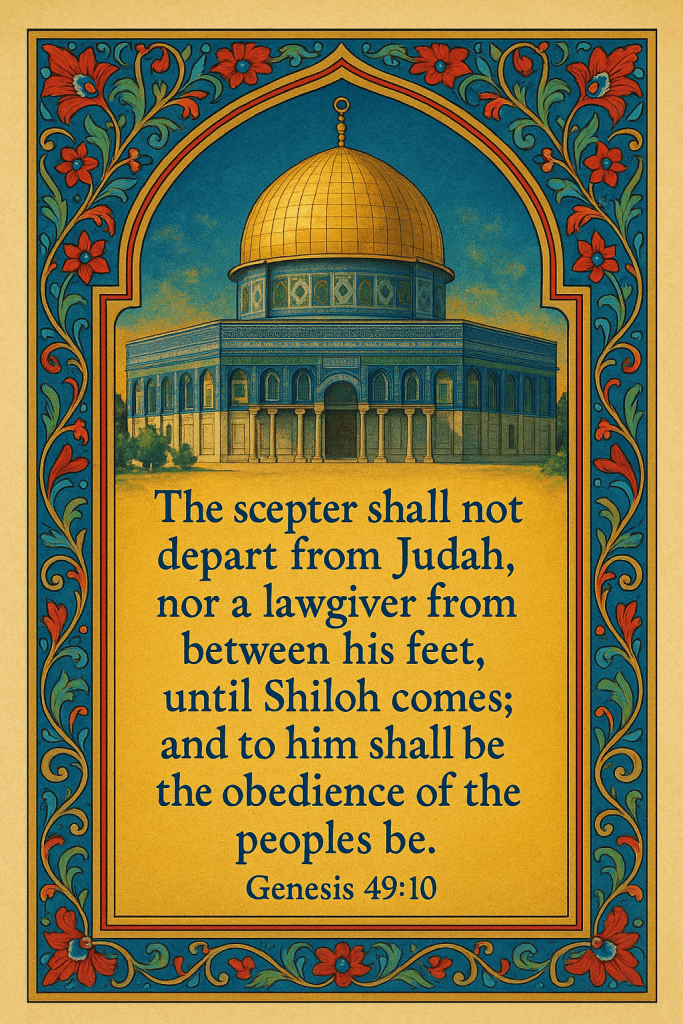
Until Shiloh Comes: The Transfer of Covenant from Sinai to Abraham through Ishmael
Introduction
🌟 Genesis 49:10 stands as one of the most profound prophecies in the Hebrew Bible, where Jacob’s blessing to Judah speaks of a mysterious figure called “Shiloh”. For centuries, both Jewish and Christian traditions have understood this verse as messianic, anticipating a redeemer from Judah’s lineage.
However, when examined through the wider lens of covenantal theology, this verse reveals a deeper transition — from the Sinai covenant, particular to Israel and bound by Mosaic law, to the Abrahamic covenant, universal in scope and ultimately fulfilled through Ishmael’s descendants.
This article explores how the prophecy of “Shiloh” may refer not to a ruler from Judah, but to a divinely appointed messenger from Ishmael’s descendants, through whom the Abrahamic faith reaches its completion and universality in the message of Islam.
This perspective recognizes that it was Ishmael, not Isaac, whom God commanded Abraham to offer in sacrifice — the supreme act of submission that sealed Abraham’s faith. This event, memorialized every year by Muslims in the festival of Eid al-Adha, signifies the enduring covenant through Ishmael’s line, culminating in the coming of Prophet Muhammad ﷺ, the promised Shiloh through whom divine guidance attained its universal form.
1. The Context of Jacob’s Prophecy
In Genesis 49, Jacob gathers his twelve sons and speaks of their future destinies. Concerning Judah, he declares:
“The scepter shall not depart from Judah,
nor a lawgiver from between his feet,
until Shiloh comes;
and to him shall the obedience of the peoples be.”
(Genesis 49:10)
Traditionally, this prophecy has been interpreted as predicting Judah’s enduring leadership until the arrival of a messianic ruler. Yet a covenantal reading reveals that this marks not permanence but transition — from Judah’s temporal authority under the Sinai covenant to the restoration of the Abrahamic covenant through Ishmael, the son of sacrifice and obedience.
Several scholars believe that the word “until” in the verse indicates the time at which Judah’s authority ended.
Therefore, Shiloh (Messiah) does not descend from David’s lineage, which is traced back to Judah.
2. The Scepter and Lawgiver: Symbols of the Sinai Covenant
The first half of the verse — “The scepter shall not depart from Judah, nor a lawgiver from between his feet” — symbolizes the religious and political authority vested in Judah.
The scepter represents kingship, embodied in David and his royal line.
The lawgiver refers to the Torah, the revealed law of Sinai that governed Israel’s covenantal life.
This Sinaitic covenant was conditional and particular, bound to a specific nation and land. It endured “until Shiloh came” — until divine authority passed to the heir of Abraham’s universal covenant through Ishmael.
3. Shiloh and the Renewal of the Abrahamic Covenant through Ishmael
The word Shiloh carries meanings such as peace, rest, or he whose right it is. It thus designates the rightful inheritor of divine authority.
In the story of Abraham’s supreme test, as preserved in Islamic tradition, Ishmael is the son chosen for sacrifice — the act that confirmed both Abraham’s faith and Ishmael’s submission. In recognition of this, God renewed His promise:
“As for Ishmael, I have blessed him, and will make him fruitful, and will multiply him exceedingly; twelve princes shall he beget, and I will make him a great nation.”
(Genesis 17:20)
This promise is inseparable from the earlier Abrahamic benediction in Genesis 22:18:
“And in your seed shall all the nations of the earth be blessed, because you have obeyed My voice.”
From an Islamic perspective, this universal blessing reaches its perfection in Shiloh — the divinely appointed messenger from Ishmael’s descendants, Prophet Muhammad ﷺ, through whom the Abrahamic faith was universalized beyond lineage and territory.
4. Shiloh as the Prophet from Ishmael’s Descendants
In the Islamic understanding, Shiloh points to Muhammad ﷺ, the final messenger and restorer of Abrahamic monotheism.
The scepter and lawgiver symbolize Judah’s rule under the Mosaic order, which lasted until Shiloh’s advent.
The arrival of Shiloh marks the transfer of divine covenant from a national to a universal dispensation.
The phrase “and to him shall the obedience of the peoples be” finds its fulfillment in the global ummah united in Islam.
Through Muhammad ﷺ, the two branches of Abraham’s family — Isaac and Ishmael — converge in spiritual unity, as the promise made on the mountain of sacrifice finds its universal realization.
This fulfills the Abrahamic prophecy of Genesis 22:18 — “in your seed shall all the nations of the earth be blessed” — echoed centuries later in the Qur’anic verse:
“And We have not sent you (O Muhammad) except as a mercy to all the worlds.”
(Surah 21:107)
The blessing to “all nations” in Genesis thus finds its full resonance in the Qur’an’s rahmah lil-‘ālamīn — mercy to the worlds.”
5. The Living Memory of the Covenant: Eid al-Adha
The memory of Abraham’s near-sacrifice of Ishmael is not a forgotten legend. It is commemorated annually by Muslims worldwide in the sacred festival of Eid al-Adha (“The Feast of Sacrifice”).
Each year, millions of believers retrace Abraham’s obedience by offering sacrifices in remembrance of his willingness to surrender his beloved son at God’s command. This universal observance — transcending race, nation, and language — is the living embodiment of the Abrahamic covenant through Ishmael, reaffirming humanity’s submission (Islām) to the One God.
Through Eid al-Adha, the covenant of faith, obedience, and trust in divine will is renewed across generations — a perpetual testimony that the legacy of Abraham and Ishmael remains alive within the heart of the Muslim community.
6. The Biblical and Qur’anic Continuity
The Qur’an reaffirms this covenantal unity:
“Were you witnesses when death approached Jacob, when he said to his sons:
‘What will you worship after me?’
They said: ‘We will worship your God, and the God of your fathers — Abraham, Ishmael, and Isaac — One God, and to Him we submit.’”
(Qur’an 2:133)
Here, Ishmael stands explicitly alongside Abraham and Isaac as a patriarch of covenantal faith, confirming that divine favor is not ethnic but spiritual — a continuity of submission to the Creator.
7. The Transfer of Covenant and Authority
The New Testament, too, preserves a hint of this covenantal transition. Jesus proclaimed:
“And I say unto you, that many shall come from the east and west, and shall sit down with Abraham, Isaac, and Jacob in the kingdom of heaven.
But the children of the kingdom shall be cast out into outer darkness: there shall be weeping and gnashing of teeth.”
(Matthew 8:11–12)
This declaration signifies a divine realignment of covenantal authority. The “children of the kingdom” — those who claimed exclusive descent from Israel — would lose their privileged position, while “many from the east and west” would inherit the covenantal blessings by embracing the faith of Abraham.
From an Islamic perspective, this imagery points to the emergence of a new spiritual community beyond ethnic or national boundaries — the ummah of Islam — gathered from all directions of the earth. It is this global assembly of believers, united in the submission (Islām) that characterized Abraham himself, who truly “sit with Abraham” in the renewed Kingdom of Heaven.
In the Abrahamic continuum, this renewal is realized through Ishmael’s descendants, led by Muhammad ﷺ, the promised Shiloh, through whom the covenant finds its universal completion. Thus, the “Kingdom of Heaven” in Jesus’ saying can be seen as the restored Abrahamic faith of submission, embodied and perfected in Islam.
8. From Sinai to Mecca: The Completion of the Covenant
The geography of revelation reflects this sacred progression:
From Mount Sinai, where the Law was given to Moses;
To Mount Zion, where David ruled over Israel;
To the Sanctuary of Mecca, where Muhammad ﷺ restored the House of Abraham.
Thus, revelation moves from law to faith, from tribe to humanity, from Sinai to Mecca. The coming of Shiloh from Ishmael’s line fulfills the Abrahamic promise in its universal form, making Islam the completion of the covenant’s long journey — the very fulfillment of Genesis 22:18 and Surah 21:107 united in one divine truth.
9. Conclusion
Genesis 49:10 encapsulates the divine drama of covenantal history — the passing of the scepter of revelation from Judah’s temporal rule to Ishmael’s enduring spiritual lineage.
For the Jews, Shiloh remains the awaited Messiah.
For Christians, he prefigures Christ.
But for Muslims, he is Muhammad ﷺ — the promised Shiloh, the Seal of Prophethood, and the descendant of Ishmael, whose submission on the altar of sacrifice became the symbol of perfect faith.
Every year, the world’s Muslim community renews this covenant through Eid al-Adha, keeping alive the memory of Abraham’s trial and Ishmael’s obedience. Through that living tradition, the promise of Genesis 22:18 — “in your seed shall all the nations of the earth be blessed” — finds its full realization in the Qur’an’s affirmation:
“And We have not sent you (O Muhammad) except as a mercy to all the worlds.”
(Surah 21:107)
Thus, the Abrahamic covenant, universalized through Ishmael and fulfilled in Muhammad ﷺ, stands as the enduring testament that divine mercy, guidance, and covenantal blessing belong to all humankind.

