Azahari Hassim
🌟 Does the Expansion of Islam in the Middle East Fulfill the Prophecy in Genesis?
⸻
📖 1. The Promise in Genesis
In the Book of Genesis (ch. 12, 15, 17), God promises Abraham that his descendants will inherit a specific land — described as stretching from the “River of Egypt” to the “Euphrates.”
• Abraham has two key lines of descendants:
• Isaac → leading to Jacob/Israel → the Israelites (the covenantal line).
• Ishmael → also blessed by God (Genesis 17:20), though not tied to the covenantal land promise.
✡️ In Jewish and Christian traditions, the covenantal promise of the land is linked specifically to Isaac’s descendants.
⸻
🌴 2. The Ishmaelite Connection and Later Arabs
• Islamic tradition traces Arab descent (and much of the Muslim world) through Ishmael, Abraham’s first son.
• Genesis records that Ishmael too will become a “great nation” (Genesis 21:18).
• Thus:
• Isaac’s line = covenantal inheritance.
• Ishmael’s line = blessing and greatness in its own right.
⸻
🌍 3. The Expansion of Islam
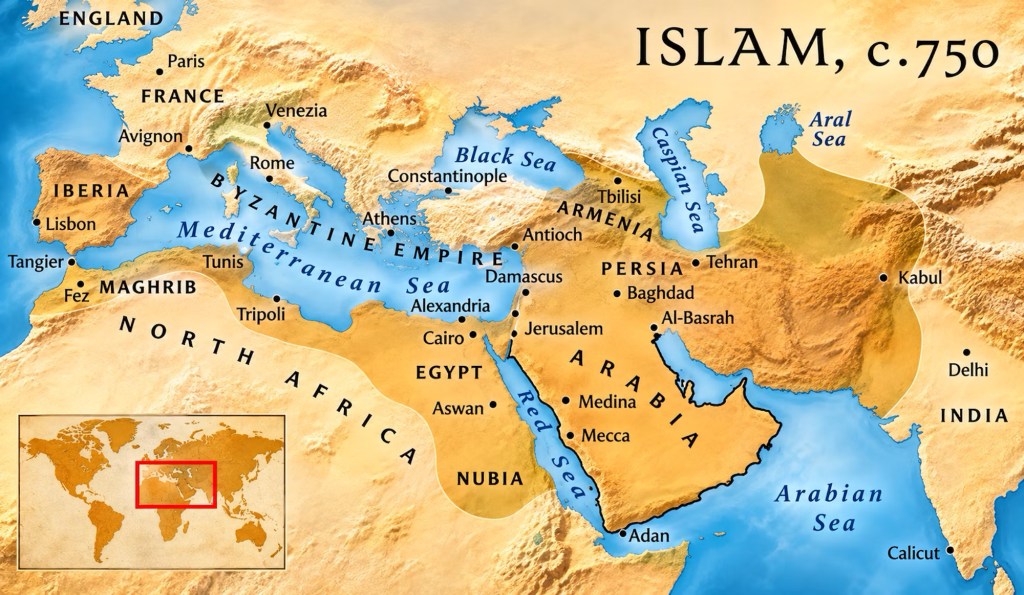
• In the 7th century, Islam arose in Arabia and rapidly spread across the Middle East and beyond.
• These lands overlap significantly with the territories mentioned in Genesis.
☪️ From an Islamic perspective: This spread reflects God’s promise to bless Ishmael’s descendants and make them into great nations across Abraham’s homeland.
✡️✝️ From Jewish and Christian perspectives: The covenantal inheritance remains with Israel, not Ishmael’s descendants.
⸻
🕊️ 4. Theological Interpretations
• ✡️ Jewish perspective: The covenant and land promise are eternal for Israel alone. Islam’s rise is historical but not covenantal fulfillment.
• ✝️ Christian perspective: Views differ — some see the promise fulfilled spiritually in Christ (extended to all believers), while others expect a future literal fulfillment for Israel.
• ☪️ Islamic perspective: Muslims see themselves as the true heirs of Abraham’s faith through Ishmael and Muhammad. The expansion of Islam is seen as a realization of God’s promise of greatness.
⸻
✅ Summary:
• ✡️/✝️ Jewish/Christian tradition: The specific land promise refers to Isaac’s descendants, not Ishmael’s.
• ☪️ Islamic tradition: The rapid growth and dominance of Ishmael’s descendants across Abraham’s homeland can be understood as a manifestation of God’s promise to Ishmael.
————–
☪️ From an Islamic theological perspective, the Children of Israel may be understood as belonging to the Sinai covenant established through Moses, whereas Islam understands its followers as heirs to the Abrahamic covenant and the faith of Abraham.
Within this interpretation, the later expansion of Islam across the Middle East can therefore be viewed as a historical fulfillment of the Abrahamic promise of inheritance—extending across the region described in Genesis 15:18 as stretching from the “River of Egypt” to the “Euphrates.” This is a specifically Islamic theological reading and differs from traditional Jewish and Christian interpretations of the biblical land promise.
From Paran to Pilgrimage: How Muslims See Hajj as the Fulfillment of Ancient Prophecy
🌄 From Paran to Pilgrimage: How Muslims See Hajj as the Fulfillment of Ancient Prophecy
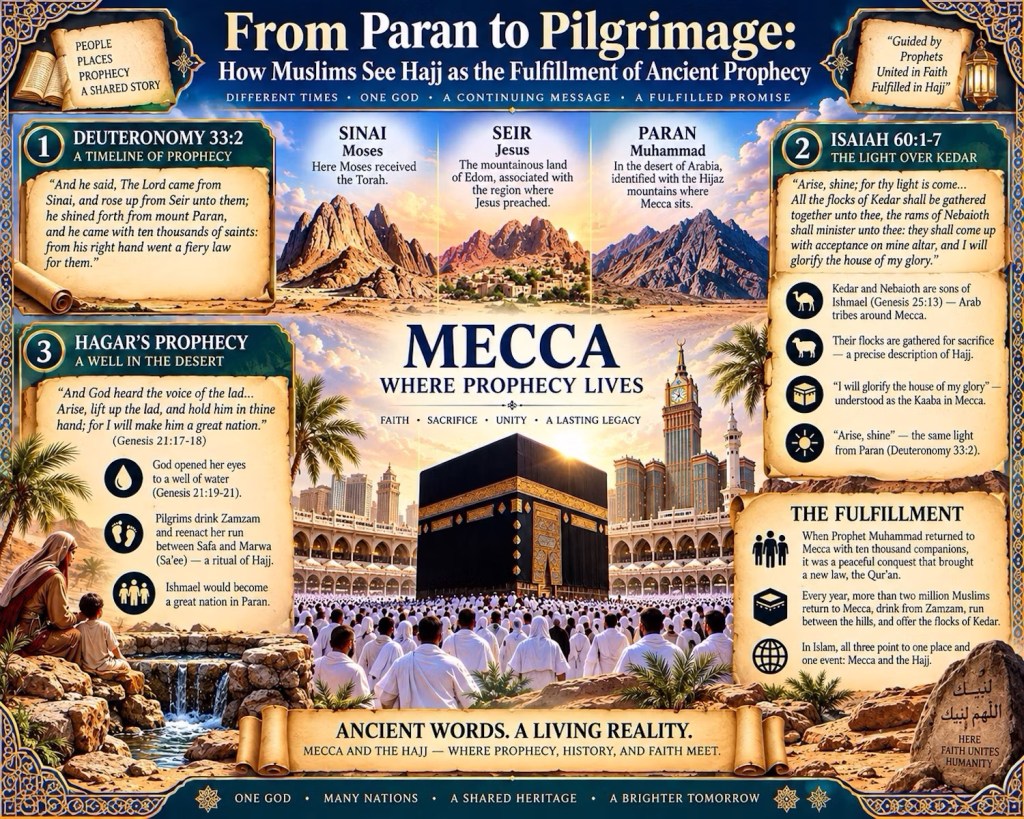
For centuries, readers of the Bible have paused over one line in Moses’ final blessing. In Deuteronomy 33:2, it says:
“And he said, The Lord came from Sinai, and rose up from Seir unto them; he shined forth from mount Paran, and he came with ten thousands of saints: from his right hand went a fiery law for them.”
In Islamic tradition, this single verse is not seen as poetry. It is seen as a timeline of prophecy.
⛰️ Three Mountains, Three Prophets
The verse names three places where God revealed Himself.
1. Sinai is universally understood. It is where Moses received the Torah.
2. Seir is the mountainous land of Edom, south of the Dead Sea. Seir is associated in the Bible with the land where Jesus preached. The Gospels place Jesus’ ministry around that region.
3. Mount Paran is where the third shining forth happens.
Where is Paran? The Bible itself gives the location.
Genesis 21:21 says about Ishmael, the son of Abraham and Hagar: “And he dwelt in the wilderness of Paran.”
Jewish and Christian maps have long placed the Wilderness of Paran in the desert of Arabia. Arab geographers and Islamic historians identify Paran as the Hijaz mountains, the range where Mecca sits. In Arabic, the mountains around Mecca were historically called Jibal Faran.
So the sequence in Deuteronomy 33:2 is read as: Sinai for Moses, Seir for Jesus, and Paran for Muhammad.
The line that follows strengthens that reading for Muslims: “he came with ten thousands of saints: from his right hand went a fiery law.” When Prophet Muhammad returned to Mecca after migrating to Medina, he entered with ten thousand companions. It was a peaceful conquest, and it brought with it a new law, the Qur’an.
✨ Isaiah 60: The Light Over Kedar
Muslim scholars say this prophecy is repeated and expanded in Isaiah 60:1-7:
“Arise, shine; for thy light is come… All the flocks of Kedar shall be gathered together unto thee, the rams of Nebaioth shall minister unto thee: they shall come up with acceptance on mine altar, and I will glorify the house of my glory.”
This passage is important for three reasons.
First, Kedar and Nebaioth are not random names. According to Genesis 25:13, they are the two eldest sons of Ishmael. Kedar is the ancestor of the Arab tribes that settled around Mecca. Wherever the Bible mentions Kedar, it is talking about the Ishmaelites in Arabia.
Second, look at what Isaiah says they will do. Their flocks will be gathered and offered on God’s altar. That is not a general image of worship. For Muslims, it is a precise description of Hajj.
Every year during Hajj, millions of Muslims bring an offering. On the Day of Sacrifice, pilgrims in the valley of Mina sacrifice sheep, goats, and camels. The flocks of Kedar are literally gathered to Mecca for sacrifice on the altar.
Third, Isaiah concludes this part of the prophecy with the words, “and I will glorify the house of my glory.” In the Islamic interpretation, this “house” can be understood as the Kaaba, the Sacred House in Mecca associated with Abraham and Ishmael. In this reading, the gathering of Kedar and Nebaioth, the sacrifices, and the glorification of God’s house form one connected picture of the Hajj pilgrimage centered on the Kaaba.
Isaiah says “Arise, shine” – the same word used in Deuteronomy: “he shined forth from mount Paran.” It is the same light, coming to the same place.
💧 Hagar’s Prophecy in the Desert
The story begins earlier, in Genesis 21.
Hagar and her infant son Ishmael are left in a waterless desert. She weeps, expecting her son to die. Then God answers.
Genesis 21:17-18:
“And God heard the voice of the lad… Arise, lift up the lad, and hold him in thine hand; for I will make him a great nation.”
Genesis 21:19-21 then says God opened her eyes to a well of water, and Ishmael grew up in the wilderness of Paran.
For Muslims, this well is Zamzam. To this day, pilgrims on Hajj drink from the well of Zamzam in Mecca, located only meters from the Kaaba. They also reenact Hagar’s desperate run between the two hills of Safa and Marwa searching for water – a required ritual of Hajj called Sa’ee.
The prophecy was: Ishmael would become a great nation in Paran, saved by a well of water.
Hajj is that prophecy alive today. Every year, more than two million people from that great nation – and from all nations who have joined his faith – return to that desert, drink from that well, run between those hills, and offer the flocks of Kedar.
Deuteronomy said a light would shine forth from Paran. Isaiah said that light would draw the flocks of Kedar to God’s altar. Genesis said Paran would be the home of Ishmael’s great nation, beginning with a well in the desert.
In Islam, all three point to one place and one event: Mecca and the Hajj.
The Blessing of Shem: Genesis 9:26–27, Islam, and the Civilizations of the Middle East
🌿 The Blessing of Shem: Genesis 9:26–27, Islam, and the Civilizations of the Middle East
Genesis 9:26–27 contains one of the Bible’s earliest statements about the descendants of Noah after the Flood. Although the passage is brief, it later became important in Jewish and Christian reflections on the nations descended from Noah.
Read through a comparative Abrahamic lens, the passage also raises an intriguing hermeneutical question: could the blessing associated with Shem be understood as having a wider historical fulfillment in the religious civilizations that later arose among the Semitic peoples of the Middle East—including Islam?
Such an interpretation is not the standard Jewish or Christian reading of Genesis 9, nor does the Qur’an explicitly connect Islam with Genesis 9:26–27. Nevertheless, it offers an interesting framework for comparative Abrahamic theology.
📖 Noah’s Blessing of Shem
After the episode involving Noah and his sons, Genesis records Noah saying:
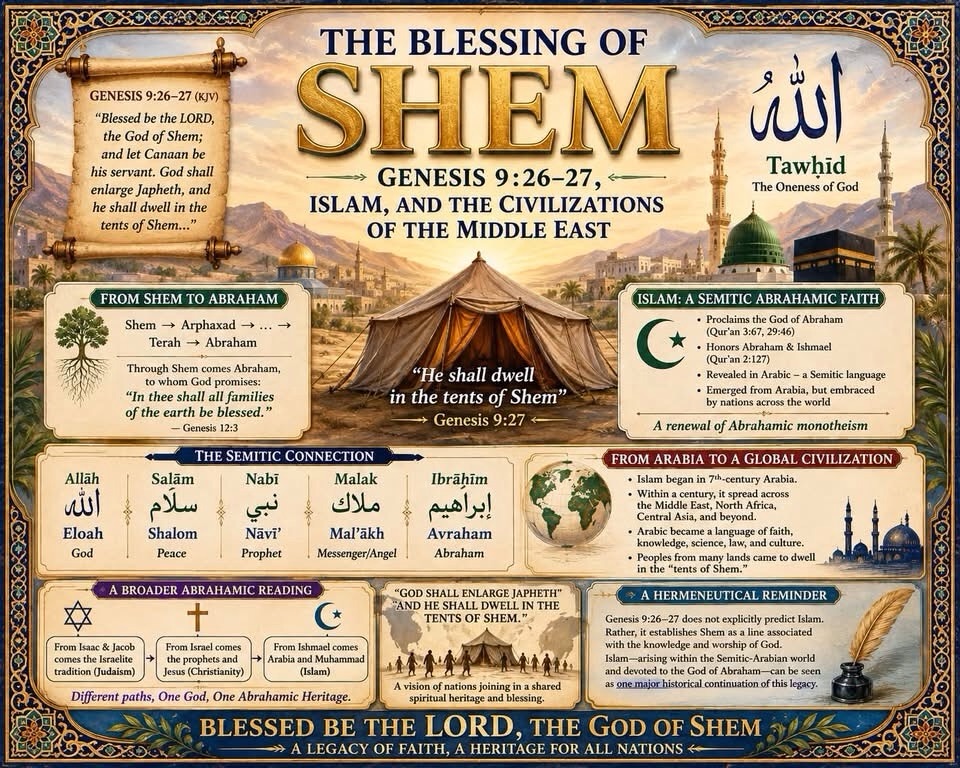
“Blessed be the LORD, the God of Shem; and let Canaan be his servant. God shall enlarge Japheth, and he shall dwell in the tents of Shem…”
— Genesis 9:26–27, KJV
What is striking is the wording of Noah’s blessing. Noah does not simply say, “Blessed be Shem.” Instead, he declares:
“Blessed be the LORD, the God of Shem.”
The blessing therefore possesses an explicitly theological character. Shem is distinguished through his relationship with God.
This becomes particularly significant when Genesis is read as a continuous narrative.
🌳 From Shem to Abraham
Genesis 10 presents the descendants of Noah, while Genesis 11 develops the genealogy of Shem in greater detail.
The line proceeds eventually from:
Shem → Arphaxad → … → Terah → Abraham
Abraham therefore emerges within Genesis itself as a descendant of Shem.
This literary sequence is important. Genesis 9 introduces the special association between God and Shem; Genesis 10–11 traces Shem’s descendants; and Genesis 12 suddenly introduces Abraham, to whom God gives a universal mission:
“In thee shall all families of the earth be blessed.”
— Genesis 12:3
From a canonical perspective, one can therefore see a theological progression:
Noah → Shem → Abraham → blessing for the nations.
The blessing of Shem becomes part of the narrative background against which the Abrahamic story unfolds.
🏜️ Shem and the Semitic World
The traditional expression “Semitic” itself ultimately derives from the name Shem, although modern linguistics uses Semitic primarily as a linguistic category rather than as proof that every Semitic-speaking population descends genealogically from the biblical Shem.
The Semitic language family includes Hebrew, Aramaic, Arabic, Akkadian, Syriac, and several other ancient and modern languages.
Geographically, these languages developed principally across the Middle East—the very region that became the heartland of the Abrahamic religious traditions.
This creates an interesting historical pattern. Judaism emerged among Hebrew-speaking Israelites. Christianity began among Jews in the Semitic environment of Roman Palestine, with Aramaic playing an important role in the world of Jesus. Centuries later, Islam arose among Arabic-speaking peoples of Arabia.
Thus, three religious traditions that came to dominate Abrahamic religious history all emerged from the broader Semitic cultural world.
🕋 Islam as a Semitic Abrahamic Religion
Islam presents itself not as an entirely new religion disconnected from biblical history, but as the restoration and continuation of the monotheistic religion of Abraham.
The Qur’an declares:
“Abraham was neither a Jew nor a Christian, but he was one inclining toward truth, a Muslim [one submitting to God].”
— Qur’an 3:67
Within Islamic theology, islām fundamentally means submission to the one God. Abraham (Ibrāhīm) therefore occupies a central position as the model of pure monotheism.
Islam also places itself within the Abrahamic family through Ishmael (Ismāʿīl), whom Islamic tradition associates particularly with Arabia and with Abraham’s sanctuary at Mecca.
The Qur’an portrays Abraham and Ishmael raising the foundations of the Kaʿbah together:
“And when Abraham and Ishmael raised the foundations of the House…”
— Qur’an 2:127
Consequently, from an Islamic theological perspective, the emergence of Islam in Arabia represents the renewal of Abrahamic monotheism within another major branch of the Semitic world.
🗣️ Arabic and the Semitic Continuity
There is also a striking linguistic dimension.
The Qur’an appeared in Arabic, one of the major Semitic languages. Its theological vocabulary consequently shares numerous cognates with biblical Hebrew and Aramaic.
Examples include:
Arabic Allāh / Hebrew Eloah — God
Arabic salām / Hebrew shalom — peace
Arabic nabī / Hebrew nāvīʾ — prophet
Arabic malak / Hebrew malʾākh — messenger/angel
Arabic Ibrāhīm / Hebrew Avraham — Abraham
These similarities do not demonstrate a supernatural fulfillment of Genesis 9 by themselves. They arise because Arabic and Hebrew belong to related branches of the Semitic language family.
Hermeneutically, however, they emphasize something significant: Islam emerged from essentially the same broad linguistic-cultural world in which much of biblical revelation had previously appeared.
🌍 From Arabia to a Semitic-Led Civilization
The historical development becomes even more interesting when Genesis 9:26 is considered alongside the rise of Islamic civilization.
Islam began in seventh-century Arabia through the preaching of Prophet Muhammad. Within little more than a century, the civilization established by his followers stretched far beyond Arabia.
Damascus became the capital of the Umayyad Caliphate. Baghdad became the intellectual center of the Abbasid world. Jerusalem became one of Islam’s sacred cities. Cairo later developed into another major center of Islamic scholarship.
Arabic consequently expanded from Arabia into an international language of religion, administration, philosophy, science, law, literature, and theology.
Muslim civilization was certainly not ethnically Semitic in its entirety. Persians, Berbers, Turks, Kurds, Africans, Central Asians, Indians, Southeast Asians, Europeans, and many others became essential contributors to Islamic civilization.
Nevertheless, its religious nucleus remained profoundly connected to the Semitic Middle East: an Arabic Qur’an, an Arabian prophet, an Abrahamic sacred history, and sacred centers at Mecca, Medina, and Jerusalem.
Islam therefore represents one of history’s most consequential civilizations to emerge initially from the Semitic cultural sphere.
🕌 “The God of Shem” and Islamic Tawḥīd
This provides the most interesting theological connection with Genesis 9:26:
“Blessed be the LORD, the God of Shem.”
From an Islamic interpretive perspective, the defining doctrine of Islam is tawḥīd—the absolute oneness of God.
The Qur’an repeatedly identifies the God worshipped by Muhammad with the God of Abraham and the biblical prophets:
“We believe in that which has been revealed to us and revealed to you; our God and your God is One.”
— Qur’an 29:46
Islamic theology therefore understands Muhammad’s proclamation not as introducing another deity, but as calling humanity back to the God worshipped by Abraham, Ishmael, Isaac, Jacob, Moses, David, and Jesus.
Within this comparative reading, Noah’s expression “the God of Shem” acquires particular resonance. From the descendants and cultural world traditionally associated with Shem arose religious movements that carried Abrahamic monotheism far beyond the Middle East.
Islam became one of the largest manifestations of that historical development.
⛺ What Does “Japheth Shall Dwell in the Tents of Shem” Mean?
Genesis 9:27 adds another enigmatic statement:
“God shall enlarge Japheth, and he shall dwell in the tents of Shem.”
Its precise meaning has long been debated. Some interpretations understand it as describing peaceful coexistence, territorial expansion, cultural participation, or Japheth sharing in Shem’s blessing.
Christian interpreters have sometimes given the passage a theological interpretation in which Gentile peoples symbolically enter the spiritual heritage associated with Shem.
A comparative Islamic interpretation could extend the imagery differently.
Islam originated among Semitic-speaking Arabs but rapidly became a universal civilization incorporating peoples far beyond Arabia. Persians, Turks, Africans, Europeans, Central Asians, South Asians, and eventually Southeast Asians entered an originally Arabic-speaking religious tradition.
In that metaphorical sense, enormous non-Semitic populations came to “dwell in the tents of Shem”—not necessarily through ancestry, but by participating in a religious civilization whose scripture, prophetic origins, sacred geography, and foundational vocabulary emerged from the Semitic Middle East.
This should be understood as a hermeneutical analogy, rather than a claim that Genesis explicitly predicts the Islamic conquests or identifies particular modern ethnic groups with Japheth.
✡️✝️☪️ A Broader Abrahamic Reading
Genesis 9:26–27 can therefore be viewed as the opening of a much larger biblical trajectory.
From Shem comes Abraham. From Abraham emerge the Israelite tradition through Isaac and Jacob and the Ishmaelite tradition associated in Islam with Arabia. From the Israelite world emerge Moses, David, the Hebrew prophets, and Jesus. From the Arabian Abrahamic tradition eventually emerges Muhammad and the Qur’anic proclamation of tawḥīd.
The historical picture is therefore larger than any single civilization.
Judaism, Christianity, and Islam each developed differently and make competing theological claims. Yet all three are historically connected with the Semitic Middle East and all three place Abraham near the center of sacred history.
The “tents of Shem,” read symbolically, could therefore represent an extraordinarily influential religious inheritance extending far beyond Shem’s geographical homeland.
⚖️ An Important Hermeneutical Qualification
Care is necessary here.
Genesis 9:26–27 does not explicitly predict Islam or Prophet Muhammad, and mainstream Jewish and Christian exegesis does not normally interpret the passage that way. Nor can modern peoples be mapped neatly onto Noah’s three sons using contemporary genetics or linguistics.
Therefore, it would be too strong to claim:
“Genesis 9 directly prophesied Islam.”
A more defensible comparative formulation would be:
Genesis 9:26–27 establishes Shem as a line particularly associated with the knowledge and worship of God. Because the biblical narrative subsequently traces Abraham through Shem, and because Islam later arose within the Semitic-Arabian world claiming to restore the monotheism of Abraham, Islamic civilization can be interpreted—within a comparative Abrahamic hermeneutic—as one major historical continuation of the religious legacy symbolically associated with the “tents of Shem.”
That distinction allows the theological parallel to be explored without presenting a later interpretation as the explicit original meaning of Genesis.
🌅 Conclusion: The Expanding Tents of Shem
Genesis begins its post-Flood history with humanity divided into the families of Noah, but its narrative soon narrows toward Shem, then Abraham, before expanding once again toward “all families of the earth.”
Seen through this broader Abrahamic lens, the history is remarkable.
A religious heritage originating in the ancient Semitic Middle East eventually crossed ethnic, linguistic, and geographical boundaries. Judaism preserved the ancient Israelite covenantal tradition. Christianity carried belief in the God of Israel throughout much of the Gentile world. Islam arose in Arabia proclaiming the restoration of Abrahamic monotheism and subsequently created a civilization encompassing peoples from the Atlantic to Southeast Asia.
Thus Genesis 9:26—“Blessed be the LORD, the God of Shem”—can acquire a wider significance in comparative theology.
Rather than treating Shem merely as the ancestor of one isolated people, the passage can be read as the beginning of a theological trajectory whose influence would eventually reach far beyond the Middle East.
And within an Islamic hermeneutical reading, the rise of Islam among an Arabic-speaking people, its devotion to the God of Abraham, and its transformation into a multiethnic global civilization can be viewed as one remarkable chapter in the continuing historical legacy of the tents of Shem.

