Azahari Hassim
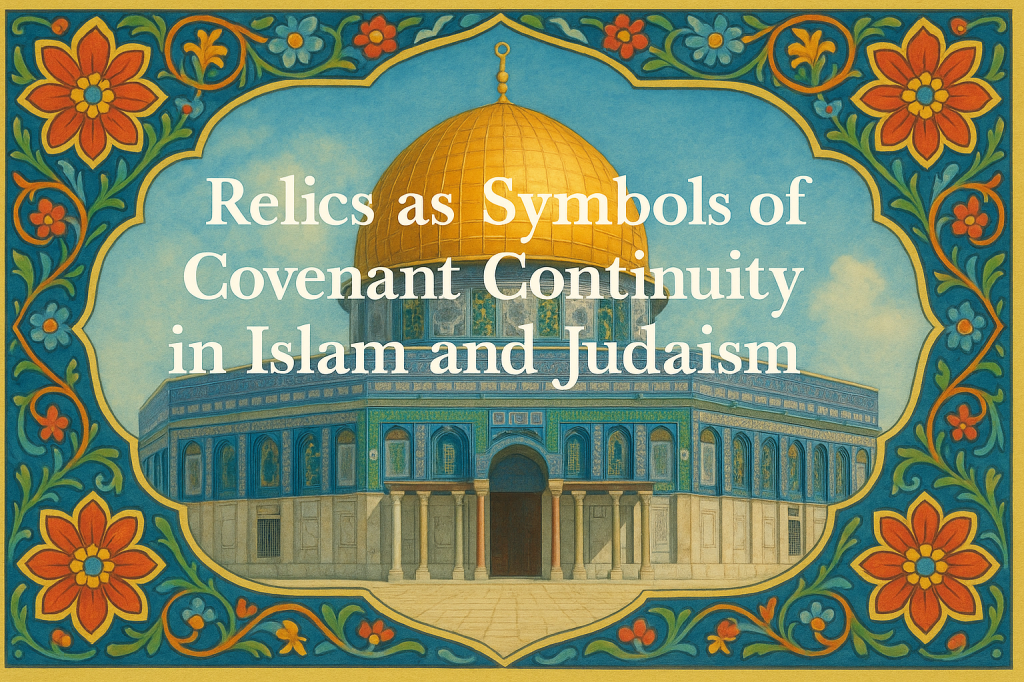
📜 Relics as Symbols of Covenant Continuity in Islam and Judaism
Throughout religious history, sacred relics have served as powerful symbols of divine-human relationships. In the Jewish tradition, the Ark of the Covenant and the First and Second Temples stood as tangible manifestations of God’s presence among the people of Israel. These objects were revered not only for their spiritual significance but also as physical markers of a covenant — a binding promise between God and His chosen people. However, within Islamic theology, the concept of relics takes on a different dimension: one that shifts the focus from static objects of memory to living, dynamic symbols of ongoing devotion.
⸻
🕊️ From Sacred Objects to Living Symbols
In Judaism, the Ark — which housed the tablets of the Law given to Moses on Mount Sinai — symbolized the Sinai Covenant, a legal and national covenant between God and Israel. The Temple in Jerusalem, as the dwelling place of God’s presence, further anchored this relationship in a specific geography and people. Yet the loss of these relics — the Ark’s disappearance and the destruction of both Temples — marked the end of a historical era.
Islam, by contrast, does not locate its covenantal identity in lost relics or vanished sanctuaries. Instead, it offers living symbols that actively participate in the spiritual lives of believers to this day. These include:
- 🕋 The Kaaba in Mecca, built by Prophet Abraham and his son Ishmael as a sanctuary for the worship of the One God, stands as the spiritual center of Islam and a lasting symbol of Abraham’s legacy.
- ⚫ The Black Stone, set in the Kaaba’s corner, is believed to have been given to Abraham by the Angel Gabriel. Pilgrims venerate it as a sign of the covenant between God and humanity.
- 👣 The Station of Abraham (Maqam Ibrahim) marks where Abraham stood while building the Kaaba, symbolizing his faith, devotion, and obedience to God.
Unlike relics confined to sacred texts or museum displays, these Islamic symbols are embodied in worship: believers walk around the Kaaba (House of God) during the Hajj, kiss the Black Stone as a gesture of reverence, and pray facing the Kaaba (House of God) five times a day. In doing so, they reaffirm a covenant not of the past but of the present — one that continues to live through ritual, faith, and devotion.
⸻
🕍 Covenant Theology: Sinai vs. Abraham
Islamic theology draws a significant distinction between two covenants central to the Abrahamic tradition:
- 📖 The Sinai Covenant, specific to the children of Israel and signified by the Ark and the Temples, was tied to a legalistic framework and particular lineage.
- 🌍 The Abrahamic Covenant, which Islam claims to fulfill universally, envisions Abraham as a monotheist who submitted to God (Qur’an 3:67–68). This covenant is timeless, inclusive, and centered on submission (Islam), not ethnicity.
Whereas the Ark belonged to the age of law, carried exclusively by Levitical priests, the Kaaba (House of God) belongs to the age of unity, open to all believers. Every Muslim, regardless of race or nation, participates equally in the rites associated with these symbols — most notably during Hajj, where the unity of believers in submission to one God is vividly enacted.
Thus, the Kaaba stands as the enduring symbol of the universal Abrahamic covenant, fulfilling the divine promise that through Abraham’s seed — specifically through Ishmael and his descendants — all nations would be blessed in the worship of the One True God.
⸻
🌟 Sacred Heritage Reimagined
Islam thus reimagines the role of relics in religious life. They are not merely sacred objects to be preserved; they are sacred acts to be lived. This is why the Kaaba (House of God), the Black Stone, and the Station of Abraham are not relics in the traditional sense — they are active participants in Islamic spiritual life.
The physical continuity of these symbols in living worship stands in stark contrast to the historical loss of the Ark and the Temples in Judaism. Islam claims this continuity as proof of its role as the final bearer of the Abrahamic covenant, fulfilling and universalizing the faith of Abraham.
⸻
🌈 Conclusion
In essence, Islam’s theology of relics reveals a profound transformation in the understanding of sacred heritage. Where other traditions may look to lost artifacts as reminders of a divine past, Islam sees in its living symbols — especially the Kaaba (House of God) — a present and enduring connection to the covenant made with Abraham. This covenant is not etched in gold or stone, but in the hearts and actions of those who, like Abraham, submit fully to the will of the One God.
Thus, the Islamic view holds that true sacred continuity lies not in relics of the past, but in the unified devotion of the present — a faith that circles, not carries, the House of God.
If Abraham Had Not Existed: Reimagining the Foundations of the Abrahamic Faiths
🕊️ Introduction
Few figures in human history hold as central a place as Abraham. Revered as a patriarch by Jews, Christians, and Muslims alike, Abraham’s life represents faith, obedience, and covenantal relationship with God. Yet one may ask: what if Abraham had not existed? How would the three great monotheistic religions—Judaism, Christianity, and Islam—have looked without him?
⸻
✡️ 1. Judaism Without Abraham
In Judaism, Abraham is Avraham Avinu—“our father Abraham”—the first to recognize and worship one God. He embodies the beginning of the covenant through which God promised descendants as numerous as the stars and granted the Land of Israel as their inheritance.
Without Abraham, Judaism might never have developed its distinctive identity as a covenantal faith. The entire theological framework linking the Jewish people to divine promise and land would lack its origin. A different patriarchal figure might have emerged, but the concept of the chosen people bound by a divine covenant could have been far less defined or even absent altogether.
⸻
✝️ 2. Christianity Without Abraham
Christianity draws deeply upon Abraham as the model of faith before the law. In Paul’s Epistle to the Romans (4:3), Abraham is cited as the one who “believed God, and it was credited to him as righteousness.” For early Christians, Abraham’s faith symbolized justification through belief rather than works—a cornerstone of Christian theology.
If Abraham were missing from the biblical narrative, Christian thought might have lacked its archetype of faith and obedience. The connection between the Old and New Testaments would have been weaker, and Paul’s theological bridge from Judaism to Christianity less convincing. The doctrine of salvation through faith could have taken a different shape or rested upon another figure entirely.
⸻
☪️ 3. Islam Without Abraham
In Islam, Abraham (Ibrahim عليه السلام) stands as one of the greatest prophets and the friend of Allah (Khalīlullāh). He is seen as the renewer of pure monotheism and the spiritual father of both prophetic lines—through Isaac leading to Israel, and through Ishmael leading to the final Messenger, Muhammad ﷺ.
Without Abraham, Islam would lose a profound ancestral link that unites the prophetic tradition. The rituals of Hajj—circumambulating the Kaaba, performing Sa‘i between Safa and Marwah, and the symbolic sacrifice—are all reenactments of Abraham’s and Ishmael’s devotion. Without his example, the pilgrimage and even the symbolism of the Kaaba as the restored “House of God” might not exist in the same form.
⸻
🔥 4. The Missing Narratives of Faith and Sacrifice
Abraham’s absence would erase some of the most formative narratives of divine testing and human submission. The binding of Isaac (in Jewish and Christian scripture) or sacrifice of Ishmael (in the Qur’anic version) expresses the highest model of surrender to God’s will. Without such a story, the moral archetype of total faith under trial would be lost. The concept of “submission” (Islam) itself finds its origin in Abraham’s willingness to yield entirely to divine command.
⸻
📜 5. The Prophetic Testimony: “That is Abraham, upon him be peace”
Islamic tradition exalts Abraham as the best of creation. Anas bin Malik reported:
A man came to the Messenger of Allah (ﷺ) and said, “O best of creation!”
The Prophet replied, “That is Abraham, upon him be peace.”
(Sahih Muslim)
This humility of the Prophet Muhammad ﷺ reveals not only reverence for Abraham’s spiritual stature but also the continuity of divine mission across time. Abraham’s unwavering monotheism and selfless faith form the spiritual DNA of all later prophets.
⸻
🌟 Conclusion: The Irreplaceable Patriarch of Monotheism
Had Abraham never lived, the landscape of world religion would be unrecognizably different. Judaism might lack its covenantal foundation; Christianity might lack its doctrine of faith; Islam might lose its living model of surrender and devotion.
Abraham’s existence bridges heaven and earth, past and future, uniting humanity under the banner of pure monotheism. As the Prophet Muhammad ﷺ affirmed, Abraham remains the best of creation—an eternal symbol of faith, obedience, and divine friendship.

📜 The Family of Abraham in Islamic and Judeo-Christian Perspectives
Ishmael as the Son of Sacrifice and Covenant, Isaac as the Son of Reward and Blessing
⸻
🌟 Introduction
Within the Abrahamic faiths, the household of Abraham (Ibrāhīm عليه السلام) stands as a sacred model of obedience and divine promise. Yet, the interpretation of this family’s story differs sharply across traditions.
In the Islamic understanding, Abraham’s family is not a story of rivalry but of divine sequence and harmony. Ishmael (Ismāʿīl عليه السلام) is the son of sacrifice, through whom the ultimate test of faith was fulfilled and the covenant was established. Isaac (Isḥāq عليه السلام) is the son of reward, granted to Abraham and Sarah as a divine blessing following their endurance and obedience.
In contrast, the Judeo-Christian tradition often portrays Abraham’s household as marked by jealousy and exclusion. Islam restores unity to this narrative by recognizing both sons as integral to God’s unfolding covenantal plan.
⸻
- The Near Sacrifice: Ishmael as the Son of Testing
The Qur’an recounts Abraham’s supreme test — the command to sacrifice his beloved son:
“He said, ‘O my son, indeed I have seen in a dream that I am sacrificing you, so see what you think.’
He said, ‘O my father, do as you are commanded; you will find me, if Allah wills, among the steadfast.’”
— Surah al-Ṣāffāt 37:102
Both father and son displayed perfect submission to the divine will. When Abraham fulfilled the command, God intervened:
“We ransomed him with a great sacrifice, and We left for him [a good mention] among later generations.”
— Surah al-Ṣāffāt 37:107–108
This episode signifies the culmination of Abraham’s trials and the perfection of his faith. Classical exegetes such as al-Ṭabarī and Ibn Kathīr affirm that the son in this event was Ishmael, as Isaac’s birth occurred only afterward. Ishmael thus becomes the son of trial, sacrifice, and covenantal submission, the one through whom Abraham’s obedience is eternally commemorated.
⸻
- The Covenant Established After the Sacrifice
The Qur’an indicates that the divine covenant (ʿahd) was granted after Abraham had successfully completed all his tests — culminating in the near sacrifice:
“And [mention] when Abraham was tested by his Lord with certain commands, and he fulfilled them. He said, ‘Indeed, I will make you a leader (Imām) for mankind.’ Abraham said, ‘And of my descendants?’ [Allah] said, ‘My covenant does not include the wrongdoers.’”
— Surah al-Baqarah 2:124
This verse marks the formal establishment of the Abrahamic Covenant, conferred only after Abraham’s demonstration of perfect obedience. The covenant was not inherited automatically, but earned through faithfulness.
Because Ishmael was the son involved in the supreme test, the covenant naturally extends through his line — the line of submission (islām) — culminating in the Prophet Muhammad ﷺ, the final bearer of the Abrahamic mission.
The covenant, therefore, follows the pattern:
Trial → Fulfillment → Covenant → Reward.
⸻
- Isaac: The Son of Reward and Blessing
After Abraham’s trial and the establishment of the covenant, God rewarded him and Sarah with the joyful announcement of a new son — Isaac:
“And We gave him good news of Isaac, a prophet from among the righteous.”
— Surah al-Ṣāffāt 37:112
Isaac’s birth represents divine reward for Abraham’s faithfulness and Sarah’s endurance. His arrival in their old age symbolizes the mercy that follows obedience. Isaac is thus the son of reward and blessing, embodying the continuation of prophecy and grace among the Children of Israel.
In the Islamic framework, Isaac’s role complements rather than replaces Ishmael’s. Ishmael carries the covenantal trust, established through the trial of sacrifice, while Isaac carries the prophetic continuation within his descendants.
According to this understanding, the descendants of Isaac through Jacob (Ya‘qūb عليه السلام) are bound by the Sinai Covenant, revealed later to Moses (Mūsā عليه السلام), whereas the descendants of Ishmael remain under the universal Abrahamic Covenant — the primordial covenant of submission (islām) that extends to all nations through the final Messenger, Muhammad ﷺ.
⸻
- The Judeo-Christian Portrayal: Rivalry and Election
In the Biblical narrative, Abraham’s household is often portrayed as a drama of jealousy and exclusion. Sarah’s envy of Hagar leads to Ishmael’s expulsion (Genesis 16; 21), and the covenantal blessing is confined to Isaac’s lineage. This introduces the theology of divine election, which prioritizes one lineage over another.
Christian writers such as Paul later spiritualize this tension, contrasting Ishmael as “born according to the flesh” with Isaac as “born according to the promise” (Galatians 4:22–31). Such readings reinforce a dichotomy of rejection versus election — a divide that Islam transcends by recognizing both sons as divinely chosen for distinct missions.
⸻
- The Islamic Restoration: Unity Through Faith and Obedience
In the Qur’anic vision, Abraham’s family is unified by faithful submission, not divided by bloodline or favoritism. The covenant rests upon righteousness and obedience, not genealogy.
• Ishmael is the son of sacrifice, through whom the covenant of divine leadership was confirmed.
• Isaac is the son of reward, through whom the chain of prophethood was extended to the Children of Israel.
The Kaaba, built by Abraham and Ishmael (2:125–127), stands as the living symbol of the universal covenant, while the Torah at Sinai represents the specific covenant with Israel. Both reflect divine guidance within their respective missions — yet Islam views the Abrahamic Covenant as the root from which all subsequent covenants branch.
⸻
- Theological Implications: Covenant as the Fruit of Obedience
The Islamic chronology clarifies the divine order of revelation:
- The Trial — Abraham’s command to sacrifice Ishmael.
- The Fulfillment — Both submit to God’s will.
- The Covenant — Leadership and divine favor established (2:124).
- The Reward — Birth of Isaac and continuation of prophecy.
Thus, the Abrahamic Covenant arises as the result of Abraham’s perfect obedience, not as a prior entitlement. Ishmael is its living witness, and Isaac is its blessed continuation — both united in purpose, distinct in role.
⸻
Conclusion
In Islam, the family of Abraham embodies the balance between sacrifice and mercy, trial and reward, covenant and continuation. Ishmael stands as the son of sacrifice and covenant, the one through whom the divine test was fulfilled; Isaac as the son of reward and blessing, the one through whom prophecy flourished among Israel.
While the descendants of Isaac through Jacob entered the Sinai Covenant, the descendants of Ishmael preserved the Abrahamic Covenant, culminating in the universal message of Islam — the final expression of monotheism envisioned by Abraham himself.
Thus, Islam transforms the story of Abraham’s family from rivalry into revelation, from division into divine harmony — where every son, every covenant, and every test reveals a single eternal truth: submission to the One God (Allāh).

