Azahari Hassim
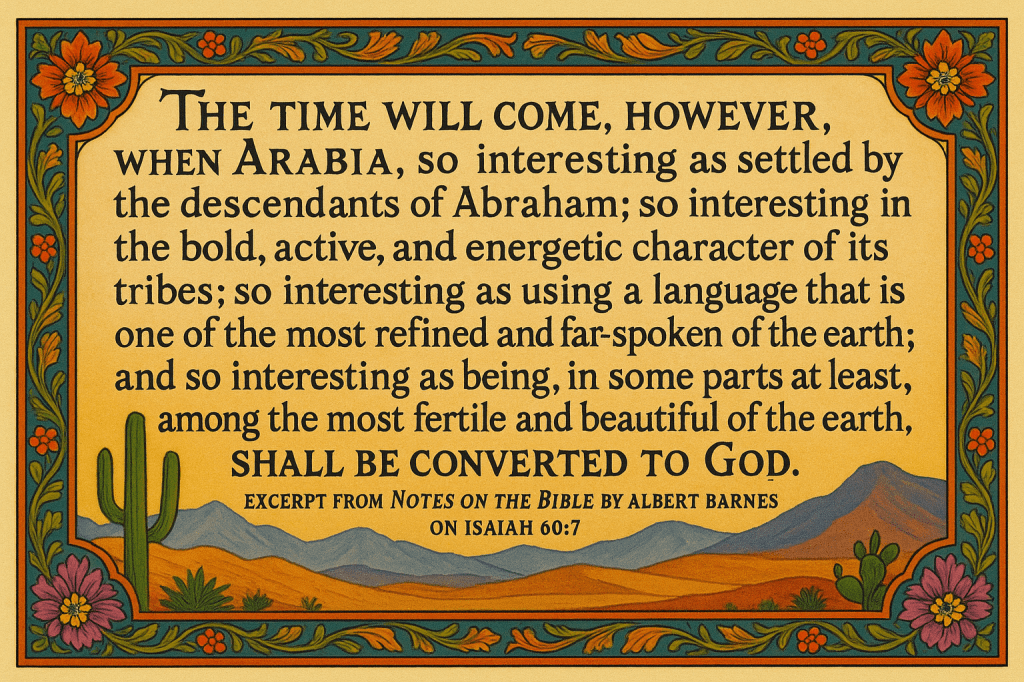
📜 Excerpt from Notes on the Bible by Albert Barnes (1834) on Isaiah 60:7
Albert Barnes (1798–1870) was an American theologian and biblical scholar.
What is the main clause of the sentence in the image?
The main clause of the sentence is:
“The time will come … when Arabia … shall be converted to God.”
Everything else between “Arabia” and “shall be converted to God” consists of a series of descriptive or modifying phrases introduced by “so interesting as…” — these describe Arabia in various ways, but the grammatical backbone of the sentence is:
Main clause: The time will come …
Embedded clause: when Arabia … shall be converted to God.
So the full main clause is “The time will come when Arabia shall be converted to God.”
Importance of the Passage and Barnes’s Interpretation of Isaiah 60:7
🔮 1. Prophetic Fulfillment Theme
Isaiah 60 is a prophetic vision describing the future glorification of Zion when nations will turn to the God of Abraham, bringing their wealth, flocks, and service to Him. Verse 7 mentions “the flocks of Kedar” and “the rams of Nebaioth,” tribes associated with Arabia and the descendants of Ishmael.
🕌 2. Arabia’s Conversion and Inclusion
Barnes interprets this as expressing a future time when even the Arab peoples—those descended from Abraham through Ishmael—would be turned to worship the true God. In his view, this demonstrates the universal reach of the gospel, extending beyond Israel to all nations, including those historically distant or opposed to it.
🏜️ 3. Cultural and Linguistic Appreciation
Barnes highlights Arabia’s distinctiveness—its lineage from Abraham, its vigorous people, its poetic language, and its beautiful landscape. He seems to underscore that these nations, with all their admirable traits, are not excluded from divine purpose. Their eventual “conversion to God” will bring these noble qualities into harmony with divine truth.
⏳ 4. Eschatological Overtones
More broadly, this reflects a 19th-century Christian eschatological vision rooted in the gospel message, which saw prophetic Scripture as anticipating the future Kingdom of God—a time when all nations, including the Arab world, would acknowledge the God of Abraham.
🌟 In sum, the significance of this passage in Barnes’s exegesis is that it expresses hope for the spiritual transformation of the Arab world as part of Isaiah’s vision of universal redemption and global faith in God. It emphasizes both the dignity of Arabia’s heritage and its destined participation in the divine plan foretold by the prophet.
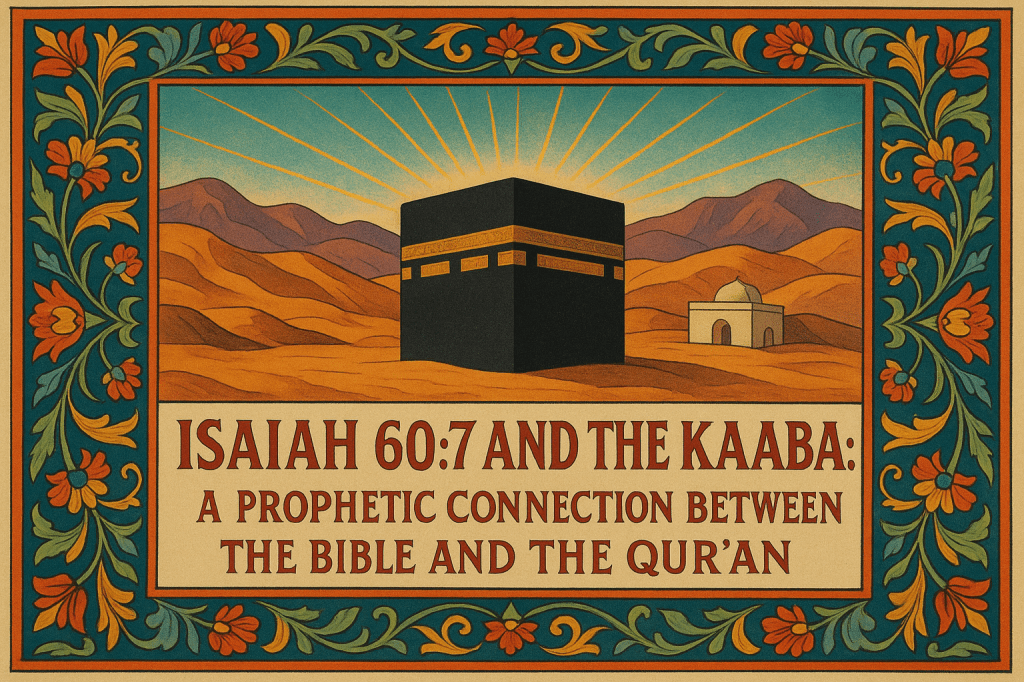
📜 Isaiah 60:7 and the Kaaba: A Prophetic Connection Between the Bible and the Qur’an
Introduction: A Meeting Point of Scriptures
The prophetic poetry of Isaiah 60 envisions a time when distant nations will turn toward the worship of the One God. Among its vivid images stands a verse that has drawn the attention of both biblical scholars and Islamic interpreters alike:
“All the flocks of Kedar shall be gathered to you; the rams of Nebaioth shall serve you; they shall come up with acceptance on My altar, and I will glorify the house of My glory.”
— Isaiah 60:7
While Christian commentators such as Albert Barnes (1834) and the Wycliffe Bible Commentary traditionally view this as symbolic of future conversion to God, others have proposed a remarkable possibility: that this prophecy refers specifically to the Kaaba in Mecca — the “House of God” associated with Abraham and Ishmael.
⸻
☪️ 1. The Arabian Lineage of Kedar and Nebaioth
Isaiah’s imagery centers on Kedar and Nebaioth, two tribes descended from Ishmael (Genesis 25:13). Their mention situates the prophecy firmly within the Arabian context.
The Wycliffe Bible Commentary notes that the treasures mentioned in Isaiah 60 are “preponderantly Arabian,” and even suggests a future turning of Islam “to the Cross,” signaling an openness among some Christian commentators to interfaith prophetic fulfillments.
Similarly, Albert Barnes, writing in 1834, observed that Arabia, with its descendants of Abraham and its deeply spiritual traditions, would eventually be “converted to God.” Though Barnes wrote from a Christian missionary perspective, his acknowledgment of Arabia’s religious importance ties into the broader idea that Ishmael’s lineage has a divine role.
Yet from an Islamic perspective, this “turning” may rather represent a return — a reorientation of the descendants of Ishmael toward the pure monotheism of Abraham, centered on the Kaaba.
⸻
🕋 2. “The Glorious House”: Identified with the Kaaba
Many Muslim scholars interpret the phrase “the house of My glory” as referring to the Kaaba (Baytullāh) — the sacred House of God in Mecca.
According to the Qur’an (2:125–127), Abraham and Ishmael were commanded to raise its foundations:
“And when We designated for Abraham the site of the House, saying, ‘Do not associate anything with Me and purify My House for those who circumambulate it and those who stand, bow, and prostrate [in prayer].’”
— Surah al-Ḥajj 22:26; cf. al-Baqarah 2:125–127
If Isaiah foresaw a time when the descendants of Kedar and Nebaioth would bring offerings to the altar of the “glorious house,” then this could signify the Hajj pilgrimage, where animals are sacrificed in devotion to God — a living ritual traceable to Abraham himself.
⸻
🌟 3. “God Was with the Lad”: The Presence of God with Ishmael
The book of Genesis provides another link to this prophetic vision. When Hagar and Ishmael were cast out, the text affirms:
“And God was with the lad; and he grew, and dwelt in the wilderness, and became an archer.”
— Genesis 21:20
Traditional Islamic exegesis understands this “wilderness” to be the valley of Bakkah (Mecca). The phrase “God was with the lad” is thus interpreted not only as divine protection but as a declaration of God’s presence in a sacred location — a site where His worship would endure through Ishmael’s lineage.
This understanding aligns perfectly with the Qur’anic narrative, in which Abraham’s prayer identifies that same location as the “Sacred House”.
⸻
📜 4. Surah 14:37 — Abraham’s Prayer and the Sacred House
The Qur’an preserves Abraham’s moving invocation:
“O our Lord! I have settled some of my offspring in an uncultivated valley near Your Sacred House, our Lord, so that they may establish prayer. So make hearts among the people incline toward them, and provide for them fruits that they might be grateful.”
— Surah Ibrāhīm 14:37
Here, Abraham explicitly locates Ishmael and Hagar beside the Sacred House (al-Bayt al-Muḥarram), implying that the Kaaba already existed as a holy site, later rebuilt by Abraham and his son. His prayer anticipates Mecca becoming a spiritual center to which human hearts would turn — precisely what Isaiah 60 envisions when nations stream toward God’s glorified house.
⸻
🌟 5. Theological Implications: Fulfillment through Ishmael’s Descendants
Interpreters who draw this connection propose that Isaiah 60:7 prophesies Mecca’s role as the universal center of monotheistic worship.
The flocks of Kedar and Nebaioth symbolize the submission of Ishmael’s descendants to God, as visibly fulfilled in the Islamic rites of Hajj and Eid al-Adha. The sacrificial offerings at the Kaaba — echoing Abraham’s own devotion — mirror Isaiah’s vision of accepted sacrifices on God’s altar.
In this interpretation:
• Isaiah 60:7 anticipates the revival of Abrahamic worship among the Ishmaelites.
• Genesis 21:20 foreshadows divine favor upon Ishmael’s descendants in a specific sacred region.
• Surah 14:37 confirms that sacred geography: the barren valley of Mecca, chosen for divine worship.
Together, they form a triadic continuity — a prophetic, historical, and theological alignment linking the Bible and the Qur’an through Abraham and Ishmael.
⸻
Conclusion: The House of God Revisited
The convergence of these scriptural strands suggests a profound harmony: that both the Bible and the Qur’an point toward a future restoration of Abrahamic monotheism centered on God’s “House of Glory.”
For believers who see the Kaaba as this very House, Isaiah’s vision is not merely about the distant conversion of nations, but about the universal return to the pure worship of the One God first established by Abraham and his son Ishmael.
⸻
References:
• Albert Barnes, Notes on the Bible (1834), on Isaiah 60:7
• The Wycliffe Bible Commentary, on Isaiah 60:4–7
• Genesis 21:18–20; Isaiah 60:7
• Qur’an 2:125–127; 14:37; 22:26
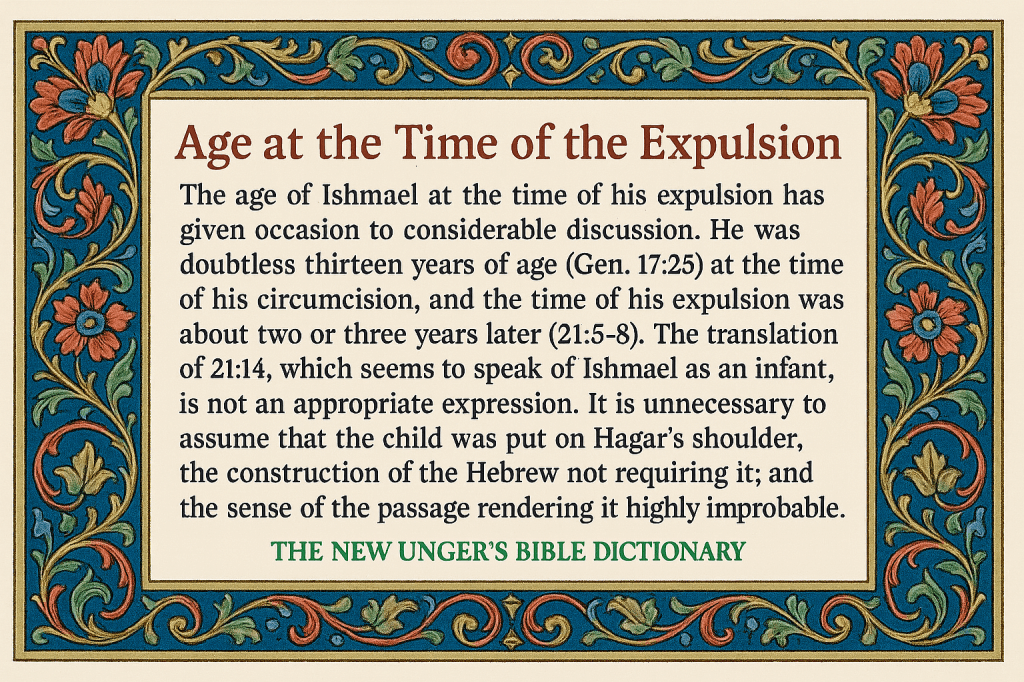
🌿 The Silent Years of Ishmael: Reconstructing the Lost Narrative Between Genesis 16 and 17
I. Introduction
The Genesis account offers a striking gap in the life of Ishmael. After his birth in Genesis 16, the narrative falls silent until Genesis 17, where Ishmael suddenly reappears as a thirteen-year-old about to be circumcised with his father Abraham. What happened between his infancy and adolescence remains untold.
This silence invites deeper scrutiny, especially when the subsequent chapters—Genesis 21:14–20 and Genesis 22:1–19—are examined in sequence. The first passage unmistakably portrays Ishmael as a baby, a helpless child carried by his mother and laid under a bush to die of thirst in the wilderness. The second describes Abraham being commanded to sacrifice his “only son,” which—when read semantically—must refer to Ishmael, since the phrase “only son” naturally denotes the sole existing child at that point in Abraham’s life, before Isaac’s birth.
Read together, these two episodes describe successive divine tests upon Abraham: first, the anguish of separation (Genesis 21), and second, the trial of sacrificial obedience (Genesis 22). Both scenes center on the destiny of Abraham’s firstborn and only son at that time, through whom God’s promise is put to the test, revealing Ishmael’s enduring place at the very heart of the Abrahamic narrative.
⸻
II. Ishmael’s Infancy and the Test of Separation (Genesis 21:14–20)
In Genesis 21:14–20, Abraham sends Hagar and Ishmael away into the wilderness of Beersheba. The narrative’s tone and imagery unmistakably convey Ishmael’s vulnerability:
“He (Abraham) put the child on her shoulder, and departed…” (Gen. 21:14)
“She (Hagar) cast the child under one of the shrubs.” (Gen. 21:15)
Such descriptions imply not a teenager of thirteen, but a young child—or even an infant—unable to walk or fend for himself. The Hebrew expression naʿar (often translated “lad”) has a wide semantic range, encompassing infancy through adolescence, but the surrounding context narrows it here to early childhood.
This impression is strengthened by Genesis 21:20, which states, “And God was with the lad, and he grew.” The verb vayigdal (“and he grew”) signals a developmental progression that follows infancy, not late adolescence. It marks the beginning of Ishmael’s independent life after divine deliverance, underscoring that God’s covenantal care accompanied him from his earliest years.
Many textual scholars observe that Genesis 21:9–10—which abruptly introduces Sarah’s jealousy toward Ishmael—is a later editorial interpolation. Its purpose appears to justify the expulsion of Hagar and Ishmael by appealing to covenantal exclusivity:
“Cast out this bondwoman and her son, for the son of this bondwoman shall not be heir with my son, with Isaac.”
This editorial insertion reframes the episode to align with later Israelite theology, which sought to centralize divine election in Isaac’s line.
⸻
III. The Offering of the “Only Son” (Genesis 22:1–19)
The following chapter, Genesis 22, narrates the binding (ʿAqedah) of Abraham’s “only son.” The phrase itself—“Take now your son, your only son, whom you love”—raises crucial questions. At this point in the canonical sequence, Abraham has two sons. Ishmael is alive, blessed, and dwelling in the wilderness of Paran (Gen. 21:21). How then could Isaac be called the “only son”?
This tension has long suggested to many critical scholars that the original narrative of Genesis 22 concerned Ishmael, not Isaac. The later insertion of Isaac’s name may have been an editorial act to reinterpret the story within Israel’s covenantal theology, transforming the universal Abrahamic test into an Israelite-specific typology.
The scene of the “only son,” the wood, and the divine intervention—“Do not lay your hand on the boy!”—mirrors the earlier scene of the dying child in the wilderness, where an angel also calls out from heaven to save Ishmael. Both episodes reveal Abraham’s faith under trial, and both culminate in divine reaffirmation of blessing. The structural and thematic symmetry between Genesis 21 and 22 suggests they were originally two versions of one theological motif: the testing and vindication of Abraham through Ishmael.
⸻
IV. Editorial Interpolations and Covenant Theology
The redactional tendencies within Genesis reflect a theological evolution from a broader Abrahamic covenant—embracing Ishmael—to a narrower Israelite identity through Isaac.
- Genesis 21:9–10 functions to justify Ishmael’s exclusion, aligning with the later national theology of Israel.
- The mention of Isaac in Genesis 22 serves to recast the universal test of faith into an Israel-centered narrative of election.
In both cases, the editorial hand shapes the text to reinforce Israel’s covenantal self-understanding. Yet beneath these layers, the original tradition—one of Abraham’s trial through Ishmael—remains visible through narrative inconsistencies, linguistic clues, and theological echoes.
⸻
V. Conclusion
Both Genesis 21:14–20 and Genesis 22 should be understood as events that precede Genesis 17, where the covenant is formally ratified and the birth of Isaac is announced. In these earlier accounts, Abraham’s faith is challenged by the events surrounding Ishmael, his firstborn and only child at the time, who represents the manifestation of divine mercy. His deliverance in the wilderness (Genesis 21) and the offering of the “only son” (Genesis 22) demonstrate Abraham’s complete submission to God, establishing the moral and spiritual foundation upon which the covenant later stands. Thus, Genesis 17 serves as the divine confirmation and formal sealing of a relationship already proven through obedience.
Although Genesis 17 appears earlier in the canonical arrangement, the internal logic of the narrative suggests that the trials described in Genesis 21:14–20 and Genesis 22 occurred beforehand. In this reconstructed chronology, Abraham’s faith is tested through Ishmael before the covenant is formally established.
Thus, Genesis 17 functions not as the starting point of the covenant but as its divine ratification—confirming Abraham as the father of many nations (Genesis 17:4–5), as the outcome of the promise articulated in Genesis 22:17 when read in non-canonical sequence. The subsequent birth of Isaac then serves as the joyful culmination of Abraham and Sarah’s lives, bestowed as a reward for Abraham’s steadfast obedience during the trials that preceded the covenant’s formalization.

