Azahari Hassim
📜 Reassessing Isaiah 54:1 in Light of Hagar and the Abrahamic Covenant
⸻
🪔 Introduction
📖 Isaiah 54:1 opens with a striking prophetic summons:
“Sing, O barren, thou that didst not bear; break forth into singing, and cry aloud, thou that didst not travail with child: for more are the children of the desolate than the children of the married wife, saith the LORD.”
Within mainstream Judeo-Christian interpretation, this verse is commonly understood as a reference to Sarah, the wife of Abraham, whose barrenness is resolved through the birth of Isaac. This interpretation is explicitly endorsed by the Apostle Paul in Galatians 4:27, where Isaiah 54:1 is allegorized to support a theological contrast between Sarah and Hagar.
Islamic theological reflection, however, offers a markedly different reading. Rather than identifying the “barren” or “desolate” woman with Sarah, Muslim scholars have proposed that Isaiah 54 symbolically reflects Hagar’s ordeal, exile, and eventual vindication, particularly in light of Genesis 21:18, where God promises to make Ishmael into a “great nation.”
According to this perspective, Isaiah 54 may echo Hagar’s experience as a woman cast out, left desolate, yet ultimately promised a vast posterity. The declaration that “more are the children of the desolate woman” can be read as a poetic foreshadowing of Hagar’s descendants, who, according to Islamic tradition, became the forebears of many Arab tribes, culminating in the Prophet Muhammad ﷺ.
This article explores these competing interpretations and presents an Islamic theological case for reading Isaiah 54 as a prophetic portrayal of Hagar’s desolation and future triumph, rather than Sarah’s biological infertility.
⸻
📜 Paul’s Interpretation: Sarah as the “Barren Woman”
In Galatians 4:21–31, Paul reinterprets the Genesis narrative through an allegorical framework. He presents:
• Sarah as the free woman, associated with the covenant of promise
• Hagar as the bondwoman, associated with Mount Sinai and bondage
Paul explicitly cites Isaiah 54:1 to validate Sarah’s role as the mother of the “children of promise.” Within this framework, “barrenness” is understood literally, referring to Sarah’s infertility prior to Isaac’s birth.
From an Islamic theological standpoint, this reading is selective and doctrinally motivated. It detaches Isaiah 54 from its broader prophetic-historical context and reassigns it to support a later theological construction commonly associated with Pauline supersessionism, wherein the covenant is narrowed and redefined through allegory rather than preserved in its original universal scope.
⸻
🔍 Reconsidering “Barrenness” in Prophetic Language
Islamic theology challenges the assumption that “barrenness” in prophetic literature must refer strictly to biological sterility. In the language of prophecy, such imagery frequently functions symbolically, denoting:
• Social abandonment
• Covenant exclusion
• Historical marginalization
• Deferred or obscured prophetic fulfillment
From this perspective, Sarah—who becomes the recognized matriarch of an established lineage within Abraham’s household—does not embody the emotional depth or narrative tension conveyed by Isaiah 54’s imagery of desolation, shame, and restoration.
By contrast, Hagar’s experience—marked by exile, vulnerability, and deferred promise—corresponds closely to the chapter’s prophetic language.
⸻
🌾 Hagar and the Deferred Promise of Genesis 21:18
In Genesis 21:18, God declares concerning Ishmael:
“I will make him into a great nation.”
Yet immediately thereafter, Hagar and Ishmael are cast into the wilderness, severed from Abraham’s household, inheritance, and covenantal visibility.
From an Islamic theological perspective:
• The divine promise exists, but its fulfillment is delayed
• Hagar lives in a state of prophetic suspension
• Ishmael’s destiny remains unseen within the Genesis narrative
Thus, Hagar is not barren biologically—she has a son—but barren covenantally within the Abrahamic household as portrayed in Genesis. She embodies promise without immediate manifestation, desolation without abandonment by God.
⸻
🪞 Isaiah 54 as a Prophetic Mirror of Hagar’s Experience
Isaiah 54:1–6 develops themes of desolation, shame, abandonment, and divine restoration. When read through an Islamic theological lens, these verses closely parallel Hagar’s experience in Genesis.
Verse 1: The Desolate Woman and the Reversal of Status
“For more are the children of the desolate than the children of the married wife, saith the LORD.” (Isaiah 54:1)
Here, the emphasis lies not on biological fertility but on prophetic reversal. The ‘desolate woman’ may be read as representing Hagar and her abandonment rather than childlessness. Although Sarah is Abraham’s “married wife,” it is Hagar’s lineage that expands into numerous nations, demonstrating that divine promise transcends social rank.
Verse 4: The Removal of Shame and Reproach
“Fear not; for thou shalt not be ashamed… for thou shalt forget the shame of thy youth, and shalt not remember the reproach of thy widowhood any more.” (Isaiah 54:4)
This language reflects Hagar’s humiliation when she was cast out. God’s reassurance mirrors His intervention in Genesis 21:17–18, where He hears Ishmael’s cry and reaffirms His promise.
Verse 5: God as Protector and Sustainer
“For your Maker is your husband—the LORD Almighty is his name.” (Isaiah 54:5)
Though abandoned by Abraham, Hagar is not abandoned by God. Divine guardianship replaces human protection, signaling restoration and covenantal care.
Verse 6: The Rejected Wife Restored
“The LORD will call you back as if you were a wife deserted and distressed in spirit.” (Isaiah 54:6)
This verse resonates deeply with Hagar’s experience of rejection and distress, portraying a compassionate God who restores dignity to the forsaken.
Verse 13: Divine Instruction and the Fulfillment of Abraham’s Prayer
“And all thy children shall be taught of the LORD; and great shall be the peace of thy children.” (Isaiah 54:13)
This verse reflects the fulfillment of Abraham’s supplication in Surah al-Baqarah 2:129:
“Our Lord, raise up among them a messenger from among themselves, who will recite to them Your revelations, teach them the Book and wisdom, and purify them.”
Though Hagar and Ishmael were cast out, Abraham’s prayer for their progeny finds fulfillment in Prophet Muhammad ﷺ, whose mission brought divine instruction and peace. Thus, the children of the once “desolate” woman emerge not as marginal figures but as recipients of divine guidance and spiritual leadership.
⸻
🧭 Reading Isaiah 54 as a Hagar Narrative
Some Muslim scholars propose that Isaiah 54 should be read as a prophetic tableau centered on Hagar. Several recurring motifs support this reading:
• Rejection followed by restoration
• Shame transformed into honor
• Promise realized after exile
• A forsaken dwelling rebuilt
These motifs parallel the Islamic sacred narrative in which:
• Hagar’s exile leads to the rise of Mecca
• Ishmael’s lineage gives rise to Prophet Muhammad ﷺ and multiple nations
• Abraham’s wilderness prayer is fulfilled universally
⸻
🕊️ An Islamic Theological Interpretation of Isaiah 54
From an Islamic perspective, Isaiah 54 is not a polemic against Hagar but a hidden testament to her destiny. It anticipates:
• The reversal of exclusion
• The expansion of Ishmael’s descendants
• The universality of Abraham’s covenant
In contrast to Paul’s interpretation in Galatians 4:21–31, the chapter may prophetically gesture toward the restoration of the marginalized branch of Abraham’s household—Hagar and Ishmael.
⸻
🏁 Conclusion
While Paul’s interpretation in Galatians has profoundly shaped Christian theology, it represents one interpretive trajectory rather than an uncontested reading. Islamic theology invites a reassessment of Isaiah 54 that:
• Expands “barrenness” beyond biological limitation
• Recognizes Hagar’s covenantal desolation
• Identifies the chapter as a prophecy of delayed yet ultimate fulfillment
In this light, Isaiah 54 emerges not as a text of exclusion, but as a testimony to divine justice—wherein the forsaken woman is restored, her descendants multiplied, and her legacy vindicated before the nations.
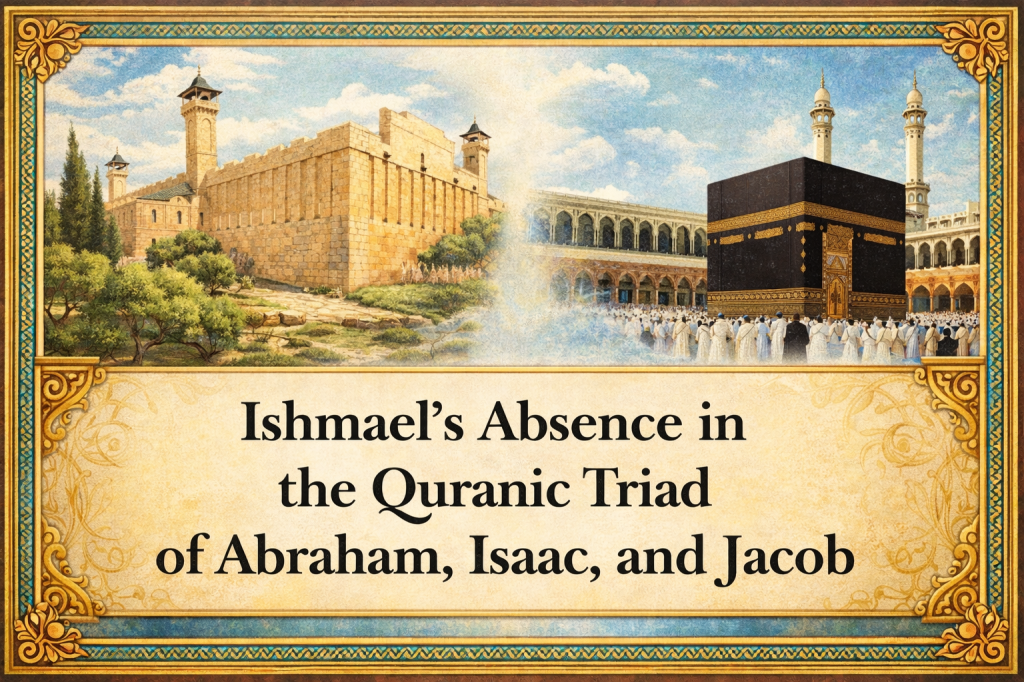
📜 Ishmael’s Absence in the Quranic Triad of Abraham, Isaac, and Jacob
❓Why Ishmael Is Not Named Alongside Isaac and Jacob in the Qur’an
Dedication, Sacrifice, and the Logic of Divine Ownership
Introduction
One of the most striking patterns in the Qur’an is the repeated pairing of Abraham with Isaac and Jacob, while Ishmael is usually not included in that triad. This has often been misunderstood as a sign of Ishmael’s lesser status. Yet, when the Qur’anic narrative is read holistically, the opposite emerges.✨
The absence of Ishmael from the Abraham–Isaac–Jacob triad does not reflect exclusion. Rather, it reflects a different mode of belonging—one that arises from Ishmael’s unique dedication to God from the earliest moments of his life.💫
⸻
Ishmael Was Given to God — Isaac Was Given to Abraham
In Islamic tradition, Abraham was commanded by God to leave Hagar and her infant son Ishmael in the barren valley of Mecca (Qur’an 14:37). This was not abandonment; it was consecration. Abraham was instructed to place Ishmael entirely in God’s custody, outside the normal structures of family, inheritance, and paternal protection.
From that moment onward, Ishmael no longer belonged to Abraham in the ordinary paternal sense. He belonged to God. 🕊️
This consecration reached its climax when Abraham later saw in a dream that he was commanded to sacrifice his “only son” (Qur’an 37:102). In Islamic understanding, this son was Ishmael, because Isaac had not yet been born at the time of that test. Abraham did not hesitate. He prepared to surrender Ishmael to God in the ultimate act of devotion. 🔥
Although God intervened and spared Ishmael, the offering had already been completed in meaning. Ishmael had been given away.
Spiritually, Ishmael was no longer Abraham’s possession.
He was God’s offering returned alive. 🌿
⸻
Why Isaac and Jacob Are Named Together with Abraham
This explains a crucial Qur’anic pattern.
When the Qur’an speaks of Abraham, Isaac, and Jacob, it is not merely listing sons. It is identifying the household lineage that remained with Abraham—the branch of his family that stayed under his direct guardianship. 🏠
Verses such as:
💎 Surah 11:71: “And his wife was standing, and she laughed. Then We gave her good tidings of Isaac and after Isaac, Jacob.”
💎 Surah 38:45: “And remember Our servants, Abraham, Isaac, and Jacob—those of strength and vision.”
💎 Surah 29:27: “And We gave to Abraham, Isaac and Jacob, and We placed in his descendants prophethood and scripture.”
💎 Surah 19:49: “So when he had left them and those they worshipped besides Allah, We gave him Isaac and Jacob, and each of them We made a prophet.”
💎 Surah 12:38: “And I have followed the religion of my fathers, Abraham, Isaac, and Jacob…”
💎 Surah 6:84: “And We gave to him Isaac and Jacob; all [of them] We guided…”
…are describing the Abrahamic household line, not the totality of Abraham’s fatherhood.
Ishmael is absent from this triad not because he was excluded, but because he had already been given away to God. 🌌
⸻
Ishmael: The Son Who Belonged to God
Ishmael occupies a different theological category.
He is:
• The son entrusted to God in the desert 🏜️
• The son offered in sacrifice 🐏
• The son through whom the final Messenger would come 🕋
He does not appear in the Abraham–Isaac–Jacob triad because he was no longer Abraham’s to enumerate.
He was God’s. ✨
In this sense, Ishmael’s omission from that lineage list is not loss—it is elevation. ⬆️
⸻
Two Covenants, One Faith
The Qur’an presents two unfolding streams of divine purpose:
• Through Isaac and Jacob came the Sinai covenant—a national and legal mission for Israel. 📜
• Through Ishmael came the Abrahamic covenant fulfilled—the universal message of monotheism through Muhammad ﷺ. 🌍
Isaac represents the reward of Abraham’s faith.
Ishmael represents the price Abraham paid in placing divine will above paternal possession. ⚖️
Isaac was what Abraham received; Ishmael was what Abraham gave.✨
⸻
Conclusion
The Qur’an’s repeated pairing of Abraham with Isaac and Jacob is not an exclusion of Ishmael but a recognition of two distinct forms of covenantal belonging. Isaac and Jacob represent continuity within Abraham’s family. Ishmael represents Abraham’s ultimate surrender—a son dedicated so completely to God that he no longer belongs to Abraham at all. 🕌
Ishmael’s omission from the Abraham–Isaac–Jacob triad reflects not marginalization, but a distinct theological status rooted in his early dedication to God.🌟👐
 ABRAHAMIC THEOLOGY