Azahari Hassim
🌍 The Abrahamic Covenant and the Promise of the Land: An Islamic Perspective on Ishmael’s Inheritance
1️⃣ Introduction
Within Islamic scholarship, there is a significant perspective that the Abrahamic Covenant—God’s promise to grant a specific land and bless all nations—was fulfilled through Ishmael (Ismā‘īl عليه السلام) and his descendants, culminating in the final Messenger, Muhammad ﷺ.
This view contrasts with the Israelite tradition, which locates the covenant’s fulfillment in the line of Isaac (Ishāq عليه السلام) and his descendants through Jacob (Ya‘qūb عليه السلام), under the Sinai Covenant.
⸻
2️⃣ The Land Promise: From the Nile to the Euphrates
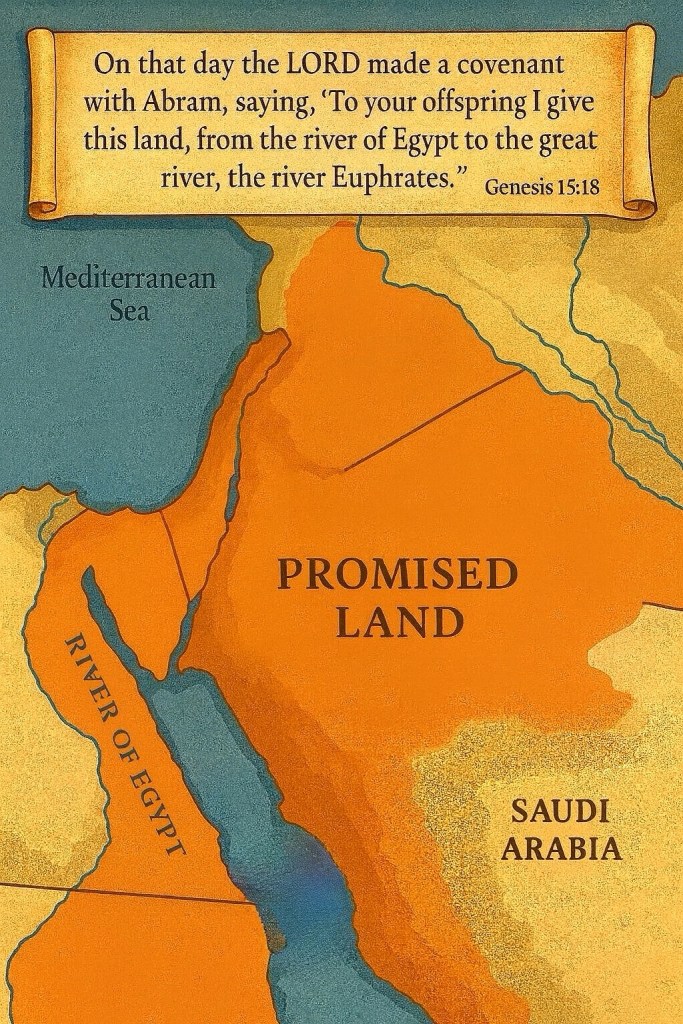
The Torah records in Genesis 15:18:
“To your descendants I give this land, from the river of Egypt to the great river, the river Euphrates.”
From an Islamic perspective, scholars who uphold the Ishmaelite fulfillment argue that:
• Geographical Alignment – The promised territory, stretching from the Nile in Egypt to the Euphrates in Mesopotamia, corresponds more closely to the expanse of Muslim lands during the Caliphates, especially under the leadership of the early successors of Prophet Muhammad ﷺ.
• Historical Realization – While the Israelites never fully possessed all the land between the two rivers, the early Muslim ummah—descendants of Ishmael through Muhammad ﷺ—established dominion over this very region, thus fulfilling the territorial aspect of the covenant.
⸻
3️⃣ Blessing to All Nations
God promised Abraham in Genesis 12:3 and Genesis 22:18:
“Through your seed all nations on earth will be blessed.”
In the Qur’an, this universal blessing is reflected in Surah al-Anbiyā’ (21:107):
“And We have not sent you, [O Muhammad], except as a mercy to the worlds.”
Islamic scholars view this as a direct fulfillment:
• Global Scope – The mission of Prophet Muhammad ﷺ was not confined to a single tribe or nation, but addressed all humanity.
• Restoration of Abraham’s Religion – Islam is understood as the revival of dīn Ibrāhīm—pure monotheism, worship of the One God without partners, and a moral code intended for all nations.
⸻
4️⃣ The Sacrifice: Ishmael or Isaac?
The identity of the sacrificial son is a central point of divergence:
• Islamic View – The Qur’an (Surah al-Ṣāffāt 37:99–113) narrates the event without naming the son, but the sequence of verses places the announcement of Isaac’s birth after the sacrifice episode, implying that Ishmael was the son offered.
• Historical Claim – Many Muslim scholars assert that ancient Israelite scribes altered the Torah to replace “Ishmael” with “Isaac” in the sacrificial narrative, thus reorienting the covenantal claim toward Israel rather than the Ishmaelite line.
⸻
5️⃣ The Sinai Covenant and Israelite Responsibility
In contrast, the Sinai Covenant (Exodus 19–24) was established specifically with the Children of Israel after their exodus from Egypt.
• Content – It contained the Ten Commandments and detailed laws governing worship, justice, and community life.
• Nature – The Sinai Covenant was conditional: blessings were tied to the Israelites’ adherence to God’s commandments.
• Scope – Unlike the Abrahamic Covenant’s universal vision, the Sinai Covenant was primarily ethnic and national, binding the Israelites as a distinct community to their divine mission.
⸻
6️⃣ Conclusion: The Restored Covenant in Islam
Those who uphold the Ishmaelite fulfillment of the Abrahamic Covenant believe:
• The land promise from the Nile to the Euphrates found its historical manifestation through the Muslim Caliphate, led by the descendants of Ishmael via Muhammad ﷺ.
• The universal blessing promised to Abraham was realized in the Prophet Muhammad ﷺ, who brought the message of Islam as a mercy to all peoples and nations.
• The original sacrificial son was Ishmael, signifying that the covenant was first and foremost with him and his righteous descendants.
From this perspective, Islam is not a new religion but the restoration of Abraham’s original monotheistic faith, uniting humanity under the worship of the One God, just as promised in the covenant.
🌿 Circumcision in Pre-Islamic Arabia: An Abrahamic Legacy Beyond the Torah
🌍 Introduction
🧭 Interestingly, long before the rise of Islam, ancient Arabs in Mecca practiced circumcision—often performing the rite at the age of thirteen or fourteen. This raises an important historical and theological question: did this practice originate from Jewish law, which mandates circumcision on the eighth day after birth, or does it reflect an older Abrahamic tradition that predates the Torah itself?
🪶 A closer examination of chronology, ritual practice, and Abrahamic lineage strongly suggests that circumcision among the Arabs of Mecca was not borrowed from Judaism, but rather inherited as a primordial covenantal rite tracing back to Abraham himself.
⸻
📜 Circumcision Before the Torah
📖 The Torah’s commandment of circumcision on the eighth day (Genesis 17:12) is often assumed to be the original source of the practice. However, the biblical narrative itself indicates that circumcision predates the Mosaic Law. Abraham was circumcised as an adult, and his son Ishmael was circumcised at the age of thirteen (Genesis 17:24–25), long before the revelation of the Torah at Sinai.
🧠 This detail is crucial. It shows that circumcision originally functioned not as a legalistic ritual tied to a fixed infancy timeline, but as a sign of covenantal submission to God—performed at an age associated with moral awareness and personal accountability.
⸻
🕰️ The Age of Thirteen and the Abrahamic Pattern
📌 The fact that ancient Arabs circumcised their children around the age of thirteen or fourteen closely mirrors the age at which Ishmael was circumcised. This parallel is difficult to dismiss as coincidence. Rather, it points to a preserved Abrahamic memory, transmitted through generations of Ishmael’s descendants independently of Jewish law.
🔍 If Arab circumcision were derived directly from Judaism, we would expect conformity to the Torah’s eighth-day requirement. Instead, the persistence of circumcision at adolescence suggests continuity with Abraham’s first covenantal act—before the Torah, before Israel, and before Sinai.
⸻
🌐 Independent Transmission of Abrahamic Tradition
🧬 Abraham is recognized as a common ancestor of both Jews and Arabs, yet the two lineages developed distinct ritual expressions of shared Abrahamic practices. Judaism formalized circumcision within a legal framework tied to infancy, while the Ishmaelite tradition appears to have retained an older form of the rite—performed at the threshold of maturity.
🏺 This divergence supports the idea that ancient Arabian circumcision was not an imitation of Jewish custom, but a parallel inheritance rooted in a shared patriarchal past. The tradition survived in Arabia as part of a living Abrahamic legacy, even as other elements of Abrahamic monotheism became obscured over time.
⸻
🕌 Islam later re-affirmed circumcision as part of the fitrah—the natural disposition associated with Abrahamic monotheism—without fixing it to a specific age in the Qur’an. This flexibility reflects the original Abrahamic character of the practice: a sign of covenant and submission rather than a rigid legal requirement.
✨ In this sense, Islam did not introduce circumcision to Arabia, nor did it borrow it from Judaism. Instead, it restored and re-contextualized an ancient Abrahamic rite that had already existed among the Arabs of Mecca for centuries.
⸻
📚 Conclusion
🧾 The practice of circumcision among pre-Islamic Arabs is best understood not as a derivative of the Torah, but as a vestige of an older Abrahamic covenant that predates Jewish law. The age at which the rite was performed, its deep cultural entrenchment, and its alignment with Ishmael’s circumcision all point toward an independent transmission rooted in Abraham himself.
🌟 Thus, circumcision in ancient Mecca stands as historical testimony to a shared Abrahamic inheritance—one that existed before the Torah, endured outside Israel, and was ultimately reaffirmed through Islam as part of the universal legacy of Abraham.

