Azahari Hassim
📜 The Absence of “Land of Moriah” in the Samaritan Torah: A Textual and Theological Analysis
Introduction
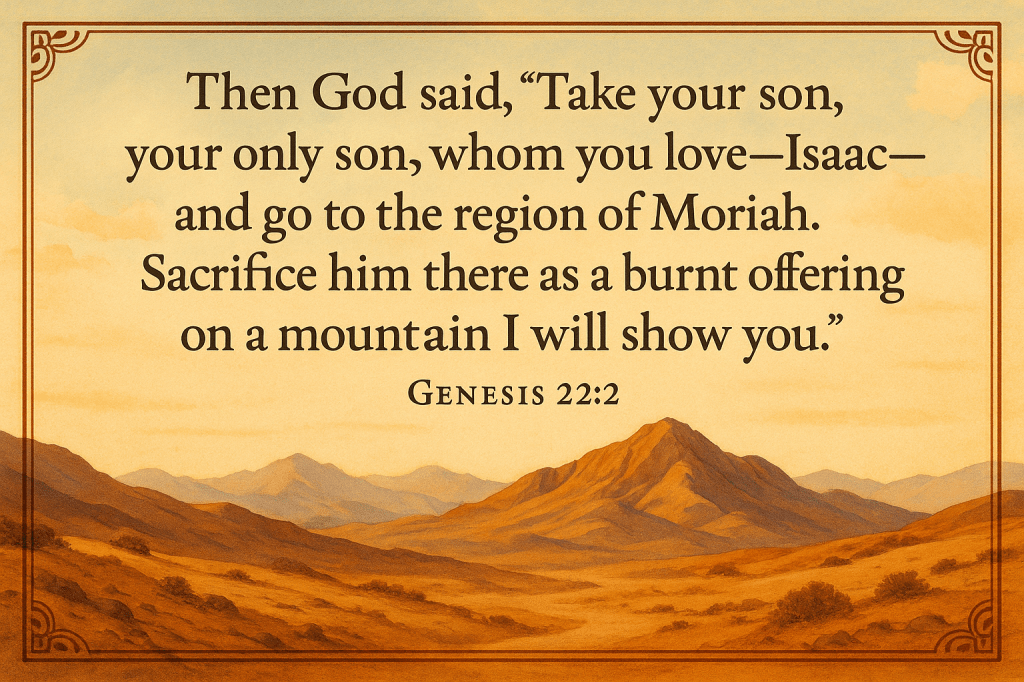
Genesis 22—the narrative traditionally known in Judaism as the Akedah—begins with God commanding Abraham to travel to a specific region to offer his son as a sacrifice. In the Masoretic Text (MT), the canonical Hebrew Bible used in Judaism, the command directs Abraham to “the land of Moriah.”
This phrase has become foundational in Jewish and Christian tradition, especially in associating the event with Jerusalem and the future Temple Mount.
Yet, the Samaritan Torah preserves a different reading, one that significantly reshapes the geographical and theological setting of the story. Importantly, the Samaritan Torah does not contain the phrase “land of Moriah” at all.
⸻
📃 The Samaritan Reading of Genesis 22
In the Samaritan Pentateuch (SP), the wording of Genesis 22:2 diverges from the Masoretic text. Instead of “Moriah,” the Samaritan version reads:
“Go to the land of Moreh.”
Thus, the Samaritan Torah identifies the location not as Moriah, but as Moreh—the same geographical region associated with Abraham’s first altar in Genesis 12. This difference is profound: while “Moriah” later becomes linked to Jerusalem, “Moreh” is firmly tied to the area around Shechem, near Mount Gerizim, the holiest site in Samaritanism.
This means that in the Samaritan tradition, the Binding of Isaac narrative (Akedah) unfolds not in the future Temple region, but within the ancient Abrahamic landscape of Shechem and Gerizim.
⸻
🌟 The Significance of This Variant Reading
- Sacred Geography
For the Samaritans, Mount Gerizim—not Jerusalem—is the chosen mountain of God.
By reading “Moreh,” the Samaritan text situates the near-sacrifice narrative geographically close to Gerizim, reinforcing their belief that this region is the true center of divine revelation.
This interpretation also aligns with earlier Abraham narratives:
• In Genesis 12, Abraham builds his first altar at the “oak of Moreh.”
• In the Samaritan worldview, Genesis 22 naturally continues Abraham’s early sacred geography.
- Textual Considerations
Scholars often note that the term “Moriah” in the Masoretic Text is linguistically difficult and appears only in two biblical texts: Genesis 22 and a much later passage in Chronicles. The rarity of the word has led many scholars to suggest that “Moriah” may reflect:
• A later interpretive development,
• Or a geographical reorientation toward Jerusalem for theological purposes.
By contrast, the Samaritan reading “Moreh” is a well-established place name within the Pentateuch itself. It is geographically coherent and consistent with the Abrahamic narrative.
This leaves open the scholarly possibility that the Samaritan reading may preserve an older or more original form of the text.
- Theological Implications
Removing “Moriah” detaches the narrative from Jerusalem, thereby separating the Binding story (Akedah) from the later Temple traditions that dominate Rabbinic Judaism and Christianity.
In Samaritan theology:
• The true sacrificial mountain is Mount Gerizim.
• The Akedah is understood as part of a continuous Abrahamic tradition centered in Shechem–Gerizim, not Zion.
• The absence of “Moriah” supports their claim that the Torah does not endorse the sanctity of Jerusalem.
This alternative textual tradition therefore becomes a foundational element in the longstanding religious differences between Samaritans and Jews.
⸻
📕 Conclusion
The Samaritan Torah’s omission of the phrase “land of Moriah” highlights a deeply significant textual variation with wide-reaching implications.
Rather than pointing Abraham toward Jerusalem, the Samaritan version locates the near-sacrifice in the land of Moreh, near Shechem and Mount Gerizim.
This difference not only shapes Samaritan sacred geography but also offers valuable insight into the diverse ways ancient communities transmitted, interpreted, and localized the Abrahamic tradition.
By noting that “land of Moriah” does not appear in the Samaritan Torah, we gain a clearer understanding of how textual variants preserve competing visions of the covenantal landscape and the history of Israel’s earliest traditions.
Isaiah 41:8 and the Meaning of ’Ohavī
📜 Isaiah 41:8 and the Meaning of ’Ohavī:
Abraham as the Lover of God in the Hebrew Covenant Framework
⸻
Abstract
Isaiah 41:8 is frequently translated in English as referring to Abraham as the “friend of God.” However, a philological analysis of the Hebrew term employed—’ohavī (אֹהֲבִי)—indicates that this translation does not fully capture its theological significance.
This article argues that ’ohavī does not denote “friend” in a social sense, but rather “one who loves God,” a covenantal term that emphasizes active love, fidelity, and obedience. By examining the linguistic form, literary structure, and theological implications of the verse, this study demonstrates that Abraham is portrayed in Isaiah not as a passive recipient of divine favor, but as an active subject who establishes covenantal relationship through love manifested in obedience and sacrifice.
⸻
🪷 1. Introduction
Isaiah 41:8 is one of the key biblical texts affirming Abraham’s unique status in the history of divine covenant:
“But you, Israel, my servant, Jacob whom I have chosen,
the offspring of Abraham my friend.”
In Jewish and Christian traditions, this verse is often cited as evidence of Abraham’s special personal relationship with God. However, the common English rendering “my friend” raises an important interpretive question: does the Hebrew term used here truly signify friendship in the ordinary sense, or does it convey a deeper covenantal concept?
This article seeks to demonstrate that the English word “friend” fails to convey the full semantic and theological depth of the original Hebrew expression, and that the underlying term carries significant implications for understanding the nature of the Abrahamic covenant.
⸻
🥀 2. Philological Analysis: The Term ’Ohavī (אֹהֲבִי)
The Hebrew text of Isaiah 41:8 reads:
זֶרַע אַבְרָהָם אֹהֲבִי
zeraʿ Avraham ’ohavī
The key term in this phrase is ’ohavī, derived from the Hebrew root א־ה־ב (ʾ–h–v), meaning “to love.” Grammatically, ’ohavī is an active participle with a first-person singular possessive suffix, yielding the literal meaning:
“the one who loves Me.”
From a linguistic standpoint, this construction places emphasis on Abraham as the acting subject—the one who loves God. This is markedly different from other Hebrew words that can denote “friend” or “companion,” such as re‘a (רֵעַ) or ḥaver (חָבֵר), neither of which appears in this verse.
The deliberate choice of a love-based participle indicates that Abraham’s relationship with God is framed in terms of covenantal fidelity rather than social familiarity.
⸻
🌱 3. Abraham as an Active Subject in the Covenant Relationship
The literal meaning of ’ohavī carries significant theological implications. It portrays Abraham not merely as someone “loved by God,” but as one who actively responds to God through love expressed in obedience.
This portrayal is consistent with the broader Abrahamic narrative in Genesis, where Abraham’s identity is shaped by a sequence of radical acts of obedience, including:
- His departure from homeland and kinship ties (Genesis 12),
- His trust in divine promises without immediate material assurance (Genesis 15),
- His acceptance of circumcision as a physical and symbolic sign of covenant (Genesis 17),
- His willingness to surrender his son in the climactic test of sacrifice (Genesis 22).
Within this narrative framework, ’ohavī functions as a theological summary of Abraham’s life orientation—an existence defined by obedience as an expression of love.
⸻
🌼 4. The Foundation of Covenant: Love Preceding Lineage
The internal structure of Isaiah 41:8 further reinforces this theological reading:
• Israel is designated as “servant,”
• Jacob as “chosen,”
• Abraham as ’ohavī.
This sequence suggests that Israel’s covenantal identity is grounded in Abraham’s relationship with God, and that this relationship is defined by love and fidelity rather than by ethnic identity alone. Lineage inherits the covenant, but the covenant itself is established through the love-driven obedience of Abraham.
Accordingly, the Abrahamic covenant is presented as pre-national and pre-institutional, not fully reducible to later political or ethnic formations associated with Israel.
⸻
🎋 5. The Translation Issue: “Friend” as Theological Softening
Most English translations opt for the word “friend” when rendering ’ohavī, largely for stylistic and cultural reasons. The term “lover” can sound awkward or misleading in modern English usage. Nevertheless, this translation choice carries theological consequences:
- It softens the covenantal notion of love into a general sense of friendship,
- It obscures the element of active obedience inherent in the original term,
- It risks portraying Abraham as a passive recipient of divine affection rather than as a moral agent whose actions shape the covenant.
A more precise translation, faithful to both philology and theology, would read:
“the offspring of Abraham, the one who loved Me.”
⸻
🪻 6. Broader Theological Implications
Understanding ’ohavī as “one who loves God” has significant implications for covenant theology. It underscores that divine covenant is not grounded solely in ethnic election, but in moral fidelity and obedience arising from love.
This principle explains why Abraham is depicted as a universal figure: he precedes the Sinai legislation, transcends national boundaries, and serves as a paradigmatic model of faith for subsequent generations.
⸻
🌴 7. Conclusion
A close examination of the term ’ohavī in Isaiah 41:8 reveals that Abraham is portrayed not merely as the “friend of God,” but as the “lover of God” in a covenantal sense. His relationship with God is defined by love demonstrated through obedience and sacrifice, rather than by ethnic privilege or social intimacy.
When read with philological precision, Isaiah 41:8 emerges as a foundational theological statement affirming that the Abrahamic covenant rests upon individual fidelity expressed through love—a principle that undergirds covenantal thought across the broader Abrahamic tradition.

