Azahari Hassim
📋 “Muhammad” as a Title for Jesus?
A Full Explanation of Jay Smith’s Argument
Introduction
In recent years, Christian polemicist and historian Jay Smith—a prominent figure in London’s Hyde Park debates—has advanced a controversial re-reading of early Islamic origins. One of his most provocative claims is that the term “Muhammad” (MHMD), as it appears in early Arabic inscriptions and coinage, did not originally refer to a historical Arabian prophet, but rather functioned as a title for Jesus used by Syriac-speaking Christian communities in the 6th–7th centuries.
This reinterpretation forms part of Smith’s broader revisionist model that challenges the traditional narrative of Islam’s emergence in 7th-century Arabia.
This article explains Smith’s reasoning, the linguistic and historical evidence he proposes, and the Christian tradition he believes produced this title.
⸻
- Syriac Christianity as the Alleged Source of “Muhammad”
According to Jay Smith, the key to understanding the early appearances of the name MHMD is the influence of Syriac-speaking Christian sects.
He argues that:
1.1. Syriac Christians used titles rather than personal names in liturgical texts
Smith points out that Syriac hymnography and homilies frequently use descriptive epithets for Jesus, including:
• Mshīḥā — “the Messiah”
• Mār(y)a — “the Lord”
• Raḥmānā — “the Merciful”
• Mḥīmmādā / Mḥamdā — “the Praised One”
This last term—rooted in the Semitic tri-consonantal cluster ḥ-m-d (to praise, to commend)—becomes the central pillar of his argument.
1.2. “Mḥmd” was allegedly a Christological title
Smith contends that in some Syriac poetic and liturgical traditions, Jesus was poetically described as mḥmd—“the praised one.”
Thus, the MHMD appearing in early inscriptions could, in his view, reasonably refer to Jesus Christ, not to a human founder of Islam.
1.3. Syriac Christians shaped early Arab religious vocabulary
Smith claims that Arab tribes living in the Levant, northern Arabia, and Mesopotamia—before Islam—were heavily influenced by:
• Syriac Orthodox (Jacobite) Christians
• Nestorian Christians
• Aramaic-speaking monastics and missionaries
Thus, the earliest Arabic religious inscriptions may reflect Christian theological language, not Islamic identity.
⸻
- Early Coins and Inscriptions: Reading MHMD as Jesus
Jay Smith frequently cites 7th-century archaeological data—coins, inscriptions, and manuscripts—to support his claim.
2.1. The earliest MHMD references do not resemble later Islamic theology
On coins from the late 7th century (especially during the reign of Abd al-Malik), the inscription:
• MHMD appears alongside Christian symbols, such as
• a cross
• Christological phrases
According to Smith, this demonstrates the following:
The earliest Muslims were still using Christian iconography and language; therefore, “Muhammad” must have been a title within this Christianized framework.
2.2. The absence of prophetic biography
Smith argues that inscriptions mentioning MHMD contain no indication of:
• a birthplace in Mecca
• a prophetic mission
• a Quran
• companions
• battles
• hadith
• prophetic sayings
Thus, he concludes that MHMD was not originally a historical prophet, but a venerated figure already known in Christian tradition.
2.3. MHMD in the Dome of the Rock inscription (691 CE)
The Dome of the Rock contains the phrase:
• “Muhammad is the servant of God and His Messenger.”
Smith argues that this phrase resembles Christian formulations about Jesus—particularly the biblical phrase “Jesus, the servant of God”—and therefore could originally have signified Jesus, before being reinterpreted as a reference to an Arabian prophet.
This is a highly contested claim, but central to his reasoning.
⸻
- Which Christian Tradition Produced This Title?
Jay Smith’s position is clear:
He attributes the “Muhammad-as-Title-for-Jesus” interpretation to:
3.1. Syriac Orthodox (Jacobite) Christianity
• Based in Syria and Mesopotamia
• Known for poetic, honorific titles for Christ
• Used Semitic linguistic roots like ḥ-m-d in Christological praise
3.2. Other Eastern Christian sects
Smith sometimes expands this to:
• Nestorian Arabs
• Syriac-speaking monastic communities
• Arabized Christian tribes
These groups, he argues, created an environment in which a title such as “the praised one” (mḥmd) could easily be applied to Jesus.
⸻
- How, According to Smith, the Title Became a Personal Name
Jay Smith argues that early Arab rulers—particularly those forging a new political-religious identity after the fall of Byzantine influence—misappropriated or reinterpreted the Syriac epithet.
4.1. A title becomes a name
He claims that as Arabic replaced Syriac as the dominant liturgical and administrative language, the term:
• mḥmd → “Muhammad”
shifted from a title meaning “praised one”
to a personal name belonging to a newly constructed prophet-figure.
4.2. The creation of a prophetic biography
Smith asserts that the sīrah (prophetic biography) and hadith literature—compiled much later—retroactively built a life story around this name, transforming a Christological epithet into a new religious founder.
⸻
- Scholarly Response
Most historians, linguists, and Islamic scholars—both Western and Muslim—reject Smith’s view, arguing that:
• “Muhammad” behaves grammatically as a proper name in early Arabic sentences
• Coins and inscriptions reflect a transitional Islamic theology, not Christian language
• Syriac texts using the root ḥ-m-d do not equate this term with a personal identity for Jesus
• Smith’s method selectively reads evidence
Nonetheless, his theory remains influential in certain polemical circles and continues to generate debate online.
⸻
Conclusion
Jay Smith’s argument that “Muhammad” was originally a title for Jesus arises from his broader revisionist project that reexamines Islam’s earliest decades. He locates this idea in Syriac-speaking Christian traditions, particularly Jacobite Christianity, which he suggests used poetic praise terms such as mḥmd for Jesus.
From this foundation, he argues that early Arab rulers and later Islamic writers misinterpreted and transformed this epithet into the personal name “Muhammad,” eventually constructing a prophetic biography around it.
Though not supported by mainstream scholarship, Smith’s thesis represents a distinctive attempt to reinterpret early Islamic materials through the lens of late antique Syriac Christianity.
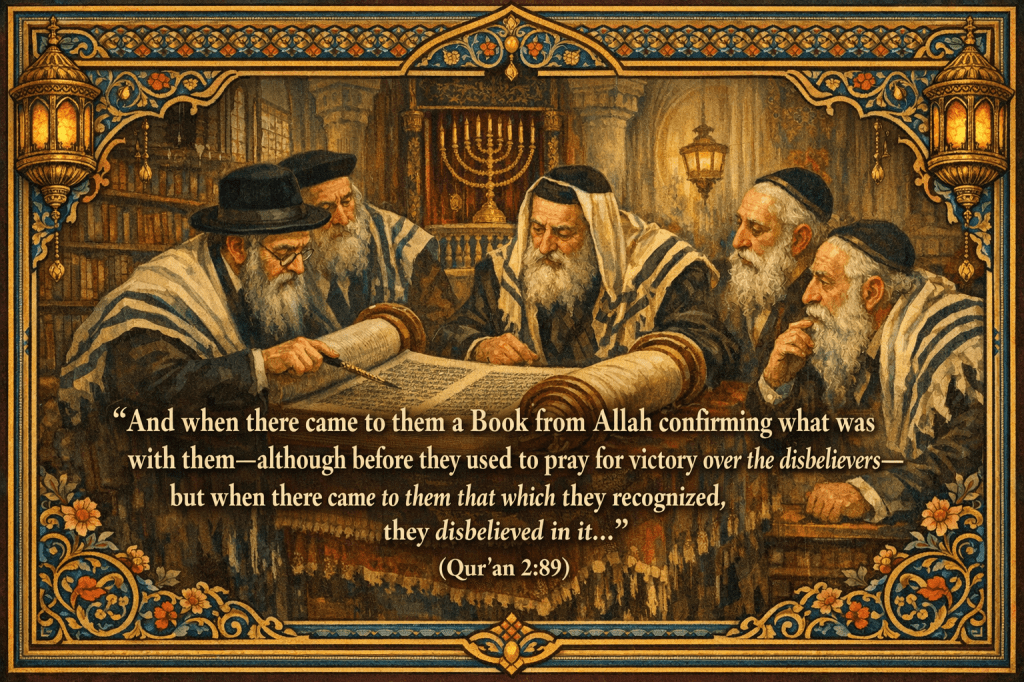
✨ Messianic Expectations and Prophethood: A Qur’anic Perspective on Muhammad and the Jews ✨
The reasoning behind the claim that the Quran indirectly refers to Prophet Muhammad ﷺ as the awaited Jewish Messiah—despite the fact that the Quran never explicitly calls him “the Messiah”—relies on a combination of historical context 🏺, Qur’anic exegesis (tafsir) 📖, and theological interpretation 🧠.
Let’s break this down carefully:
⸻
1️⃣ Understanding the Term “Messiah” in Islam vs. Judaism
• ✡️ In Judaism, the “Messiah” (Mashiach) is traditionally understood as a future leader from the line of David, who will restore Israel, defeat its enemies ⚔️, and establish God’s kingdom on earth 👑.
• ☪️ In Islam, the title “al-Masih” (the Messiah) is explicitly used in the Quran only for Jesus (‘Isa) (e.g., Qur’an 3:45, 4:157, 5:75), not Muhammad ﷺ.
• 📌 So, by terminology alone, Muhammad ﷺ is not called “the Messiah” in the Quran.
⸻
2️⃣ Surah 2:89 – Context and Interpretation
“And when there came to them a Book from Allah confirming what was with them—although before they used to pray for victory over the disbelievers—but when there came to them that which they recognized, they disbelieved in it…”
(Qur’an 2:89)
🕰️ Historical Background
• 🏘️ This verse refers to the Jewish tribes in Medina (e.g., Banu Qurayza, Banu Nadir).
• 📜 Prior to Muhammad’s arrival, these tribes were awaiting a redeemer figure—a prophet or messianic leader—foretold in their scriptures.
• 🙏 They used to pray for victory over the pagan Arabs, invoking the aid of this coming prophet.
• ❌ However, when Muhammad ﷺ arrived—not from among the Israelites, but as an Arab—they rejected him, even though, as the Quran says, “they recognized him.”
🧩 Interpretation
• 📖 Muslim scholars interpret this as meaning the Jews had knowledge from their scriptures (especially the Torah and oral traditions) of a coming prophet.
• 🌟 This expected figure—a prophet or redeemer who would fulfill a divine mission—bears some resemblance to the Jewish concept of the Messiah.
• 🔍 Therefore, while Muhammad ﷺ does not bear the title “Messiah”, some view him as functionally fulfilling aspects of that role, especially in light of certain messianic expectations.
⸻
3️⃣ The Dead Sea Scrolls and Multiple Messianic Expectations
📜 Significantly, the Dead Sea Scrolls—a collection of Jewish texts from the Second Temple period discovered near Qumran—reveal that some Jewish sects expected not one, but multiple messianic figures:
• 👑 A royal Messiah (a kingly descendant of David),
• 🕯️ A priestly Messiah (often linked to the line of Aaron or the Zadokite priesthood),
• 📘 And a prophetic Messiah (or “Messianic Prophet”), sometimes connected with a figure like Moses or a new prophet sent by God.
This tripartite messianic expectation shows that not all Jews expected only a Davidic king. Some anticipated a prophet—possibly like Deuteronomy 18:18’s “Prophet like Moses.”
🧭 This prophetic figure matches more closely with Muhammad’s role in Islam: a law-bringer, warner, and guide, speaking God’s words as a final messenger. Thus, from the viewpoint of Muslim interpreters, Muhammad ﷺ may correspond to the “Messianic Prophet” foreseen in certain Jewish traditions, especially in the Dead Sea Scrolls.
⸻
4️⃣ Why Muhammad Is Not Called “The Messiah” in the Quran
• 🕊️ The Quran exclusively applies the title “al-Masih” to Jesus (‘Isa).
• ⏳ From the Islamic perspective, Jesus is the Messiah sent to the Children of Israel and will return at the end of time.
• 🌍 Muhammad ﷺ, on the other hand, is referred to as the “Seal of the Prophets” (Qur’an 33:40)—the final messenger to all of humanity, not a Messiah figure in title.
⸻
5️⃣ So Why the Indirect Connection?
Those who argue that Surah 2:89 suggests Muhammad ﷺ fulfilled messianic expectations draw on the following points:
• ⏰ The Jews were awaiting a promised figure—a prophet or redeemer described in their scriptures.
• 👁️ The verse claims they “recognized him”, suggesting that Muhammad ﷺ matched certain known characteristics.
• 🧬 Ethnic or tribal bias (he being Arab, not Israelite) led to his rejection.
• 🔄 Therefore, Muhammad ﷺ functionally fulfilled one type of Jewish messianic expectation, especially that of the prophetic Messiah as seen in some sectarian texts like the Dead Sea Scrolls.
⸻
6️⃣ Classical and Modern Tafsir Views
• 📚 Ibn Kathir, Al-Tabari, and other classical commentators explain Surah 2:89 as referring to Jewish scriptural knowledge of a coming prophet.
• 📖 Some link this to Deuteronomy 18:18, where God promises to raise a prophet like Moses from among the “brethren” of the Israelites.
• 🧠 While these interpretations emphasize Muhammad ﷺ as a foretold prophet, they do not typically identify him as the Messiah.
⸻
🏁 Conclusion
• ❌ The Quran does not call Muhammad ﷺ the Messiah.
• ☪️ In Islamic theology, the Messiah is Jesus (‘Isa).
• 📜 However, Surah 2:89 indicates that the Jews had prior knowledge of a coming prophet—and Muhammad ﷺ fulfilled that expectation.
• 🧩 The Dead Sea Scrolls’ vision of multiple messianic figures, including a prophetic Messiah, helps explain how Muhammad ﷺ could be seen as fulfilling part of Jewish messianic hope—though not in title.
• 🔎 Hence, the claim that the Quran “indirectly refers” to Muhammad ﷺ as a messianic figure is not a matter of explicit wording, but of historical and interpretive convergence.
📜 A Muslim Theological Rebuttal to Jay Smith’s Claim that “Muhammad” Was a Title for Jesus
Introduction
Jay Smith’s revisionist proposal—that the name “Muhammad” (MHMD) in early inscriptions was not a historical individual but a title for Jesus borrowed from Syriac Christianity—directly challenges Islamic belief concerning the Prophet Muhammad ﷺ.
From a Muslim standpoint, this argument is untenable both textually and theologically. Islam upholds Muhammad as a real, historical prophet sent in the 7th century, whose life, teachings, and community are extensively documented.
The claim that his name originated as a Christological title contradicts core Islamic doctrine, linguistic evidence, and the established historical record.
This rebuttal clarifies the Muslim position in four major domains: Qur’anic theology, Arabic linguistics, prophetic biography, and historical transmission.
⸻
- Qur’anic Evidence: Muhammad as a Distinct Human Prophet 💫
The Qur’an clearly identifies Muhammad as:
• a human being,
• a prophet,
• living among the Arabs,
• delivering a message,
• surrounded by opponents and followers.
1.1 The Qur’an explicitly separates Muhammad from Jesus
Verse 3:144 states:
“Muhammad is no more than a messenger; messengers passed away before him.”
This verse presupposes:
• Muhammad is not Jesus,
• but one in a sequence of messengers,
• who has his own distinct historical mission.
Other verses (33:40, 47:2, 48:29) consistently refer to Muhammad as a unique individual with his own prophetic identity, not as a title applied to an earlier figure.
1.2 The Qur’an distinguishes their communities
Each prophet has his own ummah, laws, and circumstances. Jesus’ community is:
• al-Ḥawāriyyūn (the disciples)
Muhammad’s community is:
• the early Muslim believers of Arabia
This is theological evidence that Muhammad and Jesus cannot be conflated.
1.3 The Qur’an narrates separate missions, separate covenants
Jesus:
• Born miraculously
• Granted the Injil
• Sent to the Israelites
Muhammad:
• Born in Mecca
• Received the Qur’an in Arabic
• Sent to humanity at large
No Qur’anic narrative or doctrine merges their identities.
⸻
- Arabic Linguistic Rebuttal: “Muhammad” Functions Grammatically as a Personal Name 🌟
Jay Smith’s speculation rests on the similarity between the Syriac root ḥ-m-d and the Arabic name Muḥammad, but this comparison fails linguistically.
2.1 “Muhammad” is a standard Arabic proper noun, not a title
Arabic grammar treats “Muhammad” as a definite proper name, identical in structure to:
• Aḥmad
• Maḥmūd
• Ḥamīd
All of these derive from the same Semitic root.
Arabic names commonly derive from verbal forms, but this does not make them titles any more than “Solomon” implies “peaceful” or “David” implies “beloved.”
2.2 Arabic inscriptions present Muhammad as a concrete historical agent
In early inscriptions (e.g., early mosques, coins, rock engravings), Muhammad is described not merely as:
• “praised one”
But as:
• rasūl Allāh — the messenger of God
• ʿabd Allāh — the servant of God
These roles require a living agent, not a poetic epithet.
2.3 The title → personal name theory ignores Arabic morphology
The form Muḥammad means:
“The one who is repeatedly praised.”
This is a grammatically valid Arabic name in the pattern (mufa‘‘al).
Nothing requires this to derive from Syriac Christian vocabulary.
⸻
- Historical Rebuttal: The Biography of Prophet Muhammad Is Too Detailed to Be a Later Invention ♦️
Jay Smith’s theory implies that a vast prophetic biography was invented in the 8th–9th centuries and retroactively applied to a title originally referring to Jesus.
This contradicts the massive volume of early Islamic historical data, including:
3.1 Eyewitness testimony
The Sīrah and Hadith literature were preserved by:
• thousands of transmitters
• across multiple regions
• with rigorous chains of narration (isnād system)
This is unprecedented in world religious history.
3.2 Non-Muslim sources
6th–8th century Jewish, Christian, and Zoroastrian writers mention:
• Muhammad as a real Arab leader
• Muhammad’s battles
• Muhammad’s followers
• Muhammad’s monotheistic preaching
Such sources include:
• The Doctrina Jacobi (c. 640 CE)
• The Chronicle of Sebeos (660s CE)
• Thomas the Presbyter (640s CE)
• John of Damascus (c. 750 CE)
None of these writers equate Muhammad with Jesus.
They all treat Muhammad as a contemporary Arabian figure.
3.3 Rapid expansion of Islam requires a historical founder
A poetic title from Syriac Christianity cannot explain:
• the emergence of a unified Arabian polity
• early Islamic law
• military expansions
• administrative reforms
These require a living founder, not a misinterpreted epithet.
⸻
- Theological Rebuttal: Islam Cannot Theologically Accept a Jesus–Muhammad Identity 🌟
Even conceptually, Jay Smith’s theory contradicts Islamic doctrine:
4.1 Jesus is not the final prophet in Islam
Islam considers:
• Jesus a prophet who lived centuries earlier
• Muhammad the final prophet who seals revelation
Equating them collapses the entire Qur’anic framework.
4.2 The Qur’an names both “Muhammad” and “Aḥmad”
Surah 61:6 explicitly records Jesus predicting the coming of:
“a messenger to come after me, whose name is Aḥmad.”
This verse is theologically impossible if “Aḥmad/Muḥammad” was simply a title already used for Jesus.
4.3 Distinct missions necessitate distinct identities
Jesus:
• Brought miracles
• Was raised to heaven
• Had disciples
Muhammad:
• Delivered the Qur’an
• United the Arabs
• Governed Medina
This division is built into Islamic doctrine.
⸻
Conclusion ☪️
From a Muslim theological and historical standpoint, Jay Smith’s claim that “Muhammad” was originally a Syriac Christian title for Jesus is unsustainable. The Qur’an’s explicit differentiation between Jesus and Muhammad, the linguistic integrity of the Arabic name, the enormous breadth of historical evidence for Muhammad’s individual life, and the theological architecture of Islam all insist that Muhammad is a distinct human prophet, not a reused epithet.
Islamic tradition maintains:
Muhammad ﷺ was a unique, historical messenger sent to humanity, foretold by Jesus but never identical to him.
The claim that “Muhammad” was merely a title for Jesus is thus both theologically incompatible with Islam and historically implausible.
 ABRAHAMIC THEOLOGY