Azahari Hassim
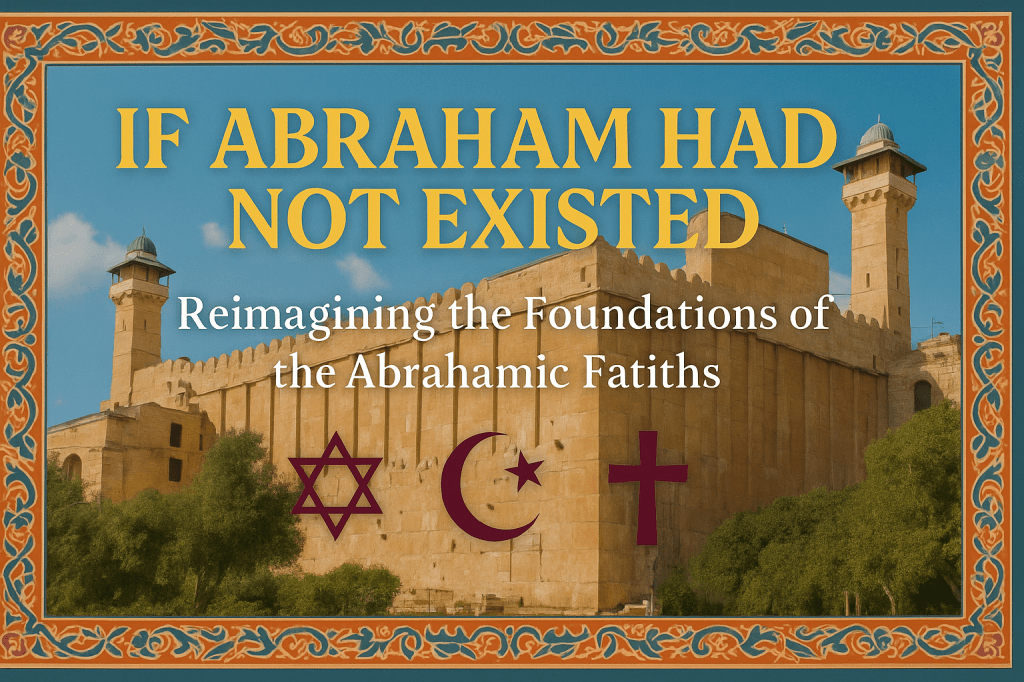
🌍 If Abraham Had Not Existed: Reimagining the Foundations of the Abrahamic Faiths
🕊️ Introduction
Few figures in human history hold as central a place as Abraham. Revered as a patriarch by Jews, Christians, and Muslims alike, Abraham’s life represents faith, obedience, and covenantal relationship with God. Yet one may ask: what if Abraham had not existed? How would the three great monotheistic religions—Judaism, Christianity, and Islam—have looked without him?
⸻
✡️ 1. Judaism Without Abraham
In Judaism, Abraham is Avraham Avinu—“our father Abraham”—the first to recognize and worship one God. He embodies the beginning of the covenant through which God promised descendants as numerous as the stars and granted the Land of Israel as their inheritance.
Without Abraham, Judaism might never have developed its distinctive identity as a covenantal faith. The entire theological framework linking the Jewish people to divine promise and land would lack its origin. A different patriarchal figure might have emerged, but the concept of the chosen people bound by a divine covenant could have been far less defined or even absent altogether.
⸻
✝️ 2. Christianity Without Abraham
Christianity draws deeply upon Abraham as the model of faith before the law. In Paul’s Epistle to the Romans (4:3), Abraham is cited as the one who “believed God, and it was credited to him as righteousness.” For early Christians, Abraham’s faith symbolized justification through belief rather than works—a cornerstone of Christian theology.
If Abraham were missing from the biblical narrative, Christian thought might have lacked its archetype of faith and obedience. The connection between the Old and New Testaments would have been weaker, and Paul’s theological bridge from Judaism to Christianity less convincing. The doctrine of salvation through faith could have taken a different shape or rested upon another figure entirely.
⸻
☪️ 3. Islam Without Abraham
In Islam, Abraham (Ibrahim عليه السلام) stands as one of the greatest prophets and the friend of Allah (Khalīlullāh). He is seen as the renewer of pure monotheism and the spiritual father of both prophetic lines—through Isaac leading to Israel, and through Ishmael leading to the final Messenger, Muhammad ﷺ.
Without Abraham, Islam would lose a profound ancestral link that unites the prophetic tradition. The rituals of Hajj—circumambulating the Kaaba, performing Sa‘i between Safa and Marwah, and the symbolic sacrifice—are all reenactments of Abraham’s and Ishmael’s devotion. Without his example, the pilgrimage and even the symbolism of the Kaaba as the restored “House of God” might not exist in the same form.
⸻
🔥 4. The Missing Narratives of Faith and Sacrifice
Abraham’s absence would erase some of the most formative narratives of divine testing and human submission. The binding of Isaac (in Jewish and Christian scripture) or sacrifice of Ishmael (in the Qur’anic version) expresses the highest model of surrender to God’s will. Without such a story, the moral archetype of total faith under trial would be lost. The concept of “submission” (Islam) itself finds its origin in Abraham’s willingness to yield entirely to divine command.
⸻
📜 5. The Prophetic Testimony: “That is Abraham, upon him be peace”
Islamic tradition exalts Abraham as the best of creation. Anas bin Malik reported:
A man came to the Messenger of Allah (ﷺ) and said,“O best of creation!”
The Prophet replied, “That is Abraham, upon him be peace.”
(Sahih Muslim)
This humility of the Prophet Muhammad ﷺ reveals not only reverence for Abraham’s spiritual stature but also the continuity of divine mission across time. Abraham’s unwavering monotheism and selfless faith form the spiritual DNA of all later prophets.
⸻
🌟 Conclusion: The Irreplaceable Patriarch of Monotheism
Had Abraham never lived, the landscape of world religion would be unrecognizably different. Judaism might lack its covenantal foundation; Christianity might lack its doctrine of faith; Islam might lose its living model of surrender and devotion.
Abraham’s existence bridges heaven and earth, past and future, uniting humanity under the banner of pure monotheism. As the Prophet Muhammad ﷺ affirmed, Abraham remains the best of creation—an eternal symbol of faith, obedience, and divine friendship.
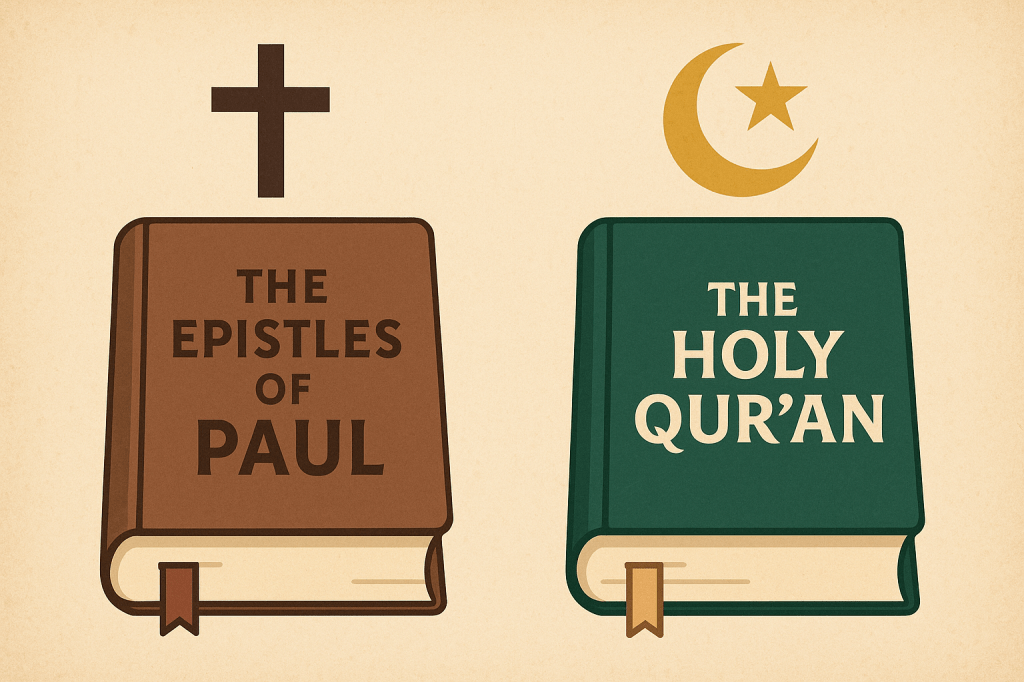
Islam and Paul on the Abrahamic Covenant ✦ Ishmael, Isaac, and the Fulfillment of Faith
🔥 Who really inherits the promise of Abraham?
For over two thousand years, this question has divided believers. To Jews, the answer is Isaac, father of Israel. To Christians, following Paul, Isaac again becomes the key—but in a spiritualized sense, fulfilled in Christ. To Muslims, however, the heir is Ishmael, the firstborn son, consecrated through sacrifice and covenant, and the forefather of Prophet Muhammad ﷺ.
This is not just a matter of family tree—it’s about the very meaning of faith, law, and salvation. Islam and Paul tell two radically different stories about Abraham’s covenant, and those stories still shape how billions of people understand their relationship with God today.
⸻
Abraham (Ibrahim, عليه السلام) is one of the few figures who holds such a central position in the Abrahamic faiths. Revered as the friend of God, he embodies pure monotheism and the bearer of a covenant that continues to shape history. Yet the legacy of Abraham takes two very different paths in Islam and in the theology of Paul of Tarsus.
➤ In Islam, Ishmael (Ismāʿīl عليه السلام) is upheld as the true heir of the covenant.
➤ In Paul’s epistles, Isaac becomes the symbolic heir, while Ishmael is cast aside.
This is not a minor exegetical debate—it is a fundamental clash over lineage, covenant, and the meaning of salvation itself.
⸻
Abraham in Islam ✦ Ishmael as Covenant Heir
The Qur’an presents Abraham as chosen to lead humanity through his submission:
“Indeed, I will make you a leader for the people.”
Abraham asked, “And of my descendants?”
Allah replied, “My covenant does not include the wrongdoers.”
— Qur’an 2:124
✔ The covenant was universal and ethical, not restricted by ethnicity.
✔ Ishmael was alive when circumcision—the sign of the covenant—was established (Genesis 17:23–26). Isaac was not yet born.
✔ Abraham prayed for a prophet from Ishmael’s descendants (Qur’an 2:129), which Muslims believe was fulfilled in Prophet Muhammad ﷺ.
Even the sacrifice story in Surah Aṣ-Ṣāffāt (37:100–113) aligns with Ishmael as the son offered—his submission alongside his father consecrated him as the rightful heir of Abraham’s mission.
⸻
Paul’s Theology ✦ Faith and Isaac
Paul reframes Abraham’s covenant for a Gentile audience. His central claim: true heirs of Abraham are those who share his faith, not his bloodline.
✦ “Understand, then, that those who have faith are children of Abraham.” — Galatians 3:7
✗ Circumcision, Paul argues, is unnecessary. Abraham was justified by faith before being circumcised (Romans 4:9–11).
✗ In Galatians 4:21–31, Paul allegorizes the two sons:
• Ishmael = slavery, law, bondage.
• Isaac = freedom, promise, fulfillment in Christ.
Here, Paul reverses what Islam upholds: Ishmael is not heir but excluded, while Isaac is made central to salvation history.
⸻
The Sinai Covenant ✦ Broken or Temporary?
➤ Islam’s View:
• The Mosaic covenant was valid but conditional.
• Israel repeatedly broke it through disobedience (Qur’an 2:63, 5:13).
• Ultimately, God restored the Abrahamic covenant universally through the Qur’an and the Prophet Muhammad ﷺ.
➤ Paul’s View:
• The Law was never ultimate but only a temporary guardian (Galatians 3:24–25).
• With Christ, the covenant of grace supersedes the Law entirely.
• The Sinai covenant is not revoked for disobedience but rendered obsolete by design.
⸻
Key Contrasts ✦ Islam vs. Paul
✔ Covenant Heir
• Islam: Ishmael, consecrated through sacrifice and circumcision.
• Paul: Isaac, symbol of promise; Ishmael cast as bondage.
✔ Sign of Covenant
• Islam: Circumcision, first practiced by Abraham and Ishmael.
• Paul: Faith alone—ritual is secondary.
✔ Fulfillment of Covenant
• Islam: Prophet Muhammad ﷺ, descendant of Ishmael, restoring pure monotheism.
• Paul: Jesus Christ, descendant of Isaac, fulfilling promise through death and resurrection.
✔ Path to Salvation
• Islam: Submission (islām), obedience, and faith in one God.
• Paul: Grace through faith in Christ, apart from works of the Law.
⸻
Conclusion ✦ Competing Visions of Abraham’s Legacy
Islam and Paul stand on opposite sides of Abrahamic theology.
✦ Islam preserves Ishmael as heir, upholding the covenant through lineage, obedience, and the coming of Muhammad ﷺ.
✦ Paul spiritualizes the covenant, detaches it from law and ritual, and anchors it solely in faith through Christ.
At stake is more than which son was chosen—it is the very definition of what it means to be a true child of Abraham:
• In Islam: surrender to God’s will.
• In Paul’s theology: faith in Christ’s grace.
⸻
✨ This contrast continues to define how Islam and Christianity understand their Abrahamic roots—not merely as history, but as competing theological claims about covenant, salvation, and divine promise.
 ABRAHAMIC THEOLOGY