Azahari Hassim
📜 The Family of Abraham in Islamic and Judeo-Christian Perspectives
Ishmael as the Son of Sacrifice and Covenant, Isaac as the Son of Reward and Blessing
⸻
🌟 Introduction
Within the Abrahamic faiths, the household of Abraham (Ibrāhīm عليه السلام) stands as a sacred model of obedience and divine promise. Yet, the interpretation of this family’s story differs sharply across traditions.
In the Islamic understanding, Abraham’s family is not a story of rivalry but of divine sequence and harmony. Ishmael (Ismāʿīl عليه السلام) is the son of sacrifice, through whom the ultimate test of faith was fulfilled and the covenant was established. Isaac (Isḥāq عليه السلام) is the son of reward, granted to Abraham and Sarah as a divine blessing following their endurance and obedience.
In contrast, the Judeo-Christian tradition often portrays Abraham’s household as marked by jealousy and exclusion. Islam restores unity to this narrative by recognizing both sons as integral to God’s unfolding covenantal plan.
⸻
- The Near Sacrifice: Ishmael as the Son of Testing
The Qur’an recounts Abraham’s supreme test — the command to sacrifice his beloved son:
“He said, ‘O my son, indeed I have seen in a dream that I am sacrificing you, so see what you think.’
He said, ‘O my father, do as you are commanded; you will find me, if Allah wills, among the steadfast.’”
— Surah al-Ṣāffāt 37:102
Both father and son displayed perfect submission to the divine will. When Abraham fulfilled the command, God intervened:
“We ransomed him with a great sacrifice, and We left for him [a good mention] among later generations.”
— Surah al-Ṣāffāt 37:107–108
This episode signifies the culmination of Abraham’s trials and the perfection of his faith. Classical exegetes such as al-Ṭabarī and Ibn Kathīr affirm that the son in this event was Ishmael, as Isaac’s birth occurred only afterward. Ishmael thus becomes the son of trial, sacrifice, and covenantal submission, the one through whom Abraham’s obedience is eternally commemorated.
⸻
- The Covenant Established After the Sacrifice
The Qur’an indicates that the divine covenant (ʿahd) was granted after Abraham had successfully completed all his tests — culminating in the near sacrifice:
“And [mention] when Abraham was tested by his Lord with certain commands, and he fulfilled them. He said, ‘Indeed, I will make you a leader (Imām) for mankind.’ Abraham said, ‘And of my descendants?’ [Allah] said, ‘My covenant does not include the wrongdoers.’”
— Surah al-Baqarah 2:124
This verse marks the formal establishment of the Abrahamic Covenant, conferred only after Abraham’s demonstration of perfect obedience. The covenant was not inherited automatically, but earned through faithfulness.
Because Ishmael was the son involved in the supreme test, the covenant naturally extends through his line — the line of submission (islām) — culminating in the Prophet Muhammad ﷺ, the final bearer of the Abrahamic mission.
The covenant, therefore, follows the pattern:
Trial → Fulfillment → Covenant → Reward.
⸻
- Isaac: The Son of Reward and Blessing
After Abraham’s trial and the establishment of the covenant, God rewarded him and Sarah with the joyful announcement of a new son — Isaac:
“And We gave him good news of Isaac, a prophet from among the righteous.”
— Surah al-Ṣāffāt 37:112
Isaac’s birth represents divine reward for Abraham’s faithfulness and Sarah’s endurance. His arrival in their old age symbolizes the mercy that follows obedience. Isaac is thus the son of reward and blessing, embodying the continuation of prophecy and grace among the Children of Israel.
In the Islamic framework, Isaac’s role complements rather than replaces Ishmael’s. Ishmael carries the covenantal trust, established through the trial of sacrifice, while Isaac carries the prophetic continuation within his descendants.
According to this understanding, the descendants of Isaac through Jacob (Ya‘qūb عليه السلام) are bound by the Sinai Covenant, revealed later to Moses (Mūsā عليه السلام), whereas the descendants of Ishmael remain under the universal Abrahamic Covenant — the primordial covenant of submission (islām) that extends to all nations through the final Messenger, Muhammad ﷺ.
⸻
- The Judeo-Christian Portrayal: Rivalry and Election
In the Biblical narrative, Abraham’s household is often portrayed as a drama of jealousy and exclusion. Sarah’s envy of Hagar leads to Ishmael’s expulsion (Genesis 16; 21), and the covenantal blessing is confined to Isaac’s lineage. This introduces the theology of divine election, which prioritizes one lineage over another.
Christian writers such as Paul later spiritualize this tension, contrasting Ishmael as “born according to the flesh” with Isaac as “born according to the promise” (Galatians 4:22–31). Such readings reinforce a dichotomy of rejection versus election — a divide that Islam transcends by recognizing both sons as divinely chosen for distinct missions.
⸻
- The Islamic Restoration: Unity Through Faith and Obedience
In the Qur’anic vision, Abraham’s family is unified by faithful submission, not divided by bloodline or favoritism. The covenant rests upon righteousness and obedience, not genealogy.
• Ishmael is the son of sacrifice, through whom the covenant of divine leadership was confirmed.
• Isaac is the son of reward, through whom the chain of prophethood was extended to the Children of Israel.
The Kaaba, built by Abraham and Ishmael (2:125–127), stands as the living symbol of the universal covenant, while the Torah at Sinai represents the specific covenant with Israel. Both reflect divine guidance within their respective missions — yet Islam views the Abrahamic Covenant as the root from which all subsequent covenants branch.
⸻
- Theological Implications: Covenant as the Fruit of Obedience
The Islamic chronology clarifies the divine order of revelation:
- The Trial — Abraham’s command to sacrifice Ishmael.
- The Fulfillment — Both submit to God’s will.
- The Covenant — Leadership and divine favor established (2:124).
- The Reward — Birth of Isaac and continuation of prophecy.
Thus, the Abrahamic Covenant arises as the result of Abraham’s perfect obedience, not as a prior entitlement. Ishmael is its living witness, and Isaac is its blessed continuation — both united in purpose, distinct in role.
⸻
Conclusion
In Islam, the family of Abraham embodies the balance between sacrifice and mercy, trial and reward, covenant and continuation. Ishmael stands as the son of sacrifice and covenant, the one through whom the divine test was fulfilled; Isaac as the son of reward and blessing, the one through whom prophecy flourished among Israel.
While the descendants of Isaac through Jacob entered the Sinai Covenant, the descendants of Ishmael preserved the Abrahamic Covenant, culminating in the universal message of Islam — the final expression of monotheism envisioned by Abraham himself.
Thus, Islam transforms the story of Abraham’s family from rivalry into revelation, from division into divine harmony — where every son, every covenant, and every test reveals a single eternal truth: submission to the One God (Allāh).
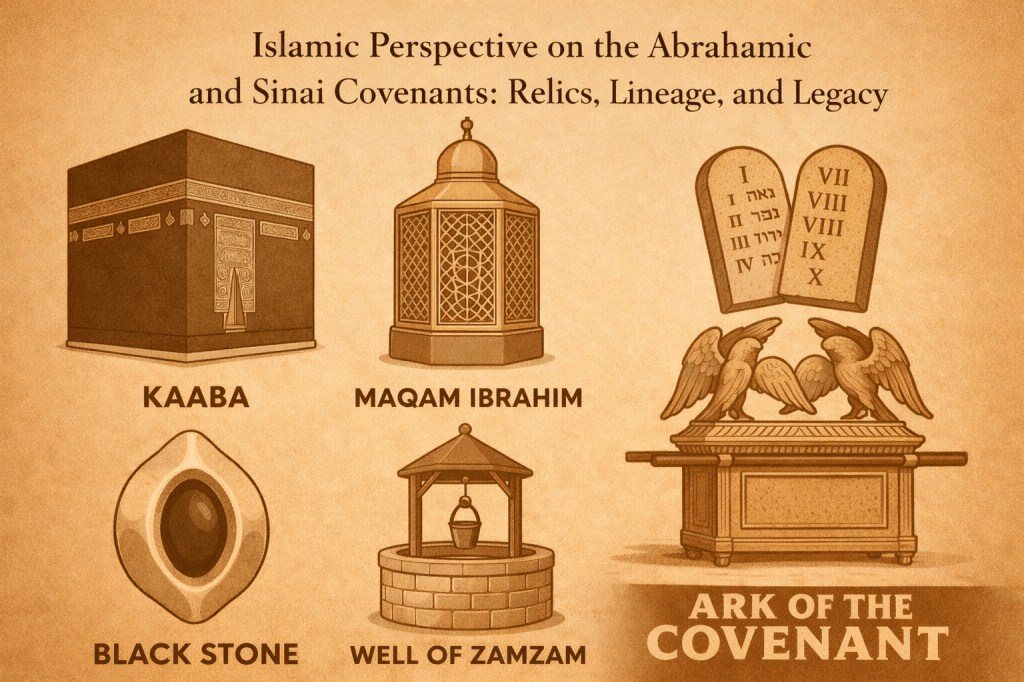
Islamic Perspective on the Abrahamic and Sinai Covenants: Relics, Lineage, and Legacy
🕋 Islamic Perspective on the Abrahamic and Sinai Covenants: Relics, Lineage, and Legacy
In the world of Abrahamic religions—Judaism, Christianity, and Islam—divine covenants are foundational. But how do Muslims view the Abrahamic Covenant differently from the Sinai (Mosaic) Covenant? And why do Islamic scholars emphasize the presence of relics such as the Kaaba and Maqam Ibrahim?
Let’s explore the Islamic argument step-by-step.
⸻
📜 1. Two Covenants, Two Purposes
🔹 Abrahamic Covenant
• Established between God and Abraham (Ibrahim عليه السلام)
• Promises: land, descendants, and blessings
• Seen as universal and everlasting
🔹 Sinai Covenant
• Made between God and the Israelites through Moses (Musa عليه السلام)
• Based on laws, rituals, and national identity
• Considered conditional and historically bound
💡 Islamic scholars emphasize that the Abrahamic Covenant is broader and deeper in scope than the Sinai Covenant, which was tailored for a specific people and time.
⸻
🕌 2. Who Inherits Abraham’s Covenant?
Islam teaches that:
• Prophet Muhammad ﷺ is a direct descendant of Abraham through Ishmael
• Muslims are the spiritual heirs of Abraham
• Islam is a continuation and completion of Abraham’s monotheistic path
🧭 “Follow the religion of Abraham, the upright one” (Qur’an 3:95)
Islam doesn’t view itself as a new religion, but as a revival of the original Abrahamic faith—centered on Tawḥīd (absolute monotheism).
⸻
🪨 3. Sacred Relics: Islam vs. Judaism
A unique Islamic argument is based on the physical relics of Abrahamic heritage.
✅ Islam’s Abrahamic Relics
• Kaaba (House of God) – Built by Abraham and Ishmael (Qur’an 2:127)
• Black Stone (Hajar al-Aswad) – Set into the Kaaba by Abraham
• Station of Abraham (Maqam Ibrahim) – Stone where Abraham stood to build the Kaaba
These are living relics, central to Islamic worship to this day.
❌ Judaism’s Absence of Abrahamic Relics
• No relics directly tied to Abraham
• The Ark of the Covenant is significant, but it belongs to the Mosaic era, not Abraham’s
🔍 Islamic scholars argue that this absence suggests a discontinuity in preserving Abraham’s legacy in Jewish tradition.
⸻
📦 4. The Ark of the Covenant: A Mosaic, Not Abrahamic, Relic
The Ark of the Covenant held the stone tablets of the Torah and symbolized God’s presence. However:
• It is connected to Moses, not Abraham
• It was lost during the destruction of the First Temple by the Babylonians
⛔️ Some Islamic scholars interpret this loss as a symbolic end to the Sinai Covenant, highlighting its temporary nature.
⸻
🌍 5. Universality vs. Particularity
Islamic scholars often highlight a critical distinction between the Abrahamic Covenant and the Sinai Covenant in terms of their scope, audience, and enduring relevance.
According to the Islamic perspective, the Abrahamic Covenant is viewed as universal—intended for all of humanity regardless of ethnicity or geography. It is seen as an eternal and inclusive promise, centered on monotheism (Tawḥīd), moral conduct, and submission to God’s will. Muslims believe this covenant continues through the line of Ishmael, culminating in the mission of Prophet Muhammad ﷺ, who is regarded as the final messenger to all nations.
In contrast, the Sinai Covenant, established through Moses with the Children of Israel, is seen as particular—limited in scope to a specific people and context. It was tied to a legal code and ritual system meant for the Israelites and was dependent on their obedience. Because of its conditional nature and the eventual loss of key elements like the Ark of the Covenant, Islamic scholars view the Sinai Covenant as historically bound and no longer universally applicable.
This contrast reinforces the Islamic claim that while earlier covenants were authentic, they were limited in time and scope, whereas Islam represents the final, universal fulfillment of God’s covenant with humanity.
📌 Muslims believe their practices are rooted in Abrahamic foundations — not innovations.
⸻
🕊 6. Islam as Fulfillment of the Covenant
Islamic theology often includes a form of supersessionism:
• Islam is the final and complete revelation
• It confirms what came before (Torah, Gospel) and corrects distortions
• The Qur’an is the final testament, just as Muhammad ﷺ is the Seal of the Prophets
🕯 “This day I have perfected for you your religion and completed My favor upon you…” (Qur’an 5:3)
⸻
✅ Summary: Why Islam Claims Abraham’s Legacy
🔑 Key Arguments by Islamic Scholars:
• Islam preserves Abraham’s practices and relics
• Muhammad ﷺ is a descendant of Abraham through Ishmael
• The Sinai Covenant was limited in scope and its relic (the Ark) is lost
• The Abrahamic Covenant, as revived in Islam, is universal, unbroken, and active
⸻
📚 Final Thought
While Jewish and Christian traditions have their own views on covenants and divine legacy, the Islamic perspective offers a compelling theological and symbolic continuity with Abraham—not just through scripture, but also through historical relics, sacred space, ritual, and lineage.
🕋 In every circumambulation of the Kaaba and every prayer facing it, Muslims affirm their living connection to the covenant of Abraham.
📜 Abraham, History, and Identity: Why Judaism and Islam Relate Differently to the Patriarch
💫 Introduction
Among the three great Abrahamic religions, all trace their spiritual lineage to Abraham. Yet the way each tradition relates to Abraham differs profoundly. A recurring argument — especially in comparative theological discourse — claims that Judaism is more connected to its historical experience, whereas Islam is more directly connected to the person and legacy of Abraham. This distinction becomes evident when comparing the centrality of the Exodus and Sinai in Judaism with the centrality of Hajj and the Abraham–Ishmael narrative in Islam.
This article explores the theological framework behind this argument, demonstrating how sacred history, covenantal identity, and ritual practices shape the role of Abraham in each tradition.
⸻
♦️ 1. Judaism: A Religion Rooted in Communal History and Covenant
1.1 Abraham as the Patriarch, but Sinai as the Core
Judaism undeniably venerates Abraham as the patriarch (Genesis 12–25). However, Jewish religious identity is shaped less by Abraham personally and more by Israel’s collective historical journey, particularly:
• The Exodus from Egypt
• The Giving of the Torah at Mount Sinai
• The Sinai Covenant (Brit Sinai)
• The formation of Israel as a holy nation (Exodus 19:6)
Judaism’s primary self-definition is not “the children of Abraham,” but rather “the people who stood at Sinai.”
The Rabbis famously state:
“Our covenant is not through Abraham alone, but through the Torah given to all Israel at Sinai.”
This is why the central liturgical memory in Judaism is not Abraham’s tests but the Exodus:
• The Passover (Pesach) festival
• The Sabbath (a memorial of liberation)
• Daily prayers constantly invoking “the God who brought you out of Egypt”
1.2 Covenant Through Isaac and Jacob
Judaism’s theological architecture rests on the Sinai Covenant and the ancestral chain:
Abraham → Isaac → Jacob → the Twelve Tribes of Israel.
Thus, covenantal continuity is traced ethnically and historically, not ritually through reenactments of Abraham’s life. Abraham is a revered ancestor — but the religion’s heart is the law (Torah) and the national history of Israel.
⸻
♦️ 2. Islam: Abraham as the Living Ritual and Spiritual Model
2.1 Islam Calls Itself “The Religion of Abraham” (Millat Ibrāhīm)
The Qur’an repeatedly emphasizes Abraham more than any other patriarch:
• “Follow the religion of Abraham” (Qur’an 3:95)
• Abraham is called ḥanīf, a pure monotheist (Qur’an 16:120)
Abraham is not just a historical patriarch — he is the archetype of submission (islām).
2.2 Abraham and Ishmael in the Kaaba and Hajj
Islam intricately weaves the story of Abraham into the lives of its believers through the rituals performed during Hajj.
Pilgrims reenact key events, such as the ṭawāf around the Kaaba, which honors the moment Abraham and Ishmael established its foundations (Qur’an 2:127). The sa‘y between Ṣafā and Marwah represents Hajar’s search for water, while drinking from Zamzam recalls the miracle provided for baby Ishmael.
Standing at ‘Arafah signifies Abraham’s devotion, and the sacrifice during ‘Eid al-Adha commemorates his willingness to obey God by offering his firstborn son. Lastly, the stoning of the Jamarāt symbolizes Abraham’s rejection of Satan’s temptations.
Thus, while Judaism remembers Abraham theologically, Islam reenacts Abraham ritually.
2.3 Ishmael’s Role Restored
In the Islamic narrative, Ishmael is not marginal but central:
• He helps Abraham build the Kaaba.
• He is linked to the sacred sanctuary (Q 2:125–129).
• He is believed to be the son whom Abraham was commanded to sacrifice, demonstrating ultimate submission to God.
• He is part of the prophetic lineage leading to Muhammad ﷺ.
Thus, Islam’s living rituals restore Abraham and Ishmael to the center of religious consciousness.
⸻
♦️ 3. Why the Two Traditions Differ
3.1 Judaism: History as Identity
Judaism emerged as a national–historical covenant. Its sacred memory is:
• Liberation from Egypt
• Revelation at Sinai
• Life under the Torah
• The historical survival of Israel
Thus, Jewish identity is shaped by collective memory, not primarily by reenacting the life of Abraham.
3.2 Islam: Abraham as the Universal Prototype
Islam presents itself as:
the restoration of Abraham’s original monotheism
(Qur’an 3:67)
Islam views Abraham as:
• the spiritual father of all who submit to God,
• the builder of the Kaaba (house of God),
• the model for rituals of pilgrimage, sacrifice, and prayer.
Therefore, Islam sees Abraham as the living foundation of its religious practice.
3.3 Two Different Theological Trajectories
• Judaism: A religion of a people and their historical covenant
• Islam: A religion of a prophet and his universal monotheism
Both honor Abraham, but the mechanisms of memory differ:
• Judaism emphasizes the journey of Israel.
• Islam emphasizes the journey of Abraham.
⸻
🌟 4. Conclusion
The claim that Judaism is more connected to its history while Islam is more connected to the person of Abraham reflects deep theological truths:
• Judaism’s heart is Sinai, the covenant of the Torah and the historical identity of Israel.
• Islam’s heart is Abraham, whose life is woven into its rituals, theology, and annual pilgrimage.
Both traditions preserve Abraham’s legacy — but Islam experiences Abraham through ritual reenactment, while Judaism remembers him through narrative and covenantal ancestry.
Thus, the argument is not about superiority, but about different religious architectures:
one built on historical memory, the other on prophetic example and ritual continuity.
 ABRAHAMIC THEOLOGY