
Azahari Hassim
Micah 6, verse 7, reads:
“Will the Lord be pleased with thousands of rams, with ten thousand rivers of olive oil? Shall I offer my firstborn for my transgression, the fruit of my body for the sin of my soul?“
Jeremiah 8, verse 8, reads:
“’How can you say, “We are wise, for we have the law of the Lord,” when actually the lying pen of the scribes has handled it falsely?“
Several Islamic scholars believe Micah 6, verse 7, and Jeremiah 8, verse 8, may reflect a scribal interpolation of Isaac’s name in Genesis 22. The son who was nearly sacrificed is believed to have been Ishmael, not Isaac. What is the articulation of their argument?
The argument presented by some Islamic scholars regarding the potential scribal interpolation of Isaac’s name in Genesis 22 is based on several key points:
1. Quranic perspective: The Quran mentions the story of Abraham being commanded to sacrifice his son but does not explicitly name the son. Islamic tradition generally holds that it was Ishmael, not Isaac, who was to be sacrificed.
2. Textual analysis of Micah 6, verse 7: This verse states, “Shall I give my firstborn for my transgression, the fruit of my body for the sin of my soul?” Some Islamic scholars interpret this as a reference to the sacrifice story and argue that since Ishmael was Abraham’s firstborn, this verse supports the idea that Ishmael was the intended sacrifice.
3. Interpretation of Jeremiah 8, verse 8: This verse reads, “How can you say, ‘We are wise, for we have the law of the Lord,’ when actually the lying pen of the scribes has handled it falsely?” Islamic scholars use this to suggest that scribes may have altered biblical texts, potentially including the story of Abraham’s sacrifice.
4. Historical context: Some scholars suggest that the emphasis on Isaac in Jewish traditions may have led to a gradual change in the story, resulting in Isaac’s name being added to the biblical narrative.
5. Linguistic analysis: Some scholars examine the original Hebrew text and argue that there are inconsistencies or ambiguities that could support the idea of later interpolation.
6. Theological implications: The argument often ties into broader Islamic theological perspectives on the role and significance of Ishmael in the Abrahamic tradition.
It is crucial to emphasize that this perspective is not universally embraced by scholars of comparative religion, and it is just one interpretation within a multifaceted interfaith discussion. The argument relies heavily on interpretation and inference, as there is no direct textual evidence of interpolation in the Genesis account itself.
This perspective challenges traditional Jewish and Christian understandings of the text and highlights the different ways sacred texts can be interpreted across religious traditions.

The Scriptural Alteration and the Abrahamic Covenant
Was the Abrahamic covenant fulfilled through Ishmael rather than Isaac?
The belief that the Abrahamic covenant was fulfilled through Ishmael rather than Isaac, including the promise of land from the Nile to the Euphrates and the blessing to all nations through Abraham’s seed, is held by some, particularly within Islamic tradition. Here’s a more detailed articulation of their argument:
Ishmael and the Covenant
- Ishmael as the Firstborn: Supporters of this view argue that Ishmael, being Abraham’s firstborn son, was the original heir to the covenant. They emphasize that Ishmael was the first child of Abraham, born to Hagar, Sarah’s Egyptian maidservant.
- Sacrifice Narrative: They contend that the narrative of Abraham being asked to sacrifice his son originally referred to Ishmael, not Isaac. This is based on the belief that ancient scriptures were altered by Israelite scribes to emphasize Isaac’s role.
- Blessing and Land Promise: The promise of land from the Nile to the Euphrates and the blessing to all nations is seen as applying to Ishmael’s descendants. Islamic tradition views Ishmael as an ancestor of the Arab peoples, and thus sees the fulfillment of these promises through the Islamic Hajj and in the rise of Islamic civilization.
Scriptural Alteration Argument - Scribal Changes: They argue that ancient Israelite scribes altered the scriptures to shift the focus from Ishmael to Isaac. This was done to establish a theological foundation for the Israelites’ claim to the land and their unique covenantal relationship with God.
- Evidence from Quranic Texts: The Quran does not name the son of the near sacrifice, but Islamic tradition identifies him as Ishmael. This is supported by the timeline in the Quran, which implies that the promise of Isaac’s birth occurred following the sacrifice event, suggesting that Ishmael was the probable candidate.
In conclusion, the perspective that Ishmael, rather than Isaac, was the true heir to the Abrahamic covenant is rooted in the belief that Ishmael, as the firstborn, was the original recipient of God’s promises.
This view is supported by interpretations of Islamic tradition and arguments regarding scriptural alterations.
While this belief contrasts with the traditional Judeo-Christian view that Isaac was the chosen heir, it highlights the diverse understandings and interpretations of Abrahamic history within different religious traditions.

Inheritance Rights
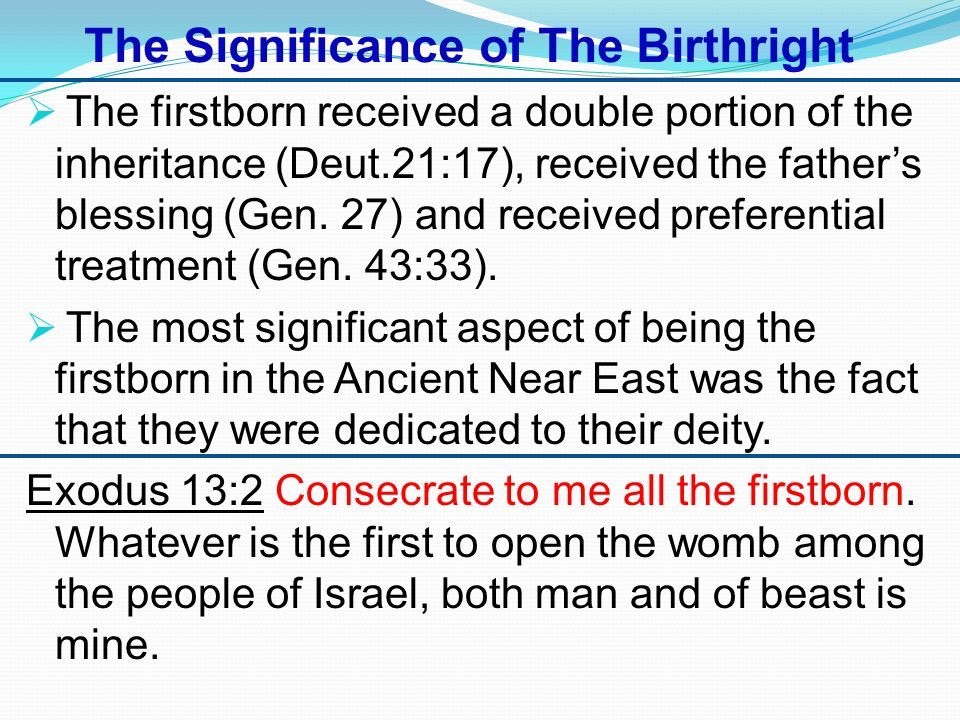
The Bible contains several passages that outline the rights and significance of the firstborn, particularly in the context of inheritance, family leadership, and religious duties. These rights are rooted in both the cultural and legal traditions of ancient Israel, and they are often intertwined with theological themes.
Deuteronomy 21:15-17 explicitly addresses the inheritance rights of the firstborn son:
“If a man has two wives, one beloved and the other unloved, and both the beloved and the unloved have borne him children, and if the firstborn son belongs to the unloved, then on the day when he wills his possessions to his sons, he may not treat the son of the beloved as the firstborn in preference to the son of the unloved, who is the firstborn. He must acknowledge the son of the unloved wife as the firstborn by giving him a double portion of all that he has, for he is the first fruits of his strength. The right of the firstborn is his.”
This passage establishes that the firstborn son is entitled to a “double portion” of the inheritance. This meant that the firstborn would receive twice as much as any other son, a right that underscored the firstborn’s role as the primary heir and leader of the family after the father’s death.

The significance of the firstborn
The significance of the firstborn has been a subject of study and commentary by many anthropologists, who have explored its importance in various cultures and societies. Here are some quotes from well-known anthropologists that touch on the theme of the firstborn:
1. Bronisław Malinowski
Bronisław Malinowski, a pioneer in the field of social anthropology, often explored the role of kinship and family structures in society. Regarding the importance of the firstborn, he noted:
“The firstborn in many societies is not just the first in line of descent but often embodies the continuity of the family’s legacy, carrying the weight of tradition and expectations, and serves as a crucial link between generations.”
— Bronisław Malinowski, The Dynamics of Cultural Change.
2. Sir Edward Burnett Tylor
Sir Edward Burnett Tylor, considered the father of cultural anthropology, explored the role of ritual and tradition in human societies. He remarked on the significance of the firstborn:
“The status of the firstborn, whether in terms of inheritance, ritual responsibility, or social rank, is deeply ingrained in the customs and legal traditions of many cultures, reflecting an ancient belief in the primacy of order and hierarchy in human society.”
— Edward B. Tylor, Primitive Culture.
3. Claude Lévi-Strauss
Claude Lévi-Strauss, a key figure in the development of structural anthropology, examined kinship and family systems in various cultures. He discussed the role of the firstborn in terms of social structure:
“The firstborn often stands as a symbol of the societal structure itself, representing the first and most visible manifestation of the underlying principles of kinship and succession that define a culture’s social organization.”
— Claude Lévi-Strauss, The Elementary Structures of Kinship.
4. Margaret Mead
Margaret Mead, an influential cultural anthropologist, studied the impact of family dynamics on individual development. She touched on the expectations placed on the firstborn:
“In many cultures, the firstborn is often seen as the torchbearer of the family’s values, traditions, and honor. The expectations placed on them can be both a burden and a privilege, shaping their role in both the family and society at large.”
— Margaret Mead, Coming of Age in Samoa.
5. Jack Goody
Jack Goody, a British social anthropologist, focused on kinship and inheritance systems. He explored the cultural importance of the firstborn:
“The position of the firstborn in various inheritance systems, whether through primogeniture or other means, is not merely a legal matter but a reflection of the cultural emphasis on continuity, stability, and the preservation of the social order.”
— Jack Goody, The Development of the Family and Marriage in Europe.
Conclusion
These quotes illustrate that the firstborn holds a critical place in the anthropology of kinship and social structure, often symbolizing continuity, leadership, and the transmission of cultural and familial values across generations. Anthropologists have recognized the firstborn’s role as pivotal in understanding the dynamics of family, inheritance, and societal expectations in various cultures.
 ABRAHAMIC THEOLOGY