Azahari Hassim
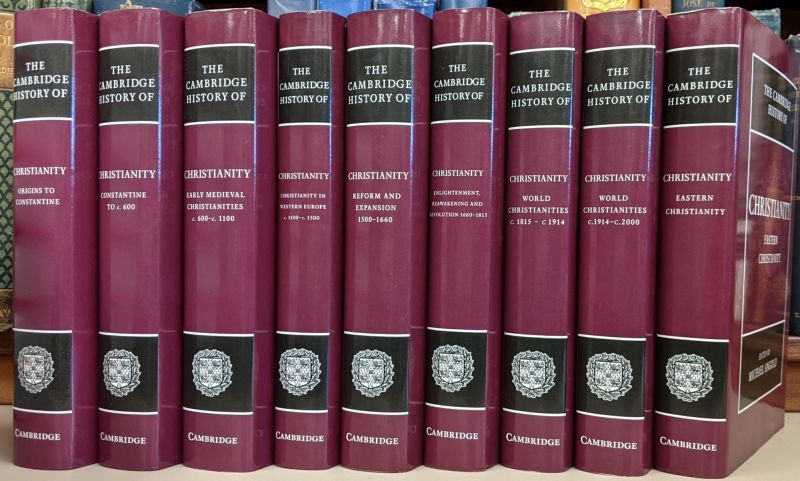
The Cambridge History of Christianity is a highly significant academic series published by Cambridge University Press. It consists of 9 volumes and is one of the most comprehensive reference works on the history of Christianity, covering developments from the early church to the modern era.
Overview
• Editors: Each volume is edited by experts in their respective fields.
• Scope: Covers theological, institutional, cultural, political, and social aspects of Christian history.
• Approach: Academic and interdisciplinary, combining church history, intellectual history, and sociopolitical developments.
List of Volumes
1. Origins to Constantine (c. 30–313 CE)
– Focuses on the early church, the initial spread of the Gospel, and interaction with the pagan Roman world.
2. Constantine to c. 600
– Chronicles the transition from a persecuted church to an imperial church, including early ecumenical councils and the role of emperors.
3. Early Medieval Christianity (c. 600–c. 1100)
– Christianity in post-Roman Europe: monasticism, missions to Germanic peoples, and the formation of Latin and Byzantine Christian identities.
4. Christianity in Western Europe, c. 1100–c. 1500
– The High Middle Ages: church institutions, scholasticism, the Inquisition, and pre-Reformation movements.
5. Eastern Christianity
– The Orthodox Church, Middle Eastern Christianity, and non-Chalcedonian traditions such as the Coptic, Armenian, and Church of the East (Nestorian) traditions.
6. Reform and Expansion 1500–1660
– The Protestant Reformation, the Catholic Counter-Reformation, and the global missionary expansion into the New World.
7. Enlightenment, Reawakening and Revolution 1660–1815
– How Christianity responded to the Enlightenment, spiritual awakenings, and the impact of the American and French revolutions.
8. World Christianities c. 1815–c. 1914
– Christianity’s global spread, mission work, and the challenges of colonialism and secularization.
9. World Christianities c. 1914–2000
– Modern and contemporary Christianity: ecumenism, Vatican II, evangelical movements, and the growth of Christianity in Africa, Asia, and Latin America.
Academic Use
• A major reference source in the fields of Church History, Historical Theology, and Global Christianity Studies.
• Widely used in undergraduate, graduate, and doctoral research in religion, theology, history, and sociology of religion.
 ABRAHAMIC THEOLOGY