Azahari Hassim
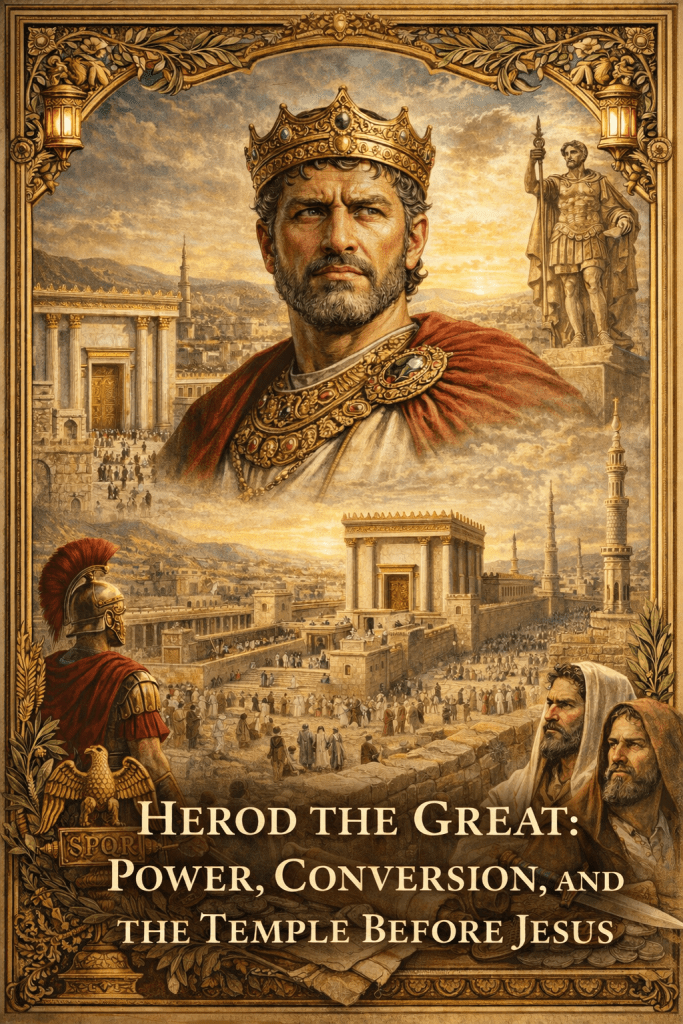
❓How did Herod the Great, originally a Gentile by ancestry, come to be recognized as King of the Jews, and what were his major contributions to Jewish society?
📜 Herod the Great: Power, Conversion, and the Temple Before Jesus
Herod the Great (c. 73–4 BCE), a fascinating and controversial figure in Jewish history, was appointed “King of the Jews” by the Roman Senate in 40 BCE and ruled Judea under Roman authority until his death. Though not ethnically Jewish by traditional standards, he played a central role in shaping Second Temple Judaism and the region of Judea in the decades before the birth of Jesus.
Let’s explore the complex layers of his identity, conversion, and contributions:
⸻
🧬 1. Was Herod a Jew? A Gentile? A Convert?
Herod was not born a Jew in the tribal or genealogical sense, but his family practiced Judaism, and he ruled as the “King of the Jews.”
🔸 Herod’s Ancestry:
• Father: Antipater the Idumaean — from the region of Idumea (Edom) south of Judea. The Idumaeans were descendants of Esau and had been forcibly converted to Judaism by the Hasmonean ruler John Hyrcanus around 125 BCE.
• Mother: Cyprus, a Nabatean (from modern-day Jordan/Arabia).
So, Herod was a second-generation Jew by conversion, not by birth or tribe. To many in Judea, he was still considered a foreigner or half-Jew, which affected how he was viewed — especially by Pharisees, Essenes, and the Hasmonean (priestly) elite.
⸻
🏛️ 2. How Did Herod Become King?
• Herod rose to power through his father’s alliance with Julius Caesar and later supported Mark Antony.
• In 40 BCE, the Roman Senate declared Herod “King of the Jews” — even though he was not from the Davidic line, nor a Hasmonean.
• He took Judea by force with Roman military backing in 37 BCE.
Thus, his rule was seen by many Jews as illegitimate and imposed by Rome, despite his nominal Judaism.
⸻
🏗️ 3. Herod’s Contributions to the Jewish People
Despite his reputation for cruelty and paranoia (even executing some of his own sons and his wife), Herod left an immense architectural and administrative legacy.
🕍 A. Rebuilding the Second Temple (Herod’s Temple)
• Perhaps Herod’s greatest contribution was the massive expansion and beautification of the Second Temple in Jerusalem (starting around 20 BCE).
• He doubled the size of the Temple Mount, built marble porticoes, a grand courtyard, and lavishly adorned the sanctuary.
• Though controversial, the Temple became a symbol of Jewish pride and national identity, even earning admiration from some later rabbis.
🛐 It was this Temple that Jesus and his disciples visited, and it stood until its destruction by the Romans in 70 CE.
🏙️ B. Urban and Architectural Projects
Herod modernized Judea with Roman-style architecture, bringing economic development, jobs, and prestige.
• Built Caesarea Maritima — a port city with a Roman amphitheater, aqueducts, and a palace.
• Constructed fortresses like Masada, Herodium, and Machaerus, often used for defense and royal retreats.
• Developed roads, water systems, and cities that helped integrate Judea into the Roman world.
🛡️ C. Political Stabilization (Temporarily)
Herod’s reign brought a period of relative peace and prosperity after the chaos of Hasmonean infighting and Roman conquest. He skillfully navigated Roman politics, shifting loyalties between Antony and Octavian (Augustus), always ensuring his survival — and by extension, Judea’s stability.
⸻
⚔️ 4. Tensions and Tyranny
While Herod left behind monumental achievements, he was also deeply distrusted by his subjects.
• He heavily taxed the people to fund his massive projects and Roman tributes.
• Executed members of the Hasmonean royal family, including Mariamme, his Jewish wife — leading to widespread resentment.
• Suppressed religious dissent and was viewed as a Roman puppet, especially by the Pharisees and zealots.
• His reign was marked by brutality, paranoia, and cruelty — including the infamous “Massacre of the Innocents” (recorded in the Gospel of Matthew, though not in other sources).
⸻
🧭 Conclusion: A Complex Legacy
Herod the Great remains one of the most complex and polarizing figures in Jewish history.
✅ His contributions:
• Rebuilt the Jerusalem Temple, making it a center of Jewish life.
• Developed Judea’s economy and infrastructure.
• Brought temporary political stability.
❌ His contradictions:
• A convert king ruling a people who didn’t fully accept him.
• Architect of Jewish grandeur — but also seen as brutal, impious, and pro-Roman.
• His reign foreshadowed the deep tensions that would later erupt in the Great Jewish Revolt against Rome.
Herod may not have been “fully Jewish” by lineage, but his rule forever shaped Jewish religious and cultural life. He is a reminder that identity, power, and faith were deeply intertwined and contested in the last century before the rise of Rabbinic Judaism and Christianity.
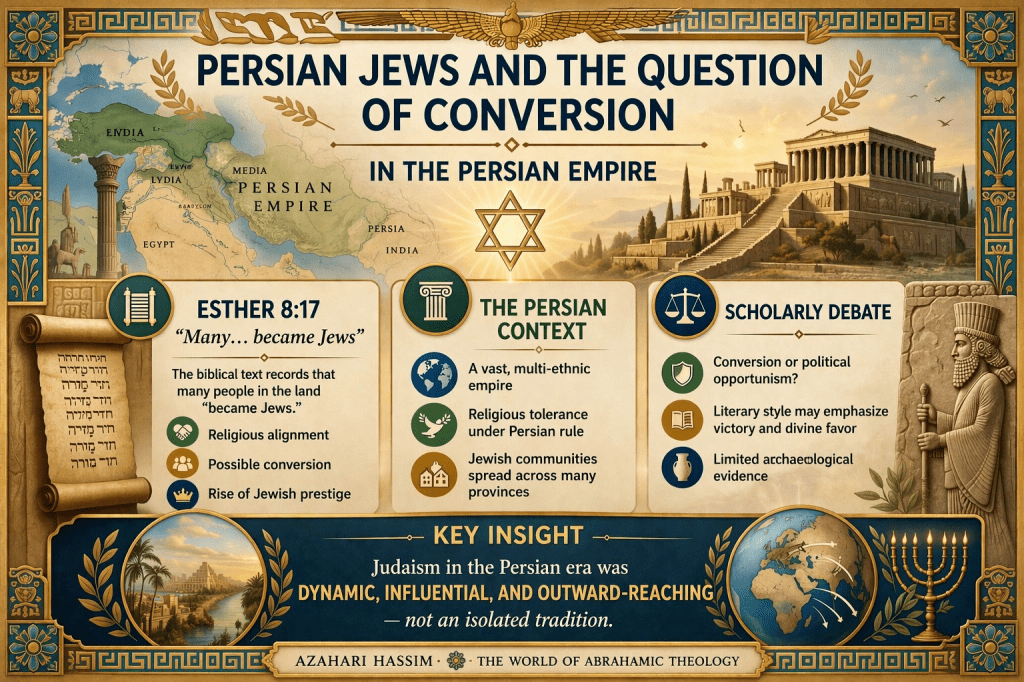
Persian Jews and the Question of Conversion in the Persian Empire
A Review Based on the Interpretation of Esther 8:17 📜
The historical relationship between the Jewish people and the Persian world is one of the most fascinating chapters in both biblical and Near Eastern history. While many modern historians tend to minimize the scale of conversion to Judaism during the Persian period, some interpreters—especially those who read the biblical narrative more literally—believe that significant numbers of people in the Persian Empire embraced Judaism. One of the primary passages used to support this view is Book of Esther 8:17.
This perspective deserves careful examination, particularly when the biblical text itself seems to suggest a wider influence of Judaism among the peoples of the Persian Empire. 🏛️
⸻
📖 The Testimony of Esther 8:17
The key passage reads:
“And in every province and in every city, wherever the king’s commandment and his decree came, the Jews had joy and gladness, a feast and a good day. And many of the people of the land became Jews, for the fear of the Jews fell upon them.”
— Esther 8:17
The story takes place during the reign of Xerxes I, ruler of the vast Achaemenid Persian Empire. After the plot of Haman to destroy the Jews was overturned through the intervention of Esther and Mordecai, the Jews were granted royal protection.
The verse then records a remarkable development: “many of the people of the land became Jews.”
Those who support the idea of significant conversion argue that the wording of the verse suggests more than mere political sympathy. Instead, it indicates that people within the empire formally joined the Jewish community. ✡️
⸻
🌍 The Persian Empire: A Fertile Environment for Religious Influence
The Persian Empire was one of the largest and most diverse empires of the ancient world. Under rulers such as Cyrus the Great, Persian policy generally allowed subject peoples to maintain their religious traditions.
This environment of relative religious tolerance made it possible for minority communities—including the Jews—to practice their faith openly across the empire.
Because Jewish communities were scattered across many Persian provinces—from Babylon to Media and Susa—their influence may have reached many different ethnic groups. In such a setting, the dramatic events described in the Book of Esther could plausibly have led some people to adopt Jewish identity and religion. 🌏
⸻
📜 Interpreting “Many Became Jews”
Supporters of the conversion hypothesis often emphasize the phrase “became Jews” in Esther 8:17.
In Hebrew, the expression used is mithyahadim, which literally means “to become Jews” or “to Judaize.”
Some interpreters argue that this wording strongly implies actual conversion, not merely temporary political alignment. The phrase suggests that people were joining the Jewish people and identifying themselves with their religion and covenant.
From this viewpoint, the verse records a moment when the prestige of the Jewish community rose dramatically throughout the empire. ✨
⸻
⚖️ Scholarly Debate
Many modern historians remain cautious about interpreting the verse as evidence of large-scale religious conversion.
Their concerns include:
• The possibility that the phrase reflects political opportunism, where people identified with the Jews for protection.
• The literary style of ancient texts, which sometimes employ dramatic language to emphasize victory or divine favor.
• The lack of clear archaeological evidence for widespread conversion to Judaism during the Persian period.
Nevertheless, the biblical text itself remains a significant historical witness, and for many readers it suggests that Judaism exerted a noticeable influence within parts of the Persian Empire. 📚
⸻
🏛️ The Lasting Significance of Persian Jewry
Regardless of the exact scale of conversion, the Persian period was enormously important for Jewish history.
During this era:
• The Jews were allowed to return to Jerusalem and rebuild the Temple under Cyrus the Great.
• Jewish communities flourished across Mesopotamia and Persia.
• The foundations of Second Temple Judaism were established.
Figures such as Ezra and Nehemiah helped reorganize Jewish religious life during Persian rule.
These developments shaped the religious landscape from which later Jewish and Christian traditions emerged. 🌿
⸻
✨ Conclusion
The question of whether large numbers of Persians converted to Judaism remains a subject of ongoing historical and textual debate. However, Esther 8:17 clearly suggests that the influence of the Jewish people extended beyond their immediate ethnic boundaries during the Persian period.
For interpreters who read the biblical account in a more literal and expansive sense, the verse may indicate that meaningful levels of conversion did occur—reflecting the heightened prestige, protection, and socio-political ascendancy of the Jewish community following the dramatic events of the Esther narrative.
Within this interpretive framework, some contemporary readers further connect these developments to prophetic texts such as Book of Ezekiel, particularly Ezekiel 38:5, where “Persia” is mentioned among the nations.
From this perspective, it is argued that the reference to Persia refers to ethnic Persians who embraced Judaism and subsequently migrated to the Holy Land, excluding those who remained within the geographical boundaries of Persia (present-day Iran).
This view is sometimes extended to include groups from regions like Ethiopia (Cush) (Ezekiel 38:5), where historical traditions record links to Judaism and conversion.
Whether one accepts this interpretive extension or approaches the texts with greater historical caution, the broader insight remains significant: Judaism, during the Persian era, was not a closed or isolated tradition but one that engaged dynamically with diverse populations across a vast imperial landscape—leaving theological, cultural, and interpretive legacies that continue to be discussed and debated today. 🌍📜
 ABRAHAMIC THEOLOGY