Azahari Hassim
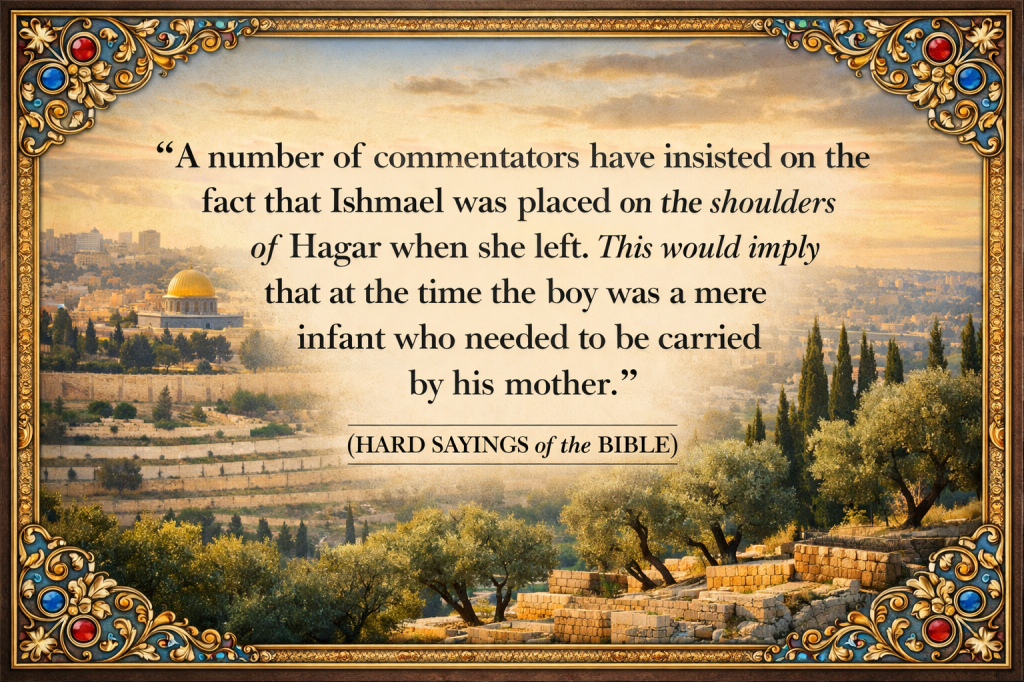
🍀 Have Bible scholars debated Ishmael’s age at the time he and Hagar were sent away from Abraham’s household (Genesis 21)?
Yes, Bible scholars have debated Ishmael’s age when he and his mother Hagar were sent away from Abraham’s household, as described in Genesis 21. The debate arises because there appears to be a tension between Ishmael’s known age from earlier chapters and how he is described in the story of his departure.
⸻
🔹 The Core Issue
By the time Ishmael is sent away in Genesis 21:
• Chronologically, he should be about 16 or 17 years old.
• But the narrative language makes him seem much younger—perhaps even a small child.
This discrepancy is what scholars have tried to reconcile.
⸻
🔸 Biblical Timeline Breakdown
1. Genesis 16:16 – Abraham is 86 years old when Ishmael is born.
2. Genesis 21:5 – Abraham is 100 years old when Isaac is born.
• This means Ishmael is about 14 years old at Isaac’s birth.
3. Genesis 21 (Hagar and Ishmael sent away) occurs after Isaac is weaned—likely around age 2 or 3.
• That puts Ishmael around 16 or 17 years old.
⸻
🔸 But in Genesis 21:14–19…
• Hagar carries water and the “child” on her shoulder.
• She places him under a bush when he is faint with thirst.
• The angel says, “Do not be afraid; God has heard the boy crying as he lies there. Lift the boy up and take him by the hand.”
These details suggest a small child, possibly even an infant, rather than a teenager:
• Hagar “placing” him under a bush implies a much younger, possibly carried child.
• The Hebrew word for “child” (yeled) can refer to a broad range of ages, but often implies a young boy.
• Some translations and interpretations even picture Ishmael as a toddler.
⸻
🔹 Scholarly Interpretations and Debates
1. Literal chronology is correct; the narrative is symbolic or stylized:
• Ishmael was a teenager, but the story uses language typical of small-child narratives for literary or emotional effect.
• The story’s focus is Hagar’s distress and God’s care, not strict age reporting.
2. There may be a doublet (two similar stories merged):
• Some scholars argue Genesis 16 and 21 are two versions of the same basic story (Hagar fleeing or being expelled), compiled from different sources.
• In this theory, one source portrays Ishmael as young and dependent, possibly even infant-like, while the other depicts him as older, more independent, and adolescent rather than a small child.
3. The reference to Hagar carrying “the child” may refer to carrying provisions or helping a weak, fainting teen.
• Some suggest the “carrying” in Hebrew could mean supporting or helping, not physically lifting.
• The word “child” can still apply to adolescents.
⸻
🔹 In Summary
Yes, Bible scholars have debated Ishmael’s age at the time he left Abraham’s house because:
• The chronology suggests he was a teenager (around 16–17).
• But the narrative imagery and vocabulary suggest a much younger child, possibly even a baby.
• This tension has led to various theories, including symbolic interpretation, source criticism, and linguistic clarifications.
Tracing the Legacy of Ishmael: Distinct Traditions in Biblical and Islamic Narratives
Do Ishmaelites possess a distinct tradition that traces back to their forefather, apart from the biblical narrative?
The Ishmaelites, as referred to in various historical and religious texts, are traditionally considered to be the descendants of Ishmael, the first son of Abraham and Hagar. Ishmael is an important figure in Judeo-Christian and Islamic traditions, but the traditions and histories diverge in significant ways across these faiths, particularly in Islam.
⸻
In Biblical Narrative 📖✡️✝️
In the Bible, particularly the Book of Genesis, Ishmael is portrayed as the elder half-brother of Isaac. The narrative describes how he and his mother Hagar were sent away into the desert by Abraham at the behest of Sarah (Isaac’s mother).
The biblical narrative primarily depicts Ishmael as the progenitor of the Ishmaelites, often considered ancestors of the Arab peoples. However, detailed traditions specifically tracing back to Ishmael in terms of rituals, laws, or unique religious practices distinct from later Jewish or Christian traditions are not extensively documented within the Bible itself.
⸻
In Islamic Tradition 📖🕋☪️
In Islamic tradition, however, Ishmael (Ismail in Arabic) holds a significantly different and more detailed historical and spiritual legacy. Islam regards Ishmael as a prophet and an ancestor of Muhammad ﷺ, which is distinct from the biblical account in several key aspects:
🛕 Foundation of Mecca: Islamic traditions hold that Ishmael and his father Abraham were involved in the rebuilding of the Kaaba (House of God) in Mecca, which is the holiest site in Islam.
🚶♀️ The Hajj Ritual: Many rituals performed during the Hajj (the Islamic pilgrimage to Mecca) are commemorated in the context of events involving Ishmael and Abraham. For instance, the ritual of the Sa’i, walking between the hills of Safa and Marwah, is a re-enactment of Hagar’s search for water for her baby son Ishmael.
🕊️ Sacrifice: The Islamic festival of Eid al-Adha commemorates the willingness of Abraham to sacrifice his son in obedience to God’s command, which in Islamic tradition is believed to have been Ishmael, rather than Isaac as in the Judeo-Christian tradition.
⸻
Cultural and Historical Perspective 🏺🌍
Beyond religious texts, the identity and historical interpretations of the Ishmaelites have evolved in various cultures. In some traditions, the Ishmaelites are often conflated with Arab tribes, and thus Ishmael is considered an important forefather of Arabs. This lineage has sometimes been used historically to claim a shared ancestry for Arab peoples.
⸻
Conclusion ✅📚
While the biblical narrative does not extensively detail distinct traditions that trace back specifically to Ishmael separate from broader Jewish and Christian practices, Islamic tradition provides a rich, detailed cultural and religious heritage tracing back to Ishmael.
This includes specific rituals and celebrations that are integral to Islamic practice today. These distinctions highlight the varying ways in which the figure of Ishmael has been revered and remembered across different cultures and religions.
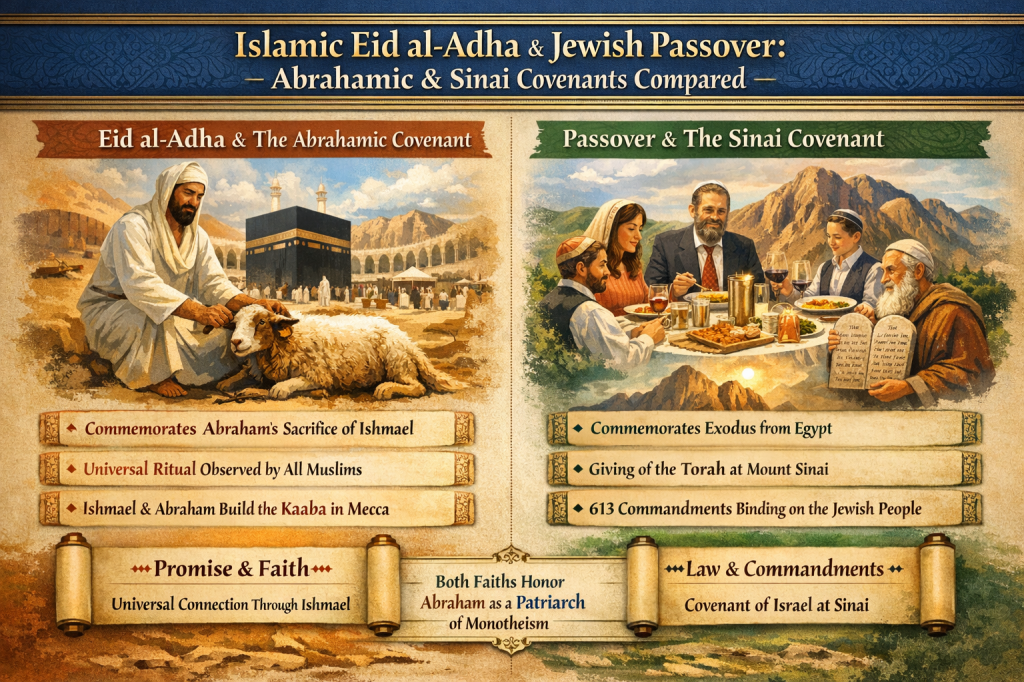
Islamic Eid al-Adha (feast of sacrifice) vs Jewish Passover
🌟 Some contend that the celebration of Eid al-Adha (feast of sacrifice) by all Muslims, in contrast to the Jewish observance of Passover, suggests that Muslims are linked to the Abrahamic covenant through Ishmael, while Jews are associated with the Sinai covenant. How does their argument go?
📖 The argument that Muslims are linked to the Abrahamic covenant through Ishmael, while Jews are associated with the Sinai covenant, is based on a few key points:
1. Eid al-Adha commemorates Abraham’s willingness to sacrifice his son, which Muslims believe was Ishmael rather than Isaac. This directly connects Muslims to Abraham and Ishmael. 🕋
2. All Muslims worldwide celebrate Eid al-Adha by sacrificing an animal, reminiscent of Abraham’s sacrifice. This universal observance is seen as linking all Muslims to the Abrahamic covenant. 🌍
3. The Quran portrays Ishmael as assisting Abraham in building the Kaaba (House of God) in Mecca, further cementing the connection between Muslims, Abraham and Ishmael. 🕊️
4. In contrast, Passover specifically commemorates the Exodus of the Israelites from Egypt under Moses’ leadership. This event is directly tied to the giving of the Torah and establishment of the Sinai covenant. 🕎
5. The Sinai covenant, with its 613 commandments, is seen as specifically binding on Jews rather than on all people. 📜
6. Some argue there is a distinction between the Abrahamic covenant characterized by promise, and the Sinai covenant characterized by law. ⚖️
7. While both trace ancestry to Abraham, Muslims see themselves as spiritual descendants of Ishmael, while Jews trace their lineage through Isaac and Jacob. 🌱
🔎 Therefore, this difference in religious observances implies that Muslims see themselves as heirs to the Abrahamic covenant through Ishmael, while Jews associate themselves more closely with the later Sinai covenant.
🤝 However, it’s important to note that both religions still consider Abraham a key patriarch and founder of monotheism.
🧠 This argument highlights some of the theological differences between Islam and Judaism regarding their relationship to Abraham and divine covenants, though both religions still revere Abraham as a major prophet and patriarch.
 ABRAHAMIC THEOLOGY