Azahari Hassim

📜 Covenant in the Present, Heir in the Future: The Internal Tension of Genesis 17
Genesis 17 contains a layered theological and narrative tension that becomes especially visible when verses 2, 19, and 21 are read together. The chapter moves back and forth between present enactment and future designation, producing an ambiguity that has long invited exegetical debate.
⸻
🔲 1. Covenant Enacted in the Present (Genesis 17:1–14)
In Genesis 17:2, God declares:
“I will establish My covenant between Me and you.” This is not framed as a future possibility but as an immediate divine action, sealed by the concrete and irreversible ritual of circumcision (vv. 9–14).
Crucially:
• The covenantal sign is enacted that very day (v. 23).
• Ishmael is already alive and is explicitly circumcised alongside Abraham.
• At the level of ritual, history, and embodiment, Ishmael is fully inside the covenantal moment.
At this stage of the narrative, the covenant exists without reference to Isaac, whose birth has not yet occurred and whose name has not yet been introduced.
⸻
🔲 2. Sudden Shift to a Future Bearer (Genesis 17:19–21)
The tension emerges sharply in verses 19–21, where God introduces Isaac by name:
“But My covenant I will establish with Isaac, whom Sarah shall bear to you at this time next year.” (v. 21)
Here, the text performs a conceptual pivot:
• The covenant that has already been enacted is now reassigned linguistically to a future, nonexistent individual.
• The verb “I will establish” reappears, even though establishment has already occurred.
• Covenant moves from ritual actuality to genealogical destiny.
This creates an internal strain: How can a covenant already sealed be simultaneously deferred to a person not yet in existence?
⸻
🔲 3. Two Levels of Covenant Operating at Once
The tension in Genesis 17 arises because the chapter appears to operate with two overlapping covenantal registers:
a. Historical–Ritual Covenant
• Established immediately with Abraham.
• Marked by circumcision.
• Historically inclusive of Ishmael.
• Grounded in time, flesh, and enacted obedience.
b. Genealogical–Promissory Covenant
• Projected forward.
• Attached to Isaac by name.
• Concerns lineage, inheritance, and narrative continuity.
The problem is not that these two layers exist, but that the text does not clearly distinguish them, allowing the later genealogical focus to retroactively overshadow the earlier enacted reality.
⸻
🔲 4. Why This Produces Narrative Ambiguity
From a literary and theological standpoint, Genesis 17 reads as if a covenant already in force is being re-narrated to prioritize a future heir. This raises several tensions:
• Temporal tension: covenant enacted now, heir designated later.
• Ontological tension: a named covenant bearer who does not yet exist.
• Narrative tension: Ishmael is present in the covenantal act but marginalized in its later interpretation.
These tensions have led some scholars to suggest:
• Redactional layering, where later theological priorities are inserted into, or interwoven with, earlier ritual traditions.
• Theological harmonization, whereby promise and fulfillment are deliberately fused into a single covenantal framework, even at the cost of chronological and narrative consistency.
⸻
🌟 5. Theological Implications
The tension in Genesis 17 is not accidental; it reflects a struggle within the text to balance historical reality with theological destiny. The chapter preserves the memory of a covenant enacted with Abraham and Ishmael, while simultaneously reorienting the covenant’s future toward Isaac. The result is a text that is ritually inclusive but narratively selective, historically grounded yet theologically projected forward.
This unresolved duality is precisely what makes Genesis 17 such a fertile ground for later Jewish, Christian, and Islamic interpretations—each tradition resolving the tension differently, but all responding to the same internal strain embedded in the text itself.

🕊️ Ishmael and the Abrahamic Covenant: A Reexamination of Biblical Circumcision
📜 The Abrahamic covenant stands as a foundational pillar in the sacred histories of Judaism, Christianity, and Islam. Central to this covenant is the rite of circumcision, instituted by God as a binding sign between Himself and Abraham and his descendants. Traditionally, Jewish and Christian interpretations maintain that Isaac, the son born to Abraham and Sarah, is the rightful heir through whom this covenant is fulfilled.
🔍 However, a careful reexamination of the biblical chronology presents a significant challenge to this long-held assumption. This study argues that Ishmael—not Isaac—was the first and only son to receive the covenantal sign alongside Abraham himself, prior to Isaac’s birth. By examining the timing, recipients, and theological implications of circumcision in Genesis 17 and Genesis 21, this article invites readers to reconsider the overlooked centrality of Ishmael in the original Abrahamic covenant.
⸻
🪶 1. Circumcision as the Defining Sign of the Covenant
📖 In Genesis 17:9–11, God explicitly establishes circumcision as the enduring sign of the covenant between Himself and Abraham and his offspring. This rite is not a secondary ritual but the defining and binding marker of the Abrahamic covenant itself. Through circumcision, the covenant is made visible, embodied, and binding across generations.
⸻
⏳ 2. The Covenant Instituted Prior to Isaac’s Birth
🕰️ Scripture makes clear that the covenantal act of circumcision occurred before Isaac was born. Genesis 17:23–26 records that Abraham circumcised himself and Ishmael on the very day God commanded it. At this moment, Abraham was ninety-nine years old and Ishmael was thirteen. Crucially, Isaac did not yet exist.
Therefore, the covenantal sign was enacted in a historical setting where only Abraham and Ishmael stood as Abraham’s natural father-son lineage, while Isaac was not yet born and thus absent from this foundational moment.
⸻
👶 3. Ishmael’s Unique Participation in the Covenant’s Original Enactment
🧬 This sequence of events leads to an important observation. Although other males in Abraham’s household were circumcised, they were servants and dependents rather than biological heirs. Ishmael alone was Abraham’s son at the time and therefore uniquely shared with Abraham in the covenant’s original historical enactment.
In this sense, Ishmael stands as the sole son who received the covenantal sign simultaneously with Abraham himself, at the moment the covenant was first embodied through circumcision.
⸻
🔁 4. Isaac as a Later Participant in an Established Covenant
✂️ Genesis 21:4 states that Abraham circumcised Isaac on the eighth day after his birth, in accordance with God’s command. However, this act took place within a covenantal framework that was already fully established. Isaac’s circumcision did not initiate the covenant; it inducted him into an existing covenantal practice that was already operative.
From a strictly chronological perspective, Isaac’s circumcision parallels that of other household members who entered an existing covenantal practice rather than participating in its original institution.
⸻
⚖️ 5. Distinguishing the Abrahamic and Sinai Covenants
📘 It is crucial to distinguish the Abrahamic covenant from the later Sinai covenant. The Sinai covenant, revealed to Moses, was addressed specifically to the descendants of Jacob (Israel) and introduced a comprehensive legal and national framework. The Abrahamic covenant, by contrast, predates Isaac’s birth and is marked solely by circumcision as its sign.
As such, the Abrahamic covenant represents an earlier and broader divine promise—one whose initial historical embodiment involved Abraham and Ishmael alone.
⸻
🔥 6. Reconsidering Jewish and Christian Interpretive Traditions
🧠 Traditional Jewish and Christian interpretations identify Isaac as the sole heir of the Abrahamic covenant. However, the biblical chronology complicates this claim. Ishmael alone shares the covenantal enactment with Abraham himself, while Isaac, like the other household members, enters a covenantal practice already established.
This perspective does not deny Isaac’s theological importance but challenges the assumption that he uniquely embodies the Abrahamic covenant in its foundational moment.
⸻
📌 Concluding Synthesis
📝 Circumcision, the defining sign of the Abrahamic covenant, was first performed on Abraham and Ishmael before Isaac’s birth. While Isaac and others later received this sign, only Ishmael shared in the covenant’s original and historical establishment alongside Abraham.
From this chronological and textual standpoint, Ishmael’s role transcends mere participation: he stands as the sole son present at the covenant’s inception and, therefore, as its original historical heir.
This reading finds resonance in the Qur’anic affirmation found in Surah 3:68:
“Indeed, the people who have the best claim to Abraham are those who followed him, and this Prophet (Muhammad), and those who believe — and Allah is the Protector of the believers.”
(Qur’an 3:68)
Here, the Qur’an emphasizes spiritual and genealogical continuity with Abraham through genuine adherence, not mere biological descent. Ishmael’s early and direct involvement in the covenant’s foundation — as both son and circumcised follower — reinforces his status as a legitimate and original heir of Abraham’s legacy.
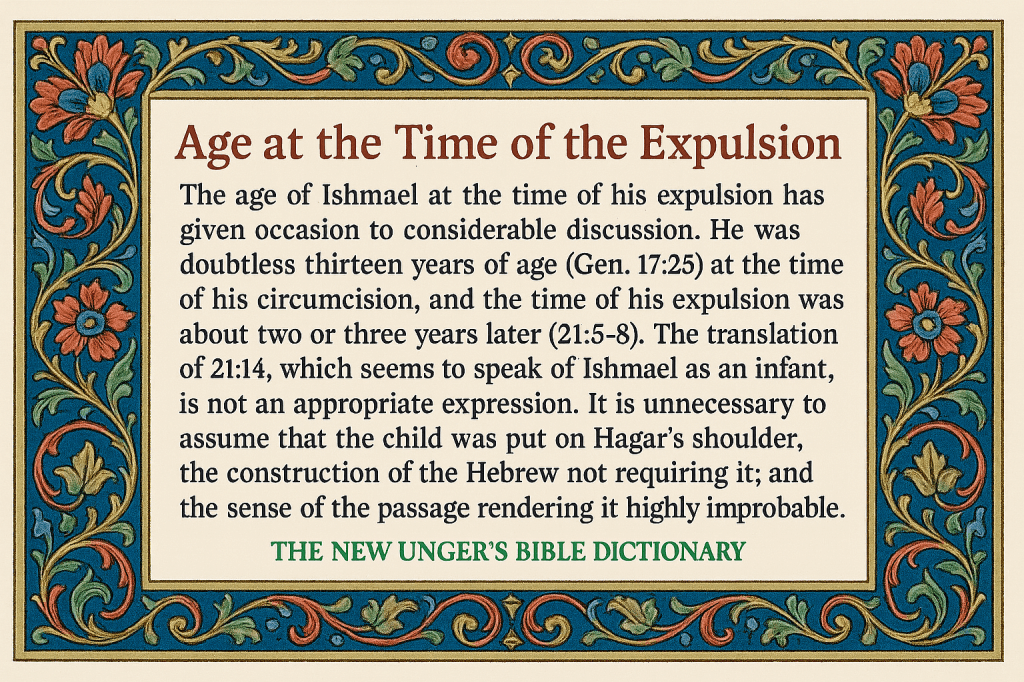
The Silent Years of Ishmael: Reconstructing the Lost Narrative Between Genesis 16 and 17
I. Introduction
The Genesis account offers a striking gap in the life of Ishmael. After his birth in Genesis 16, the narrative falls silent until Genesis 17, where Ishmael suddenly reappears as a thirteen-year-old about to be circumcised with his father Abraham. What happened between his infancy and adolescence remains untold.
This silence invites deeper scrutiny, especially when the subsequent chapters—Genesis 21:14–20 and Genesis 22:1–19—are examined in sequence. The first passage unmistakably portrays Ishmael as a baby, a helpless child carried by his mother and laid under a bush to die of thirst in the wilderness. The second describes Abraham being commanded to sacrifice his “only son,” which—when read semantically—must refer to Ishmael, since the phrase “only son” naturally denotes the sole existing child at that point in Abraham’s life, before Isaac’s birth.
Read together, these two episodes describe successive divine tests upon Abraham: first, the anguish of separation (Genesis 21), and second, the trial of sacrificial obedience (Genesis 22). Both scenes center on the destiny of Abraham’s firstborn and only son at that time, through whom God’s promise is put to the test, revealing Ishmael’s enduring place at the very heart of the Abrahamic narrative.
⸻
II. Ishmael’s Infancy and the Test of Separation (Genesis 21:14–20)
In Genesis 21:14–20, Abraham sends Hagar and Ishmael away into the wilderness of Beersheba. The narrative’s tone and imagery unmistakably convey Ishmael’s vulnerability:
“He (Abraham) put the child on her shoulder, and departed…” (Gen. 21:14)
“She (Hagar) cast the child under one of the shrubs.” (Gen. 21:15)
Such descriptions imply not a teenager of thirteen, but a young child—or even an infant—unable to walk or fend for himself. The Hebrew expression naʿar (often translated “lad”) has a wide semantic range, encompassing infancy through adolescence, but the surrounding context narrows it here to early childhood.
This impression is strengthened by Genesis 21:20, which states, “And God was with the lad, and he grew.” The verb vayigdal (“and he grew”) signals a developmental progression that follows infancy, not late adolescence. It marks the beginning of Ishmael’s independent life after divine deliverance, underscoring that God’s covenantal care accompanied him from his earliest years.
Many textual scholars observe that Genesis 21:9–10—which abruptly introduces Sarah’s jealousy toward Ishmael—is a later editorial interpolation. Its purpose appears to justify the expulsion of Hagar and Ishmael by appealing to covenantal exclusivity: “Cast out this bondwoman and her son, for the son of this bondwoman shall not be heir with my son, with Isaac.” This editorial insertion reframes the episode to align with later Israelite theology, which sought to centralize divine election in Isaac’s line.
⸻
III. The Offering of the “Only Son” (Genesis 22:1–19)
The following chapter, Genesis 22, narrates the binding (ʿAqedah) of Abraham’s “only son.” The phrase itself—“Take now your son, your only son, whom you love”—raises crucial questions. At this point in the canonical sequence, Abraham has two sons. Ishmael is alive, blessed, and dwelling in the wilderness of Paran (Gen. 21:21). How then could Isaac be called the “only son”?
This tension has long suggested to many critical scholars that the original narrative of Genesis 22 concerned Ishmael, not Isaac. The later insertion of Isaac’s name may have been an editorial act to reinterpret the story within Israel’s covenantal theology, transforming the universal Abrahamic test into an Israelite-specific typology.
The scene of the “only son,” the wood, and the divine intervention—“Do not lay your hand on the boy!”—mirrors the earlier scene of the dying child in the wilderness, where an angel also calls out from heaven to save Ishmael. Both episodes reveal Abraham’s faith under trial, and both culminate in divine reaffirmation of blessing. The structural and thematic symmetry between Genesis 21 and 22 suggests they were originally two versions of one theological motif: the testing and vindication of Abraham through Ishmael.
⸻
IV. Editorial Interpolations and Covenant Theology
The redactional tendencies within Genesis reflect a theological evolution from a broader Abrahamic covenant—embracing Ishmael—to a narrower Israelite identity through Isaac.
1. Genesis 21:9–10 functions to justify Ishmael’s exclusion, aligning with the later national theology of Israel.
2. The mention of Isaac in Genesis 22 serves to recast the universal test of faith into an Israel-centered narrative of election.
In both cases, the editorial hand shapes the text to reinforce Israel’s covenantal self-understanding. Yet beneath these layers, the original tradition—one of Abraham’s trial through Ishmael—remains visible through narrative inconsistencies, linguistic clues, and theological echoes.
⸻
V. Conclusion
Both Genesis 21:14–20 and Genesis 22 should be understood as events that precede Genesis 17, where the covenant is formally ratified and the birth of Isaac is announced. In these earlier accounts, Abraham’s faith is challenged by the events surrounding Ishmael, his firstborn and only child at the time, who represents the manifestation of divine mercy. His deliverance in the wilderness (Genesis 21) and the offering of the “only son” (Genesis 22) demonstrate Abraham’s complete submission to God, establishing the moral and spiritual foundation upon which the covenant later stands. Thus, Genesis 17 serves as the divine confirmation and formal sealing of a relationship already proven through obedience.
Although Genesis 17 appears earlier in the canonical arrangement, the internal logic of the narrative suggests that the trials described in Genesis 21:14–20 and Genesis 22 occurred beforehand. In this reconstructed chronology, Abraham’s faith is tested through Ishmael before the covenant is formally established. Thus, Genesis 17 functions not as the starting point of the covenant but as its divine ratification—confirming Abraham as the father of many nations (Genesis 17:4–5), as the outcome of the promise articulated in Genesis 22:17 when read in non-canonical sequence. The subsequent birth of Isaac then serves as the joyful culmination of Abraham and Sarah’s lives, bestowed as a reward for Abraham’s steadfast obedience during the trials that preceded the covenant’s formalization.
 ABRAHAMIC THEOLOGY