Azahari Hassim
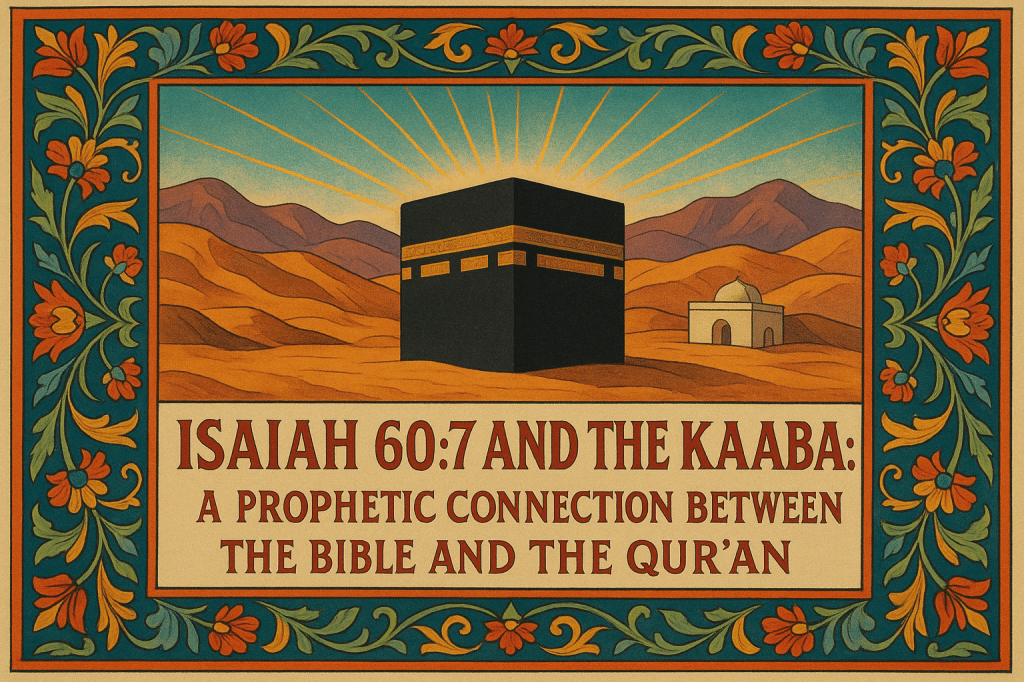
📜 Isaiah 60:7 and the Kaaba: A Prophetic Connection Between the Bible and the Qur’an
Introduction: A Meeting Point of Scriptures
The prophetic poetry of Isaiah 60 envisions a time when distant nations will turn toward the worship of the One God. Among its vivid images stands a verse that has drawn the attention of both biblical scholars and Islamic interpreters alike:
“All the flocks of Kedar shall be gathered to you; the rams of Nebaioth shall serve you; they shall come up with acceptance on My altar, and I will glorify the house of My glory.”
— Isaiah 60:7
While Christian commentators such as Albert Barnes (1834) and the Wycliffe Bible Commentary traditionally view this as symbolic of future conversion to God, others have proposed a remarkable possibility: that this prophecy refers specifically to the Kaaba in Mecca — the “House of God” associated with Abraham and Ishmael.
⸻
☪️ 1. The Arabian Lineage of Kedar and Nebaioth
Isaiah’s imagery centers on Kedar and Nebaioth, two tribes descended from Ishmael (Genesis 25:13). Their mention situates the prophecy firmly within the Arabian context.
The Wycliffe Bible Commentary notes that the treasures mentioned in Isaiah 60 are “preponderantly Arabian,” and even suggests a future turning of Islam “to the Cross,” signaling an openness among some Christian commentators to interfaith prophetic fulfillments.
Similarly, Albert Barnes, writing in 1834, observed that Arabia, with its descendants of Abraham and its deeply spiritual traditions, would eventually be “converted to God.” Though Barnes wrote from a Christian missionary perspective, his acknowledgment of Arabia’s religious importance ties into the broader idea that Ishmael’s lineage has a divine role.
Yet from an Islamic perspective, this “turning” may rather represent a return — a reorientation of the descendants of Ishmael toward the pure monotheism of Abraham, centered on the Kaaba.
⸻
🕋 2. “The Glorious House”: Identified with the Kaaba
Many Muslim scholars interpret the phrase “the house of My glory” as referring to the Kaaba (Baytullāh) — the sacred House of God in Mecca.
According to the Qur’an (2:125–127), Abraham and Ishmael were commanded to raise its foundations:
“And when We designated for Abraham the site of the House, saying, ‘Do not associate anything with Me and purify My House for those who circumambulate it and those who stand, bow, and prostrate [in prayer].’”
— Surah al-Ḥajj 22:26; cf. al-Baqarah 2:125–127
If Isaiah foresaw a time when the descendants of Kedar and Nebaioth would bring offerings to the altar of the “glorious house,” then this could signify the Hajj pilgrimage, where animals are sacrificed in devotion to God — a living ritual traceable to Abraham himself.
⸻
🌟 3. “God Was with the Lad”: The Presence of God with Ishmael
The book of Genesis provides another link to this prophetic vision. When Hagar and Ishmael were cast out, the text affirms:
“And God was with the lad; and he grew, and dwelt in the wilderness, and became an archer.”
— Genesis 21:20
Traditional Islamic exegesis understands this “wilderness” to be the valley of Bakkah (Mecca). The phrase “God was with the lad” is thus interpreted not only as divine protection but as a declaration of God’s presence in a sacred location — a site where His worship would endure through Ishmael’s lineage.
This understanding aligns perfectly with the Qur’anic narrative, in which Abraham’s prayer identifies that same location as the “Sacred House”.
⸻
📜 4. Surah 14:37 — Abraham’s Prayer and the Sacred House
The Qur’an preserves Abraham’s moving invocation:
“O our Lord! I have settled some of my offspring in an uncultivated valley near Your Sacred House, our Lord, so that they may establish prayer. So make hearts among the people incline toward them, and provide for them fruits that they might be grateful.”
— Surah Ibrāhīm 14:37
Here, Abraham explicitly locates Ishmael and Hagar beside the Sacred House (al-Bayt al-Muḥarram), implying that the Kaaba already existed as a holy site, later rebuilt by Abraham and his son. His prayer anticipates Mecca becoming a spiritual center to which human hearts would turn — precisely what Isaiah 60 envisions when nations stream toward God’s glorified house.
⸻
🌟 5. Theological Implications: Fulfillment through Ishmael’s Descendants
Interpreters who draw this connection propose that Isaiah 60:7 prophesies Mecca’s role as the universal center of monotheistic worship.
The flocks of Kedar and Nebaioth symbolize the submission of Ishmael’s descendants to God, as visibly fulfilled in the Islamic rites of Hajj and Eid al-Adha. The sacrificial offerings at the Kaaba — echoing Abraham’s own devotion — mirror Isaiah’s vision of accepted sacrifices on God’s altar.
In this interpretation:
• Isaiah 60:7 anticipates the revival of Abrahamic worship among the Ishmaelites.
• Genesis 21:20 foreshadows divine favor upon Ishmael’s descendants in a specific sacred region.
• Surah 14:37 confirms that sacred geography: the barren valley of Mecca, chosen for divine worship.
Together, they form a triadic continuity — a prophetic, historical, and theological alignment linking the Bible and the Qur’an through Abraham and Ishmael.
⸻
Conclusion: The House of God Revisited
The convergence of these scriptural strands suggests a profound harmony: that both the Bible and the Qur’an point toward a future restoration of Abrahamic monotheism centered on God’s “House of Glory.”
For believers who see the Kaaba as this very House, Isaiah’s vision is not merely about the distant conversion of nations, but about the universal return to the pure worship of the One God first established by Abraham and his son Ishmael.
⸻
References:
• Albert Barnes, Notes on the Bible (1834), on Isaiah 60:7
• The Wycliffe Bible Commentary, on Isaiah 60:4–7
• Genesis 21:18–20; Isaiah 60:7
• Qur’an 2:125–127; 14:37; 22:26
 ABRAHAMIC THEOLOGY