Azahari Hassim

📜 Abraham, History, and Identity: Why Judaism and Islam Relate Differently to the Patriarch
💫 Introduction
Among the three great Abrahamic religions, all trace their spiritual lineage to Abraham. Yet the way each tradition relates to Abraham differs profoundly. A recurring argument — especially in comparative theological discourse — claims that Judaism is more connected to its historical experience, whereas Islam is more directly connected to the person and legacy of Abraham. This distinction becomes evident when comparing the centrality of the Exodus and Sinai in Judaism with the centrality of Hajj and the Abraham–Ishmael narrative in Islam.
This article explores the theological framework behind this argument, demonstrating how sacred history, covenantal identity, and ritual practices shape the role of Abraham in each tradition.
⸻
♦️ 1. Judaism: A Religion Rooted in Communal History and Covenant
1.1 Abraham as the Patriarch, but Sinai as the Core
Judaism undeniably venerates Abraham as the patriarch (Genesis 12–25). However, Jewish religious identity is shaped less by Abraham personally and more by Israel’s collective historical journey, particularly:
• The Exodus from Egypt
• The Giving of the Torah at Mount Sinai
• The Sinai Covenant (Brit Sinai)
• The formation of Israel as a holy nation (Exodus 19:6)
Judaism’s primary self-definition is not “the children of Abraham,” but rather “the people who stood at Sinai.”
The Rabbis famously state:
“Our covenant is not through Abraham alone, but through the Torah given to all Israel at Sinai.”
This is why the central liturgical memory in Judaism is not Abraham’s tests but the Exodus:
• The Passover (Pesach) festival
• The Sabbath (a memorial of liberation)
• Daily prayers constantly invoking “the God who brought you out of Egypt”
1.2 Covenant Through Isaac and Jacob
Judaism’s theological architecture rests on the Sinai Covenant and the ancestral chain:
Abraham → Isaac → Jacob → the Twelve Tribes of Israel.
Thus, covenantal continuity is traced ethnically and historically, not ritually through reenactments of Abraham’s life. Abraham is a revered ancestor — but the religion’s heart is the law (Torah) and the national history of Israel.
⸻
♦️ 2. Islam: Abraham as the Living Ritual and Spiritual Model
2.1 Islam Calls Itself “The Religion of Abraham” (Millat Ibrāhīm)
The Qur’an repeatedly emphasizes Abraham more than any other patriarch:
• “Follow the religion of Abraham” (Qur’an 3:95)
• Abraham is called ḥanīf, a pure monotheist (Qur’an 16:120)
Abraham is not just a historical patriarch — he is the archetype of submission (islām).
2.2 Abraham and Ishmael in the Kaaba and Hajj
Islam intricately weaves the story of Abraham into the lives of its believers through the rituals performed during Hajj.
Pilgrims reenact key events, such as the ṭawāf around the Kaaba, which honors the moment Abraham and Ishmael established its foundations (Qur’an 2:127). The sa‘y between Ṣafā and Marwah represents Hajar’s search for water, while drinking from Zamzam recalls the miracle provided for baby Ishmael.
Standing at ‘Arafah signifies Abraham’s devotion, and the sacrifice during ‘Eid al-Adha commemorates his willingness to obey God by offering his firstborn son. Lastly, the stoning of the Jamarāt symbolizes Abraham’s rejection of Satan’s temptations.
Thus, while Judaism remembers Abraham theologically, Islam reenacts Abraham ritually.
2.3 Ishmael’s Role Restored
In the Islamic narrative, Ishmael is not marginal but central:
• He helps Abraham build the Kaaba.
• He is linked to the sacred sanctuary (Q 2:125–129).
• He is believed to be the son whom Abraham was commanded to sacrifice, demonstrating ultimate submission to God.
• He is part of the prophetic lineage leading to Muhammad ﷺ.
Thus, Islam’s living rituals restore Abraham and Ishmael to the center of religious consciousness.
⸻
♦️ 3. Why the Two Traditions Differ
3.1 Judaism: History as Identity
Judaism emerged as a national–historical covenant. Its sacred memory is:
• Liberation from Egypt
• Revelation at Sinai
• Life under the Torah
• The historical survival of Israel
Thus, Jewish identity is shaped by collective memory, not primarily by reenacting the life of Abraham.
3.2 Islam: Abraham as the Universal Prototype
Islam presents itself as:
the restoration of Abraham’s original monotheism
(Qur’an 3:67)
Islam views Abraham as:
• the spiritual father of all who submit to God,
• the builder of the Kaaba (house of God),
• the model for rituals of pilgrimage, sacrifice, and prayer.
Therefore, Islam sees Abraham as the living foundation of its religious practice.
3.3 Two Different Theological Trajectories
• Judaism: A religion of a people and their historical covenant
• Islam: A religion of a prophet and his universal monotheism
Both honor Abraham, but the mechanisms of memory differ:
• Judaism emphasizes the journey of Israel.
• Islam emphasizes the journey of Abraham.
⸻
🌟 4. Conclusion
The claim that Judaism is more connected to its history while Islam is more connected to the person of Abraham reflects deep theological truths:
• Judaism’s heart is Sinai, the covenant of the Torah and the historical identity of Israel.
• Islam’s heart is Abraham, whose life is woven into its rituals, theology, and annual pilgrimage.
Both traditions preserve Abraham’s legacy — but Islam experiences Abraham through ritual reenactment, while Judaism remembers him through narrative and covenantal ancestry.
Thus, the argument is not about superiority, but about different religious architectures:
one built on historical memory, the other on prophetic example and ritual continuity.
📜 Isaiah 41:8 and the Meaning of ’Ohavī: Abraham as the Lover of God in the Hebrew Covenant Framework
⸻
Abstract
Isaiah 41:8 is frequently translated in English as referring to Abraham as the “friend of God.” However, a philological analysis of the Hebrew term employed—’ohavī (אֹהֲבִי)—indicates that this translation does not fully capture its theological significance.
This article argues that ’ohavī does not denote “friend” in a social sense, but rather “one who loves God,” a covenantal term that emphasizes active love, fidelity, and obedience. By examining the linguistic form, literary structure, and theological implications of the verse, this study demonstrates that Abraham is portrayed in Isaiah not as a passive recipient of divine favor, but as an active subject who establishes covenantal relationship through love manifested in obedience and sacrifice.
⸻
🪷 1. Introduction
Isaiah 41:8 is one of the key biblical texts affirming Abraham’s unique status in the history of divine covenant:
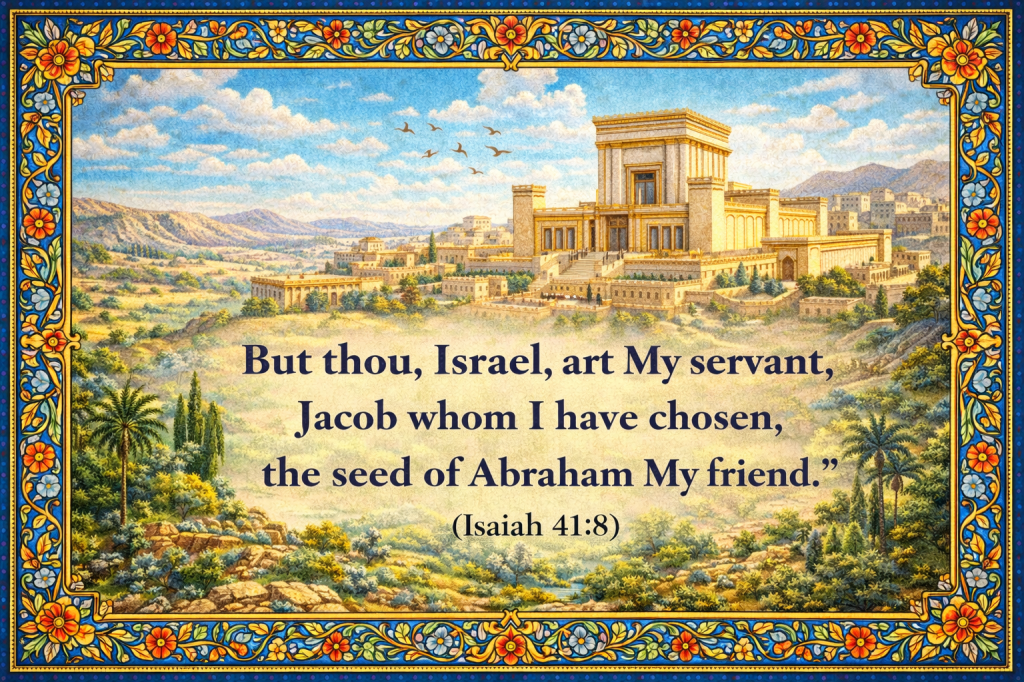
“But you, Israel, my servant, Jacob whom I have chosen,
the offspring of Abraham my friend.”
In Jewish and Christian traditions, this verse is often cited as evidence of Abraham’s special personal relationship with God. However, the common English rendering “my friend” raises an important interpretive question: does the Hebrew term used here truly signify friendship in the ordinary sense, or does it convey a deeper covenantal concept?
This article seeks to demonstrate that the English word “friend” fails to convey the full semantic and theological depth of the original Hebrew expression, and that the underlying term carries significant implications for understanding the nature of the Abrahamic covenant.
⸻
🥀 2. Philological Analysis: The Term ’Ohavī (אֹהֲבִי)
The Hebrew text of Isaiah 41:8 reads:
זֶרַע אַבְרָהָם אֹהֲבִי
zeraʿ Avraham ’ohavī
The key term in this phrase is ’ohavī, derived from the Hebrew root א־ה־ב (ʾ–h–v), meaning “to love.” Grammatically, ’ohavī is an active participle with a first-person singular possessive suffix, yielding the literal meaning:
“the one who loves Me.”
From a linguistic standpoint, this construction places emphasis on Abraham as the acting subject—the one who loves God. This is markedly different from other Hebrew words that can denote “friend” or “companion,” such as re‘a (רֵעַ) or ḥaver (חָבֵר), neither of which appears in this verse.
The deliberate choice of a love-based participle indicates that Abraham’s relationship with God is framed in terms of covenantal fidelity rather than social familiarity.
⸻
🌱 3. Abraham as an Active Subject in the Covenant Relationship
The literal meaning of ’ohavī carries significant theological implications. It portrays Abraham not merely as someone “loved by God,” but as one who actively responds to God through love expressed in obedience.
This portrayal is consistent with the broader Abrahamic narrative in Genesis, where Abraham’s identity is shaped by a sequence of radical acts of obedience, including:
- His departure from homeland and kinship ties (Genesis 12),
- His trust in divine promises without immediate material assurance (Genesis 15),
- His acceptance of circumcision as a physical and symbolic sign of covenant (Genesis 17),
- His willingness to surrender his son in the climactic test of sacrifice (Genesis 22).
Within this narrative framework, ’ohavī functions as a theological summary of Abraham’s life orientation—an existence defined by obedience as an expression of love.
⸻
🌼 4. The Foundation of Covenant: Love Preceding Lineage
The internal structure of Isaiah 41:8 further reinforces this theological reading:
• Israel is designated as “servant,”
• Jacob as “chosen,”
• Abraham as ’ohavī.
This sequence suggests that Israel’s covenantal identity is grounded in Abraham’s relationship with God, and that this relationship is defined by love and fidelity rather than by ethnic identity alone. Lineage inherits the covenant, but the covenant itself is established through the love-driven obedience of Abraham.
Accordingly, the Abrahamic covenant is presented as pre-national and pre-institutional, not fully reducible to later political or ethnic formations associated with Israel.
⸻
🎋 5. The Translation Issue: “Friend” as Theological Softening
Most English translations opt for the word “friend” when rendering ’ohavī, largely for stylistic and cultural reasons. The term “lover” can sound awkward or misleading in modern English usage. Nevertheless, this translation choice carries theological consequences:
- It softens the covenantal notion of love into a general sense of friendship,
- It obscures the element of active obedience inherent in the original term,
- It risks portraying Abraham as a passive recipient of divine affection rather than as a moral agent whose actions shape the covenant.
A more precise translation, faithful to both philology and theology, would read:
“the offspring of Abraham, the one who loved Me.”
⸻
🪻 6. Broader Theological Implications
Understanding ’ohavī as “one who loves God” has significant implications for covenant theology. It underscores that divine covenant is not grounded solely in ethnic election, but in moral fidelity and obedience arising from love.
This principle explains why Abraham is depicted as a universal figure: he precedes the Sinai legislation, transcends national boundaries, and serves as a paradigmatic model of faith for subsequent generations.
⸻
🌴 7. Conclusion
A close examination of the term ’ohavī in Isaiah 41:8 reveals that Abraham is portrayed not merely as the “friend of God,” but as the “lover of God” in a covenantal sense. His relationship with God is defined by love demonstrated through obedience and sacrifice, rather than by ethnic privilege or social intimacy.
When read with philological precision, Isaiah 41:8 emerges as a foundational theological statement affirming that the Abrahamic covenant rests upon individual fidelity expressed through love—a principle that undergirds covenantal thought across the broader Abrahamic tradition.
 ABRAHAMIC THEOLOGY