Azahari Hassim
🌿 The Missing Years: Ishmael’s Hidden Journey in the Book of Genesis
Introduction
The book of Genesis contains a striking silence in the life of Ishmael.
He is born in Genesis 16… and then he disappears.
The next time we see him—in Genesis 17—he is suddenly thirteen years old, standing beside Abraham, about to be circumcised.
What happened during those missing years?
Why does the text fall silent?
And what does this silence reveal about the deeper Abrahamic story?
To answer this, we look at the two major episodes that follow:
Genesis 21, where Ishmael is a helpless child sent into the wilderness,
and Genesis 22, where Abraham is commanded to sacrifice his “only son.”
Read in sequence—and without assuming the later editorial layers—both narratives point to Ishmael as Abraham’s firstborn, beloved, and only son at those points in time.
⸻
Ishmael’s Infancy and the Test of Separation
(Genesis 21:14–20)
Genesis 21 describes Abraham placing Ishmael on Hagar’s shoulder, and later Hagar laying him under a bush to die of thirst. This is not the picture of a thirteen-year-old teenager.
The Hebrew word naʿar, often translated “lad,” covers a wide age range.
But the context here—being carried, unable to walk, crying out—makes it clear Ishmael was still a young child.
Then, verse 20 says:
“And God was with the lad, and he grew.”
The phrase vayigdal—“and he grew”—signals a new developmental stage beginning after his infancy.
Many scholars note that Genesis 21:9–10, the sudden appearance of Sarah’s jealousy, appears to be a later editorial insert.
Its purpose?
To justify removing Ishmael from the covenantal story in favor of Isaac.
But beneath this layer, the original narrative highlights a divine test of Abraham—
a test centered on the life of his firstborn son.
⸻
The Offering of the “Only Son”
(Genesis 22:1–19)
In the very next chapter, Genesis 22, God commands Abraham:
“Take your son, your only son, whom you love…”
At this point in the story, Abraham has two sons.
Ishmael is alive, blessed, and living in Paran.
So how can Isaac be called the “only son”?
This tension has led many critical scholars to conclude that the original Akedah narrative—Genesis 22—was about Ishmael, not Isaac.
Only later was Isaac’s name inserted to fit the rising Israelite theology of exclusive election.
The parallels are remarkable:
• In Genesis 21, a child is left to die; an angel calls from heaven and saves him.
• In Genesis 22, a child is about to be sacrificed; an angel calls from heaven and saves him.
Two tests.
Two near-deaths.
Two divine interventions.
One original story:
Abraham’s faith tested through Ishmael.
⸻
Editorial Interpolations and Covenant Theology
The final shape of Genesis reflects layers of theological editing:
- Genesis 21:9–10 justifies Ishmael’s exclusion.
- Genesis 22 is reshaped so that Isaac becomes the child of sacrifice.
These changes reflect later Israelite identity formation—but they do not erase the earlier, deeper tradition of Ishmael at the center of Abraham’s trials.
⸻
Conclusion
When read without the later editorial layers, Genesis 21 and 22 appear to occur before Genesis 17.
In this reconstructed sequence:
• Ishmael is Abraham’s only son.
• Abraham’s faith is tested through him.
• The covenant of Genesis 17 becomes the ratification of a relationship already proven through obedience.
Only later does Isaac enter the story as a gift—
a joyful reward after Abraham has endured the greatest tests with Ishmael.
Thus, Ishmael is not a marginal figure.
He stands at the very core of the Abrahamic narrative, the first vessel of divine blessing, mercy, and trial.
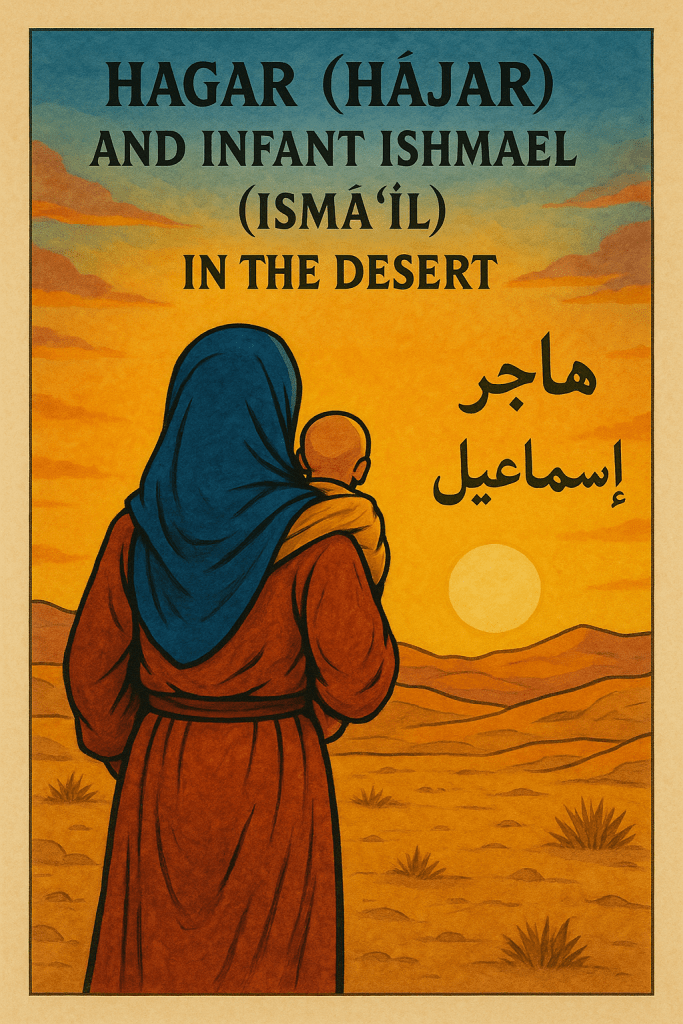
Hagar’s Elevated Status in Islam Through the Hajj Pilgrimage
Understanding Her Role as a Matriarch and Mother of Many Nations
⸻
📜 Covenantal Roots: Abraham, Hagar, and the Promise
In the Torah, God established a covenant with Abraham (Ibrahim عليه السلام), promising that he would be:
• 🌍 A blessing to all nations
• 👑 A father of many nations—both biologically and spiritually
Yet, Hagar, the Egyptian woman who bore him Ishmael (Isma’il عليه السلام), is notably absent from the list of Jewish matriarchs. In the Qur’an, her name is never mentioned directly, and even the miraculous well linked to her—Zamzam—is not cited by name, though its legacy is deeply woven into Islamic ritual.
⸻
🏜 The Desert Trial: Faith in the Face of Desperation
According to Islamic tradition, Abraham was commanded by God to leave Hagar and the infant Ishmael in the barren valley of Makkah. With no water and no vegetation, Hagar’s maternal desperation turned into an act of enduring faith:
• She ran 🏃♀️ seven times between the hills of Safa and Marwa searching for water.
• In her struggle, an angel appeared, striking the ground and causing the Zamzam well to gush forth.
This was not merely survival—it was the divine establishment of a new spiritual legacy through Ishmael, from whom Prophet Muhammad ﷺ would later descend.
⸻
🕋 The Sa’i Ritual: Immortalizing a Mother’s Struggle
One of the central pillars of the Hajj pilgrimage is Sa’i, the reenactment of Hagar’s search for water:
• Pilgrims walk or run seven times between Safa and Marwa, just as Hagar once did.
• This act is not symbolic alone—it is an obligatory rite for completing Hajj and ‘Umrah.
By making her desperate search a permanent part of Islamic worship, Islam does what the Torah and Jewish tradition do not—it elevates Hagar to the rank of a spiritual matriarch.
⸻
🌟 Hagar: The Matriarch of Many Nations
Through the Hajj, Hagar’s status is transformed:
• 📖 From obscurity in the Qur’an’s text → to central remembrance in Islamic practice.
• 🏛 From marginalization in Judeo-Christian tradition → to being honored as a mother of the Muslim ummah.
• ❤️ From a desperate mother in the desert → to a symbol of resilience, faith, and divine providence.
Her story teaches that:
Faith under trial can create legacies that outlive generations.
⸻
✨ Why This Matters Today
In every Hajj season, millions of Muslims—men and women—trace Hagar’s footsteps, physically placing themselves in her journey. Her endurance is not merely remembered; it is experienced.
She is thus not only Ishmael’s mother but also:
• 🌍 Mother of many nations through Abraham’s covenant
• 🕊 Embodiment of trust in God’s plan
• 🏅 A spiritual role model for all believers
⸻
📌 Conclusion:
In Islamic tradition, the desert story of Hagar is not a footnote—it is a foundational narrative. The Sa’i ritual immortalizes her courage, transforming her from a historical figure into a living symbol of faith. In this way, the Hajj pilgrimage enshrines Hagar as a matriarch in the spiritual lineage of Islam, fulfilling God’s promise to make her and her son a great nation.
📜 The Family of Abraham in Islamic and Judeo-Christian Perspectives
Ishmael as the Son of Sacrifice and Covenant, Isaac as the Son of Reward and Blessing
⸻
🌟 Introduction
Within the Abrahamic faiths, the household of Abraham (Ibrāhīm عليه السلام) stands as a sacred model of obedience and divine promise. Yet, the interpretation of this family’s story differs sharply across traditions.
In the Islamic understanding, Abraham’s family is not a story of rivalry but of divine sequence and harmony. Ishmael (Ismāʿīl عليه السلام) is the son of sacrifice, through whom the ultimate test of faith was fulfilled and the covenant was established. Isaac (Isḥāq عليه السلام) is the son of reward, granted to Abraham and Sarah as a divine blessing following their endurance and obedience.
In contrast, the Judeo-Christian tradition often portrays Abraham’s household as marked by jealousy and exclusion. Islam restores unity to this narrative by recognizing both sons as integral to God’s unfolding covenantal plan.
⸻
1. The Near Sacrifice: Ishmael as the Son of Testing
The Qur’an recounts Abraham’s supreme test — the command to sacrifice his beloved son:
“He said, ‘O my son, indeed I have seen in a dream that I am sacrificing you, so see what you think.’
He said, ‘O my father, do as you are commanded; you will find me, if Allah wills, among the steadfast.’”
— Surah al-Ṣāffāt 37:102
Both father and son displayed perfect submission to the divine will. When Abraham fulfilled the command, God intervened:
“We ransomed him with a great sacrifice, and We left for him [a good mention] among later generations.”
— Surah al-Ṣāffāt 37:107–108
This episode signifies the culmination of Abraham’s trials and the perfection of his faith. Classical exegetes such as al-Ṭabarī and Ibn Kathīr affirm that the son in this event was Ishmael, as Isaac’s birth occurred only afterward. Ishmael thus becomes the son of trial, sacrifice, and covenantal submission, the one through whom Abraham’s obedience is eternally commemorated.
⸻
2. The Covenant Established After the Sacrifice
The Qur’an indicates that the divine covenant (ʿahd) was granted after Abraham had successfully completed all his tests — culminating in the near sacrifice:
“And [mention] when Abraham was tested by his Lord with certain commands, and he fulfilled them. He said, ‘Indeed, I will make you a leader (Imām) for mankind.’ Abraham said, ‘And of my descendants?’ [Allah] said, ‘My covenant does not include the wrongdoers.’”
— Surah al-Baqarah 2:124
This verse marks the formal establishment of the Abrahamic Covenant, conferred only after Abraham’s demonstration of perfect obedience. The covenant was not inherited automatically, but earned through faithfulness.
Because Ishmael was the son involved in the supreme test, the covenant naturally extends through his line — the line of submission (islām) — culminating in the Prophet Muhammad ﷺ, the final bearer of the Abrahamic mission.
The covenant, therefore, follows the pattern:
Trial → Fulfillment → Covenant → Reward.
⸻
3. Isaac: The Son of Reward and Blessing
After Abraham’s trial and the establishment of the covenant, God rewarded him and Sarah with the joyful announcement of a new son — Isaac:
“And We gave him good news of Isaac, a prophet from among the righteous.”
— Surah al-Ṣāffāt 37:112
Isaac’s birth represents divine reward for Abraham’s faithfulness and Sarah’s endurance. His arrival in their old age symbolizes the mercy that follows obedience. Isaac is thus the son of reward and blessing, embodying the continuation of prophecy and grace among the Children of Israel.
In the Islamic framework, Isaac’s role complements rather than replaces Ishmael’s. Ishmael carries the covenantal trust, established through the trial of sacrifice, while Isaac carries the prophetic continuation within his descendants.
According to this understanding, the descendants of Isaac through Jacob (Ya‘qūb عليه السلام) are bound by the Sinai Covenant, revealed later to Moses (Mūsā عليه السلام), whereas the descendants of Ishmael remain under the universal Abrahamic Covenant — the primordial covenant of submission (islām) that extends to all nations through the final Messenger, Muhammad ﷺ.
⸻
4. The Judeo-Christian Portrayal: Rivalry and Election
In the Biblical narrative, Abraham’s household is often portrayed as a drama of jealousy and exclusion. Sarah’s envy of Hagar leads to Ishmael’s expulsion (Genesis 16; 21), and the covenantal blessing is confined to Isaac’s lineage. This introduces the theology of divine election, which prioritizes one lineage over another.
Christian writers such as Paul later spiritualize this tension, contrasting Ishmael as “born according to the flesh” with Isaac as “born according to the promise” (Galatians 4:22–31). Such readings reinforce a dichotomy of rejection versus election — a divide that Islam transcends by recognizing both sons as divinely chosen for distinct missions.
⸻
5. The Islamic Restoration: Unity Through Faith and Obedience
In the Qur’anic vision, Abraham’s family is unified by faithful submission, not divided by bloodline or favoritism. The covenant rests upon righteousness and obedience, not genealogy.
• Ishmael is the son of sacrifice, through whom the covenant of divine leadership was confirmed.
• Isaac is the son of reward, through whom the chain of prophethood was extended to the Children of Israel.
The Kaaba, built by Abraham and Ishmael (2:125–127), stands as the living symbol of the universal covenant, while the Torah at Sinai represents the specific covenant with Israel. Both reflect divine guidance within their respective missions — yet Islam views the Abrahamic Covenant as the root from which all subsequent covenants branch.
⸻
6. Theological Implications: Covenant as the Fruit of Obedience
The Islamic chronology clarifies the divine order of revelation:
1. The Trial — Abraham’s command to sacrifice Ishmael.
2. The Fulfillment — Both submit to God’s will.
3. The Covenant — Leadership and divine favor established (2:124).
4. The Reward — Birth of Isaac and continuation of prophecy.
Thus, the Abrahamic Covenant arises as the result of Abraham’s perfect obedience, not as a prior entitlement. Ishmael is its living witness, and Isaac is its blessed continuation — both united in purpose, distinct in role.
⸻
Conclusion
In Islam, the family of Abraham embodies the balance between sacrifice and mercy, trial and reward, covenant and continuation. Ishmael stands as the son of sacrifice and covenant, the one through whom the divine test was fulfilled; Isaac as the son of reward and blessing, the one through whom prophecy flourished among Israel.
While the descendants of Isaac through Jacob entered the Sinai Covenant, the descendants of Ishmael preserved the Abrahamic Covenant, culminating in the universal message of Islam — the final expression of monotheism envisioned by Abraham himself.
Thus, Islam transforms the story of Abraham’s family from rivalry into revelation, from division into divine harmony — where every son, every covenant, and every test reveals a single eternal truth: submission to the One God (Allāh).
 ABRAHAMIC THEOLOGY