Azahari Hassim
📜 Muhammad Mythicism: Origins, Arguments, and Scholarly Responses
❇️ Abstract:
Muhammad mythicism—the claim that the Prophet Muhammad did not exist as a historical person—has emerged in recent decades from both ideological and revisionist impulses. While it draws on broader skepticism toward early Islamic historiography, it remains largely outside peer-reviewed academic scholarship. This article outlines the development of Muhammad mythicism, evaluates its central arguments, and highlights the scholarly consensus affirming Muhammad’s historicity based on a range of converging evidences.
⸻
♦️1. Introduction
The figure of the Prophet Muhammad stands at the foundation of Islam, yet a small but vocal movement questions whether he existed at all. This position, known as Muhammad mythicism, has garnered attention in popular circles, particularly since the early 2000s. Although often perceived as a new phenomenon, its roots can be traced back to a largely forgotten Soviet Marxist tradition. Today, its proponents include figures such as Yehuda Navo, Judith Corin, the Inara school, Johannes Jantzen, and Robert Spencer. Despite its public appeal, Muhammad mythicism is virtually absent from mainstream academic discourse.
⸻
♦️2. Historical Development of Muhammad Mythicism
Muhammad mythicism has two distinct phases:
• Soviet Marxist Origins: Early expressions of Muhammad mythicism appeared within the context of Soviet ideology, where religion was broadly critiqued as a socio-economic construct. These views, however, did not significantly impact Western scholarship.
• Western Revival (2000s–present): A more developed form of mythicism emerged in the early 21st century, influenced by broader skepticism towards early Islamic historiography. This revival coincided with an increase in revisionist approaches to the study of Islam’s origins, though mythicism remains a fringe position even within revisionism.
⸻
♦️3. Core Arguments of Muhammad Mythicism
3.1. Argument from Silence
Mythicists often argue that early sources fail to mention Muhammad explicitly, implying he was invented later. However, this is contradicted by a growing body of early non-Muslim sources, coins, and inscriptions that reference Muhammad or closely associated events within a few decades of his death. Scholars also note that earlier strata of Islamic reports can often be reconstructed through isnāds (chains of transmission), preserving information from a relatively early period.
3.2. “Muhammad” as a Title
Another mythicist argument claims that “Muhammad” originally functioned as a title for Jesus, rather than a personal name. This interpretation fails linguistically and contextually. In both Quranic passages and early inscriptions, “Muhammad” appears as the definite subject in nominal sentences—a syntactic structure indicating a proper name. Additionally, non-Arabic sources transliterate the name, a treatment typically reserved for personal names, not titles. Historical evidence also shows “Muhammad” was already in use as a personal name decades prior to the earliest known inscriptions bearing the name.
3.3. Geographical Discrepancies – The Petra Thesis
Some mythicists propose that early Islam originated not in Mecca but in Petra, based on perceived discrepancies in geographical descriptions. However, early non-Muslim sources that would have known of Petra provide no such indication. Furthermore, Islamic tradition preserves no memory of a shift in the sanctuary’s location, which would be an unlikely omission had such a move occurred. Scholars widely consider this thesis speculative and unsupported.
⸻
♦️4. Scholarly Consensus on Muhammad’s Historicity
Despite justified caution regarding the reliability of many early Islamic sources, most scholars maintain that a historical Muhammad did exist. This position is supported by several key lines of evidence.
4.1. Corroboration from Non-Muslim Sources
One of the most compelling pieces of evidence comes from an Armenian chronicle dated around 660 CE—approximately 30 years after Muhammad’s death. It summarizes Muhammad’s career in terms that largely match the traditional Islamic narrative. The source is widely accepted as authentic and undermines claims of late fabrication or interpolation.
4.2. Chronological and Political Frameworks
Coins, inscriptions, and non-Muslim writings from the 7th century corroborate the chronological and political framework of Islamic history as preserved in Islamic tradition. These external sources reinforce the notion that key elements of early Islam, including its leadership structures and expansionist policies, were in place soon after Muhammad’s supposed lifetime.
4.3. Reliability of Genealogical Traditions
The detailed genealogical data found in early Islamic sources, particularly regarding Arabian tribes, has been partially verified through inscriptions and is considered largely accurate. Muhammad’s lineage, for example, fits within this broader genealogical framework, further affirming his historical reality.
4.4. Inter-Regional Consistency and the Criterion of Dissimilarity
Early Islamic centers—Medina, Kufa, Basra, and Syria—independently preserved traditions about Muhammad that align on basic facts, including his name, his marriage to Khadijah, and his tribal affiliation with the Banu Hashim. Importantly, some of this information contradicts the interests of powerful factions (e.g., the Umayyads), suggesting it was inherited and widely accepted rather than fabricated. This aligns with the criterion of dissimilarity, often used in historical Jesus studies, which holds that information unlikely to have been invented for polemical reasons is more likely to be authentic.
⸻
♦️5. Conclusion
While Muhammad mythicism has gained some popularity in certain online and ideological circles, it lacks serious support in academic scholarship. The weight of evidence—from early non-Muslim testimony, material culture, internal consistency across regions, and linguistic and genealogical data—strongly supports the conclusion that Muhammad was a real historical figure. The study of ancient figures frequently presents challenges in establishing historical certainty. Nevertheless, the most credible interpretation of the available evidence indicates that a Prophet Muhammad did exist in 7th-century Arabia.
📋 How Jay Smith and His Group Argue That “Muhammad” (MHMD) Originally Referred to Jesus
Jay Smith is part of a Christian polemical movement that challenges the early history of Islam. Within this framework, Smith and his colleagues—such as those connected to the “Inarah Institute”-inspired revisionist school—propose that the term MHMD (محمد / muhammad, meaning “the praised one”) in the earliest Islamic texts may not refer to a historical Arabian prophet, but instead to Jesus as the “praised” or “glorified” figure.
Their argument has five major pillars:
⸻
- “Muhammad” Means The Praised One, Not Necessarily a Personal Name
Smith’s foundational linguistic claim:
• The word muhammad is a passive participle meaning “the praised one”.
• It can function as a title, not only a personal name.
• Christian traditions frequently refer to Jesus as:
• “The Glorified One”
• “The Praised One”
• “The Blessed One”
Smith’s group argues that the Qur’anic and inscriptional term MHMD may originally have functioned like these titles.
⸻
- Early Arabic Inscriptions Contain “MHMD” Without Any Biographical Link to Mecca or a Human Prophet
Smith refers to early inscriptions such as:
• The Dome of the Rock inscriptions (690 CE)
• The Arab-Byzantine coins (early 7th–8th century)
• The Zuhayr inscription and others
He argues:
• The inscriptions say things like “Muhammad is the servant of God” but do not give:
• A birthplace,
• A mother,
• A life story,
• A prophetic career.
• He claims these phrases could easily be read as:
“The Praised One is God’s servant” → referring to Jesus.
Thus, he says:
Early Islam’s use of “MHMD” was devotional and Christological, not biographical.
⸻
- Early Coins Depict a Human Figure Who Resembles Byzantine Christian Imagery
Smith famously analyzes early Islamic coins:
• Some feature a standing figure with a cross-like staff.
• Others include Christian formulas.
• The term mhmd appears alongside symbols long associated with Jesus.
Smith’s interpretation:
• These coins do not depict an Arabian prophet, but rather a modified representation of Jesus, adapted by Arab Christians who later formed part of the Umayyad administration.
Thus he claims:
“MHMD” was a Christological epithet on early Arab-Christian coins.
⸻
- The Qur’an Never Gives Muhammad a Biography—Indicating, Smith Claims, That the Name Was Originally Symbolic
Jay Smith argues:
• The Qur’an does not describe Muhammad’s:
• Parents,
• Childhood,
• Tribe,
• Location,
• Chronology,
• Battles (except allusions without names),
• Wife names,
• Mecca.
Since the Qur’an contains no narrative biography, he argues the term muhammad may not have originally referred to a person, but to a theological figure—similar to:
• al-Masīḥ (the Messiah)
• al-Muṣṭafā (the Chosen One)
He claims early Muslims later retroactively attached a biography to the title.
⸻
- Christian Sources Before Islam Refer to Jesus as “The Praised One” (Parallel to MHMD)
Smith cites Syriac Christian literature:
• The Syriac word “maḥmūdā” (ܡܗܡܘܕܐ) meaning “praised, glorified”
• Used in reference to Jesus
He argues:
• Arab Christians may have used the Arabic equivalent “muhammad” as a devotional epithet for Jesus.
• Thus, MHMD originally identified Jesus, not a separate prophet.
This supports his claim of a Christological reading of early Qur’anic phrases such as:
wa-muḥammadun rasūlu-llāh
“The Praised One is the messenger of God.”
From Smith’s perspective, this could mean:
“Jesus, the praised one, is God’s messenger.”
⸻
Synthesis: Jay Smith’s Overall Thesis
Putting the claims together:
- MHMD = “The Praised One,” a title.
- Early inscriptions and coins do not reference a historical prophet Muhammad.
- MHMD appears in Christianized contexts with Christological imagery.
- Qur’an lacks biographical material, consistent with a title rather than a person.
- Syriac Christian liturgy used similar titles for Jesus.
Conclusion (according to Jay Smith):
The earliest “Muhammad” was not the Prophet of Islam but a title for Jesus, and only later—during the 8th–9th centuries—was this title reinterpreted as the proper name of a new Arabian prophet.
⸻
Important Note
This is Jay Smith’s polemical position, not the mainstream academic view.
Most historians—Muslim and non-Muslim—accept that:
• “Muhammad” was a real historical figure,
• The Qur’an’s references to him are contextual,
• Early inscriptions genuinely refer to the Prophet of Islam.
📜 Is “Muhammad” a Title? A Critical Examination of the Claim in Light of Early Islamic Evidence
A recurring argument in certain revisionist circles—most notably among some Christian polemical scholars—is the proposal that the name “Muhammad” (MHMD) in early Islamic inscriptions and within the Qur’an itself is not a personal name but a title meaning “the praised one.” Proponents of this view claim that these references originally pointed not to a historical Arabian prophet, but rather to Jesus as a praised or exalted figure.
However, a closer examination of linguistic, historical, and epigraphic evidence reveals significant weaknesses in this theory. The totality of available data points instead to “Muhammad” functioning as a proper name from the earliest strata of Islamic history. This article evaluates the argument critically and demonstrates why the thesis of “Muhammad as a title for Jesus” fails under scrutiny.
⸻
- Linguistic Structure of Early Islamic Formulae
One of the most decisive challenges to the title-theory lies in the grammatical construction of early Islamic declarations, especially the formula:
“Muḥammad rasūl Allāh” — “Muhammad is the messenger of God.”
In classical Arabic syntax, this phrase is:
• A standard nominal sentence consisting of a clear subject (mubtadaʾ) and predicate (khabar).
• The word Muḥammad functions as a definite, non-descriptive subject, which is how proper names consistently behave in Arabic.
If muhammad were intended as a title or adjective, we would expect linguistic markers such as:
• The definite article al- (i.e., al-muḥammad = “the praised one”),
• Or syntactic positioning that reflects adjectival usage rather than nominal identity.
These features do not appear. Instead, the phrase behaves identically to other proper-name constructions such as:
• ʿĪsā rasūl Allāh (Jesus, a messenger of God)
• Mūsā kalīm Allāh (Moses, the one who spoke with God)
Thus, the grammar of early Islamic formulae strongly implies a named individual, not an honorific applied to another figure.
⸻
- Transliteration in Non-Arabic Sources Indicates a Personal Name
A second major weakness in the title-theory concerns the way Muḥammad is rendered in contemporary external sources, including:
• Syriac chronicles
• Greek Christian writings
• Armenian historical texts
These sources consistently:
• Transcribe Muḥammad phonemically, not semantically.
• Treat the term as a proper noun, analogous to how they transcribe names like Abraham, Ishmael, or ʿUmar.
Had muhammad been understood by non-Muslims as a title meaning “praised one,” translators would have rendered it into their own languages—e.g., “the praised,” “the glorified.” But they do not. The foreign transliterations reflect recognition of a personal figure who is named Muhammad, not a descriptive epithet attached to Jesus or any other figure.
This pattern is consistent and widespread, offering strong historical evidence that contemporaries of early Islam understood Muhammad to be an actual person, not a symbolic title.
⸻
- Personal Use of the Name “Muhammad” Predates the Earliest Inscriptions
Archaeological and documentary evidence indicates that “Muhammad” was already used as a personal name by Arabs before the first Islamic inscriptions that mention the Prophet.
Generations prior to Islam, the name Muḥammad appears in:
• Pre-Islamic Arabian genealogical records
• South Arabian inscriptions
• Early Arabic naming traditions documented by later historians
These attestations demonstrate that:
- The name was culturally available and recognizable before the rise of Islam.
- It was used as a human personal name, not as a title.
- The appearance of the name in early Islamic contexts fits a pre-existing naming pattern, not a sudden invention for theological purposes.
This genealogical continuity significantly undermines any theory that mhmd originally functioned as a Christological epithet.
⸻
- Early Inscriptions Treat Muhammad as a Historical Figure
The earliest Islamic inscriptions—including the Dome of the Rock (691 CE), the Zuhayr inscription, and Arab-Sasanian coins—contain formulae linking Muhammad to:
• God’s messengership
• The proclamation of monotheism
• The emerging Islamic community
These inscriptions reflect:
• A figure with clear prophetic identity,
• Integrated into developing Islamic statecraft,
• Referred to in ways typical for leaders and historical figures, not theological abstractions.
Even inscriptions lacking narrative biography still treat Muhammad as a recognizable referent, consistent with proper-name usage. None of this fits the theory that “Muhammad” originally denoted Jesus or functioned exclusively as a praise-title.
⸻
- Conclusion: The Title-Theory Lacks Linguistic and Historical Support
While the idea that “Muhammad” is a title may appear attractive within certain polemical frameworks, it is undermined by multiple lines of evidence:
(a) Linguistic evidence:
Early formulae function grammatically as naming statements.
(b) Philological evidence:
Non-Arabic sources transliterate Muhammad as a proper noun, not a descriptive title.
(c) Onomastic evidence:
The name was used in Arabian society before Islam, showing its function as a personal name.
(d) Epigraphic evidence:
Early Islamic inscriptions employ “Muhammad” in ways that presuppose a concrete, historical referent.
Taken together, these findings overwhelmingly support the view that “Muhammad” in the Qur’an and early Islamic inscriptions denotes a historical individual, not a title referring to Jesus or any other figure.
The title-theory, therefore, remains linguistically weak, historically implausible, and epigraphically unsupported.
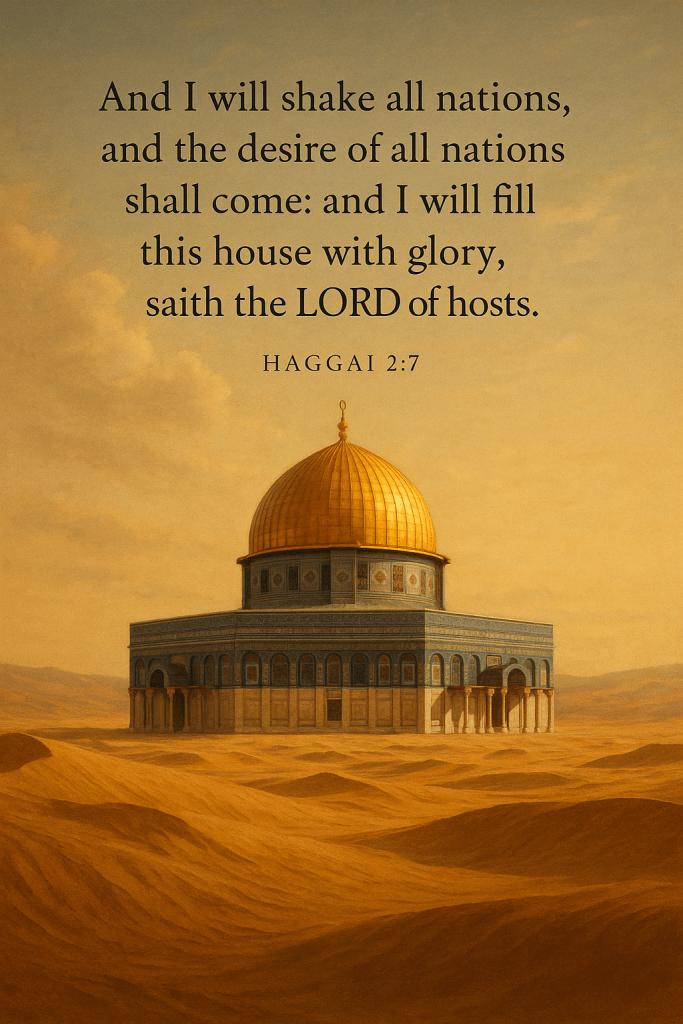
Haggai 2:7 and the Night Journey of the Prophet Muhammad ﷺ: An Islamic Reading
🌟 Introduction
Haggai 2:7 declares:
“And I will shake all nations, and the desire of all nations shall come: and I will fill this house with glory, saith the LORD of hosts.” (KJV)
From an Islamic perspective, this verse can be seen as an allusion to the Prophet Muhammad ﷺ and his Night Journey (al-Isrāʾ) to Jerusalem. The key lies in the Hebrew term חֶמְדָּה (ḥemdāh)—translated as “desire” or “delight”—which shares its root with the Arabic names Muhammad and Ahmad. ✨ Notably, the Hebrew word ḥemdāh is the feminine form of ḥemed, while the Arabic name Ahmad is another title of Muhammad ﷺ, prophesied by Jesus in Surah 61:6. This linguistic bridge offers a fascinating interfaith reflection on prophecy, sacred language, and divine promise.
⸻
🔤 The Hebrew Root ח מ ד (ḥ-m-d)
The root ḥ-m-d in Hebrew conveys desirability, preciousness, and belovedness. Several Hebrew words derive from it:
• 📖 ḥāmed (חָמֵד): “desirable” or “coveted”
• 📖 ḥemdāh (חֶמְדָּה): “delight” or “precious object” (appearing in Haggai 2:7)
• 📖 neḥmād (נֶחְמָד): “pleasant” or “lovely”
• 📖 maḥmād (מַחְמָד): “delight” or “desirable thing”
All of these share the same root idea of something beloved or longed for 💖.
⸻
🕌 “The Desire of All Nations Shall Come”
Haggai’s prophecy envisions a time when the house of God in Jerusalem will be filled with divine glory. For Muslims, this recalls the Prophet’s miraculous Night Journey (al-Isrāʾ), explicitly mentioned in the Qur’an:
“Exalted is He who took His Servant by night from al-Masjid al-Ḥarām to al-Masjid al-Aqṣā, whose surroundings We have blessed, to show him of Our signs. Indeed, He is the Hearing, the Seeing.” (Qur’an 17:1)
🌙 This verse establishes the link between the Prophet Muhammad ﷺ, Mecca, and Jerusalem. His presence at al-Masjid al-Aqṣā sanctified the site, bringing a moment of divine glory to the Temple Mount. Thus, Haggai’s vision of the “desire of all nations” entering God’s house can be interpreted as pointing to Muhammad ﷺ, whose Night Journey symbolically unites all prophets and all nations 🌍 in worship of the One God.
⸻
🔗 A Linguistic and Theological Bridge
The connection becomes clearer when Hebrew and Arabic are read side by side:
• ✡️ Hebrew: ḥemdāh → “delight” / “precious object”
• ✡️ Related forms: ḥāmed → “desirable,” neḥmād → “pleasant,” maḥmād → “delight”
• ☪️ Arabic: ḥ-m-d → Names Muhammad (“the praised one”) and Ahmad (“the most praiseworthy”)
The Qur’an itself records Jesus ✝️ foretelling the coming of a messenger named Ahmad:
“And [remember] when Jesus, the son of Mary, said, ‘O Children of Israel, indeed I am the messenger of Allah to you, confirming what came before me of the Torah and bringing good tidings of a messenger to come after me, whose name is Ahmad.’” (Qur’an 61:6)
In both languages, the root carries the idea of something or someone deeply desired, beloved, praised, and precious. 🌹
Theologically, the prophecy of nations being “shaken” 🌍⚡ aligns with Islam’s transformative impact on world history. Within a generation of Muhammad’s Night Journey, the message of Islam spread across nations, fulfilling the vision of divine glory filling God’s house 🕋.
⸻
⚖️ Limits and Interpretive Context
It is important to stress that this reading is an interpretive possibility rather than a universally held Islamic doctrine. Classical Muslim exegetes (mufassirūn) did not directly cite Haggai 2:7 as prophecy of the Night Journey. Rather, modern interfaith scholars and daʿwah perspectives highlight it as an example of linguistic and symbolic overlap between the Hebrew Bible and the Qurʾan.
⸻
✅ Conclusion
From an Islamic perspective, Haggai 2:7 can be read as an anticipation of the Prophet Muhammad’s Night Journey 🌙 to Jerusalem. The shared Semitic root ḥ-m-d links the Hebrew ḥemdāh (“desire, delight”) with the Arabic Muhammad (“praised one”) and Ahmad, while the verse’s imagery of nations shaken 🌍 and the house of God filled with glory ✨ aligns with Islam’s transformative impact on world history and resonates deeply with the Prophet’s presence at al-Masjid al-Aqṣā (Qur’an 17:1).
Coupled with Jesus’ announcement of Ahmad in Qur’an 61:6, this interpretation reflects the profound ways in which language, prophecy, and sacred history intertwine across the Abrahamic traditions ☪️✡️✝️.
Does the name of Muhammad appear in the Bible?
Some interpret Song of Solomon 5, verses 10 to 16, as a depiction of Muhammad using hyperbolic language. What is the comparative religious perspective on the argument regarding the manifestation of the name Muhammad in verse 16, expressed in the plural form as a sign of respect?
The Islamic perspective on the interpretation of Song of Solomon 5, verses 10 to 16, particularly verse 16, as a reference to the Prophet Muhammad stems from the claim that the Hebrew word “מַחֲמַדִּים”, found in this verse, is remarkably similar to the name Muhammad.
This word is translated into English as “altogether lovely,” “very pleasant,” or similar phrases, but some Muslims argue that it should be understood as a direct reference to Muhammad, given the phonetic similarity and the significance of the name.
In Islamic tradition, Muhammad is believed to be the final prophet sent by God to guide humanity, and his coming is interpreted by some Muslims as having been foretold in previous scriptures, including the Bible. The argument here hinges on the linguistic and phonetic connection between the Hebrew word in the text and the name Muhammad.
Proponents of this view argue that the use of “מַחֲמַדִּים” in the plural form is a stylistic or honorific form in Hebrew, used to convey respect or exaltation, rather than a literal plural. This is seen as analogous to how Arabic uses certain plural forms to denote honor or respect, rather than quantity.
The verses Song of Solomon 5, verses 10 to 16 read:
Verse 10: My beloved is white and ruddy,
Chief among ten thousand.
Verse 11: His head is like the finest gold;
his locks are wavy,
and black as a raven.
Verse 12: His eyes are like doves
by the rivers of waters,
washed with milk,
and fitly set.
Verse 13: His cheeks are like a bed of spices,
banks of scented herbs.
His lips are lilies,
Dripping liquid myrrh.
Verse 14: His hands are rods of gold
set with beryl.
His body is carved ivory
inlaid with sapphires.
Verse 15: His legs are pillars of marble
set on bases of fine gold.
His countenance is like Lebanon,
excellent as the cedars.
Verse 16: His mouth is most sweet,
yes, he is altogether, מַחֲמַדִּים (lovely).
This is my beloved,
and this is my friend,
O daughters of Jerusalem.
 ABRAHAMIC THEOLOGY