Azahari Hassim
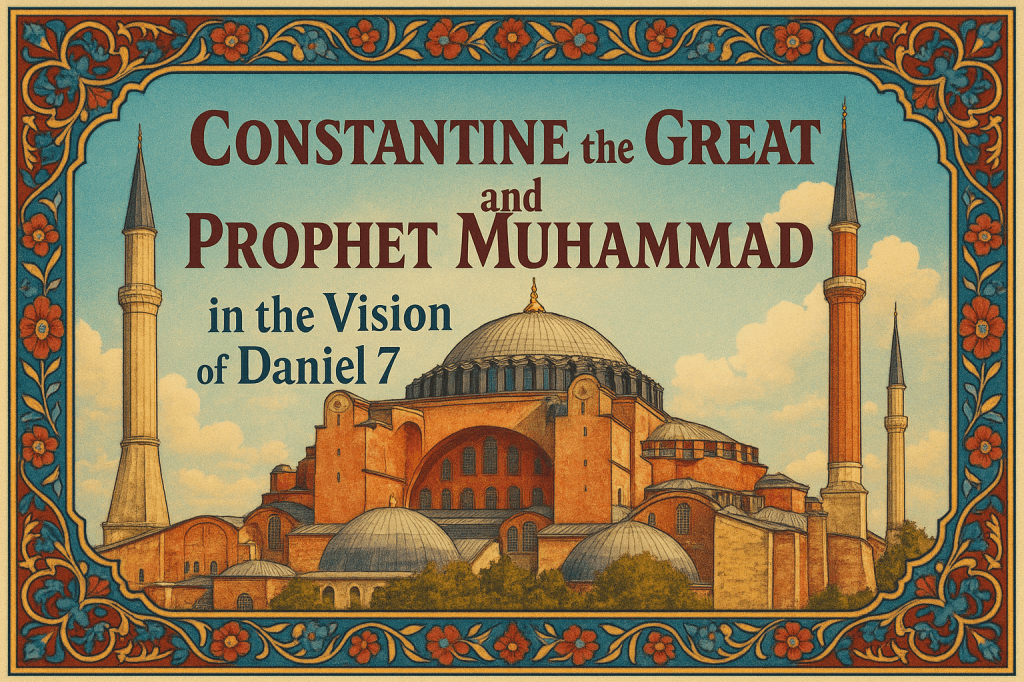
📜 Constantine the Great and Prophet Muhammad in the Vision of Daniel 7: An Alternative Interpretation
⸻
♦️ I. Introduction
The seventh chapter of the Book of Daniel has long captivated theologians, historians, and mystics alike. Within its apocalyptic imagery lies a vision of four beasts, a “little horn” that speaks arrogantly against God, and the appearance of the “Son of Man” coming with the clouds of heaven. Traditional Judeo-Christian interpretations identify the “little horn” with the Antichrist and the “Son of Man” with the Messiah—most often understood as Jesus Christ.
However, an alternative and highly controversial view, circulating among certain Islamic thinkers and independent researchers, proposes a radically different interpretation: that Daniel 7:25 alludes to Constantine the Great and the Council of Nicaea (325 CE), while Daniel 7:13 foreshadows Prophet Muhammad’s Night Journey (al-Isrāʾ wa al-Miʿrāj). Though not accepted by mainstream scholars, this perspective offers a striking counter-reading of history and prophecy.
⸻
♦️ II. Constantine the Great as the “Little Horn” (Daniel 7:25)
The verse in question declares:
“He shall speak pompous words against the Most High, shall persecute the saints of the Most High, and shall intend to change times and law.”
(Daniel 7:25)
Those who associate this verse with Constantine argue that it corresponds to his religious and political reforms that reshaped Christianity and the Roman world. They maintain that Constantine, though hailed as the first Christian emperor, altered the faith’s original teachings and merged political expedience with theology, giving rise to an imperial form of Christianity.
Proponents claim that:
- Changing “times and laws” refers to Constantine’s alteration of key religious observances.
• He replaced the Sabbath (Saturday) with Sunday worship, aligning Christian practice with the solar cult of Sol Invictus.
• He endorsed Easter in place of Passover, detaching Christianity from its Judaic roots. - Speaking “pompous words” symbolizes his role in defining divine doctrine.
• At the Council of Nicaea (325 CE), Constantine presided over theological debates that condemned Arianism—a movement denying the full divinity of Jesus—and established the Nicene Creed, proclaiming Christ as “of one substance with the Father.”
• Critics argue this moment marked the institutionalization of the Trinity, a concept absent from Jesus’ original message of pure monotheism. - Persecution of dissenters reflects Constantine’s suppression of alternative Christian sects.
• Those who refused to accept Nicene orthodoxy—particularly the Arians—were marginalized, exiled, or silenced, thereby consolidating a new orthodoxy under imperial control.
In this view, Constantine emerges as the “little horn” who rose from the fourth beast—the Roman Empire—changing divine law and redefining the spiritual calendar of the faithful.
⸻
♦️ III. Prophet Muhammad as the “Son of Man” (Daniel 7:13)
Daniel 7:13–14 describes a majestic vision:
“I saw in the night visions, and behold, one like the Son of Man came with the clouds of heaven, and came to the Ancient of Days (God), and they brought him near before Him. And there was given him dominion, and glory, and a kingdom, that all people, nations, and languages should serve him.”
(Daniel 7:13–14)
While Christians traditionally interpret this passage as a prophecy of Jesus Christ, some Muslim scholars draw intriguing parallels with Prophet Muhammad’s Night Journey (al-Isrāʾ wa al-Miʿrāj). They observe that Daniel’s vision occurs specifically “in the night”, which resonates with the Qur’anic account of the Prophet’s miraculous ascent to heaven from Jerusalem, guided by the angel Gabriel.
Key interpretive points include:
- “Night visions” correspond to the nocturnal nature of Muhammad’s ascension, as mentioned in Surah al-Isrāʾ (17:1) and Surah al-Najm (53:13–18).
• This event, which took place around 621 CE, is said to have culminated in the Prophet’s encounter with God (“the Ancient of Days”) and the conferral of divine authority. - “Coming with the clouds of heaven” symbolizes the Prophet’s heavenly journey, not as a divine being but as a chosen servant elevated by God.
• His ascent was not an act of self-deification but a manifestation of divine favor and revelation. - “Given dominion, glory, and a kingdom” reflects the universal scope of Islam, which emerged soon after as a civilization uniting diverse nations, languages, and peoples under one creed of monotheism (tawḥīd).
• The phrase “an everlasting dominion that shall not pass away” aligns with the Islamic belief that the message of Muhammad is final and enduring, sealing all previous revelations.
In this framework, Muhammad is not identified as a deity but as the final prophet, fulfilling the vision of a divine kingdom based on submission to the One God—a restoration of Abrahamic monotheism after its corruption in earlier traditions.
⸻
♦️ IV. Historical and Theological Implications
This interpretation views Daniel 7 as a prophetic drama depicting two pivotal moments in sacred history:
• The corruption of faith through Constantine’s imperial Christianity, symbolized by the little horn who changes divine law.
• The restoration of true monotheism through Muhammad’s mission, symbolized by the Son of Man who ascends to God in a night vision and is granted universal dominion.
Supporters argue that this reading reconciles the continuity of divine revelation across time, casting Islam not as a break from the biblical narrative but as its culmination.
It reframes Daniel’s prophecy as a chronicle of decline and renewal—from theological distortion to prophetic restoration.
⸻
♦️ V. Conclusion
Though controversial and rejected by mainstream Christian exegesis, the alternative interpretation of Daniel 7 provides a provocative interfaith lens. It depicts Constantine the Great as the agent who altered the message of Jesus and Prophet Muhammad as the divinely chosen messenger who restored it.
Seen this way, Daniel’s vision transcends time, linking the fall of a corrupted empire with the rise of a new spiritual order in Islam, which restored the principle of pure monotheism after centuries of distortion. Whether one accepts this interpretation or not, it highlights a profound truth shared by both scriptures—that divine sovereignty continues beyond the rise and fall of empires, and that ultimate authority belongs only to the Eternal God, “the Ancient of Days.”
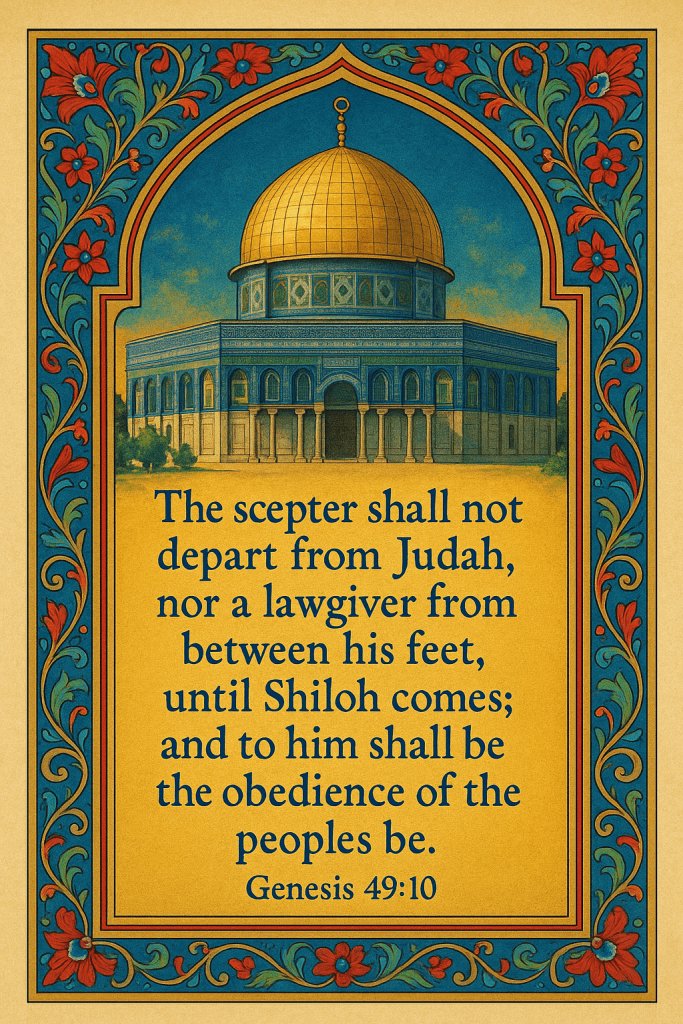
Until Shiloh Comes: The Transfer of Covenant from Sinai to Abraham through Ishmael
Introduction
🌟 Genesis 49:10 stands as one of the most profound prophecies in the Hebrew Bible, where Jacob’s blessing to Judah speaks of a mysterious figure called “Shiloh”. For centuries, both Jewish and Christian traditions have understood this verse as messianic, anticipating a redeemer from Judah’s lineage.
However, when examined through the wider lens of covenantal theology, this verse reveals a deeper transition — from the Sinai covenant, particular to Israel and bound by Mosaic law, to the Abrahamic covenant, universal in scope and ultimately fulfilled through Ishmael’s descendants.
This article explores how the prophecy of “Shiloh” may refer not to a ruler from Judah, but to a divinely appointed messenger from Ishmael’s descendants, through whom the Abrahamic faith reaches its completion and universality in the message of Islam.
This perspective recognizes that it was Ishmael, not Isaac, whom God commanded Abraham to offer in sacrifice — the supreme act of submission that sealed Abraham’s faith. This event, memorialized every year by Muslims in the festival of Eid al-Adha, signifies the enduring covenant through Ishmael’s line, culminating in the coming of Prophet Muhammad ﷺ, the promised Shiloh through whom divine guidance attained its universal form.
- The Context of Jacob’s Prophecy
In Genesis 49, Jacob gathers his twelve sons and speaks of their future destinies. Concerning Judah, he declares:
“The scepter shall not depart from Judah,
nor a lawgiver from between his feet,
until Shiloh comes;
and to him shall the obedience of the peoples be.”
(Genesis 49:10)
Traditionally, this prophecy has been interpreted as predicting Judah’s enduring leadership until the arrival of a messianic ruler. Yet a covenantal reading reveals that this marks not permanence but transition — from Judah’s temporal authority under the Sinai covenant to the restoration of the Abrahamic covenant through Ishmael, the son of sacrifice and obedience.
Several scholars believe that the word “until” in the verse indicates the time at which Judah’s authority ended.
Therefore, Shiloh (Messiah) does not descend from David’s lineage, which is traced back to Judah.
- The Scepter and Lawgiver: Symbols of the Sinai Covenant
The first half of the verse — “The scepter shall not depart from Judah, nor a lawgiver from between his feet” — symbolizes the religious and political authority vested in Judah.
The scepter represents kingship, embodied in David and his royal line.
The lawgiver refers to the Torah, the revealed law of Sinai that governed Israel’s covenantal life.
This Sinaitic covenant was conditional and particular, bound to a specific nation and land. It endured “until Shiloh came” — until divine authority passed to the heir of Abraham’s universal covenant through Ishmael.
- Shiloh and the Renewal of the Abrahamic Covenant through Ishmael
The word Shiloh carries meanings such as peace, rest, or he whose right it is. It thus designates the rightful inheritor of divine authority.
In the story of Abraham’s supreme test, as preserved in Islamic tradition, Ishmael is the son chosen for sacrifice — the act that confirmed both Abraham’s faith and Ishmael’s submission. In recognition of this, God renewed His promise:
“As for Ishmael, I have blessed him, and will make him fruitful, and will multiply him exceedingly; twelve princes shall he beget, and I will make him a great nation.”
(Genesis 17:20)
This promise is inseparable from the earlier Abrahamic benediction in Genesis 22:18:
“And in your seed shall all the nations of the earth be blessed, because you have obeyed My voice.”
From an Islamic perspective, this universal blessing reaches its perfection in Shiloh — the divinely appointed messenger from Ishmael’s descendants, Prophet Muhammad ﷺ, through whom the Abrahamic faith was universalized beyond lineage and territory.
- Shiloh as the Prophet from Ishmael’s Descendants
In the Islamic understanding, Shiloh points to Muhammad ﷺ, the final messenger and restorer of Abrahamic monotheism.
The scepter and lawgiver symbolize Judah’s rule under the Mosaic order, which lasted until Shiloh’s advent.
The arrival of Shiloh marks the transfer of divine covenant from a national to a universal dispensation.
The phrase “and to him shall the obedience of the peoples be” finds its fulfillment in the global ummah united in Islam.
Through Muhammad ﷺ, the two branches of Abraham’s family — Isaac and Ishmael — converge in spiritual unity, as the promise made on the mountain of sacrifice finds its universal realization.
This fulfills the Abrahamic prophecy of Genesis 22:18 — “in your seed shall all the nations of the earth be blessed” — echoed centuries later in the Qur’anic verse:
“And We have not sent you (O Muhammad) except as a mercy to all the worlds.”
(Surah 21:107)
The blessing to “all nations” in Genesis thus finds its full resonance in the Qur’an’s rahmah lil-‘ālamīn — mercy to the worlds.”
- The Living Memory of the Covenant: Eid al-Adha
The memory of Abraham’s near-sacrifice of Ishmael is not a forgotten legend. It is commemorated annually by Muslims worldwide in the sacred festival of Eid al-Adha (“The Feast of Sacrifice”).
Each year, millions of believers retrace Abraham’s obedience by offering sacrifices in remembrance of his willingness to surrender his beloved son at God’s command. This universal observance — transcending race, nation, and language — is the living embodiment of the Abrahamic covenant through Ishmael, reaffirming humanity’s submission (Islām) to the One God.
Through Eid al-Adha, the covenant of faith, obedience, and trust in divine will is renewed across generations — a perpetual testimony that the legacy of Abraham and Ishmael remains alive within the heart of the Muslim community.
- The Biblical and Qur’anic Continuity
The Qur’an reaffirms this covenantal unity:
“Were you witnesses when death approached Jacob, when he said to his sons:
‘What will you worship after me?’
They said: ‘We will worship your God, and the God of your fathers — Abraham, Ishmael, and Isaac — One God, and to Him we submit.’”
(Qur’an 2:133)
Here, Ishmael stands explicitly alongside Abraham and Isaac as a patriarch of covenantal faith, confirming that divine favor is not ethnic but spiritual — a continuity of submission to the Creator.
- The Transfer of Covenant and Authority
The New Testament, too, preserves a hint of this covenantal transition. Jesus proclaimed:
“And I say unto you, that many shall come from the east and west, and shall sit down with Abraham, Isaac, and Jacob in the kingdom of heaven.
But the children of the kingdom shall be cast out into outer darkness: there shall be weeping and gnashing of teeth.”
(Matthew 8:11–12)
This declaration signifies a divine realignment of covenantal authority. The “children of the kingdom” — those who claimed exclusive descent from Israel — would lose their privileged position, while “many from the east and west” would inherit the covenantal blessings by embracing the faith of Abraham.
From an Islamic perspective, this imagery points to the emergence of a new spiritual community beyond ethnic or national boundaries — the ummah of Islam — gathered from all directions of the earth. It is this global assembly of believers, united in the submission (Islām) that characterized Abraham himself, who truly “sit with Abraham” in the renewed Kingdom of Heaven.
In the Abrahamic continuum, this renewal is realized through Ishmael’s descendants, led by Muhammad ﷺ, the promised Shiloh, through whom the covenant finds its universal completion. Thus, the “Kingdom of Heaven” in Jesus’ saying can be seen as the restored Abrahamic faith of submission, embodied and perfected in Islam.
- From Sinai to Mecca: The Completion of the Covenant
The geography of revelation reflects this sacred progression:
From Mount Sinai, where the Law was given to Moses;
To Mount Zion, where David ruled over Israel;
To the Sanctuary of Mecca, where Muhammad ﷺ restored the House of Abraham.
Thus, revelation moves from law to faith, from tribe to humanity, from Sinai to Mecca. The coming of Shiloh from Ishmael’s line fulfills the Abrahamic promise in its universal form, making Islam the completion of the covenant’s long journey — the very fulfillment of Genesis 22:18 and Surah 21:107 united in one divine truth.
- Conclusion
Genesis 49:10 encapsulates the divine drama of covenantal history — the passing of the scepter of revelation from Judah’s temporal rule to Ishmael’s enduring spiritual lineage.
For the Jews, Shiloh remains the awaited Messiah.
For Christians, he prefigures Christ.
But for Muslims, he is Muhammad ﷺ — the promised Shiloh, the Seal of Prophethood, and the descendant of Ishmael, whose submission on the altar of sacrifice became the symbol of perfect faith.
Every year, the world’s Muslim community renews this covenant through Eid al-Adha, keeping alive the memory of Abraham’s trial and Ishmael’s obedience. Through that living tradition, the promise of Genesis 22:18 — “in your seed shall all the nations of the earth be blessed” — finds its full realization in the Qur’an’s affirmation:
“And We have not sent you (O Muhammad) except as a mercy to all the worlds.”
(Surah 21:107)
Thus, the Abrahamic covenant, universalized through Ishmael and fulfilled in Muhammad ﷺ, stands as the enduring testament that divine mercy, guidance, and covenantal blessing belong to all humankind.
📜 Muhammad Mythicism: Origins, Arguments, and Scholarly Responses
❇️ Abstract:
Muhammad mythicism—the claim that the Prophet Muhammad did not exist as a historical person—has emerged in recent decades from both ideological and revisionist impulses. While it draws on broader skepticism toward early Islamic historiography, it remains largely outside peer-reviewed academic scholarship. This article outlines the development of Muhammad mythicism, evaluates its central arguments, and highlights the scholarly consensus affirming Muhammad’s historicity based on a range of converging evidences.
⸻
♦️1. Introduction
The figure of the Prophet Muhammad stands at the foundation of Islam, yet a small but vocal movement questions whether he existed at all. This position, known as Muhammad mythicism, has garnered attention in popular circles, particularly since the early 2000s. Although often perceived as a new phenomenon, its roots can be traced back to a largely forgotten Soviet Marxist tradition. Today, its proponents include figures such as Yehuda Navo, Judith Corin, the Inara school, Johannes Jantzen, and Robert Spencer. Despite its public appeal, Muhammad mythicism is virtually absent from mainstream academic discourse.
⸻
♦️2. Historical Development of Muhammad Mythicism
Muhammad mythicism has two distinct phases:
• Soviet Marxist Origins: Early expressions of Muhammad mythicism appeared within the context of Soviet ideology, where religion was broadly critiqued as a socio-economic construct. These views, however, did not significantly impact Western scholarship.
• Western Revival (2000s–present): A more developed form of mythicism emerged in the early 21st century, influenced by broader skepticism towards early Islamic historiography. This revival coincided with an increase in revisionist approaches to the study of Islam’s origins, though mythicism remains a fringe position even within revisionism.
⸻
♦️3. Core Arguments of Muhammad Mythicism
3.1. Argument from Silence
Mythicists often argue that early sources fail to mention Muhammad explicitly, implying he was invented later. However, this is contradicted by a growing body of early non-Muslim sources, coins, and inscriptions that reference Muhammad or closely associated events within a few decades of his death. Scholars also note that earlier strata of Islamic reports can often be reconstructed through isnāds (chains of transmission), preserving information from a relatively early period.
3.2. “Muhammad” as a Title
Another mythicist argument claims that “Muhammad” originally functioned as a title for Jesus, rather than a personal name. This interpretation fails linguistically and contextually. In both Quranic passages and early inscriptions, “Muhammad” appears as the definite subject in nominal sentences—a syntactic structure indicating a proper name. Additionally, non-Arabic sources transliterate the name, a treatment typically reserved for personal names, not titles. Historical evidence also shows “Muhammad” was already in use as a personal name decades prior to the earliest known inscriptions bearing the name.
3.3. Geographical Discrepancies – The Petra Thesis
Some mythicists propose that early Islam originated not in Mecca but in Petra, based on perceived discrepancies in geographical descriptions. However, early non-Muslim sources that would have known of Petra provide no such indication. Furthermore, Islamic tradition preserves no memory of a shift in the sanctuary’s location, which would be an unlikely omission had such a move occurred. Scholars widely consider this thesis speculative and unsupported.
⸻
♦️4. Scholarly Consensus on Muhammad’s Historicity
Despite justified caution regarding the reliability of many early Islamic sources, most scholars maintain that a historical Muhammad did exist. This position is supported by several key lines of evidence.
4.1. Corroboration from Non-Muslim Sources
One of the most compelling pieces of evidence comes from an Armenian chronicle dated around 660 CE—approximately 30 years after Muhammad’s death. It summarizes Muhammad’s career in terms that largely match the traditional Islamic narrative. The source is widely accepted as authentic and undermines claims of late fabrication or interpolation.
4.2. Chronological and Political Frameworks
Coins, inscriptions, and non-Muslim writings from the 7th century corroborate the chronological and political framework of Islamic history as preserved in Islamic tradition. These external sources reinforce the notion that key elements of early Islam, including its leadership structures and expansionist policies, were in place soon after Muhammad’s supposed lifetime.
4.3. Reliability of Genealogical Traditions
The detailed genealogical data found in early Islamic sources, particularly regarding Arabian tribes, has been partially verified through inscriptions and is considered largely accurate. Muhammad’s lineage, for example, fits within this broader genealogical framework, further affirming his historical reality.
4.4. Inter-Regional Consistency and the Criterion of Dissimilarity
Early Islamic centers—Medina, Kufa, Basra, and Syria—independently preserved traditions about Muhammad that align on basic facts, including his name, his marriage to Khadijah, and his tribal affiliation with the Banu Hashim. Importantly, some of this information contradicts the interests of powerful factions (e.g., the Umayyads), suggesting it was inherited and widely accepted rather than fabricated. This aligns with the criterion of dissimilarity, often used in historical Jesus studies, which holds that information unlikely to have been invented for polemical reasons is more likely to be authentic.
⸻
♦️5. Conclusion
While Muhammad mythicism has gained some popularity in certain online and ideological circles, it lacks serious support in academic scholarship. The weight of evidence—from early non-Muslim testimony, material culture, internal consistency across regions, and linguistic and genealogical data—strongly supports the conclusion that Muhammad was a real historical figure. The study of ancient figures frequently presents challenges in establishing historical certainty. Nevertheless, the most credible interpretation of the available evidence indicates that a Prophet Muhammad did exist in 7th-century Arabia.
 ABRAHAMIC THEOLOGY