Azahari Hassim

✦ The Eschatological Supremacy of Jesus in Islam: Greater than the Mahdi ✦
⸻
In Islamic eschatology, both Jesus and the Imam Mahdi are central figures expected to appear in the end times. However, their roles differ significantly in scope and theological significance. While the Mahdi is recognized as a righteous leader who will restore justice and guide the Muslim ummah, Jesus occupies a uniquely exalted status as the divinely appointed Messiah who will:
➤ Defeat the Antichrist (al-Masīḥ ad-Dajjāl)
➤ Overcome Gog and Magog (Yaʾjuj wa Maʾjuj)
➤ Affirm the final truth of Islam
The narrative affirms that Jesus’s return is more pivotal than that of the Mahdi, as he bears the universal mission of completing God’s plan on earth.
⸻
❖ Jesus: The True Messiah and Divine Appointee ❖
According to the Qur’an and Hadith, Jesus was neither killed nor crucified, but was raised up to God and will return at the end of time:
“They did not kill him, nor did they crucify him, but it was made to appear so to them…”
(Surah An-Nisā’ 4:157)
✧ His second coming is not to bring a new religion but to vindicate the original message of tawḥid (monotheism), which was later distorted by his followers.
✧ In Islamic belief, Jesus will return as a follower of Muhammad’s sharīʿah, correcting Christian doctrines and uniting humanity under Islam.
Most significantly, Jesus will personally slay the Dajjāl, a feat that not even the Mahdi is capable of accomplishing:
“It will be at this very time that Allah will send Christ, son of Mary, and he will descend… He will search for him (Dajjāl) until he catches hold of him and kills him at the gate of Ludd.”
(Ṣaḥīḥ Muslim 2937)
✔ This act highlights Jesus’s supreme authority in the eschatological timeline and reaffirms his title as al-Masīḥ, the True Messiah—in contrast to the false messiah (al-Masīḥ ad-Dajjāl).
⸻
❖ The Mahdi: The Guided Leader ❖
The Imam Mahdi is described in Islamic traditions as a descendant of the Prophet Muhammad ﷺ. He will:
➤ Appear before the return of Jesus
➤ Lead the Muslim community
➤ Establish justice and equity
➤ Prepare the world for Christ’s descent
⚑ However, the Mahdi is a temporal leader, not a prophet, and his role is subordinate to that of Jesus.
When Jesus descends, he will defer to the Mahdi’s leadership in prayer:
“The Mahdi will ask Jesus to lead the prayer, but Jesus will decline, saying: ‘The iqāmah was made for you, so lead the prayer.’”
(Musnad Aḥmad; supported by Abū Dāwūd and others)
✦ This gesture is not inferiority, but humility. Jesus’s greater role lies in:
• Correcting Christian misbeliefs
• Breaking the cross
• Killing the swine
• Abolishing the jizyah
These acts symbolize the end of religious division and the triumph of pure monotheism.
⸻
❖ Jesus and the Defeat of Gog and Magog ❖
Another mission exclusive to Jesus is his confrontation with Gog and Magog (Yaʾjuj wa Maʾjuj)—chaotic forces unleashed after the Dajjāl’s defeat.
⚑ Neither the Mahdi nor anyone else on earth will be able to resist them.
⚑ Jesus will lead the believers in refuge and supplicate to God.
⚑ Divine intervention will annihilate them:
“Then Jesus and his companions will be besieged… until Allah will send worms that attack the necks of Gog and Magog, and they will die en masse.”
(Ṣaḥīḥ Muslim 2937)
✔ This reveals God’s direct support for Jesus and underscores his unique eschatological authority.
⸻
✦ Summary of Jesus’s Supreme Role ✦
In the grand narrative of Islamic eschatology:
➤ The Mahdi restores justice and unity as Caliph.
➤ But Jesus fulfills the highest divine mission:
✧ He destroys the Antichrist
✧ He corrects doctrinal errors and affirms Islam
✧ He leads the final confrontation with Gog and Magog
✧ He ushers in a period of global peace before the world’s end
⸻
❖ Conclusion ❖
Thus, Jesus is not merely a returning prophet; he is the seal of eschatological fulfillment, divinely appointed to complete what began with Abraham and culminated in Muhammad ﷺ.
His return signals the climax of human history, where truth triumphs over falsehood and all deviations in belief are rectified.
The Qur’an alludes to this in Surah Az-Zukhruf (43:61):
وَإِنَّهُ لَعِلْمٌ لِّلسَّاعَةِ فَلَا تَمْتَرُنَّ بِهَا وَاتَّبِعُونِ ۚ هَـٰذَا صِرَاطٌ مُّسْتَقِيمٌ
“And indeed, he [Jesus] will be a sign for the Hour, so do not doubt it, and follow Me. This is a straight path.”
✦ By defeating the Antichrist, overcoming Gog and Magog, and affirming the finality of the Muhammadan message, Jesus validates the universality and supremacy of Islam.
❖ His return fulfills the eschatological hope of divine justice, the unification of belief, and the final proof of God’s truth to all mankind. ❖

Dajjal on the Throne of Solomon: A Subtle Revelation in Surah Ṣād
📖 Introduction
In Islamic eschatology, some argue that Dajjal, the great deceiver of the end times, is not mentioned explicitly in the Qur’an.
Yet, a closer look at Surah Ṣād (38:34–35) uncovers a symbolic but profound clue—a body placed on the throne of Prophet Solomon (Sulayman عليه السلام).
Some scholars view this as a foreshadowing of Dajjal himself—the impostor king awaited by many in the Jewish tradition as the Messiah ben David.
⸻
📜 The Qur’anic Verses
“And We certainly tested Solomon, and placed upon his throne a body; then he turned in repentance (to Allah).”
He said, ‘My Lord, forgive me and grant me a kingdom that will never be possessed by anyone after me. Indeed, You are the Bestower.’” (38:34–35)
🔑 The word jasad (جَسَدًا) means a body without a soul—an artificial or hollow form.
Classical scholars debated whether this was Solomon’s child or a devil, but modern eschatologists interpret it as a symbolic appearance of Dajjal.
⸻
👤 Dajjal as the “Body” on the Throne
1️⃣ A False Usurper
The jasad represents something incomplete, mimicking the form of true kingship but lacking the spirit of divine authority.
This aligns with hadith descriptions of Dajjal as:
• An imitator of the prophets
• A miracle-forger
• A false god-claimant
Placed on Solomon’s throne, it is as though Dajjal posed as the rightful ruler—but was in reality, the ultimate fraud.
⸻
2️⃣ Solomon’s Strategic Prayer
After seeing this, Solomon prayed:
“Grant me a kingdom that will never be possessed by anyone after me.”
⚠️ Why ask for a kingdom that cannot be duplicated?
Because he had just witnessed a terrifying imitation—an impostor who nearly seized his throne.
This was not an ordinary political loss, but a prophetic preview of the end-times deception.
⸻
👑 Dajjal & the “Son of David” Concept
🕍 1. The Jewish Messianic Expectation
Jewish tradition speaks of Messiah ben David, a king who will:
• Restore Israel’s kingdom
• Rule the entire world
• Rebuild the Temple of Solomon
However, Islam teaches that the true Messiah is Jesus (ʿĪsā عليه السلام)—not the political “Son of David” awaited by many Jews today.
⸻
❌ 2. The False Messiah
Hadiths describe Dajjal as al-Masīḥ ad-Dajjāl—the False Messiah—because he will claim to be the promised savior.
This makes it highly probable that the political Messiah awaited by many Jews is Dajjal himself.
⸻
📚 Perspectives from Islamic Scholarship
Classical Tafsīr:
• al-Ṭabarī & al-Qurṭubī: Jasad was either Solomon’s son or a jinn impersonator.
Modern Eschatology:
• Sheikh Imran N. Hosein: Jasad symbolizes Dajjal’s early manifestation—a rehearsal of the final deception in the end times.
⸻
🧩 Conclusion: The Qur’an’s Hidden Warning
Surah Ṣād 38:34–35 is not merely a story of Solomon’s trial—it is a layered allegory pointing to Dajjal as:
• An imitator of divine kingship
• A symbol of end-time deception
• A prophetic warning hidden in symbolic language
📢 The Qur’an does mention Dajjal—but in a veiled form, shown to Solomon and rejected through his prayer.
⸻
“Indeed, this is a reminder; so whoever wills—let him take a path to his Lord.” (76:29)
⸻
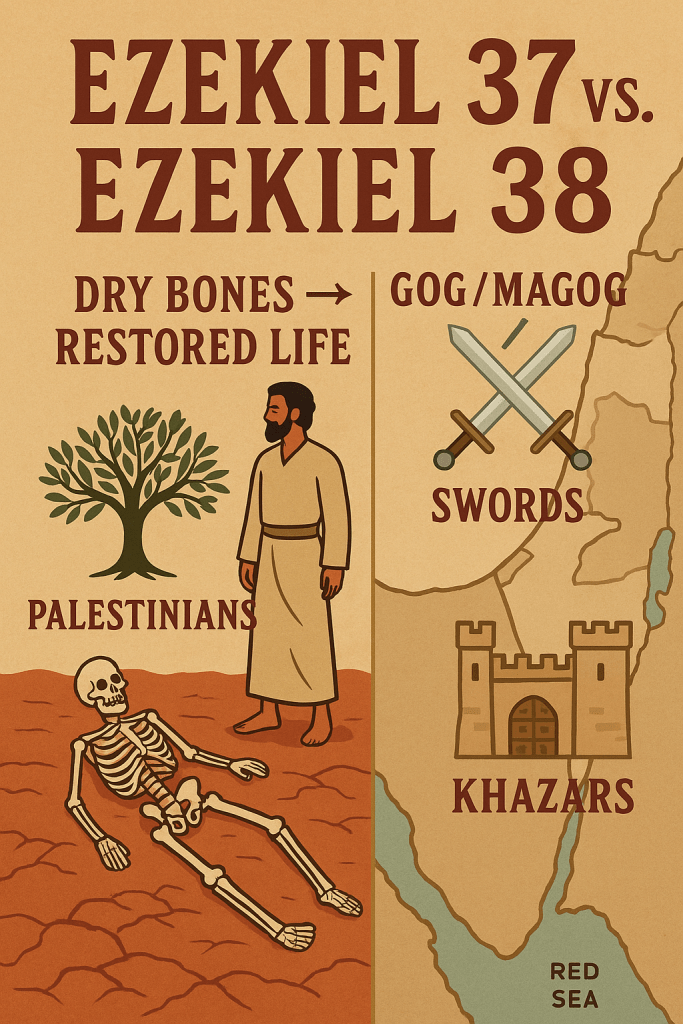
Ezekiel’s Prophecies, the Khazar Hypothesis, and Ben-Gurion’s Paradox of Ancestry
Ezekiel’s Prophecies, the Khazar Hypothesis, and Ben-Gurion’s Paradox of Ancestry ✡️☪️✝️
Introduction 📜
The establishment of the modern State of Israel in 1948 has often been framed as the fulfillment of biblical prophecy. Many point to Ezekiel 37—the “valley of dry bones”—as the divine foretelling of Israel’s national resurrection. Yet competing perspectives challenge this narrative. Some scholars argue that the prophecy of Ezekiel 37 remains unfulfilled and that the events surrounding the modern state may instead align with Ezekiel 38–39, where Gog and Magog ⚔️ rise against the land. This interpretive debate is further complicated by the Khazar hypothesis 🏹 regarding Ashkenazi origins and by a paradoxical statement from David Ben-Gurion 🇮🇱, Israel’s first Prime Minister, who acknowledged that many Palestinians may be direct descendants of the ancient Jews.
⸻
The Khazar Hypothesis and Ashkenazi Identity 🏰✡️
The “Khazar hypothesis” proposes that Ashkenazi Jews largely descend from the Khazars, a Turkic people whose ruling class converted to Judaism in the 8th–9th centuries. While contested and not universally accepted, this theory has influenced theological interpretations, especially among those who question the legitimacy of modern Zionism in biblical terms.
If modern Ashkenazim descend primarily from converts rather than the exiled tribes of Israel, then the biblical framework of “return” to the land becomes less clear. Critics argue that in such a scenario, the establishment of Israel would not represent Ezekiel’s vision of restored Israel, but rather a foreign incursion ⚔️ upon it.
⸻
Ezekiel 37: The Vision of Restoration 🌄✡️
Ezekiel 37 presents a powerful vision of dry bones coming to life 💀➡️🌱, symbolizing not only physical restoration to the land but also spiritual renewal:
“I will put My Spirit in you, and you shall live, and I will place you in your own land” (Ezek. 37:14).
Proponents of Zionism often point to Israel’s rebirth after the Holocaust 🕯️ as a miraculous fulfillment of this passage. Yet critics note that the modern state is largely secular and political, lacking the covenantal transformation envisioned in the text. For them, the true restoration of Israel described by Ezekiel 37 has not yet taken place ⏳.
⸻
Ezekiel 38–39: Gog and Magog in the Holy Land ⚔️🌍
Ezekiel 38–39 describes the invasion of the holy land by Gog of Magog and his allies, leading to a climactic confrontation in which God Himself intervenes ✡️🔥.
Some interpreters argue that modern Israel, rather than fulfilling Ezekiel 37, fits more closely with this apocalyptic scenario (Ezekiel 38–39 )📖. By this reasoning, the presence of Khazar-descended Jews 🏹 in the land could correspond to the role of Gog and Magog—outsiders whose settlement sparks the eschatological conflict.
⸻
Ben-Gurion’s Paradox: Palestinians as Descendants of Ancient Jews 🌿☪️
David Ben-Gurion himself complicated the Zionist narrative. He acknowledged the belief that many Palestinians 🇵🇸 were descendants of the ancient Jews who had remained in the land after the Roman expulsions of 70 CE and 135 CE. Over time, these communities converted—first to Christianity ✝️ and later to Islam ☪️—while retaining cultural and agricultural continuities with their ancestors.
Ben-Gurion’s rationale rested on several perspectives:
1. Historical Continuity 🕰️: Not all Jews were exiled; many remained and gradually assimilated into the local population.
2. Sociological Evidence 🌾: Palestinian fellahin (peasants) preserved agricultural practices and customs resembling those of ancient Israelites.
3. Ideological Reflection 💭: If Palestinians were indeed descendants of ancient Jews, then the paradox arises that those seen as “strangers” by Zionism might actually be the truer heirs 🌿✡️ of the land promised in scripture.
⸻
Theological and Political Implications ⚖️
This paradox destabilizes the neat narrative of prophecy fulfillment. If Ashkenazim are linked to Khazars 🏹, while Palestinians carry Israelite ancestry 🌿, then the lines between “restoration” and “intrusion” blur.
Ezekiel 37 may then point toward a future yet to come ⏳—a spiritual return of covenant fidelity—while Ezekiel 38–39 foreshadows the current geopolitical struggle involving outsiders in the land.
⸻
Conclusion 🔍
The convergence of the Khazar hypothesis 🏹, Ezekiel’s prophecy 📖, and Ben-Gurion’s reflections 🇮🇱 highlights the complexities of modern Israel’s identity.
Is the state a fulfillment of the valley of dry bones 💀➡️🌱, or is it the stage for Gog and Magog ⚔️🌍? Is the true Israelite heritage found in the Jewish immigrants of Europe ✡️, or in the Palestinians ☪️🌿 who never left the land?
These questions reveal not only theological tensions but also the paradox at the heart of Israel’s national story: prophecy, history, and identity remain contested and unresolved 🔄.

📜 The Kuzari: The Khazar King’s Conversion and Yehudah Halevi’s Philosophical Masterpiece
👑 The King and Nobles of the Khazar Kingdom embraced Judaism — a story preserved in the book “Kuzari”, written by the Jewish scholar ✍️ Yehudah Halevi. The Kuzari stands as a profound apologetic defense of Judaism and a critique of its Abrahamic counterparts—Christianity and Islam.
🧑⚕️ Yehudah Halevi, who lived in the 11th–12th centuries, was famous as a philosopher, doctor, and poet from Spain 🇪🇸. His masterpiece, Kuzari, is considered a profound work of literature 📜.
In 1140 CE, he left Spain and embarked on a dangerous journey to Israel 🇮🇱. It remains uncertain whether he actually reached his destination.
📖 The book consists of five parts and is presented in the form of a dialogue 💬 between a pagan Khazar king 👑 and a Jewish sage ✡️, who was invited to explain the Jewish faith. It also compares Judaism with Christianity ✝️ and Islam ☪️.
Originally written in Arabic, it was later translated into Hebrew ✡️📖 and many other languages. The work is regarded as one of the most important apologetic writings in Jewish philosophy, while Halevi is also renowned for his poetry 🕊️ that reflects his love for Israel.
✨ The Kuzari tells the story of how the Khazar king and his nobles converted to Judaism. The book presents a conversation in which the king investigates religious truths from the three Abrahamic faiths: Judaism, Christianity, and Islam.
🌙 According to the Kuzari:
• The King of the Khazars 👑 had a disturbing dream 😴⚡ that made him question his faith.
• He invited representatives of the three great religions — Islam ☪️, Christianity ✝️, and Judaism ✡️ — to explain their beliefs.
• After listening carefully, the king was most convinced by the Jewish sage ✡️📖.
• He and his nobles embraced Judaism 🙌✡️, shaping the spiritual path of the kingdom.
📚 Through this tale, Halevi sought to defend Judaism and critique other religions, especially Christianity ✝️ and Islam ☪️.
💎 Kuzari is deeply respected in Jewish tradition ✡️ and is considered one of the classics of Jewish philosophy 🕎. Even though its historical accuracy is debated 🤔, the story has had a lasting influence 🌍 on Jewish thought and on the study of Khazar history 🏰.
Gog and Magog: Their Religion and Obsession with the “Town”
The figures of Gog and Magog—known in Islamic tradition as Yajuj and Majuj—are shrouded in apocalyptic mystery across Abrahamic religions. While the Quran and Hadith literature provide limited but evocative details about them, interpretations and speculation abound. Among these is the idea that Gog and Magog may adhere to the Jewish faith and harbor a fixation on the Holy Land, especially the city of Jerusalem.
Quranic Reference and the “Town”
In Surah 21, verse 95, the Quran states:
“And there is a ban upon [the people of] a town which We destroyed: they shall not return.
Until, when Gog and Magog are let loose, and they swarm down from every mound.”
This verse has been interpreted by some exegetes and commentators to refer to Jerusalem, the “town” whose destruction and the divine decree against its reentry become symbolically significant. In this context, the town becomes central to eschatological narratives, particularly involving Gog and Magog. Their emergence is linked to the end of days and the unfolding of divine justice on earth.
Who Are Gog and Magog?
In both Islamic and Judeo-Christian texts, Gog and Magog are described as tribes or peoples of great power and corruption. In the Quran (Surah 18, verses 94 to 99), they are described as causing “mischief in the land” and being temporarily sealed off by the righteous ruler Dhul-Qarnayn, only to break free near the end of time.
In the Islamic eschatological view, their release marks a cataclysmic moment in human history—one of chaos, global strife, and ultimately, divine intervention.
The Theory: Adherents of the Jewish Faith?
One theory proposed by some interpreters and observers is that Gog and Magog might be associated with the Jewish faith. This theory is not explicitly supported by classical Islamic texts, but it arises from certain geopolitical and scriptural readings. The idea hinges on their supposed obsession with the Holy Land, particularly Jerusalem—a city central to Jewish theology, identity, and eschatology.
According to this view, the reference in Surah 21, verse 95 to a town (Jerusalem) and a divine prohibition on return could be indirectly linked to the movements or aspirations of Gog and Magog. Their “obsession” with the land may be interpreted as a reflection of a deeper theological or historical attachment, possibly rooted in Jewish claims to the area.
However, this view remains speculative and is not universally accepted. Many Islamic scholars argue that Gog and Magog are not to be identified with any specific religious group but rather represent a corrupt and destructive force, devoid of spiritual alignment and indifferent to divine guidance.
Symbolism vs. Literalism
The Quranic and Hadith portrayals of Yajuj and Majuj allow room for symbolic interpretation. Rather than focusing solely on their ethnic or religious identity, many scholars emphasize their role in divine narrative: as signs of the approaching Day of Judgment, their release into the world serves as a stark reminder of human vulnerability, the limits of power, and the necessity of divine guidance.
Thus, whether or not they adhere to a specific religion, the deeper message lies in what their emergence represents—chaos preceding divine order, falsehood before the triumph of truth.
Conclusion
While some theorists suggest that Gog and Magog may follow the Jewish faith and possess an enduring obsession with the Holy Land—particularly Jerusalem—Islamic scripture provides little direct support for such claims. Surah 21, verse 95 does refer to a town whose people are barred from return, and this is often interpreted to mean Jerusalem. Yet, the identities and motives of Gog and Magog remain deliberately vague, serving more as eschatological signs than as historical actors.
As with many elements of apocalyptic literature, the role of Gog and Magog ultimately points beyond themselves—to the divine plan, the coming of the final hour, and the unfolding of cosmic justice.
 ABRAHAMIC THEOLOGY