Azahari Hassim
Isaac: A Son of Joy, Not Sacrifice — Rethinking the Identity of the Sacrificial Son
The story of Abraham’s willingness to sacrifice his son is one of the most profound and contested episodes in the Abrahamic traditions. While the Hebrew Bible clearly names Isaac as the intended sacrifice, Islamic tradition maintains that it was Ishmael. In recent years, some scholars and believers have revisited the linguistic, theological, and contextual clues surrounding the narrative. A compelling argument centers around the meaning and role of Isaac’s name, suggesting that Isaac’s very identity may indicate he was never meant to be the sacrificial son.
The Meaning of Isaac’s Name
The name Isaac (Hebrew: Yitzḥaq, meaning “he will laugh” or “laughter”) is deeply tied to the emotional response of Abraham and Sarah upon hearing the divine promise that they would have a child in their old age (Genesis 17:17, 18:12). This laughter reflects astonishment, joy, and divine mercy—emphasizing the miraculous and comforting nature of Isaac’s birth. The child represents the culmination of a divine promise and the joy of old age, rather than a figure marked for trial and sacrifice.
Isaac as a Symbol of Fulfillment and Closure
From this perspective, Isaac is seen not as a son of trial, but as a gift of consolation—the final chapter in the long journey of Abraham and Sarah. His birth occurs after decades of wandering, waiting, and testing. His role in the narrative is one of continuation, legacy, and divine reward, not intense sacrifice. The Biblical text even notes that Abraham was 100 years old and Sarah 90 when Isaac was born—a clear emphasis on grace and joy rather than hardship and testing.
Ishmael as the Son of Trial
In contrast, Ishmael—Abraham’s firstborn by Hagar—is born amid tension, struggle, and uncertainty. According to both Islamic and Biblical narratives, he and his mother were sent away into the wilderness. In the Islamic tradition, this is framed as part of a divine plan, with Ishmael becoming the ancestor of a great nation and a prophet in his own right. Importantly, Islamic scripture (Qur’an 37:99–113) narrates the near-sacrifice without naming the son, but contextual clues suggest it refers to Ishmael, since the announcement of Isaac’s birth follows after the sacrifice episode.
Linguistic and Narrative Inference
The sequence of events in the Qur’an is particularly telling:
“So We gave him the good news of a forbearing son… And when he reached the age of striving, he said: ‘O my son! I have seen in a dream that I am sacrificing you…’” (Qur’an 37:101–102)
This is followed later by:
“And We gave him good news of Isaac, a prophet from among the righteous.” (Qur’an 37:112)
This sequence supports the interpretation that the son being sacrificed was not Isaac, but someone before him—namely, Ishmael. Moreover, this interpretation aligns with a thematic reading: Ishmael is the son through whom Abraham is first tested, while Isaac is the son through whom Abraham is blessed.
Pre-Islamic Arab Tradition
Arab oral traditions preceding Islam also reflect the belief that Ishmael was the son nearly sacrificed. This belief was deeply rooted in the collective memory of the Arab people and manifested in religious rituals such as Eid al-Adha and the Sa’i—the reenactment of Hagar’s search for water. These practices are tied to Ishmael, not Isaac, further reinforcing his role as the son of trial.
Conclusion
While the Biblical tradition names Isaac as the sacrificial son, both linguistic and theological reflections open space for rethinking this assumption. The joyful connotation of Isaac’s name, the sequence of Qur’anic verses, and longstanding Arab traditions all support the idea that Isaac was not the son marked for sacrifice, but rather a son of comfort and reward.
In contrast, Ishmael bears the marks of trial, testing, and divine submission—characteristics that align more directly with the sacrificial narrative. This perspective invites a deeper, more nuanced understanding of Abraham’s legacy and the roles of his two sons in the shared heritage of monotheism.
Ishmael: The Rightful Heir of the Abrahamic Covenant – Revisiting Biblical Circumcision and Lineage
The Abrahamic covenant stands as a foundational pillar in the sacred histories of Judaism, Christianity, and Islam. Central to this covenant is the rite of circumcision, instituted by God as a binding sign between Himself and Abraham’s descendants. Traditionally, Jewish and Christian interpretations assert that Isaac, the son born to Abraham and Sarah, is the rightful heir through whom this covenant is fulfilled.
However, a careful reexamination of the biblical chronology challenges this assumption. This article argues that Ishmael, not Isaac, was the first and only son to receive the covenantal sign alongside Abraham himself—prior to Isaac’s birth—thereby establishing Ishmael as the sole and true heir of the original Abrahamic covenant. By exploring the timing, recipients, and implications of circumcision in Genesis 17 and 21, this piece invites readers to reconsider long-held views and appreciate the overlooked centrality of Ishmael in the divine covenant.
- The Biblical Basis for Circumcision as a Covenant
The Bible establishes circumcision as the sign of the covenant between God and Abraham:
“Then God said to Abraham, ‘As for you, you must keep my covenant, you and your descendants after you for the generations to come. This is my covenant with you and your descendants after you, the covenant you are to keep: Every male among you shall be circumcised… it will be the sign of the covenant between me and you.’”
Genesis 17:9–11
Here, circumcision is the definitive sign of the Abrahamic covenant.
- The Timing of Circumcision Before Isaac’s Birth
The Bible affirms that circumcision was performed before Isaac was born:
“On that very day Abraham took his son Ishmael and all those born in his household or bought with his money, every male in his household, and circumcised them, as God told him… Abraham was ninety-nine years old when he was circumcised, and his son Ishmael was thirteen.”
At this critical juncture, only Abraham and Ishmael were Abraham’s natural descendants to receive the sign of the covenant. Isaac had not yet been born.
- Ishmael as the Sole and True Heir of the Abrahamic Covenant
This sequence of events reveals that:
Circumcision is the outward and binding sign of the Abrahamic covenant.
Ishmael was the only son of Abraham present to receive this sign alongside him.
All others circumcised at that time were household members and servants—not Abraham’s direct offspring.
Therefore, Ishmael alone stands as the true and sole heir of the Abrahamic covenant, sharing this foundational covenantal sign with Abraham himself.
- Isaac as Merely a Participant Like Other Household Members
When Isaac was born, he too was circumcised on the eighth day (Genesis 21:4). However, this circumcision occurred after the covenant was already established through Abraham and Ishmael. Like the other members of Abraham’s household, Isaac simply entered into an existing covenantal practice rather than establishing or uniquely embodying it.
In this understanding:
Isaac’s circumcision parallels that of Abraham’s other household members.
He was brought into the covenantal sign but did not share in the original covenantal enactment alongside Abraham.
Thus, Isaac is seen merely as a participant in the Abrahamic covenant, not as its unique heir.
- Distinction from the Sinai Covenant
The Sinai covenant was revealed exclusively to the descendants of Isaac through Jacob (Israel), establishing a separate covenantal framework for the Israelites.
In contrast, the original Abrahamic covenant—established through circumcision before Isaac’s birth—finds its complete and exclusive fulfillment in Ishmael, who was the first to embody and share this sign with Abraham.
- Challenging Traditional Jewish and Christian Views
Traditionally, Jewish and Christian interpretations place Isaac as the sole heir of the Abrahamic covenant. However, this argument radically reorients that view:
Ishmael alone shares the covenantal enactment with Abraham.
Isaac, like the other household members, enters a covenantal practice already established.
Therefore, Ishmael alone emerges as the true and rightful heir of the Abrahamic covenant.
Summary of the Articulation
Circumcision, the outward sign of the Abrahamic covenant, was first performed on Abraham and Ishmael before Isaac was born. This historical reality establishes that while Isaac and others in Abraham’s household were participants in the sign of the covenant, only Ishmael shared in the covenant’s original establishment and thus stands as its true and exclusive heir. In this perspective, Ishmael’s role transcends mere participation—he alone embodies the Abrahamic covenant in its full and foundational form.
The Abrahamic and Sinai Covenants: An Islamic Perspective on Sacred Continuity and Relics
In the comparative theology of Abrahamic religions, the concept of divine covenants occupies a central role. Judaism, Christianity, and Islam all trace their spiritual lineage to the Prophet Abraham (Ibrahim عليه السلام), but they diverge in their understanding of which covenant is binding and through whom it continues.
One unique Islamic perspective highlights the theological and symbolic significance of sacred relics and the distinction between the Abrahamic Covenant and the Sinai (Mosaic) Covenant. This article explores how Islamic scholars frame the continuity of divine promise, drawing attention to the absence of Abrahamic relics in Jewish tradition and the centrality of Abrahamic symbolism in Islamic rites.
1. Two Covenants: Abrahamic and Sinai
The Abrahamic Covenant, as recorded in both the Bible and Qur’an, was made between God and Abraham, promising:
• A multitude of descendants
• A blessed lineage
• A divinely appointed land
In contrast, the Sinai Covenant—or Mosaic Covenant—was established generations later, between God and the Israelites through Moses at Mount Sinai. This covenant was heavily centered on legal ordinances, ritual purity, and national identity.
Islamic scholars underscore this distinction, arguing that while the Sinai Covenant was specific to the Israelites and conditional upon their obedience, the Abrahamic Covenant is universal, unconditional, and eternal, forming the foundation of Islamic monotheism.
2. Islamic Continuity: Inheriting the Abrahamic Legacy
From an Islamic theological standpoint, the Prophet Muhammad ﷺ is seen as a direct descendant of Abraham through his firstborn son Ishmael. This lineage is critical in Islamic thought, as it places Muhammad ﷺ and the Muslim ummah within the direct stream of Abrahamic blessing and covenantal responsibility.
Islam views itself not as a new religion, but as the revival and perfection of the original Abrahamic faith. This perspective is reinforced by the Qur’an’s emphasis on following “the religion of Abraham, the upright” (Qur’an 3:95), and by prophetic traditions affirming the the reconstruction of the House of God (Kaaba) by Abraham and Ishmael.
3. The Role of Sacred Relics
A distinctive element of the Islamic argument involves the presence or absence of Abrahamic relics:
In Islam, the Kaaba (House of God) in Mecca is considered the house built by Abraham and Ishmael (Qur’an 2:125–127), accompanied by the Black Stone (Hajar al-Aswad) and the Station of Abraham (Maqam Ibrahim). These physical sites serve as living relics of the Abrahamic legacy, venerated by over a billion Muslims worldwide.
In Judaism, no physical relic directly associated with Abraham has been preserved. The most significant ancient artifact, the Ark of the Covenant, belongs to the Mosaic era and is tied to the Sinai Covenant, not Abraham. Moreover, it was lost during the destruction of the First Temple.
Islamic scholars point to this contrast to suggest that the direct covenantal heritage of Abraham has been preserved in Islam, not in Judaism. The absence of relics connected to Abraham in Jewish tradition is interpreted by some as symbolic of a rupture in the transmission of his legacy.
4. The Ark of the Covenant: Significance and Loss
The Ark of the Covenant remains an iconic symbol in Jewish history. It was said to contain the tablets of the Law (Torah) and represented the divine presence among the Israelites. However, from an Islamic perspective, the Ark is not seen as an Abrahamic relic but rather as a Mosaic artifact.
Its eventual loss during the Babylonian destruction of the First Temple is often viewed by Islamic scholars as a symbolic termination of the Sinai Covenant, marking the end of that specific historical phase of divine interaction.
5. Universality of the Abrahamic Covenant in Islam
A key theme in Islamic theology is the universality of the Abrahamic Covenant. Unlike the Sinai Covenant, which was exclusively for the Children of Israel, the Abrahamic Covenant—according to Islamic understanding—was meant for all peoples who follow the monotheistic path of submission to God (Islam).
This universalism is enshrined in the Qur’an (Surah 22:78):
“It is He who has named you Muslims before and in this [revelation], that the Messenger may be a witness over you and you may be witnesses over mankind.”
Thus, Islam positions itself as the final and universal expression of the Abrahamic mission, encompassing all of humanity beyond ethnic or tribal lines.
6. Supersession and Theological Fulfillment
While Islam respects the prophets of Judaism and Christianity, many Islamic scholars adopt a form of theological supersessionism: the idea that Islam, as revealed to Muhammad ﷺ, completes and supersedes previous revelations. This includes both the Abrahamic and Mosaic covenants.
According to this view, the Qur’an is the final testament, and the Muslim community (ummah) is the rightful heir to Abraham’s spiritual legacy, fulfilling his vision of pure monotheism (tawḥīd) untainted by tribal exclusivism or theological alteration.
Conclusion
The Islamic view on the Abrahamic and Sinai covenants is deeply rooted in both theological reasoning and historical symbolism. By emphasizing the continuity of Abrahamic rites, the preservation of sacred relics, and the universal scope of its message, Islam asserts itself as the true fulfillment of the covenant established with Abraham. The absence of equivalent Abrahamic relics in Jewish tradition and the eventual disappearance of the Ark are seen not as mere historical events, but as spiritual markers—signifying a shift from the tribal covenant of Sinai to the universal mission embodied by Islam.
While these perspectives are uniquely Islamic and may not be shared by Jewish or Christian theology, they contribute meaningfully to the broader discourse on how each faith understands its relationship with Abraham, the friend of God.
Two covenants: Abrahamic and Sinai covenants from an Islamic perspective
Genesis 49, verse 10, reads:
“The sceptre shall not depart from Judah, nor a lawgiver from between his feet, until Shiloh come; and unto him shall the gathering of the people be.”
The verse implies that Judah’s offspring will govern Israel until the arrival of “Shiloh,” who holds all royal power. Here, Shiloh, similar to “the Seed” in Genesis 22, verse 18, refers to the future Messiah.
From an Islamic perspective, the word “Shiloh” in Genesis 49, verse 10, is connected to the Abrahamic covenant through Ishmael, who, not Isaac, is believed to be nearly sacrificed. Conversely, the terms “scepter” and “lawgiver” mentioned in Genesis 49, verse 10, are associated with the Sinai covenant. How is their argument articulated?
From an Islamic perspective, the interpretation of Genesis 49, verse 10, and its connection to the Abrahamic covenant through Ishmael involves several key arguments:
- Shiloh as Muhammad:
Some Islamic scholars interpret “Shiloh” as a reference to Prophet Muhammad. They argue that the prophecy indicates a shift in divine authority away from the line of Judah to a descendant of Ishmael. - Abrahamic Covenant through Ishmael:
Islamic tradition holds that it was Ishmael, not Isaac, who was nearly sacrificed by Abraham. This is seen as a pivotal moment in the Abrahamic covenant, establishing Ishmael’s line as the inheritors of God’s promise. - Scepter and Lawgiver:
The terms “scepter” and “lawgiver” in Genesis 49, verse 10, are associated with the Sinai covenant given to Moses. Islamic interpretation suggests that these symbols of authority and divine law would remain with the descendants of Judah until the coming of “Shiloh” (Muhammad). - Transfer of Authority:
The verse is interpreted to mean that the religious and political authority (“scepter” and “lawgiver”) would depart from Judah’s line when Shiloh (Muhammad) comes. This is seen as a prophecy of the transition of divine guidance from the Israelite tradition to Islam. - Gathering of the People:
The phrase “unto him shall the gathering of the people be” is interpreted as referring to the universal message of Islam brought by Muhammad, which would unite people from various nations and backgrounds. - Continuation of Abrahamic Legacy:
Islamic scholars argue that Muhammad, as a descendant of Ishmael, fulfills this prophecy by bringing the final revelation that completes and supersedes previous covenants, while still maintaining continuity with the Abrahamic tradition. - Non-Judahite Messiah:
Some interpretations suggest that the verse implies the coming of a messianic figure from outside the tribe of Judah, which aligns with the Islamic view of Muhammad’s lineage through Ishmael.
It’s important to note that this interpretation is specific to Islamic theology and is not accepted in Jewish or Christian exegesis. The Islamic perspective sees this verse as one of many biblical passages that they believe foretell the coming of Prophet Muhammad and the establishment of Islam as the final Abrahamic faith.
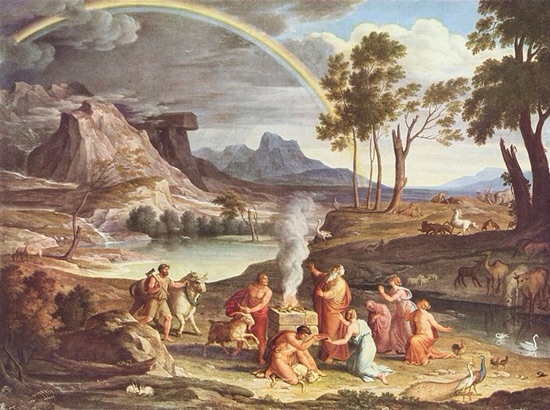
COVENANT
The word used to describe the agreements made between God and the Jewish people. Tradition says that God made several covenants. The Torah tells of the covenant God makes with Abraham, promising him that he will be the patriarch of a great nation. In return, Abraham agrees that every male will be circumcised as a sign of this covenant.
This ancient rite is still practiced today; Jewish males are circumcised in a ceremony known as brit milah, or “the covenant of circumcision.” God also makes a covenant with Moses as he prepares to receive the Ten Commandments. God tells Moses: “If you obey me faithfully and keep My covenant, you shall be treasured among all the peoples.”
Many scholars regard acceptance of the teachings of the Ten Commandments as an example of the Israelites’ covenantal relationship with God. God also made a covenant with Noah, a non-Jew, after the Great Flood, giving him the Noahide Laws and promising never again to destroy the world. God created the rainbow as a sign of this covenant.
 ABRAHAMIC THEOLOGY