
Azahari Hassim
The Jewish Encyclopedia (published 1901–1906) does indeed discuss the connection between the peoples of Gog and Magog and the Khazars, reflecting both medieval Jewish traditions and interpretations circulating at the time.
Key Points from the Jewish Encyclopedia
1. Biblical and Apocalyptic Origins: Gog and Magog are originally biblical figures and nations mentioned in Ezekiel (chapters 38–39) and later in apocalyptic literature. They are depicted as nations from the far north who will attack Israel in the end times.
2. Medieval Jewish Tradition: In the Middle Ages, Jewish writers and travelers often tried to identify Gog and Magog with actual peoples or nations known to them.
The Jewish Encyclopedia notes that, according to some Jewish traditions, the “barbarous nations” of the far north, particularly those beyond the Caucasus, were associated with Gog and Magog.
3. Connection to the Khazars:
The Jewish Encyclopedia specifically mentions that in some medieval Jewish sources, the Khazars—a Turkic people who established a powerful kingdom north of the Caucasus and whose ruling class converted to Judaism—were identified with the peoples of Gog and Magog.
This identification is found in the writings of Jewish travelers such as Petachiah of Regensburg and Benjamin of Tudela, who described the Khazar lands as being those of Gog and Magog.
The Encyclopedia states:
“The name [Gog and Magog] was applied to the wild peoples of the north, especially the Khazars, by the Jews of the Middle Ages…”
4. Legends and Folklore: The association was partly based on the legend that Alexander the Great had built a wall to confine the uncivilized peoples of Gog and Magog, and that the Khazars were believed to live beyond this barrier.
Summary
The Jewish Encyclopedia records that, in medieval Jewish tradition and folklore, the Khazars were sometimes identified with the apocalyptic peoples of Gog and Magog—nations expected to play a role in the events preceding the Messianic era. This connection was not based on historical or biblical evidence but rather on the geographical imagination and apocalyptic expectations of the time.
Do Gog and its allies embrace Judaism?
The interpretation you are referring to suggests that Gog, the mentioned invader in the Book of Ezekiel, represents a nation that converted to Judaism and subsequently develops an obsession with the Holy Land and Jerusalem.
It is important to note that this interpretation is not universally accepted and represents a specific perspective among certain individuals or groups.
Those who hold this viewpoint often base their argument on various passages from the Old Testament, particularly Ezekiel 38-39. They claim that Gog and its allies, portrayed as invading forces, could symbolize a nation that is intimately connected to or influenced by Judaism.
Supporters of this interpretation suggest that the nation’s conversion to Judaism might influence its territorial ambitions, particularly towards the Holy Land and Jerusalem. They argue that this conversion leads to a deep attachment to the land and a desire to possess it for religious or messianic reasons.
However, it is crucial to acknowledge that this specific interpretation is speculative and there are alternative explanations for the meaning and identity of Gog presented in various schools of thought. Different religious traditions and scholars may offer diverging perspectives on the subject matter.
As with any interpretive claim, it is essential to critically evaluate the evidence and consider a range of viewpoints to gain a comprehensive understanding of different perspectives on the topic.
Prophetic Parallels: The Role of Gog and Magog in Islam and Judaism and Their Implications
In the Quran, Allah provides a prophecy concerning Gog and Magog, identifying them and their allies as adversaries of Allah and the Muslims, particularly those residing in the Holy Land, the site of Muhammad’s Night Journey.
Given that the prophecy of Gog and Magog also appears in Jewish scripture, what message does this convey to the Jewish community?
The prophecy of Gog and Magog appears in both Islamic and Jewish scripture, and the message it conveys is significant to both communities. In the Jewish tradition, the prophecy is found in the Hebrew Bible, particularly in the Book of Ezekiel. It describes a great apocalyptic battle involving Gog of the land of Magog, a powerful and hostile force that will invade the Holy Land.
The message of the Quran to the Jews who also have the prophecy of Gog and Magog in their scripture is that they should believe in Allah and His Messenger Muhammad, and follow the guidance of Islam, which is the final and complete revelation from Allah.
The Quran warns the Jews that they will face a severe punishment from Allah if they persist in their disbelief and corruption, and that they will be among the allies of Gog and Magog, who are the enemies of Allah and His righteous servants.
The Quran also informs the Muslims that they will be victorious over Gog and Magog, with the help of Allah, and that they will inherit the Holy Land after the destruction of Gog and Magog.
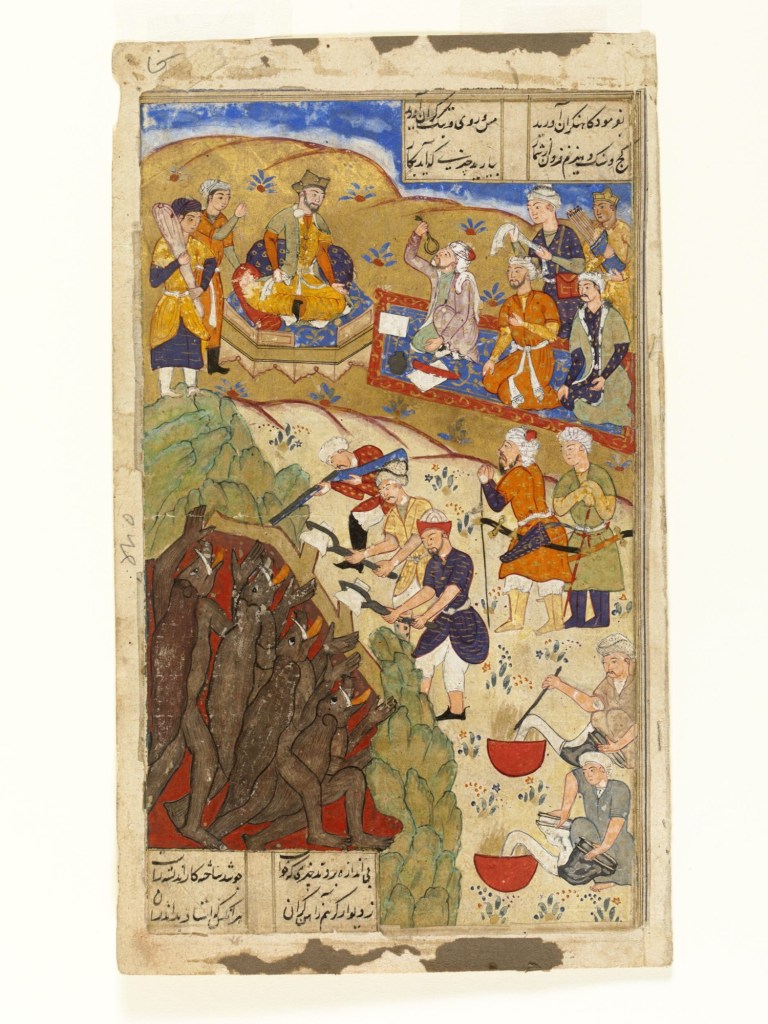
Key Visual Clues:
The humanoid figures with beastly or demonic appearances, trapped behind a barrier on the left side, are characteristic of how Gog and Magog are illustrated in Islamic miniatures.
The barrier of iron or brass being built or maintained, often associated with Dhul-Qarnayn (a figure mentioned in Surah Al-Kahf 18:83–98), who is said to have constructed a massive wall to contain Gog and Magog.
The regal figure seated on a throne, likely Dhul-Qarnayn, receiving counsel or giving orders.
The architectural and artistic style—including Persian calligraphy and iconography—links it to Islamic manuscript illustrations, possibly from a Shahnama (Book of Kings) or a Qisas al-Anbiya’ (Stories of the Prophets) type manuscript.

Download: The Matrix of Gog.pdf
The Matrix of Gog
Who is the author of the book “The Matrix of Gog”?
The author of the book is Daniel Patrick.
According to the author, who is Gog?
According to the author, Gog is the demonic leader or king of the land of Khazaria, which is the country of origin for today’s “Jews.” The book “The Matrix of Gog” informs us about Gog, Magog, and the Jews, revealing that today’s “Jews” are the “Synagogue of Satan” as mentioned in Revelation 2 and 3.
According to the author, who are the present-day descendants of the ancient Israelites?
According to the author, the present-day descendants of the ancient Israelites are not the majority of Jews, but rather some Palestinians who have more Israelite blood than the Jews. Some Palestinians even have DNA markers that establish them as descendants of the ancient priests who worked in the Jewish temples and synagogues.
In what way does “The Matrix of Gog” establish a connection between Khazars and Gog from the land of Magog?
The book “The Matrix of Gog” establishes a connection between Khazars and Gog from the land of Magog by revealing that Gog is the demonic leader or king of Khazaria, which is located in the Caucasus, south of Russia. It explains that the people we call “Jews” today are actually of the Turkic bloodline and not descendants of Abraham, Israelites, or Semites.
The book informs us about Gog, Magog, and the Jews, showing that the Holy Bible is accurate in its depiction. Additionally, it delves into the lineage of Togarmah, who is related to Magog and Ashkenaz, giving insight into the origins of the Khazars and their connection to the Ashkenazi Jews.
The perspective of the author towards Palestinians is what exactly?
The perspective of the author towards Palestinians is that they had more Israelite blood than the Jews themselves, and some Palestinians even had DNA that established they were ‘Cohens’ – workers at the ancient Temple and synagogues of the Jews.
What is the author’s perspective towards Ashkenazi Jews?
The author’s perspective towards Ashkenazi Jews is critical, as they view revealing books on the origins of Ashkenazi Jewry as a “Frankenstein nightmare” that won’t die despite attempts to suppress it in the media. The author also mentions a book by Dr. Paul Wexler that challenges Zionist beliefs about Ashkenazi Jews. Additionally, the author discusses the Khazar mass migration into Eastern Europe and the DNA research findings that suggest most Jews came from Khazar blood.
What is the religion of the people of Gog and Magog?
Some believe Gog, mentioned in the Book of Ezekiel that invades the Holy Land, is the nation that converted to Judaism. They obsess over the Holy Land and Jerusalem due to their conversion. How is this argument explained?
The argument that Gog, mentioned in the Book of Ezekiel, is a nation that converted to Judaism and will invade the Holy Land can be explained through various interpretations and beliefs held by some individuals.
In the Book of Ezekiel, Gog is described as a powerful ruler who leads an army against the people of the Holy land. Some people interpret this passage metaphorically, suggesting that Gog represents a nation or group of nations rather than an individual. According to this interpretation, these nations are believed to have converted to Judaism and developed a strong attachment to the Holy Land and Jerusalem.
This belief may stem from the idea that conversion to Judaism involves adopting not only religious practices but also a connection with Jewish history and heritage. The Holy Land holds immense significance in Judaism as it is considered the promised land given by God to the Jewish people. Therefore, those who convert might develop an intense focus on reclaiming or protecting this sacred territory.
Additionally, Jerusalem holds great importance in both religious and historical contexts for Jews. It is home to significant religious sites such as the Western Wall and Temple Mount. Consequently, individuals who believe in this argument might emphasize Jerusalem’s role as a central point for their newly adopted faith.
It’s important to note that interpretations of biblical texts can vary widely among different individuals or religious groups. While some may support this argument about Gog being a converted nation invading the Holy Land due to their intense focus on Jerusalem, others may have alternative explanations or reject this interpretation altogether.
 ABRAHAMIC THEOLOGY