Azahari Hassim
The figures of Gog and Magog—known in Islamic tradition as Yajuj and Majuj—are shrouded in apocalyptic mystery across Abrahamic religions.
While the Quran and Hadith literature provide limited but evocative details about them, interpretations and speculation abound. Among these is the idea that Gog and Magog may adhere to the Jewish faith and harbor a fixation on the Holy Land, especially the city of Jerusalem.
Quranic Reference and the “Town”
In Surah 21, verse 95, the Quran states:
“And there is a ban upon [the people of] a town which We destroyed: they shall not return.
Until, when Gog and Magog are let loose, and they swarm down from every mound.”
This verse has been interpreted by some exegetes and commentators to refer to Jerusalem, the “town” whose destruction and the divine decree against its reentry become symbolically significant. In this context, the town becomes central to eschatological narratives, particularly involving Gog and Magog. Their emergence is linked to the end of days and the unfolding of divine justice on earth.
Who Are Gog and Magog?
In both Islamic and Judeo-Christian texts, Gog and Magog are described as tribes or peoples of great power and corruption. In the Quran (Surah 18, verses 94 to 99), they are described as causing “mischief in the land” and being temporarily sealed off by the righteous ruler Dhul-Qarnayn, only to break free near the end of time.
In the Islamic eschatological view, their release marks a cataclysmic moment in human history—one of chaos, global strife, and ultimately, divine intervention.
The Theory: Adherents of the Jewish Faith?
One theory proposed by some interpreters and observers is that Gog and Magog might be associated with the Jewish faith. This theory is not explicitly supported by classical Islamic texts, but it arises from certain geopolitical and scriptural readings. The idea hinges on their supposed obsession with the Holy Land, particularly Jerusalem—a city central to Jewish theology, identity, and eschatology.
According to this view, the reference in Surah 21, verse 95 to a town (Jerusalem) and a divine prohibition on return could be indirectly linked to the movements or aspirations of Gog and Magog. Their “obsession” with the land may be interpreted as a reflection of a deeper theological or historical attachment, possibly rooted in Jewish claims to the area.
However, this view remains speculative and is not universally accepted. Many Islamic scholars argue that Gog and Magog are not to be identified with any specific religious group but rather represent a corrupt and destructive force, devoid of spiritual alignment and indifferent to divine guidance.
Symbolism vs. Literalism
The Quranic and Hadith portrayals of Yajuj and Majuj allow room for symbolic interpretation. Rather than focusing solely on their ethnic or religious identity, many scholars emphasize their role in divine narrative: as signs of the approaching Day of Judgment, their release into the world serves as a stark reminder of human vulnerability, the limits of power, and the necessity of divine guidance.
Thus, whether or not they adhere to a specific religion, the deeper message lies in what their emergence represents—chaos preceding divine order, falsehood before the triumph of truth.
Conclusion
While some theorists suggest that Gog and Magog may follow the Jewish faith and possess an enduring obsession with the Holy Land—particularly Jerusalem—Islamic scripture provides little direct support for such claims. Surah 21, verse 95 does refer to a town whose people are barred from return, and this is often interpreted to mean Jerusalem. Yet, the identities and motives of Gog and Magog remain deliberately vague, serving more as eschatological signs than as historical actors.
As with many elements of apocalyptic literature, the role of Gog and Magog ultimately points beyond themselves—to the divine plan, the coming of the final hour, and the unfolding of cosmic justice.
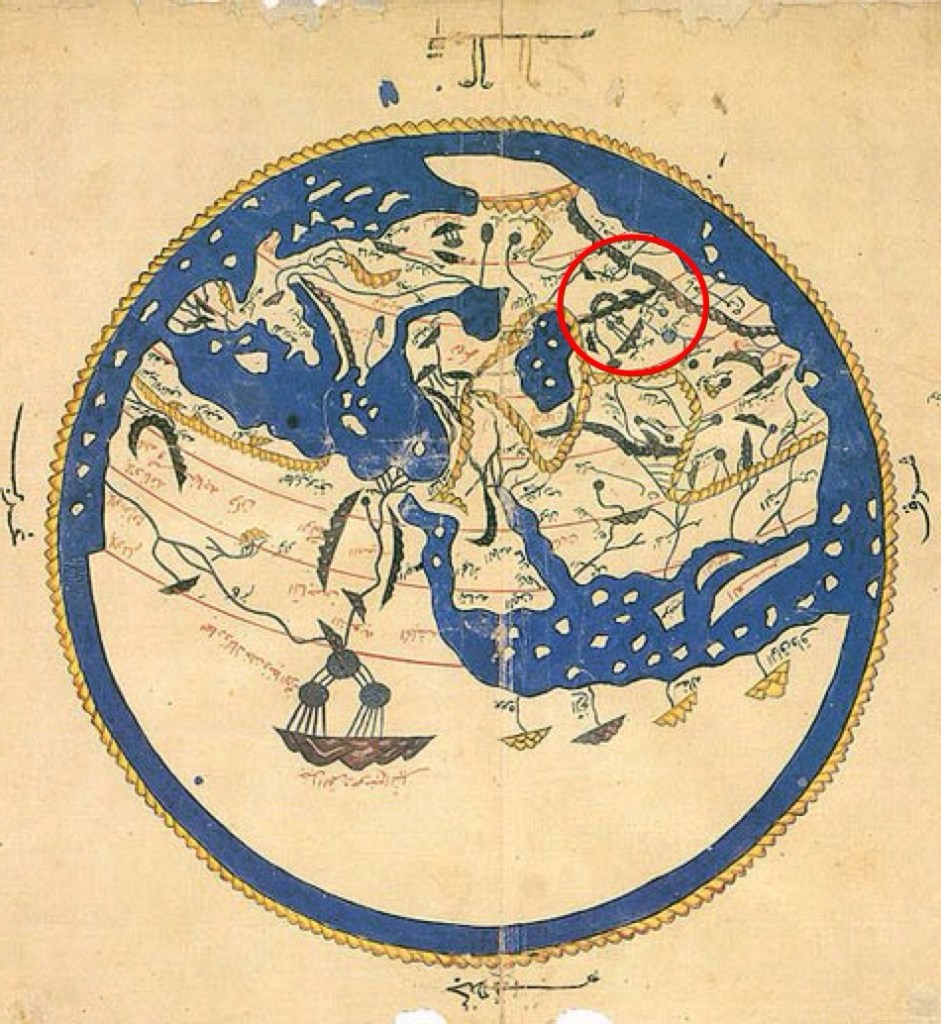
Red-Circled Area: Yajuj and Majuj
The red circled area is widely believed by scholars to depict the land of Yajuj and Majuj (Gog and Magog). In Al-Idrisi’s worldview, they are placed in the far northeast—which, when flipped by modern orientation, corresponds roughly to parts of Central Asia, near the Caucasus Mountains, between the Caspian Sea and the Black Sea.
This placement aligns with:
The Islamic tradition where Dhul-Qarnayn travels to a region between two mountains and builds a massive barrier (Surah al-Kahf 18:93–98) to contain Yajuj and Majuj.
Geographical theories connecting this location to the Dariel Gorge or Derbent Pass, historically known as a barrier zone between Eurasian steppes and the Middle East.
Possible Modern Correlates:
The map’s red-circled area likely corresponds today to:
Caucasus region (Georgia, Azerbaijan, Dagestan)
Khazar territory in historical memory (linked by some theories to Gog and Magog)
Steppe borderlands of Central Asia, often seen as the “edge of civilization” in medieval Islamic geography
Summary:
Map Source: Al-Idrisi’s Tabula Rogeriana (1154 CE)
Red Circle: Likely depicts the region of Yajuj and Majuj
Modern Equivalent: Roughly the Caucasus and Central Asian frontier, possibly including southern Russia, Dagestan, Georgia, and Azerbaijan
Theological/Geopolitical Purpose: A symbolic frontier of chaos, beyond which the apocalyptic forces of Yajuj and Majuj are imprisoned until the End Times
Exploring the Connection Between Gog, Magog, and the Khazars in the Jewish Encyclopedia
How does Jewish Encyclopedia make a connection between people of Gog and Magog and the Khazars?
The Jewish Encyclopedia, a comprehensive work published in the early 20th century, discusses various historical, religious, and cultural topics related to Judaism. In its entries, the encyclopedia explores the connection between Gog and Magog and the Khazars, drawing upon historical and biblical sources.
Gog and Magog are biblical figures mentioned in the Book of Ezekiel and the Book of Revelation, often associated with apocalyptic prophecies and the end times. Over time, these names have been linked to various groups and regions, sometimes representing distant lands or threatening forces.
The Khazars were a semi-nomadic Turkic people who established a powerful empire in the region of the Caucasus and the Volga River between the 7th and 10th centuries. Notably, the Khazar elite and parts of their population converted to Judaism around the 8th century.
In the Jewish Encyclopedia, the connection between Gog and Magog and the Khazars is explored through the lens of medieval Jewish and Christian writings. Some medieval Jewish authors, influenced by earlier traditions and geopolitical realities, identified the Khazars with the apocalyptic figures of Gog and Magog. This association might have been bolstered by the Khazars’ geographical location on the fringes of the known world and their involvement in regional power dynamics.
It’s important to note that these connections are more interpretative and speculative rather than based on concrete historical evidence. They reflect the ways in which biblical prophecies and historical events were intertwined in the medieval imagination, often serving as a means to understand contemporary geopolitical situations through a religious and eschatological framework.
The revelation of Gog and Magog in the Scripture of the Jews, Christians, and Muslims
Both the Hebrew and Christian Bibles have the prophecy of Gog and Magog invading the Holy Land. Curiously the Quran also has it. What is the message behind the revelation of Gog and Magog in the Quran for the Jews and the Christians?
The message behind the revelation of Gog and Magog in the Quran for the Jews and the Christians is a matter of interpretation and debate among scholars and believers. Some possible messages are:
Gog and Magog are a sign of the end times and the final battle between good and evil. They will emerge from behind a barrier that was built by a righteous king named Dhul Qarnayn, who is identified by some as Alexander the Great, Cyrus the Great, or another historical figure. They will cause corruption and destruction on earth until they are destroyed by Allah or by Jesus (peace be upon him) who will return to lead the believers.
Gog and Magog are not literal people or tribes, but symbolic names for the forces of oppression and injustice that have dominated the world throughout history. They represent the enemies of God and His messengers, who have persecuted the believers of all faiths. They are also associated with the modern Zionist movement and its allies, who have occupied the holy land of Palestine and oppressed its people.
Gog and Magog are a reminder of the common origin and destiny of all human beings, who are descendants of Adam and Eve (peace be upon them). They are also a warning to the Jews and the Christians to uphold the true teachings of their prophets, Moses and Jesus (peace be upon them), and not to follow the corrupted versions of their scriptures or the innovations of their sects. They are also an invitation to the Jews and the Christians to recognize Muhammad (peace be upon him) as the final prophet and messenger of God, who was sent to confirm and complete their previous revelations.
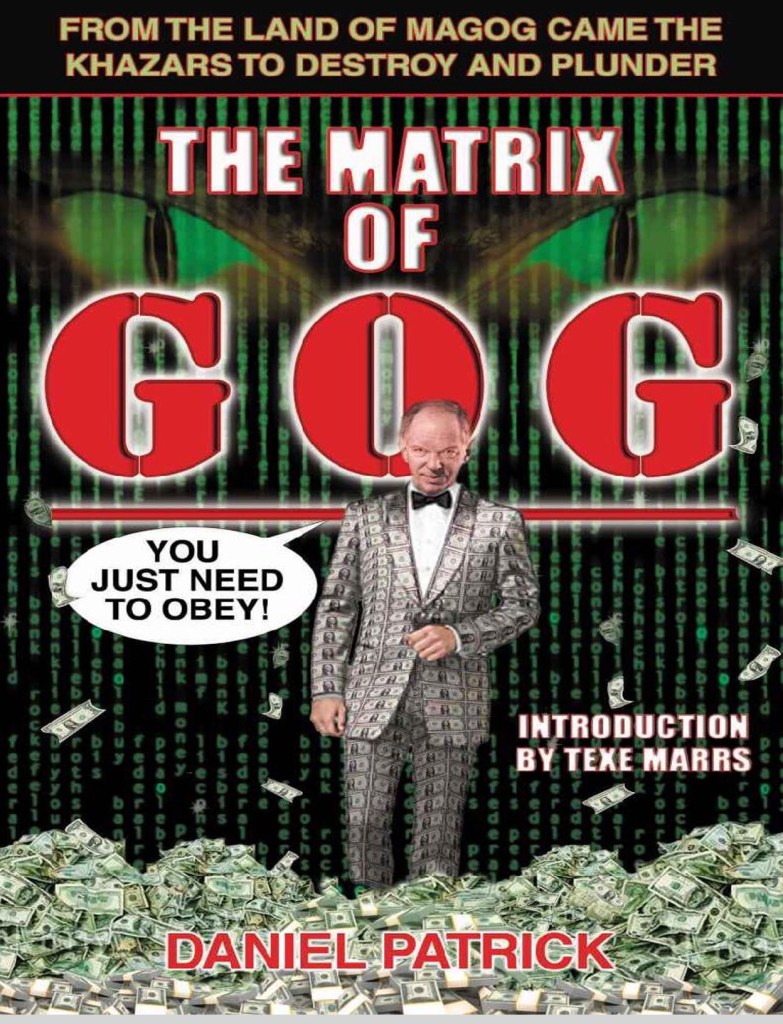
The Matrix of Gog
Who is the author of the book “The Matrix of Gog”?
The author of the book is Daniel Patrick.
According to the author, who is Gog?
According to the author, Gog is the demonic leader or king of the land of Khazaria, which is the country of origin for today’s “Jews.” The book “The Matrix of Gog” informs us about Gog, Magog, and the Jews, revealing that today’s “Jews” are the “Synagogue of Satan” as mentioned in Revelation 2 and 3.
According to the author, who are the present-day descendants of the ancient Israelites?
According to the author, the present-day descendants of the ancient Israelites are not the majority of Jews, but rather some Palestinians who have more Israelite blood than the Jews. Some Palestinians even have DNA markers that establish them as descendants of the ancient priests who worked in the Jewish temples and synagogues.
In what way does “The Matrix of Gog” establish a connection between Khazars and Gog from the land of Magog?
The book “The Matrix of Gog” establishes a connection between Khazars and Gog from the land of Magog by revealing that Gog is the demonic leader or king of Khazaria, which is located in the Caucasus, south of Russia. It explains that the people we call “Jews” today are actually of the Turkic bloodline and not descendants of Abraham, Israelites, or Semites.
The book informs us about Gog, Magog, and the Jews, showing that the Holy Bible is accurate in its depiction. Additionally, it delves into the lineage of Togarmah, who is related to Magog and Ashkenaz, giving insight into the origins of the Khazars and their connection to the Ashkenazi Jews.
The perspective of the author towards Palestinians is what exactly?
The perspective of the author towards Palestinians is that they had more Israelite blood than the Jews themselves, and some Palestinians even had DNA that established they were ‘Cohens’ – workers at the ancient Temple and synagogues of the Jews.
What is the author’s perspective towards Ashkenazi Jews?
The author’s perspective towards Ashkenazi Jews is critical, as they view revealing books on the origins of Ashkenazi Jewry as a “Frankenstein nightmare” that won’t die despite attempts to suppress it in the media. The author also mentions a book by Dr. Paul Wexler that challenges Zionist beliefs about Ashkenazi Jews. Additionally, the author discusses the Khazar mass migration into Eastern Europe and the DNA research findings that suggest most Jews came from Khazar blood.
 ABRAHAMIC THEOLOGY