Azahari Hassim
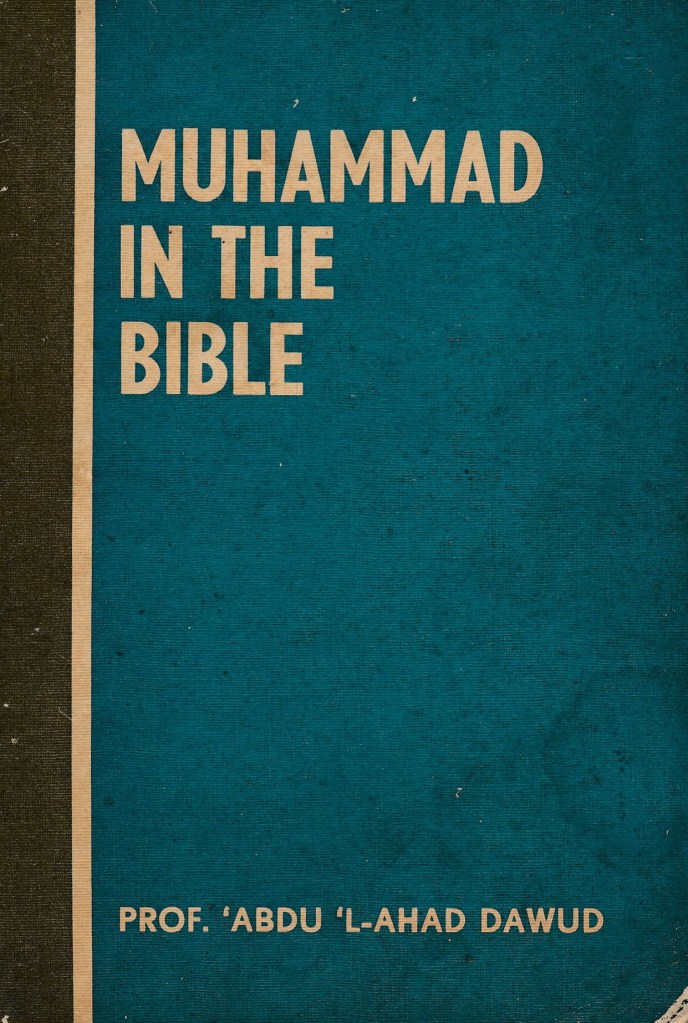
The book “Muhammad in the Bible” by Prof. Abdul Ahad Dawud (formerly Rev. David Benjamin Keldani), is an analysis that argues that Prophet Muhammad is prophesied in both the Old and New Testaments of the Bible. The author, a former Christian priest who converted to Islam, presents theological arguments supported by biblical texts, linguistic analysis, and historical context.
Key Themes and Arguments:
1. The Author’s Background:
Prof. Abdul Ahad Dawud, previously Rev. David Benjamin Keldani, was a Roman Catholic priest of the Uniate-Chaldean sect.
His conversion to Islam was based on his deep study of Christian scripture, concluding that Muhammad was the promised prophet mentioned in the Bible.
2. Muhammad in the Old Testament:
The book presents linguistic and contextual analysis to show that Muhammad is the “Promised One” foretold in the Hebrew scriptures.
The term “Himda” (חֶמְדָּה) in Haggai 2:7, which is commonly translated as “the desire of all nations”, is argued to be referring to Ahmed (another name for Muhammad).
The Book of Deuteronomy 18:18, which speaks of a prophet like Moses, is interpreted to refer to Muhammad, not Jesus, because Muhammad, like Moses, was a lawgiver.
3. The Birthright and the Covenant:
The book argues that Ishmael, not Isaac, was the rightful heir of Abraham’s covenant because he was the firstborn.
It asserts that the biblical narrative has been altered to favor Isaac, even though God’s original promise was to Ishmael and his descendants.
4. Muhammad in the New Testament:
The Gospel of John 14, verse 16, John 15, verse 26, and John 16, verses 7 to 14) refer to the coming of the Paraclete, often translated as the “Comforter” or “Advocate.”
The book argues that the Greek term “Paracletos” (παράκλητος) was likely a mistranslation of “Periclytos”, meaning “the praised one” (Ahmed, a name of Muhammad).
Jesus is said to have predicted Muhammad’s arrival as the final Messenger of God.
5. Comparison Between Jesus and Muhammad:
The book highlights key differences between Jesus and Muhammad, arguing that Jesus did not bring a new law, whereas Muhammad did—aligning him with Moses as predicted in Deuteronomy 18, verse 18.
It also argues that Jesus’ message was for the Children of Israel, whereas Muhammad’s message was universal.
6. Biblical Prophecies of Arabia and the Coming of Islam:
Isaiah 42 is interpreted as predicting Muhammad’s arrival, pointing to Kedar, a reference to Ishmael’s descendants, which includes the Arabs.
The mention of Paran in the Bible (Deuteronomy 33:2, Habakkuk 3:3) is linked to Mecca, Muhammad’s birthplace.
Conclusion:
The book aims to demonstrate that Muhammad is the final prophet prophesied in the Bible, and it challenges Christian interpretations that reject this claim. It is a theological and historical argument advocating for the Islamic perspective on biblical prophecy.
Quoted by Rev. David Benjamin Keldani:
“I must remind Christians that unless they believe in the absolute unity of God and renounce the belief in three persons, they are certainly unbelievers in the true God. The Old Testament and the Qur’an condemn the doctrine of three persons in God. The New Testament does not expressly uphold or defend it; even if it contains hints and traces regarding the Trinity, it holds no authority at all because it was neither seen nor written by Christ himself, nor in the language he spoke, and it did not exist in its present form and content for at least the first two centuries after him.”
Reinterpreting the “Son of Man”: Prof. Abdul Ahad Dawud’s Perspective in Muhammad in the Bible
In his groundbreaking work Muhammad in the Bible, Prof. Abdul Ahad Dawud—formerly Rev. David Benjamin Keldani, a former Catholic priest—presents a provocative and meticulously reasoned argument that challenges traditional Christian interpretations of the “Son of Man” figure in biblical literature.
According to Dawud, the title “Son of Man” has been misunderstood and misapplied over centuries, and he asserts that its true referent is not Jesus Christ, but rather the Prophet Muhammad.
1. Jesus’ Reluctance to Claim the Title
Dawud begins his analysis by addressing the silence of Jesus regarding the title “Son of Man.” Drawing from historical and textual evidence, he argues that Jesus consciously avoided adopting this title. In Muhammad in the Bible, Dawud notes that had Jesus claimed to be the “Son of Man” as portrayed in the apocalyptic visions of the Hebrew Scriptures, it would have rendered him “ridiculous in the eyes of his audience”. Faced with Messianic expectations, Dawud suggests that Jesus had only two options: to either reject the Messianic prophecies as interpolations or to embrace them fully by claiming the title—something Jesus notably refrained from doing.
2. The Quranic Terminology
A key theological point raised by Dawud is the distinction made in the Quran, where Jesus is never referred to as the “Son of Man.” Instead, he is consistently called the “Son of Mary”. Dawud interprets this linguistic choice as deliberate and meaningful. In his view, since Jesus was born of a virgin, he had no biological father and thus could not be accurately described as the “Son of Man.” According to Dawud, this reinforces the argument that Jesus does not fulfill the criteria associated with the “Son of Man” in biblical prophecies.
3. Prophecies and Apocalyptic Visions
Perhaps the most controversial aspect of Dawud’s thesis is his reinterpretation of biblical apocalyptic literature. He argues that the “Son of Man” described in texts like the Book of Daniel and other visionary writings more accurately describe the life, mission, and characteristics of Prophet Muhammad. From global impact and moral authority to the establishment of divine law and finality of prophecy, Dawud asserts that Muhammad uniquely fulfills these prophetic descriptions—traits which, he argues, are not fully manifested in the life of Jesus.
4. A Historical Reassessment
In the concluding sections of his book, Dawud posits that the early Church engaged in what he terms a “policy and cunning propaganda” to align Jesus with the Messianic expectations surrounding the “Son of Man”. He contends that Jesus himself never claimed this identity, and that it was the later ecclesiastical narrative that retroactively applied the title to him in order to appeal to Jewish expectations of a coming Messiah. Instead, Dawud believes that Jesus deliberately left the title unclaimed, reserving it for the true fulfillment of the prophecy—Prophet Muhammad.
Conclusion
Prof. Abdul Ahad Dawud’s Muhammad in the Bible offers a radical re-examination of long-held beliefs within Christian theology. By reinterpreting the “Son of Man” through a Qur’anic and historical lens, Dawud challenges readers to rethink the identity of the prophetic figure awaited in Jewish and Christian tradition. Whether one agrees or disagrees with his conclusions, his work remains a thought-provoking contribution to interfaith dialogue and comparative theology.
Does the phrase “the night visions” in Daniel 7 refer to Muhammad’s Night Journey?
How do some argue that the phrase “the night visions” in Daniel 7, verse 13 refers to Muhammad’s Night Journey to the seventh heaven to meet God instead of Jesus, whose ascension did not occur at night?
Some argue that the phrase “the night visions” in Daniel 7, verse 13, refers to Muhammad’s Night ( الإسراء والمعراج) rather than Jesus’ ascension based on the following points:
1. The term “night visions” directly suggests an event that takes place at night. Muhammad’s Night Journey, which is said to have occurred during the night, aligns with this description. In contrast, Jesus’ ascension is generally not described as happening at night in Christian texts.
2. According to Islamic tradition, during the Isra, Muhammad traveled from Mecca to Jerusalem and then ascended through the heavens in the Mi’raj. He is described as having profound spiritual experiences, meeting past prophets, and ultimately coming into the presence of God.
In Daniel 7, verses 13 to 14, “one like a son of man” is seen coming with the clouds of heaven and approaching the “Ancient of Days” (interpreted by scholars as God). This imagery of traveling through the heavens and meeting a divine figure has parallels with Muhammad’s Night Journey.
3. The mention of the “clouds of heaven” could be metaphorically linked to the ethereal and divine nature of Muhammad’s ascent through the heavens, which is a central element in the Night Journey narrative.
4. Some Muslim scholars see Daniel’s vision as prophetic, foretelling not just events relevant to Jewish history but also later significant religious events. They interpret the “one like a son of man” as a reference to a future prophet who would establish a new era, which Muhammad is believed to have done in Islam.
5. In the vision, the figure receives authority, glory, and sovereign power, and all nations serve him. Supporters of this interpretation argue that Muhammad’s establishment of Islam fits this prophecy as he united tribes and established a widespread religious and political community.
While these arguments are compelling within an Islamic interpretive framework, this interpretation is not widely accepted in Christian and Jewish traditions.
However, it’s important to note that these interpretations are not mainstream and are often viewed within the context of interfaith dialogue or polemics.
Traditional Jewish and Christian interpretations generally identify the “one like a son of man” as a messianic figure, often associated with Jesus in Christian theology, while in Jewish thought, it can be seen as a representation of Israel or the Messiah.
The Prophecy of Daniel: Constantine the Great and Muhammad the Prophet
Some believe that Daniel 7, verse 25 alludes to Constantine the Great, who presided over the council of Nicaea, while Daniel 7, verse 13, points to Muhammad’s Night Journey. How is this argument explained?
This is a very controversial argument that is not widely accepted by most biblical scholars and Christians, who believe that Daniel 7, verse 25, and Daniel 7, verse 13, refer to the Antichrist and the Messiah, respectively. However, some people who support this argument explain it in the following way:
They claim that Constantine the Great, who was the first Roman emperor to convert to Christianity and who convened the Council of Nicaea in 325 AD, was the little horn of Daniel 7, verse 25, who spoke pompous words against the Most High and tried to change the times and the laws.
They argue that Constantine corrupted the original teachings of Jesus and imposed his own doctrines and creeds on the Christian church, such as the doctrine of the Trinity, the observance of Sunday instead of Saturday as the Sabbath, and the celebration of Easter instead of Passover.
They also accuse Constantine of persecuting and oppressing those who did not conform to his version of Christianity, such as the followers of Arianism, who denied the divinity of Jesus.
Arianism sparked significant debates within the Church, particularly during the early Ecumenical Councils. The First Council of Nicaea in 325 AD condemned Arianism, affirming the doctrine of the Trinity and the full divinity of Christ. The Nicene Creed established the belief that the Son is “begotten, not made, of one substance with the Father.”
Islamic scholars claim that Muhammad, who was the prophet of Islam and who claimed to have a miraculous Night Journey from Mecca to Jerusalem and then to heaven in 621 AD, was the Son of Man of Daniel 7, verse 13, who came with the clouds of heaven and was given dominion, glory, and a kingdom by the Ancient of Days, that is God.
The term “night visions” directly suggests an event that takes place at night. Muhammad’s Night Journey, which is said to have occurred during the night, aligns with this description. In contrast, Jesus’ ascension is generally not described as happening at night in Christian texts.
They argue that Muhammad was a true prophet of God who restored the pure monotheism that was lost by Constantine and his followers. They also assert that Muhammad’s kingdom is an everlasting kingdom that will never be destroyed, and that all nations and peoples of every language will serve him or submit to his law.
In summary, these are a few points made by Islamic scholars to back the notion that Daniel 7, verse 25, and 7, verse 13, refer to Constantine as the little horn who established the Trinity at the Council of Nicea, and Muhammad as the Son of Man who encountered God on his Night Journey to the seventh heaven.
 ABRAHAMIC THEOLOGY