Azahari Hassim
Jewish beliefs indicate that there were no prophetic warnings concerning the destruction of the Second Temple, in contrast to the warnings issued regarding the First Temple. Conversely, Surah 17:4 and 7 of the Quran affirm the existence of a prophecy pertaining to the destruction of the Second Temple, referencing the divine message conveyed by Jesus and John the Baptist.
The claim that there were no prophetic warnings about the destruction of the Second Temple in Jewish tradition, while the Quran affirms such prophecies, presents an interesting contrast between these religious perspectives.
Jewish Perspective
In traditional Jewish belief, there is indeed a notable difference in the prophetic warnings regarding the First and Second Temples:
- First Temple: The destruction of the First Temple in 586 BCE was preceded by numerous prophetic warnings, particularly from prophets like Jeremiah and Ezekiel.
- Second Temple: There is less emphasis on explicit prophetic warnings about the Second Temple’s destruction in 70 CE within mainstream Jewish sources.
Rabbi Joseph said, “Prophecy ceased during the time of the Second Temple, and thus there was no prophet to warn of its destruction as there had been for the First Temple.” This statement suggests that during the period of the Second Temple, which stood from around 516 BCE to 70 CE, there were no prophets who received divine messages or visions to warn the people about the impending destruction of the temple.
Islamic Perspective
The Quran, in Surah 17 (Al-Isra), verses 4 and 7, does refer to two instances of destruction and defilement of the temple:
“And We conveyed to the Children of Israel in the Scripture that, ‘You will surely cause corruption on the earth twice, and you will surely reach a degree of great haughtiness’… ‘So when the final promise came, We sent your enemies to sadden your faces and to enter the temple in Jerusalem as they entered it the first time, and to destroy what they had taken over with total destruction.’”
The verse addresses two instances of corruption by the Children of Israel and describes divine punishments for these transgressions. The verses suggest that the first punishment corresponds to the Babylonian destruction of Jerusalem and its Temple. The second punishment is interpreted by many Islamic scholars as referring to the Roman destruction of the Second Temple in 70 CE. The Quran states that enemies would enter “the Masjid” (interpreted as the Temple) and destroy it with utter devastation, just as they did during the first instance.
Islamic commentators often link this prophecy to historical events, with some identifying Jesus and John the Baptist as figures who warned against corruption and foretold divine retribution. These figures are seen as part of God’s message to guide and warn their communities before calamity struck.
Christian Perspective
The New Testament records Jesus predicting the destruction of the Second Temple. For example, in Matthew 24:1-2, Jesus says:
“You see all these things, do you not? Truly I say to you, there shall not be left here one stone upon another, that shall not be thrown down.”
This prophecy is seen by Christians as being fulfilled when the Romans destroyed the Temple in 70 CE.
In conclusion, while traditional Jewish sources may not emphasize prophetic warnings about the Second Temple’s destruction to the same degree as the First Temple, both Islamic and Christian traditions do record such prophecies. This difference in emphasis reflects the distinct theological perspectives and historical interpretations of these religious traditions.
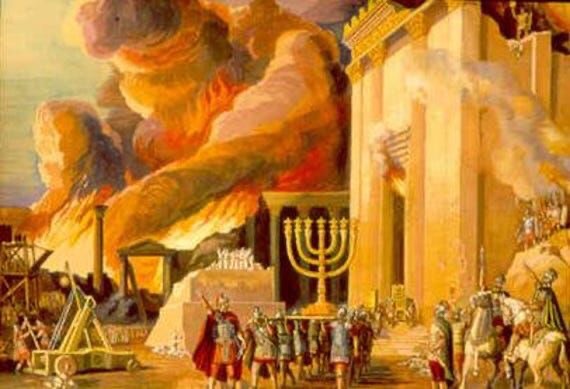
The destruction of the Second Temple
The destruction of the Second Temple in Jerusalem occurred in 70 CE and is a pivotal event in Jewish history. Here’s a summary of the key points:
Background:
Second Temple Period: The Second Temple was constructed in 516 BCE, replacing Solomon’s Temple, and it became the center of Jewish worship and national identity.
Roman Rule: By the 1st century CE, Judea was under Roman control, leading to tensions between the Jewish population and Roman authorities.
Key Events Leading to Destruction:
1. Jewish Revolt: In 66 CE, a Jewish rebellion against Roman rule broke out, driven by religious and political discontent.
2. Siege of Jerusalem: The conflict escalated, culminating in the Roman siege of Jerusalem in 70 CE, led by General Titus.
The Siege and Destruction:
Roman Assault: The Romans surrounded the city, cutting off supplies and engaging in brutal tactics to break the Jewish defenses.
Fall of the Temple: On Tisha B’Av (the 9th of Av in the Hebrew calendar), the Romans breached the walls of the city. They set fire to the Temple, leading to its complete destruction.
Aftermath: The destruction of the Second Temple marked the end of the Second Temple period, leading to significant changes in Jewish life, including the shift towards rabbinic Judaism and the diaspora.
Significance:
Cultural Impact: The destruction had a profound impact on Jewish religion and identity, leading to mourning rituals and the development of new religious practices.
Historical Memory: Tisha B’Av is observed as a day of mourning for the destruction of both the First and Second Temples.
This event remains a critical moment in Jewish history, shaping religious practices and cultural identity for centuries to come.
Islamic Interpretation of Daniel 7: The Fifth Kingdom as the Rise of Islam
Numerous biblical scholars maintain that the four beasts described in Daniel 7 symbolize four distinct kingdoms: Babylon, Medo-Persia, Greece, and Rome. Subsequently, the establishment of the kingdom of God is noted. In contrast, certain Islamic scholars assert that the fifth kingdom, which they identify as the kingdom of God, corresponds to Islam, as it arose subsequent to the Byzantine Empire, also referred to as the Eastern Roman Empire. What is the rationale behind this interpretation?
The Islamic interpretation of the prophecy in Daniel 7, which identifies the “fifth kingdom” (the kingdom of God) with Islam, is based on historical and theological reasoning. Here are the key points behind this interpretation:
1. Historical Succession of Empires
Daniel 7 describes four beasts representing four successive kingdoms. Many biblical scholars identify these as Babylon, Medo-Persia, Greece, and Rome.
Islam emerged in the 7th century CE, after the decline of the Western Roman Empire and during the weakening of the Byzantine (Eastern Roman) Empire. Since Daniel’s vision mentions the establishment of God’s kingdom after the fourth empire, some Islamic scholars argue that Islam, which emerged after Rome, fulfills this prophecy.
2. The Fall of the Byzantine Empire and the Rise of Islam
The Byzantine (Eastern Roman) Empire was a dominant power before Islam’s expansion. Islamic scholars argue that with the conquests of the Rashidun and Umayyad Caliphates, Islam effectively replaced Byzantine rule in large parts of the Mediterranean, the Levant, and North Africa.
The rapid spread of Islam and its dominance over former Roman territories is seen as a fulfillment of the prophecy that a divine kingdom would supersede worldly empires.
3. The Concept of God’s Kingdom in Islam
Jesus did not equate the kingdom of God that he preached with the religion of Christianity. Rather, the concept of the “kingdom of God” is frequently linked to the arrival of a figure resembling a son of man as described in Daniel 7.
Islamic scholars, however, interpret God’s kingdom as a system of governance based on divine law (Sharia). Since Islam established a political-religious order that claimed to rule by divine law, it is seen as fulfilling the vision of God’s kingdom replacing human empires.
4. Islam as a Universal and Everlasting Kingdom
Daniel 7, verse 14 describes the final kingdom as one that will never be destroyed. Islamic scholars argue that Islam, despite historical challenges, continues to be a major global faith and political influence.
The continuity of Islam as a religious and civilizational force is seen as evidence that it aligns with the prophecy of a kingdom that endures.
5. The Role of Prophet Muhammad in Quranic Prophecy
Some Islamic scholars extend this interpretation by linking it to prophecies about a future religion of Islam. They cite Surah 61, verse 9 of the Quran:
“He it is Who hath sent His messenger with the guidance and the religion of truth, that He may make it conqueror of all religion however much idolaters may be averse.”
Muhammad’s establishment of a religious-political order is viewed as the fulfillment of the divine kingdom prophesied in Daniel.
Conclusion
Islamic scholars interpret Daniel 7’s prophecy through a historical and theological lens, identifying Islam as the divine kingdom that follows Rome. They argue that Islam’s rise, territorial expansion, and legal-political system based on divine law fulfill the vision of a God-ordained kingdom that replaces human rule.
Muhammad’s Night Journey and the Fate of the Jewish Temple: A Theological Perspective
What is the rationale behind the theological implications of the correlation between Surah 17 verse 1 and verse 7 of the Quran, which indicates that Judaism as a sacrificial religion has been abolished?
Surah 17 of the Quran, known as “Al Isra” (The Night Journey), contains verses that reference the Israelites and events associated with them. Let’s explore the verses you mentioned:
1. Surah 17 verse 1:
“Exalted is He who took His Servant by night from al Masjid Al Haram to Al Masjid Al Aqsa, whose surroundings We have blessed, to show him of Our signs. Indeed, He is the Hearing, the Seeing.”
This verse refers to the Isra, or the Night Journey, where Muslims believe that the Prophet Muhammad was taken from Mecca to Jerusalem and then ascended to the heavens (the Miraj). Al Masjid Al Aqsa is identified with the Temple Mount in Jerusalem.
2. Surah 17 verse 7:
“If you do good, you do good for yourselves; and if you do evil, [you do it] to yourselves. Then when the final promise came, [We sent your enemies] to sadden your faces and to enter the temple in Jerusalem, as they entered it the first time, and to destroy what they had taken over with [total] destruction.”
This verse refers to the punishment meted out to the Israelites due to their disobedience and recalls the destruction of the Temple in Jerusalem.
The argument you’re referencing seems to derive from the juxtaposition of these verses in the same chapter. By connecting the Night Journey of Prophet Muhammad to Al Masjid Al Aqsa (associated with the ancient Jewish Temples) with the subsequent verse about the Temple’s destruction, one might argue that it signifies a transfer of religious legitimacy from the Israelites to the followers of Muhammad.
The theological implication drawn from this, as posited in your question, is that the Quran might be suggesting that the original sacrificial religion of Judaism (centered around the Temple) has been superseded or “abolished” by Islam.
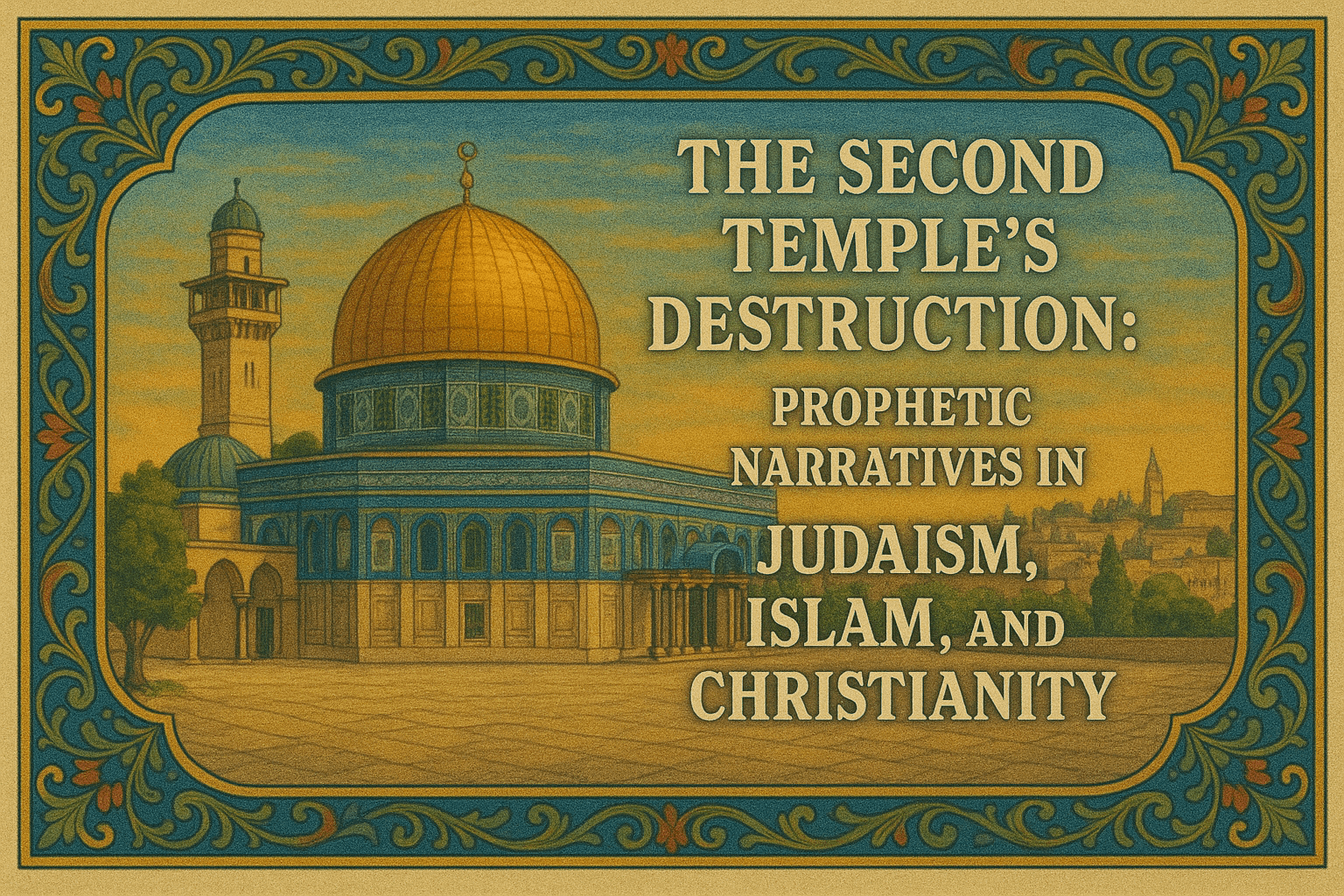
The Dome of the Rock in Jerusalem, which commemorates Muhammad’s Night Journey, symbolizes the continued connection between Abrahamic faiths. Islam is often seen as the final message that surpasses Judaism and Christianity.

Some scholars believe the Night Journey of the Prophet Muhammad to Heaven is theologically related to Daniel 7 verse 13. How is this argument explained?
The argument connecting the Night Journey of the Prophet Muhammad to Heaven with Daniel 7 verse 13 is based on theological interpretations that draw parallels between the two events. Here’s an explanation of this argument:
1. The Night Journey of Prophet Muhammad (الإسراء والمعراج):
According to Islamic tradition, the Night Journey (الإسراء) and Ascension (المعراج) is a miraculous event in which the Prophet Muhammad was transported from Mecca to Jerusalem and then ascended through the heavens, meeting various prophets and eventually coming into the presence of Allah.
2. Daniel 7 verse 13 in the Bible:
In the Book of Daniel in the Old Testament of the Bible, specifically in Daniel 7 verse 13, there is a prophecy that says: “I saw in the night visions, and behold, with the clouds of heaven there came one like a son of man, and he came to the Ancient of Days (that is, God) and was presented before him.” This verse is often interpreted as a reference to a messianic figure.
The argument connecting these two events revolves around the idea that both the Night Journey of Prophet Muhammad and the vision of “one like a son of man” in Daniel 7 verse 13 involve a figure coming into the presence of God. Some scholars, particularly in comparative religion and interfaith dialogue, suggest that there are thematic similarities between these events:
Divine Revelation: In both cases, there is a profound encounter with the divine. Prophet Muhammad ascended to the highest levels of heaven, and in Daniel 7 verse 13, the figure of “one like a son of man” is presented before the “Ancient of Days,” who is a divine entity.
Prophetic Roles: The figure in Daniel 7 verse 13 is often associated with a messianic or prophetic role. Similarly, Prophet Muhammad is considered the final prophet in Islam, and his Night Journey is seen as a confirmation of his messianic or prophetic role.
It’s important to note that this argument is primarily a matter of theological interpretation and interfaith dialogue. Different scholars and religious traditions may have varying perspectives on the significance and connections between these events.
 ABRAHAMIC THEOLOGY