
Azahari Hassim
The Dead Sea Scrolls foretell the coming of a priestly Messiah from the lineage of Aaron. Is it possible to explain the argument that Jesus was an Aaronic and priestly messiah instead of a Davidic and royal messiah, considering the connection between Mary and Elizabeth’s lineage, as mentioned in Luke 1, verse 5, and Luke 1, verse 36?
The Dead Sea Scrolls describe a priestly messiah descended from Aaron, the brother of Moses. Some scholars argue that Jesus may have been considered an Aaronic and priestly messiah, rather than a Davidic and royal messiah, due to the connection between the lineages of Mary and Elizabeth mentioned in the Gospel of Luke. Elizabeth was the mother of John the Baptist.
Luke 1, verse 5, states that Elizabeth was “of the daughters of Aaron“, while Luke 1, verse 36, mentions the relationship between Mary and Elizabeth, suggesting a priestly lineage for Jesus through his mother Mary.
Jesus’ lineage through his mother Mary is suggested that Mary’s lineage is connected to Aaron through her relative Elizabeth, who is described as being “of the daughters of Aaron”. This connection to the priestly line could be seen as fulfilling the Dead Sea Scrolls’ prediction of a priestly messiah who is a descendant of Aaron.
The Quran does not provide a detailed genealogy for Jesus, but links him with Mary, who is associated with the line of Imran, known in the Bible as Amram, the father of Aaron and Moses. This connection may lead to the belief that Jesus is traced back to Aaron and the Levite lineage.
Islamic scholars focus on Jesus’ prophethood and message rather than his lineage, unlike Christian scholars who emphasize the Davidic lineage. The Quran highlights Jesus and Mary’s piety and roles in God’s plan without emphasizing a Davidic or royal messianic lineage.
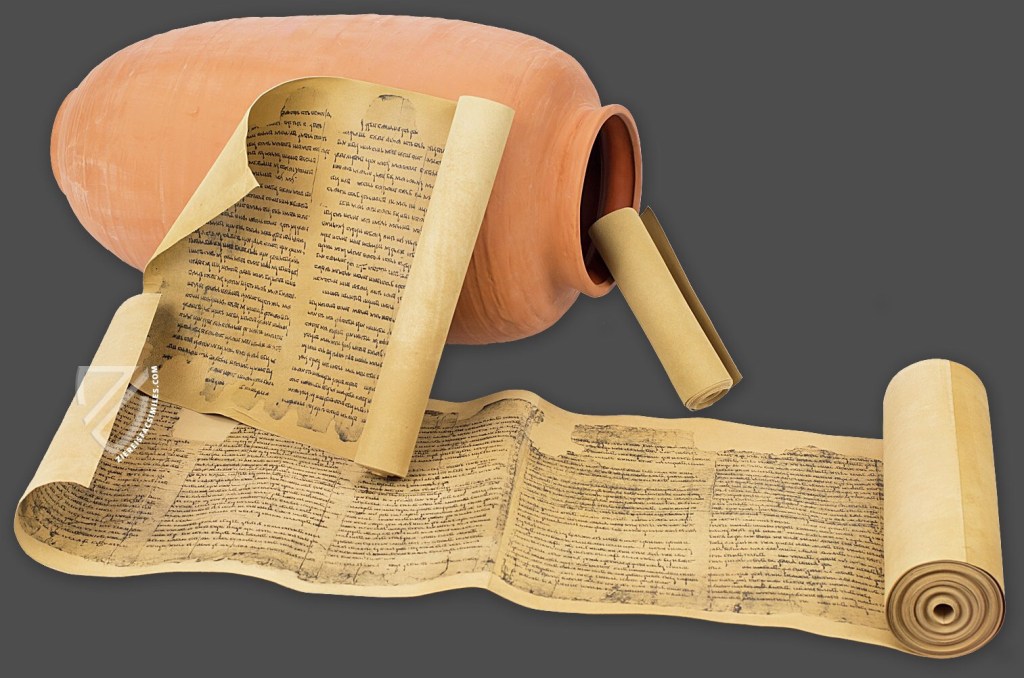
The Dead Sea Scrolls are a collection of ancient Jewish texts discovered between 1947 and 1956 in the Qumran Caves near the Dead Sea, in what is now Israel. These scrolls date from the third century BCE to the first century CE and include a variety of writings, such as biblical texts, apocryphal works, and sectarian manuscripts associated with the Jewish community known as the Essenes.
Key points about the Dead Sea Scrolls:
- Historical Significance: The scrolls provide invaluable insights into the religious beliefs, practices, and daily life of Jewish communities during the Second Temple period. They also shed light on the development of early Judaism and the context of early Christianity.
- Biblical Texts: Many of the scrolls contain copies of books from the Hebrew Bible, including Isaiah, Psalms, and Deuteronomy. These texts are among the oldest known manuscripts of the Hebrew Bible and have contributed to the study of biblical textual criticism.
- Sectarian Writings: Some scrolls reflect the beliefs and rules of the Essenes, a Jewish sect that likely lived in Qumran. These writings include the Community Rule, which outlines the community’s regulations, and the War Scroll, which describes an apocalyptic battle.
- Language and Material: The scrolls are primarily written in Hebrew, Aramaic, and Greek, and they are made from materials such as parchment and papyrus.
- Preservation and Access: The scrolls were preserved in the dry climate of the region, and many have been digitized and made accessible to researchers and the public. Ongoing studies continue to reveal new insights about their content and context.
The Dead Sea Scrolls are considered one of the most significant archaeological discoveries of the 20th century, profoundly impacting the fields of biblical studies, archaeology, and the understanding of Jewish history.
The Value of the Masoretic Text and Dead Sea Scrolls in Christian Biblical Scholarship
Which holds greater reliability from a Christian standpoint: the Hebrew Masoretic Text or the Dead Sea Scrolls?
From a Christian standpoint, both the Hebrew Masoretic Text and the Dead Sea Scrolls hold significant value for understanding the reliability of the biblical texts.
The Masoretic Text is a medieval manuscript tradition that has been the basis for many modern Bible translations. It is highly valued for its meticulous preservation of the Hebrew text through the work of the Masoretes, Jewish scribes who developed a system of pronunciation and grammatical guides to ensure accurate transmission of the Scriptures.
On the other hand, the Dead Sea Scrolls, which are older than the Masoretic Text, contain portions of nearly every book of the Old Testament and provide a snapshot of biblical texts as they existed around the Second Temple period.
They have been instrumental in confirming the reliability of the biblical text over time and in some cases, have provided variants that have enriched the understanding of certain passages.
In essence, both the Masoretic Text and the Dead Sea Scrolls contribute to the Christian understanding of the Bible’s reliability, each offering unique insights and affirming the care with which the biblical texts have been transmitted through the centuries. Scholars often use both, along with other ancient manuscripts, to produce the most accurate text possible.
The Dead Sea Scrolls are particularly valued for their antiquity and for providing evidence of the biblical text’s consistency over time, while the Masoretic Text is appreciated for its detailed preservation of the traditional Hebrew text.
Understanding Jesus as Messiah: Differing Expectations in Jewish and Christian Beliefs
There is a belief that Jesus was a messiah in the same sense as other messiahs before him. Scripturally, Jesus was not the apocalyptic messiah who was predicted by the Hebrew prophets to establish God’s kingdom in the Holy Land. Could you kindly provide an explanation for the meaning of the preceding statement?
The belief that Jesus was a messiah in the same sense as other messiahs before him refers to the idea that he was seen as a savior figure who would bring about spiritual redemption and salvation. In this context, messiah is understood as a leader or deliverer chosen by God to fulfill a specific role in the divine plan.
However, scripturally speaking, Jesus was not the apocalyptic messiah that many Jews were expecting based on the prophecies found in Hebrew scriptures. The traditional Jewish understanding of the apocalyptic messiah was of a powerful political and military leader who would liberate Israel from its enemies, establish God’s kingdom on earth in the Holy Land, and rebuild the Holy Temple in Jerusalem.
Jesus’ teachings and actions did not align with these expectations of a conquering warrior king. Instead, he preached about love, forgiveness, and spiritual transformation. He emphasized inner righteousness over outward displays of power. This led many Jews to reject Jesus as their expected messiah, that is, the apocalyptic messiah.
In Christian theology, Jesus is believed to be the fulfillment of Old Testament prophecies in a different way than what was traditionally expected. Christians see Jesus as the ultimate savior who brings salvation through his sacrificial death and resurrection, rather than through political conquest.
So, when it is said that Jesus was not the apocalyptic messiah predicted by Hebrew prophets to establish God’s kingdom in the Holy Land, it means that his role and mission were different from what many people at that time were anticipating based on their interpretation of scripture.
Who in the Old Testament is anointed with sacred oil to be God’s Messiah?
Numerous figures in the Old Testament were consecrated with holy oil to symbolize their appointment as holy messengers, commonly known as messiahs (anointed ones). Among them were:
- Kings: The most prominent examples are the kings of Israel and Judah. For instance:
Saul: Anointed by the prophet Samuel to be the first king of Israel (1 Samuel 10, verse 1).
David: Also anointed by Samuel to succeed Saul as king (1 Samuel 16, verse 13).
Solomon: Anointed by the priest Zadok and the prophet Nathan to succeed David (1 Kings 1, verse 39). - Priests: The high priests and their successors were also anointed with sacred oil, signifying their holy office. For example:
Aaron: Anointed by Moses to serve as the first high priest (Leviticus 8, verse 12). - Prophets: Occasionally, prophets were anointed to signify their special role and mission. For example:
Elisha: Anointed by Elijah to be his successor as a prophet (1 Kings 19, verse 16).
In the Old Testament, the act of anointing priests, kings, and prophets with holy oil was a crucial ceremony that identified them as “messiahs” or “anointed ones” in their specific positions.
The term “Messiah” is not restricted to one person but refers to different individuals who are anointed for specific purposes as directed by God.
 ABRAHAMIC THEOLOGY