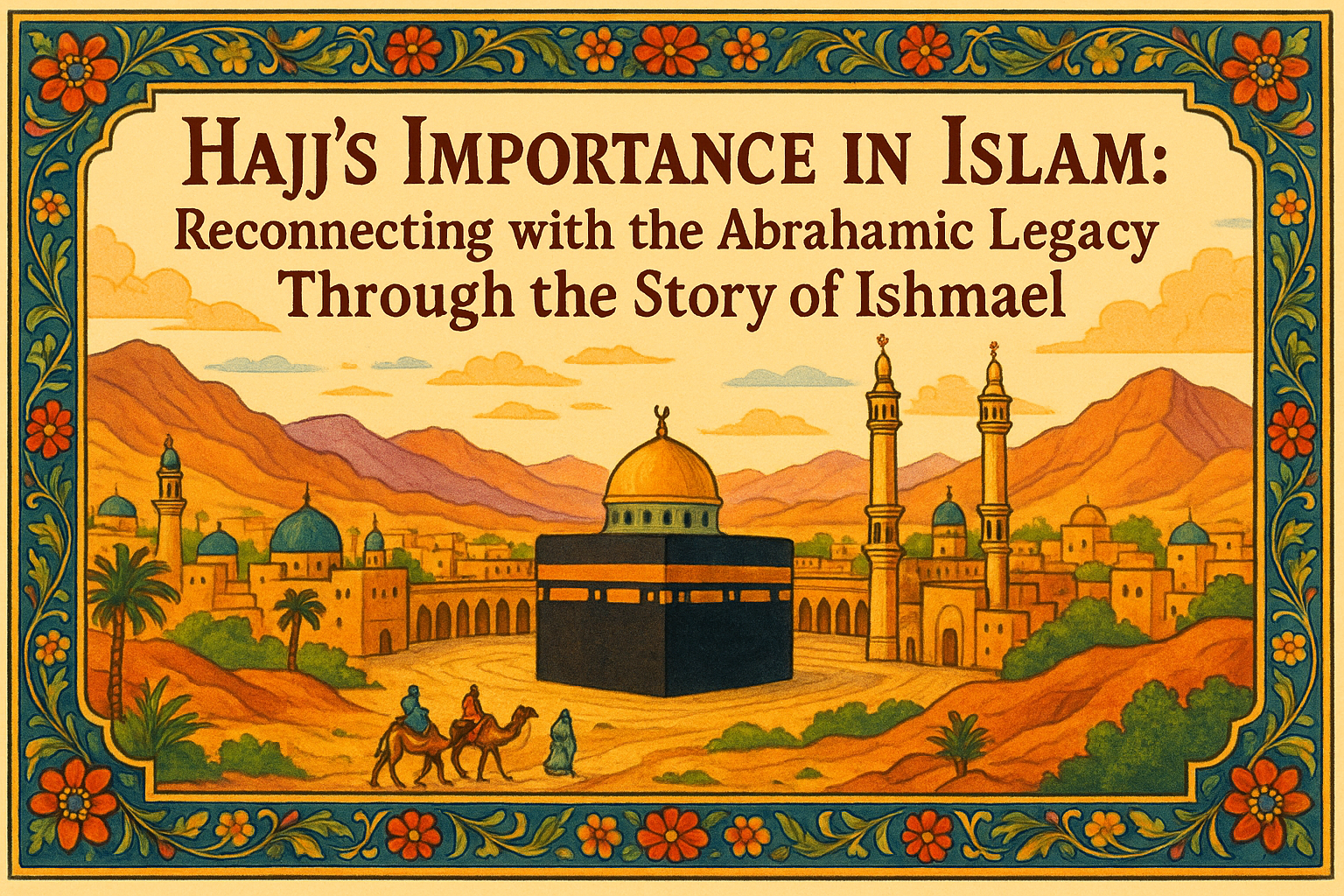
Azahari Hassim
There is an argument among scholars regarding the significance of Hajj in Islam as a restored religion tracing back to Abraham. It is posited that Ishmael was exiled as a young child well before the birth of Isaac, and that Ishmael, rather than Isaac, was the intended sacrifice. How is this argument articulated?
The argument regarding the significance of Hajj in Islam as a restored religion tracing back to Abraham, and the associated narrative involving Ishmael and Isaac, is articulated through several key points:
1. Lineage and Prophetic Tradition:
In Islamic tradition, Hajj is deeply connected to the figure of Abraham (Ibrahim). Muslims believe that Abraham, along with his son Ishmael (Ismail), played a foundational role in establishing the rites of Hajj. The Kaaba, the central structure around which Hajj is performed, is believed to have been built by Abraham and Ishmael.
2. The Story of Ishmael and Isaac:
Exile of Ishmael: According to Islamic narratives, long before Isaac was born, Ishmael and his mother Hagar were settled by Abraham in the desert of Mecca, which is where the Zamzam well miraculously appeared to sustain both of Hagar and her infant son Ishmael. This event is commemorated during the Hajj.
The Sacrifice: Islamic tradition holds that it was Ishmael, not Isaac, who was the intended sacrifice. This is based on interpretations of the Quran, specifically Surah 37, verses 100 to 113, where it is generally understood that the son who was to be sacrificed was Ishmael. According to the sequence of events in the Quran, the promise of Isaac’s birth comes after the story of sacrifice, indicating that Ishmael is the son in question.
This contrasts with the Judeo-Christian tradition, which identifies Isaac as the intended sacrifice.
3. Symbolic Acts of Hajj:
The rites of Hajj include reenactments and commemorations of events from the lives of Abraham, Hagar, and Ishmael. For instance:
The Sa’i, which involves walking seven times between the hills of Safa and Marwah, commemorates Hagar’s desperate search for water for her infant son Ishmael.
The stoning of the Jamarat represents Abraham’s rejection of Satan’s temptation, which is believed to have occurred when he was about to sacrifice Ishmael.
4. Restoration of Abrahamic Monotheism:
Islam views itself as a continuation and restoration of the pure monotheistic faith of Abraham. The Hajj serves as a means to reconnect with the Abrahamic legacy, emphasizing monotheism, obedience to God, and the unity of the Muslim community.
In summary, the argument hinges on the belief that Ishmael, rather than Isaac, was central to the narrative of sacrifice and that the rites of Hajj are rooted in the events of Abraham’s life as they unfolded in Mecca with Ishmael. This perspective underscores the significance of Hajj in Islam and its connection to Abraham as a pivotal prophet in the monotheistic tradition.
Abrahamic Covenant: Analyzing the Perspective of Fulfillment Through Ishmael
There is a belief among Islamic scholars that the Abrahamic covenant, fulfilled through Ishmael instead of Isaac, entails the promise of the land from the Nile River to the great river of Euphrates, along with the blessing to all nations through Abraham’s seed.
Those who hold this view argue that God asked Abraham to offer Ishmael, not Isaac. They also contend that the ancient Israelite scribes altered their scriptures.
In contrast, the Israelites are bound by the Sinai covenant, which highlights communal responsibilities and accountability to God and to each other as part of the agreement between God and the Israelites. What is the articulation of their argument?
The argument that the Abrahamic covenant is fulfilled through Ishmael rather than Isaac involves several key points articulated by those who support this view. Here is a summary and analysis of their arguments:
- Promise of the Land: Proponents of this view argue that the promise of the land extending from the Nile River to the Euphrates, as mentioned in Genesis 15, verse 18, was intended for the descendants of Ishmael. They believe that this geographic expanse aligns with the territories historically associated with Islam and Muhammad, who was a descendant of Ishmael.
- Blessing to All Nations: They interpret the promise of blessings to all nations through Abraham’s seed (Genesis 12, verse 3, and Genesis 22, verse 18) as being fulfilled through Muhammad (Surah 21, verse 107) which reads: “And We have not sent you (O Muhammad) but as a mercy for the unto all beings.” They argue that Islam, preached by Muhammad, has had a significant historical and cultural impact on a global scale, thus fulfilling the promise of being a blessing to all nations.
- Sacrifice of Ishmael: This argument hinges on the belief that God asked Abraham to offer Ishmael as a sacrifice, rather than Isaac. This is primarily based on Islamic tradition found in the Quran (Surah 37, verses 99 to 113), which states that Abraham was asked to sacrifice his son, and many Muslims believe this son was Ishmael. They argue that this narrative was the original one, which was later altered by Israelite scribes to place Isaac in the position of the sacrificial son.
- Scriptural Alterations: Supporters of this view contend that ancient Israelite scribes altered the scriptures to reflect Isaac as the chosen son who was to be sacrificed and through whom the covenant would be fulfilled. They believe that these alterations were made to establish and legitimize the Israelite claim to the covenantal promises.
Sinai Covenant Context
The Sinai covenant, distinct from the Abrahamic covenant, focuses on the relationship between God and the Israelites, emphasizing communal responsibilities and accountability. This covenant, given at Mount Sinai, includes the Ten Commandments and a detailed code of laws that govern the moral, religious, and social conduct of the Israelite community. The Sinai covenant underscores the idea that the Israelites are to be a holy nation and a kingdom of priests, dedicated to serving God and adhering to His commandments.
Articulation of Their Argument
Those who argue for the fulfillment of the Abrahamic covenant through Ishmael articulate their position by highlighting these key points:
- Historical and Geographic Claims: They argue that the promise of the land and blessings align more closely with the historical and geographic realities of Ishmael’s descendants rather than those of Isaac.
- Islamic Tradition: They cite Islamic scripture and tradition, which they believe preserves the original account of the sacrifice involving Ishmael, rather than Isaac. This account is viewed as being more authentic and less altered than the Hebrew Bible’s version.
- Critical View of Scripture: They take a critical view of the Hebrew Bible, suggesting that it underwent alterations by Israelite scribes to support their theological and political claims. They argue that these changes were made to establish a narrative that centers on Isaac and his descendants as the primary inheritors of God’s covenant with Abraham.
- Fulfillment Through Ishmael’s Lineage: They believe that the widespread influence and significance of Ishmael’s descendants fulfill the covenantal promises more broadly and inclusively, aligning with the idea of being a blessing to all nations.
In summary, the viewpoint that the Abrahamic covenant is realized through Ishmael instead of Isaac is based on scriptural interpretations, historical context, and theological perspectives. This stands in contrast to the conventional interpretation of the covenant, which is linked to Isaac’s descendants, and underscores notable distinctions between the Abrahamic and Sinai covenants.
Islamic Views on the Abrahamic and Sinai Covenants in Relation to Heritage and Relics
There is no specific Abrahamic relic that has been preserved through Jewish generations, similar to the Kaaba, the Black Stone (Hajar al-Aswad) and the Station of Abraham (Maqam Ibrahim) in Islam. The sole significant artifact associated with Jewish heritage is the Ark of the Covenant.
However, it is important to note that the Ark can be traced back to Moses rather than Abraham and was lost during the destruction of the First Temple. Consequently, Islamic scholars maintain that the Israelites were bound by the Sinai Covenant, while Muslims are considered to be under the Abrahamic Covenant. How does their argument go?
The argument presented by Islamic scholars regarding the Abrahamic Covenant and the Sinai Covenant is based on several theological and historical points. To understand their perspective, let’s break down the key elements:
- Abrahamic Covenant vs. Sinai Covenant: The Abrahamic Covenant is believed to be the original covenant between God and Abraham, which includes promises of land, descendants, and blessings.
The Sinai Covenant, also known as the Mosaic Covenant, was established between God and the Israelites through Moses at Mount Sinai. - Islamic view on continuity: Islamic scholars argue that Muslims are the true inheritors of the Abrahamic Covenant, which they consider to be universal and eternal.
They contend that the Sinai Covenant was specific to the Israelites and was temporary or conditional. - Lack of physical relics: The absence of a specific Abrahamic relic in Jewish tradition, comparable to the Kaaba, the Black Stone, or the Station of Abraham in Islam, is seen by some Islamic scholars as significant.
They argue that this absence might indicate a break in the direct line of Abrahamic heritage. - The Ark of the Covenant: While the Ark of the Covenant is a significant artifact in Jewish history, it is associated with Moses rather than Abraham.
Its loss during the destruction of the First Temple is sometimes interpreted by Islamic scholars as a symbolic end to the Sinai Covenant. - Islamic claim to Abrahamic heritage: Islamic scholars often emphasize the direct lineage of Muhammad to Abraham through Ishmael.
They argue that Islam represents a restoration of the original Abrahamic monotheism, unencumbered by later additions or alterations. - Universality vs. particularity: The Islamic view often presents the Abrahamic Covenant as universal, meant for all of humanity.
In contrast, they view the Sinai Covenant as particular to the Israelites and not binding on all people. - Supersessionism: Some Islamic interpretations incorporate a form of supersessionism, suggesting that Islam supersedes earlier revelations and covenants.
It’s important to note that this argument represents a specific Islamic perspective and is not universally accepted outside of Islamic scholarship. Jewish and Christian traditions have their own interpretations of these covenants and their ongoing relevance. The topic of covenants and their applicability is a complex theological issue with various interpretations across different faith traditions.
Ishmael: The Rightful Heir of the Abrahamic Covenant – Revisiting Biblical Circumcision and Lineage
The Abrahamic covenant stands as a foundational pillar in the sacred histories of Judaism, Christianity, and Islam. Central to this covenant is the rite of circumcision, instituted by God as a binding sign between Himself and Abraham’s descendants.
Traditionally, Jewish and Christian interpretations assert that Isaac, the son born to Abraham and Sarah, is the rightful heir through whom this covenant is fulfilled.
However, a careful reexamination of the biblical chronology challenges this assumption. This article argues that Ishmael, not Isaac, was the first and only son to receive the covenantal sign alongside Abraham himself—prior to Isaac’s birth—thereby establishing Ishmael as the sole and true heir of the original Abrahamic covenant. By exploring the timing, recipients, and implications of circumcision in Genesis 17 and 21, this piece invites readers to reconsider long-held views and appreciate the overlooked centrality of Ishmael in the divine covenant.
1. The Biblical Basis for Circumcision as a Covenant
The Bible establishes circumcision as the sign of the covenant between God and Abraham:
Genesis 17:9–11:
“Then God said to Abraham, ‘As for you, you must keep my covenant, you and your descendants after you for the generations to come. This is my covenant with you and your descendants after you, the covenant you are to keep: Every male among you shall be circumcised… it will be the sign of the covenant between me and you.’”
Here, circumcision is the definitive sign of the Abrahamic covenant.
2. The Timing of Circumcision Before Isaac’s Birth
The Bible affirms that circumcision was performed before Isaac was born:
Genesis 17:23–26:
“On that very day Abraham took his son Ishmael and all those born in his household or bought with his money, every male in his household, and circumcised them, as God told him… Abraham was ninety-nine years old when he was circumcised, and his son Ishmael was thirteen.”
At this critical juncture, only Abraham and Ishmael were Abraham’s natural descendants to receive the sign of the covenant. Isaac had not yet been born.
3. Ishmael as the Sole and True Heir of the Abrahamic Covenant
This sequence of events reveals that:
Circumcision is the outward and binding sign of the Abrahamic covenant.
Ishmael was the only son of Abraham present to receive this sign alongside him.
All others circumcised at that time were household members and servants—not Abraham’s direct offspring.
Therefore, Ishmael alone stands as the true and sole heir of the Abrahamic covenant, sharing this foundational covenantal sign with Abraham himself.
4. Isaac as Merely a Participant Like Other Household Members
When Isaac was born, he too was circumcised on the eighth day (Genesis 21:4). However, this circumcision occurred after the covenant was already established through Abraham and Ishmael. Like the other members of Abraham’s household, Isaac simply entered into an existing covenantal practice rather than establishing or uniquely embodying it.
In this understanding:
Isaac’s circumcision parallels that of Abraham’s other household members.
He was brought into the covenantal sign but did not share in the original covenantal enactment alongside Abraham.
Thus, Isaac is seen merely as a participant in the Abrahamic covenant, not as its unique heir.
5. Distinction from the Sinai Covenant
The Sinai covenant was revealed exclusively to the descendants of Isaac through Jacob (Israel), establishing a separate covenantal framework for the Israelites.
In contrast, the original Abrahamic covenant—established through circumcision before Isaac’s birth—finds its complete and exclusive fulfillment in Ishmael, who was the first to embody and share this sign with Abraham.
6. Challenging Traditional Jewish and Christian Views
Traditionally, Jewish and Christian interpretations place Isaac as the sole heir of the Abrahamic covenant. However, this argument radically reorients that view:
Ishmael alone shares the covenantal enactment with Abraham.
Isaac, like the other household members, enters a covenantal practice already established.
Therefore, Ishmael alone emerges as the true and rightful heir of the Abrahamic covenant.
Summary of the Articulation
Circumcision, the outward sign of the Abrahamic covenant, was first performed on Abraham and Ishmael before Isaac was born. This historical reality establishes that while Isaac and others in Abraham’s household were participants in the sign of the covenant, only Ishmael shared in the covenant’s original establishment and thus stands as its true and exclusive heir. In this perspective, Ishmael’s role transcends mere participation—he alone embodies the Abrahamic covenant in its full and foundational form.
 ABRAHAMIC THEOLOGY