Azahari Hassim
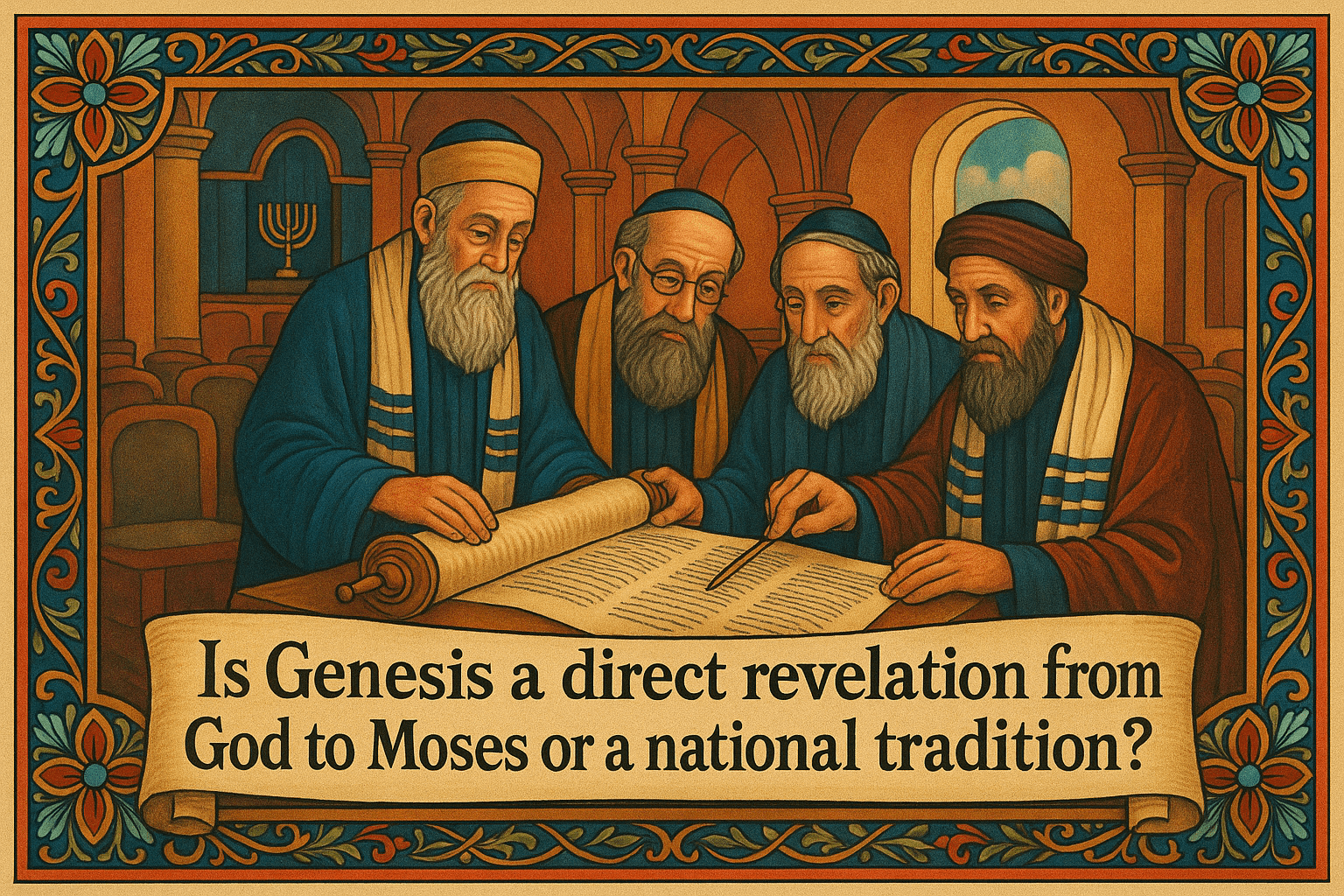
Is the story in Genesis known to the Israelites long before the birth of Moses and is it not a direct revelation from God to Moses, but rather a national tradition handed down from their ancestors? How did this tradition become formalized as scripture?
The stories in the book of Genesis likely originated as oral traditions passed down through generations before being written. These narratives, including creation, the patriarchs, and early human history, reflect the cultural context of the ancient Near East, with parallels to Mesopotamian myths.
Many scholars believe that rather than being direct revelations to Moses, Genesis consists of national traditions expressing the Israelites’ collective experiences and understanding of God. Moses may have played a role in formalizing these stories, but he likely did not author them.
The transition from oral to written form occurred over centuries, possibly beginning during the Monarchy (around 1000 BCE) and intensifying during the Babylonian exile (6th century BCE). Scribes compiled these traditions into the Pentateuch, which later underwent editing and canonization.
In summary, the stories in Genesis likely existed as oral traditions long before Moses. They were part of the Israelites’ national heritage and identity, handed down from their ancestors. These traditions were later collected, edited, and formalized into scripture through a process involving various authors, scribes, and community leaders over several centuries, culminating in the canonical form we recognize today.
The direct revelation of God to Moses and the children of Israel primarily refers to the events described in the books of Exodus, Leviticus, Numbers, and Deuteronomy. These moments of direct communication serve as the foundation of Israelite religion and law. Here are the key instances of this revelation:
- The Burning Bush (Exodus 3): God reveals His name (Yahweh) and commissions Moses.
- Mount Sinai (Exodus 19-20): God gives the Ten Commandments and speaks to the people.
- The Covenant Code (Exodus 21-23): Laws for social and ethical conduct.
- Tabernacle Instructions (Exodus 25-40, Leviticus): Guidelines for worship, sacrifices, and the priesthood.
- Renewal of the Law (Deuteronomy): Moses reiterates the law and covenant before his death.
- Wilderness Guidance (Numbers): Divine guidance through a cloud and fire, and various miracles.
These revelations establish God’s covenant, laws, and Israel’s religious identity.
In summary, the direct revelations given to Moses and the Israelites mainly center on God’s laws, ethical instructions, and covenantal promises, shaping the theological and moral foundation of the Israelite community.

Pre-Islamic Arab Tradition vs Torah
According to established tradition, prior to the advent of Muhammad, the Arabs believed that their ancestor Abraham was on the verge of offering his son Ishmael as a sacrifice to God. It is believed that their pre-Islamic tradition about Ishmael predates the Torah given to Moses. How is their argument articulated?
Scholars argue that the oral traditions of the Arabs, including those surrounding Ishmael, predate the written texts of the Torah. This assertion is based on the notion that oral traditions can be older than their written counterparts, as they may have been passed down through generations long before being codified in scripture.
The argument that the pre-Islamic Arab tradition about Ishmael predates the Torah given to Moses is articulated through several points:
- Historical Narratives: Early Arab traditions held that Ishmael, not Isaac, was the son Abraham was commanded to sacrifice. This belief is deeply rooted in the cultural and religious narratives of pre-Islamic Arabia.
- Religious Significance: The story of Ishmael’s near-sacrifice is significant in Islam, where it is believed that both Abraham and Ishmael willingly submitted to God’s command. This act of submission is seen as a profound demonstration of faith and obedience.
- Cultural Artifacts: Some early Muslim scholars argued that the horns of the ram, which was sacrificed in place of Ishmael, were once displayed in the Kaaba, suggesting a long-standing tradition that predates Islamic scripture.
- Jealousy Argument: There is also an argument that Jews claimed Isaac was the intended sacrifice out of jealousy, as Ishmael is considered the ancestor of the Arabs.
These points collectively support the belief that the tradition of Ishmael’s near-sacrifice has ancient roots, predating the Torah and reflecting the unique relationship between God and the Arab people.
Interestingly, before the rise of Islam, ancient Arabs in Mecca circumcised their children at the age of 13 or 14. Did they inherit this practice from the Torah, which requires circumcision at eight days, or was it a tradition tracing back to Abraham that predated the Torah?
It is plausible that the tradition of circumcision among ancient Arabs in Mecca traced back to Abraham, who is considered a common ancestor by both Jews and Arabs. It could be that this practice was passed down through generations independently of any direct influence from the Torah or Judaism.
The Divergent Accounts of Abraham, Hagar, and Ishmael in Islamic and Judeo-Christian Traditions
Islamic tradition holds that Abraham left his wife Hagar and their son Ishmael alone in the desert near Mecca. Ishmael was still an infant at the time. The interpolation of Genesis 21, verses 9 to 10, is therefore evident from this event. How are they articulating their argument?
The argument regarding the interpolation of Genesis 21, verses 9 to 10, in the context of Abraham, Hagar, and Ishmael is articulated by contrasting the Islamic tradition with the Judeo-Christian narrative. Here’s how the argument is framed:
- Divine Command Versus Human Jealousy:
In Islamic tradition, Abraham’s decision to leave Hagar and Ishmael in the desert was a direct command from God as a test of faith. This is seen as a noble and divinely ordained act, rather than a result of Sarah’s jealousy.
In the Judeo-Christian narrative, the banishment is attributed to Sarah’s jealousy when she saw Ishmael “mocking” Isaac, which led her to demand their expulsion.
- Age Discrepancy:
Islamic sources describe Ishmael as a nursing infant when he was left in the desert, which aligns with the practical details of Hagar carrying him and the subsequent events.
The Bible suggests Ishmael was about 17 years old, which raises logical issues about Hagar carrying him and the depiction of him as a helpless child under a bush.
- Miraculous Provision:
In Islamic tradition, the story emphasizes the miraculous provision of water through the Zamzam well, which is a central part of Hajj rituals and symbolizes God’s care and provision.
The Judeo-Christian account also mentions divine intervention, but it does not have the same ritualistic and symbolic significance as in Islam.
- Cultural and Religious Impact:
The Islamic narrative underscores the foundational role of Ishmael and Hagar in the establishment of Mecca and the Kaaba, highlighting their importance in Islamic tradition.
In contrast, Ishmael plays a minor role in Judeo-Christian traditions, primarily recognized as the ancestor of the Arabs but not central to religious practices.
Conclusion
The interpolation argument is articulated by highlighting these differences and suggesting that the Genesis account may have been influenced or altered to fit the theological and cultural context of the Judeo-Christian tradition. The Islamic narrative, with its emphasis on divine command and the early age of Ishmael, presents a coherent and practical story that aligns with the physical and spiritual elements of the Hajj pilgrimage, thus offering a distinct perspective on the events surrounding Abraham, Hagar, and Ishmael.
 ABRAHAMIC THEOLOGY