Azahari Hassim
Excerpt from Notes on the Bible by Albert Barnes (1834) on Isaiah 60:7
The time will come, however, when Arabia, so interesting as settled by the descendants of Abraham; so interesting in the bold, active, and energetic character of its tribes; so interesting as using a language that is one of the most refined and far-spoken of the earth; and so interesting as being, in some parts at least, among the most fertile and beautiful of the earth, shall be converted to God.
Excerpt from The Wycliffe Bible Commentary on Isaiah 60, verses 4 to 7:
It is quite remarkable that, in origin, all these offered treasures are preponderantly Arabian. Perhaps there is a suggestion here that Islam will some day turn to the Cross.
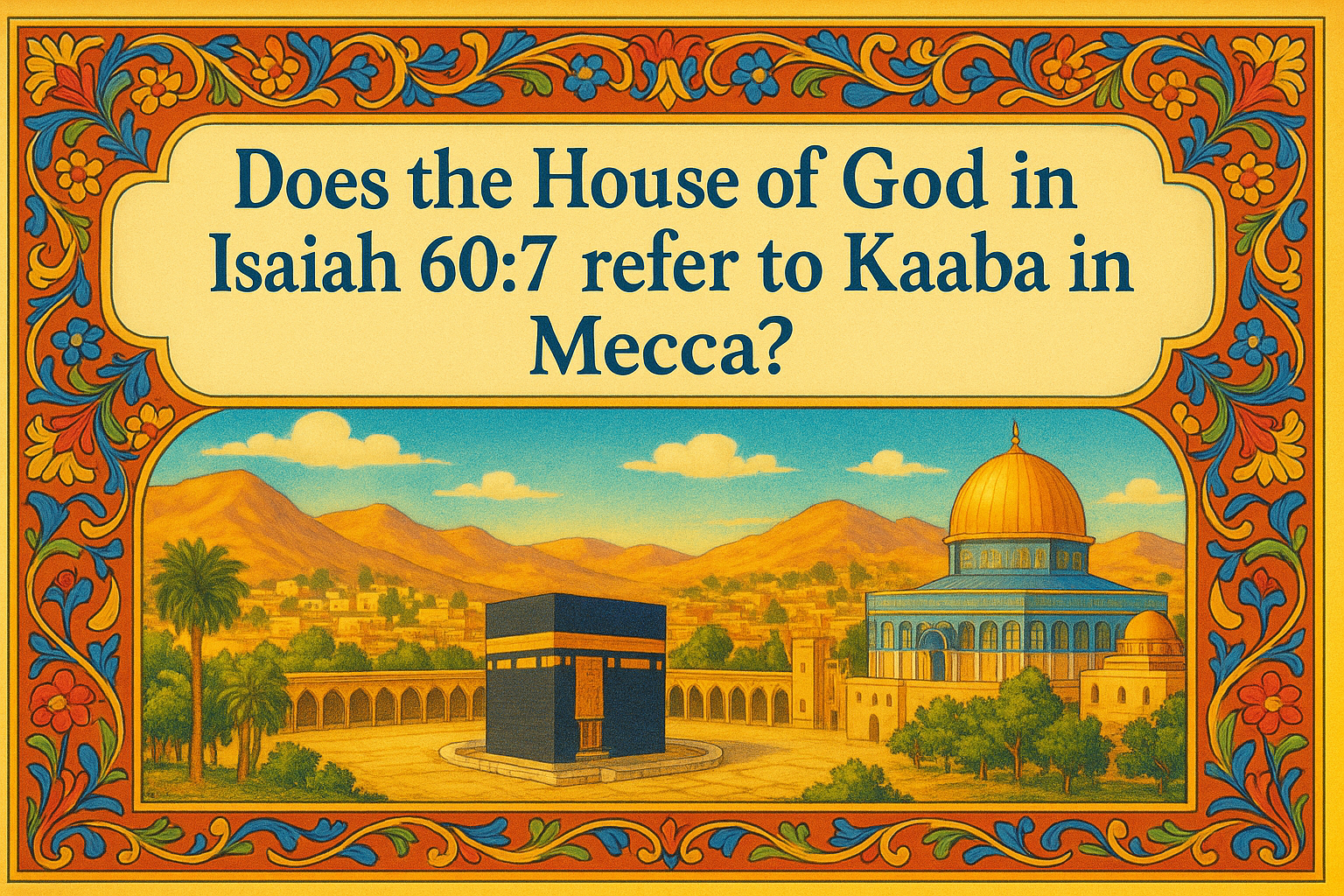
Some believe that the “House of God” mentioned in Isaiah 60, verse 7, refers to the Kaaba, which will be restored as a place dedicated to the God of Abraham.
They connect this verse with the phrase ‘God was with the lad,’ referring to Ishmael in Genesis 21:20. This suggests a specific sacred location where God’s presence would be particularly manifest.
In other words, Abraham left Ishmael and Hagar near the House of God (the Kaaba) and dedicated them to God, as noted in Surah 14, verse 37 of the Quran. How does their argument proceed?
The argument that Isaiah 60, verse 7, refers to the Kaaba and connects with the story of Ishmael in Genesis 21, verse 20, and Surah 14, verse 37, of the Quran is built on several interwoven interpretations from both the Bible and Islamic tradition.
Key Points of the Argument:
1. Isaiah 60:7, and the Kaaba:
Isaiah 60, verse 7, speaks of “the flocks of Kedar” and “the rams of Nebaioth” being gathered and accepted on God’s altar, followed by the glorification of a “glorious house.” Kedar and Nebaioth are descendants of Ishmael, which leads some interpreters to associate this verse with the Arabs, who are traditionally considered descendants of Ishmael.
The “glorious house” is interpreted by some as referring to the Kaaba in Mecca. This interpretation is supported by the belief that Abraham and Ishmael built the Kaaba as a house dedicated to God, making it a sacred site for monotheistic worship. The gathering of Kedar’s flocks is seen as a prophecy about future Arab worship at this site, particularly during the Hajj pilgrimage.
2. Genesis 21:20, and “God was with the lad”:
These scholars argue that the phrase suggests not only divine safeguarding but also refers to a specific sacred location. They connect this notion to Surah 14, verse 37 of the Quran, where Abraham implores:
“O our Lord! I have settled some of my offspring in an uncultivated valley near Your Sacred House.”
The parallels between these texts are viewed as supporting evidence that Ishmael was situated near the Kaaba (the House of God), a place believed to be particularly infused with God’s presence.
3. Surah 14:37, and the Sacred House:
In Surah 14, verse, 37, Abraham prays after leaving Hagar and Ishmael in a barren valley near God’s “Sacred House” (interpreted as the Kaaba). This Quranic passage reinforces the idea that Abraham intentionally placed his son near this sacred site, which would later become central to Islamic worship.
The prayer also asks for people’s hearts to be inclined toward this place, which some interpret as foreshadowing the establishment of Mecca as a center for monotheistic worship, particularly during Hajj.
Theological Implications:
The argument suggests that Isaiah 60, verse 7, is a prophetic vision about Mecca and its significance in future worship. By connecting this verse with Genesis 21, verse 20, proponents argue that God’s promise to make Ishmael into a great nation (Genesis 21, verse 18) finds its ultimate fulfillment in Mecca, where his descendants would worship God at the Kaaba.
This interpretation also ties into Islamic theology, where Abraham’s legacy is closely linked to the Kaaba. The Hajj rituals, including animal sacrifices during Eid al-Adha, are seen as fulfilling prophetic visions like those in Isaiah.
In summary, proponents of this view argue that Isaiah 60, verse 7, refers to the Kaaba and its role in future worship by Ishmael’s descendants. They connect this with Genesis 21, verse 20 (“God was with the lad“) and Surah 14, verse 37 (Abraham settling Ishmael near God’s sacred house), suggesting that these texts collectively point towards Mecca as a divinely favored location for monotheistic worship.
Hajj as the Fulfillment of Abrahamic Prophecy
Torah, Genesis 22 verse 18, reads:
“And in thy seed shall all the nations of the earth be blessed; because thou hast obeyed my voice.”
It is believed the event of the Hajj in Mecca is the fulfillment of the biblical prophecy of Genesis 22 verse 18. According to the Islamic belief, Abraham offered Ishmael, not Isaac, as a sacrifice to God, emphasizing Ishmael’s role in fulfilling God’s covenant with Abraham. The event of Hajj proves that God made a covenant with Abraham through Hagar and Ishmael rather than Sarah and Isaac. How is this viewpoint presented?
The viewpoint that the Hajj in Mecca is a fulfillment of the biblical prophecy of Genesis 22 verse 18, and represents a covenant made by God with Abraham through Hagar and Ishmael, rather than Sarah and Isaac, is articulated based on several key aspects of Islamic belief and interpretation of religious texts:
- Prophecy of Genesis 22 verse 18: The verse in Genesis states, “And in thy seed shall all the nations of the earth be blessed; because thou hast obeyed my voice.” Some interpret this as a prophecy that is fulfilled through the descendants of Ishmael, Abraham’s son with Hagar. The Islamic narrative holds that it was Ishmael, not Isaac, who was offered by Abraham as a sacrifice to God. This signifies Ishmael’s importance in the fulfillment of God’s covenant with Abraham. The Hajj, as a major Islamic ritual commemorating the actions of Abraham and Ishmael, is seen as a manifestation of this blessing.
- The Hajj and Ishmael’s Legacy: In Islamic tradition, the Hajj includes rituals that are believed to commemorate the life and trials of Abraham and his son Ishmael. The ritual of Sa’i, where pilgrims travel back and forth between the hills of Safa and Marwah, is seen as a re-enactment of Hagar’s desperate search for water for her infant son Ishmael. According to Islamic belief, the well of Zamzam originated to rescue baby Ishmael.
- The Kaaba and Islamic Tradition: The Kaaba in Mecca, which is the focal point of the Hajj, is believed in Islamic tradition to have been built by Abraham and Ishmael as a house of worship to the one true God. This act of establishing monotheism in the region is viewed as a key part of fulfilling God’s covenant with Abraham.
- Universal Blessing and Unity of Humankind: The Hajj is seen as a fulfillment of God’s promise to bless all nations through Abraham’s descendants. The gathering of millions of Muslims from diverse nations during Hajj is viewed as a symbol of this blessing and the unity of humankind under God’s guidance.
- Continuity of Abrahamic Tradition: The Hajj is also seen as a continuation and fulfillment of the Abrahamic tradition of monotheism. This perspective posits that Islam, as the final revelation in the Abrahamic tradition, fulfills and perfects earlier revelations given to Jews and Christians.
This viewpoint is part of the broader Islamic interpretation of religious history, which sees Islam as both a continuation and a completion of the monotheistic tradition established by Abraham.
Abraham’s Covenant in Islamic Theology
Surah 2, verses 124 to 125 of the Quran read:
“And when his Lord tested Abraham with certain words, and he fulfilled them. God said, “I am making you a leader of humanity.” Abraham said, “And my descendants?” God said, “My covenant does not include the wrongdoers.”
“And We made the House a focal point for the people, and a sanctuary. Use the shrine of Abraham as a place of prayer. And We commissioned Abraham and Ishmael, “Sanctify My House for those who circle around it, and those who seclude themselves in it, and those who kneel and prostrate.”
The phrase “And when his Lord tested Abraham with certain words,” presented in verse 124, is understood by Quranic commentators to refer to the tests and commands that God imparted to Abraham. These included leaving his family in a barren land, sacrificing his son Ishmael, rebuilding the Kaaba (House of God), and instituting the rite of circumcision.
The Quran clearly states in Surah 2, verse 124 that God made a covenant with Abraham through his son Ishmael, not Isaac. The covenant was established prior to the birth of Isaac, who is regarded as a divine gift to Abraham and Sarah, a result of Abraham’s readiness to offer Ishmael as a sacrifice.
In this context, Ishmael is understood as a son dedicated to God, whereas Isaac is considered a son of blessing for Abraham and Sarah. This contradicts the Biblical account which portrays Isaac as the son who was to inherit the covenant from Abraham.
According to the Quran and Islamic tradition, the Biblical account was distorted to diminish Ishmael’s status as Abraham’s heir in favor of Isaac. This alteration is thought to stem from the bias of Jewish scribes toward the Israelite lineage.
The Quran asserts that it rectifies this distortion by confirming Ishmael as the son who carried on Abraham’s legacy in accordance with the original divine covenant. Additionally, the divine selection of the ancient Israelites and their Hebrew prophets before the advent of Islam is seen as a preparation for the arrival of Muhammad, the final Prophet.
The Fulfillment of Prophecy: The Jewish Rabbi’s Admiration for Islam’s Sacrificial Legacy
Religious traditions frequently assert their divine fulfillment, searching for validation of their legitimacy and divine favor within their scriptures. A notably significant moment in Islamic history illustrates this dynamic—when a Jewish rabbi came to Caliph ʿUmar ibn al-Khaṭṭāb with a remarkable confession: “If a verse like this had been revealed to us Jews, we would have declared the day of its revelation a festival day.” The verse in question is from Surah al-Mā’idah (5:3):
“This day I have perfected for you your religion, completed My favor upon you, and have chosen for you Islam as your religion.”
This Quranic declaration came during the Prophet Muhammad’s final pilgrimage (Ḥajj), marking the formal completion of Islam as a revealed religion. But why would a Jewish rabbi regard this verse with such admiration—perhaps even envy? To understand this, we must explore a prophetic verse from the Hebrew Bible, found in Isaiah 60:7, and analyze how Islamic rituals, particularly the Ḥajj, embody the prophetic vision better than the expectations of either Judaism or Christianity.
Isaiah 60:7 – A Sacrificial Vision Involving Arabs
The Hebrew verse in Isaiah reads:
“All the flocks of Kedar shall be gathered unto thee, the rams of Nebaioth shall minister unto thee: they shall come up with acceptance on Mine altar, and I will glorify the house of My glory.”
(Isaiah 60:7)
This verse envisions a time when the descendants of Kedar and Nebaioth, two sons of Ishmael (Genesis 25:13), will offer sacrifices acceptable to God. The mention of “Mine altar” and “house of My glory” is generally understood by Jewish commentators to refer to the Temple in Jerusalem, where animal sacrifices were once offered according to the Torah.
Yet, the destruction of the Second Temple in 70 CE left a void in Jewish religious life. Without the altar, the sacrificial system central to the Mosaic covenant could no longer be practiced. Jews have since longed for the rebuilding of the Third Temple, expecting the resumption of sacrificial rites in fulfillment of such prophetic verses.
But here lies the tension: the sacrificial act involving the Ishmaelite tribes—Arabs from the lineage of Kedar and Nebaioth—has not been realized in Judaism. Instead, it is in Islam’s Ḥajj rituals, especially the ʿEid al-Aḍḥā sacrifice, that this prophecy seems to find a living expression.
Islam’s Living Sacrifice: A Fulfillment of Isaiah?
During the annual pilgrimage in Mecca, Muslims from all over the world—many of them literal descendants of Ishmael—participate in animal sacrifices in remembrance of Abraham’s willingness to sacrifice his son (identified in Islam as Ishmael, not Isaac). These animals are offered near the Kaʿbah, the sanctuary Muslims believe was originally built by Abraham and Ishmael.
The connection becomes theologically provocative:
Kedar and Nebaioth: Represent Ishmaelite tribes, settled in the Arabian Peninsula.
Offerings accepted on the altar: The animals offered during Ḥajj are intended as acts of devotion to God, distributed to the poor in a ritual of divine acceptance.
“House of My glory”: In Islamic interpretation, this refers not to the destroyed Temple in Jerusalem, but to the Kaʿbah in Mecca—revived and purified by Prophet Muhammad, a descendant of Ishmael.
This paradigm effectively transfers the axis of prophetic fulfillment from Jerusalem to Mecca, and from Temple Judaism to Islam. The Jewish rabbi, recognizing this shift, would understandably feel a mix of reverence and regret—hence his comment to ʿUmar.
Christianity and the Sacrifice: Atonement Without Altars
Christianity diverges sharply in interpreting sacrificial themes. For most Christians, Jesus’ crucifixion is understood as the once-for-all sacrifice that atones for sin, rendering animal offerings obsolete:
“We have been made holy through the sacrifice of the body of Jesus Christ once for all.”
(Hebrews 10:10)
Thus, Isaiah 60:7, with its focus on physical offerings and ritual sacrifice, is often spiritualized or placed in an eschatological future. Some Christian theologians believe it refers to Arab conversion to Christianity in the end times, where the imagery of Kedar and Nebaioth signifies a gentile embrace of the Gospel.
Yet, the explicit association with animal sacrifice, a practice explicitly abandoned in Christian theology, remains problematic for this interpretation. Islam, by contrast, continues the sacrificial rites within a monotheistic framework that maintains Abrahamic purity and the legacy of Ishmael.
The Quranic Rebuttal: Abraham Was Neither Jew Nor Christian
The Qur’an addresses this theological contention directly in Surah Āl ʿImrān (3:67):
“Abraham was neither a Jew nor a Christian, but he was a monotheist, submitting to God (a Muslim), and he was not of the polytheists.”
Islam positions itself not as a new religion but as the restoration of the pure monotheism of Abraham, inclusive of the sacrificial rites and covenantal practices once diluted or abandoned by later traditions.
Conclusion: A Verse to Be Envied
The statement of the Jewish rabbi to ʿUmar ibn al-Khaṭṭāb reflects a profound religious realization: Islam had fulfilled a prophecy that Jews were still awaiting. The verse in Surah 5:3, revealed during the Prophet’s final pilgrimage, proclaims the completion of divine religion and favor:
“This day I have perfected for you your religion, completed My favor upon you, and have chosen for you Islam as your religion.”
This stands in sharp contrast to Judaism’s waiting for the Third Temple and Christianity’s departure from sacrificial rites. Islam emerges as the living continuation of Abrahamic worship—including the role of Ishmael’s descendants—thus embodying both the form and spirit of prophetic visions such as Isaiah 60:7.
In the end, it is not merely doctrinal differences, but the embodiment of prophecy in historical and living religious practice, that made that verse in the Qur’an the object of such profound rabbinic envy.
 ABRAHAMIC THEOLOGY