Azahari Hassim
Here is how the Jewish scribe manipulated Ishmael’s story:
- The age of Ishmael at the time of his departure from Abraham’s house.
- Abraham’s son, who was offered as a sacrifice.
Some Islamic scholars suspect that the scribes tampered with the story of Hagar and Ishmael in the Torah. It is argued that Genesis 21, verses 9 to 10, may have been added later because Ishmael and Hagar had already left Abraham’s house long before Isaac was born, with Ishmael being an infant according to Islamic tradition.
Similarly, some question whether Genesis 22, verse 2, could refer to Ishmael, since Isaac had never been Abraham’s only son, whereas Ishmael had been for fourteen years before Isaac was born. How is this Islamic viewpoint presented?
The Islamic perspective on the stories of Hagar, Ishmael, and Isaac, as presented in the Torah, differs significantly from the Jewish and Christian narratives. These differences have led some Islamic scholars to question the authenticity of certain Biblical passages, suggesting possible later additions or alterations.
In the Islamic tradition, Hagar and Ishmael’s story is seen through a different lens compared to the Biblical account. According to Islamic belief, Ishmael was an infant when he and his mother Hagar were left in the desert, which contrasts with the Biblical narrative where Ishmael is depicted as a young boy during this event. Some Islamic scholars argue that certain verses in Genesis, such as Genesis 21:9-10, might have been added later, as they imply that Ishmael was older and capable of mocking Isaac, which would not align with the Islamic timeline where Ishmael had already left before Isaac’s birth.
The question of who was the intended son of sacrifice is another point of divergence. In the Quran, it is generally believed that Ishmael was the son whom Abraham was commanded to sacrifice, whereas the Bible identifies Isaac as the intended sacrifice. This discrepancy has led some Islamic scholars to suggest that Genesis 22, verse 2, which refers to Isaac as Abraham’s “only son,” might be inaccurate, as Ishmael was Abraham’s firstborn and was his only son for fourteen years before Isaac’s birth. The argument is that the description of Isaac as the “only son” could have been a later addition to emphasize Isaac’s significance in the Jewish tradition.
Islamic narratives emphasize the significance of Ishmael and his descendants, linking them to the lineage of the Prophet Muhammad. The Islamic tradition holds that Abraham and Ishmael together built the Kaaba in Mecca, a central element in Islamic faith, which is not mentioned in the Bible. The Quran and Islamic teachings often highlight the spiritual and prophetic roles of both Ishmael and Isaac, but with a focus on Ishmael’s role in the lineage leading to Islam.
Conclusion
The Islamic viewpoint on the story of Hagar and Ishmael in the Torah is characterized by skepticism towards the authenticity of certain verses. Islamic scholars argue that the timeline and events described in the Torah may have been altered, and that Ishmael may have been the son referred to in Genesis 22:2 instead of Isaac.
Rashi on Genesis 22:2 – “And He said, ‘Please take your son’… God said to him, ‘Take your son.’ He [Abraham] said, ‘I have two sons.’ He said to him, ‘Your only one.’ He said, ‘This one is the only son of his mother, and this one is the only son of his mother.’ He said to him, ‘The one you love.’ He said to him, ‘I love them both.’ He said to him, ‘Isaac.’”
Rashi’s commentary focuses on the emotional tension in the dialogue between God and Abraham. Abraham’s deep love for both his sons is highlighted, but God singles out Isaac as the one who will be involved in this ultimate test.
Reinterpreting Ishmael’s Age: The Use of ‘Yelid’ and the Question of His Youth in Genesis 21
Some people think that Ishmael, when sent away by Abraham in the Torah, was just a young child, not a teenager, based on the phrase “and he grew” in Genesis 21, verse 20. They point out that the Hebrew word “yelid” is used for both Ishmael and baby Moses (Exodus 2, verse 6). How do they explain this argument?
The argument is articulated by pointing out the use of the Hebrew word “yelid” in both Genesis 21, verses 14 to 15, and Exodus 2, verse 6. In these verses, “yelid” is used to describe both Ishmael and infant Moses. Supporters of the argument claim that since “yelid” is used to describe Moses when he was an infant, it should also be understood to mean that Ishmael was still a young child in Genesis 21, verse 20.
Additionally, the phrase “and he grew” in Genesis 21, verse 20, is interpreted by some to imply that Ishmael was still in the process of growing and developing, suggesting a younger age. They argue that if Ishmael were already a teenager or older, it would not be necessary to mention his growth.
It should be noted, however, that interpretations of biblical texts can vary, and different scholars or readers may have different understandings of the intended meaning.
Here is how the Jewish scribe manipulated Ishmael’s story:
1. The age of Ishmael at the time of his departure from Abraham’s house.
2. Abraham’s son, who was offered as a sacrifice.
Calculating Ishmael’s age as 27, a midrash takes a different tack: Sarah had cast the evil eye on him and made him ill, thus incapable of walking.
(‘Gen. Rab.’ 53.12)
The Unnamed Son of Abraham’s Sacrifice in the Quran
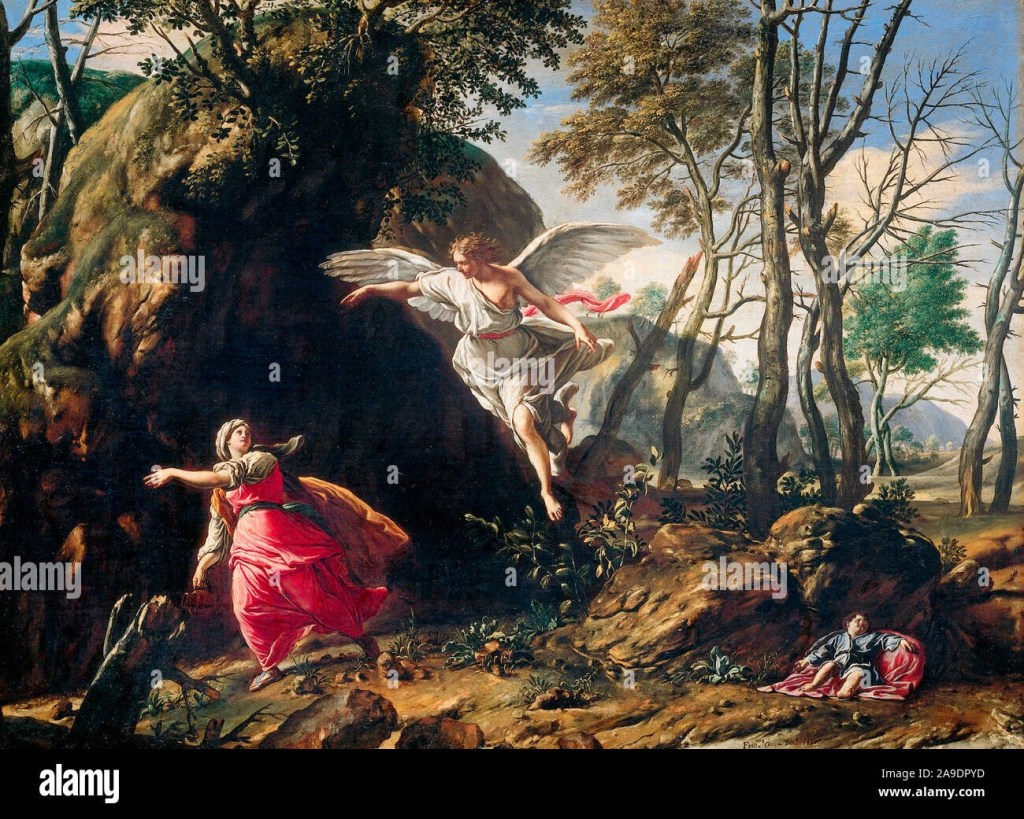
In the Quran, the specific name of the son to be sacrificed by Abraham is not mentioned. Thus it signifies that the name of Isaac in Genesis 22, verse 2, is nothing but a scribal interpolation. What is the explanation for this argument?
The argument that the Quran’s omission of the specific name of the son to be sacrificed by Abraham signifies that the name of Isaac in Genesis 22, verse 2, is a scribal interpolation is a viewpoint held by some scholars, but it is not universally accepted within the field of biblical studies or Islamic theology. This argument is based on textual and historical analysis and often arises in discussions about the relationship between the Quran and the Bible.
Here’s a brief overview of the argument:
- Quranic account: In the Quran, the story of Abraham’s willingness to sacrifice his son is mentioned in Surah As Saffat (Chapter 37), but the specific name of the son is not provided. This omission has led some scholars to argue that the Quran intentionally avoids naming the son to prevent any confusion or dispute regarding the identity of the son.
- Biblical account: In the Book of Genesis (Genesis 22, verse 2), the son to be sacrificed is identified as Isaac. This is a well-known account in both Jewish and Christian traditions.
- Argument: Some scholars propose that the Quranic omission of the son’s name suggests that the original, unaltered biblical account did not specify the son’s name, and the name Isaac was added later through scribal interpolation in the biblical text.
- Quranic Interpretation: The Quranic narrative does not explicitly name the son of the near sacrifice, but Islamic tradition and many Muslim scholars have historically identified him as Ishmael. This belief is supported by the chronological events in the Quran, indicating that the promise of Isaac’s birth was made after the account of sacrifice, suggesting that Ishmael was the likely candidate for sacrifice.
It’s important to note that this argument is not universally accepted, and there is ongoing debate among scholars regarding the relationship between the Quran and the Bible. Islamic tradition generally does not delve into such textual criticism but rather focuses on the theological and moral aspects of the story.
Holy Quran 37:102
فَلَمَّا بَلَغَ مَعَهُ ٱلسَّعْىَ قَالَ يَٰبُنَىَّ إِنِّىٓ أَرَىٰ فِى ٱلْمَنَامِ أَنِّىٓ أَذْبَحُكَ فَٱنظُرْ مَاذَا تَرَىٰ ۚ قَالَ يَٰٓأَبَتِ ٱفْعَلْ مَا تُؤْمَرُ ۖ سَتَجِدُنِىٓ إِن شَآءَ ٱللَّهُ مِنَ ٱلصَّٰبِرِينَ
Then, when he was old enough to accompany him, he said, “O My son, I see in a dream that I am sacrificing you; see what you think.” He said, “O my Father, do as you are commanded; you will find me, God willing, one of the steadfast.”
The Near Sacrifice of Ishmael: Islamic Theology and Its Support for the Prophethood of Muhammad
What theological reasoning do Islamic scholars offer to explain how Abraham’s near sacrifice of Ishmael, instead of Isaac, supports the prophethood of Muhammad?
According to Islamic tradition and theology, the near sacrifice of Ishmael by Abraham, rather than Isaac, provides support for the prophethood of Muhammad in several key ways:
Judaism, Christianity, and Islam all trace their spiritual lineage to Abraham as a shared patriarch. The story of Abraham’s willingness to sacrifice his son at God’s command is seen as a supreme test of faith in all three traditions. By identifying the son as Ishmael rather than Isaac, Islam establishes a direct link between Abraham and Muhammad through Ishmael.
The Quran in Surah 37 recounts the story of Abraham’s willingness to sacrifice his son out of obedience to God. Despite not explicitly naming the son, the Quran places the narrative of the sacrifice before the announcement of Isaac’s birth, which some interpret as an indication that Ishmael was the one sacrificed. This Quranic account is seen as affirming Ishmael’s role.
Islamic tradition holds that Muhammad is a direct descendant of Ishmael. The legitimacy and authenticity of Muhammad’s prophethood is thus connected to this lineage going back to Abraham through Ishmael. Ishmael’s willingness to be sacrificed is viewed as a significant event that foreshadows the prophethood of Muhammad, which holds a central role in the religion.
Muslims believe the Quran is the final, unaltered word of God as revealed to Muhammad, arguing that earlier scriptures like the Torah and Bible have been changed over time. In this view, the Quran corrects these alterations, and its indication that Ishmael was the sacrificial son is seen as the accurate version of the story. This affirms Muhammad’s role in restoring the original monotheistic message.
While acknowledging the prophets of Judaism and Christianity, Islam considers Muhammad to be the final prophet who came to restore the pure monotheistic faith and correct deviations that had entered the earlier religions. The story of Ishmael’s near-sacrifice is thus seen as part of this corrective prophetic message continuing through Muhammad.
In summary, the Islamic theological argument is that the identification of Ishmael as the son Abraham was commanded to sacrifice establishes a direct link between Abraham, Ishmael, and Muhammad, supporting the legitimacy of Muhammad’s prophethood as a continuation of the Abrahamic lineage and monotheistic message that was preserved intact through Ishmael and fully restored in the revelation of the Quran to Muhammad. The Ishmael narrative reinforces Muhammad’s prophetic authority for Muslims.
 ABRAHAMIC THEOLOGY