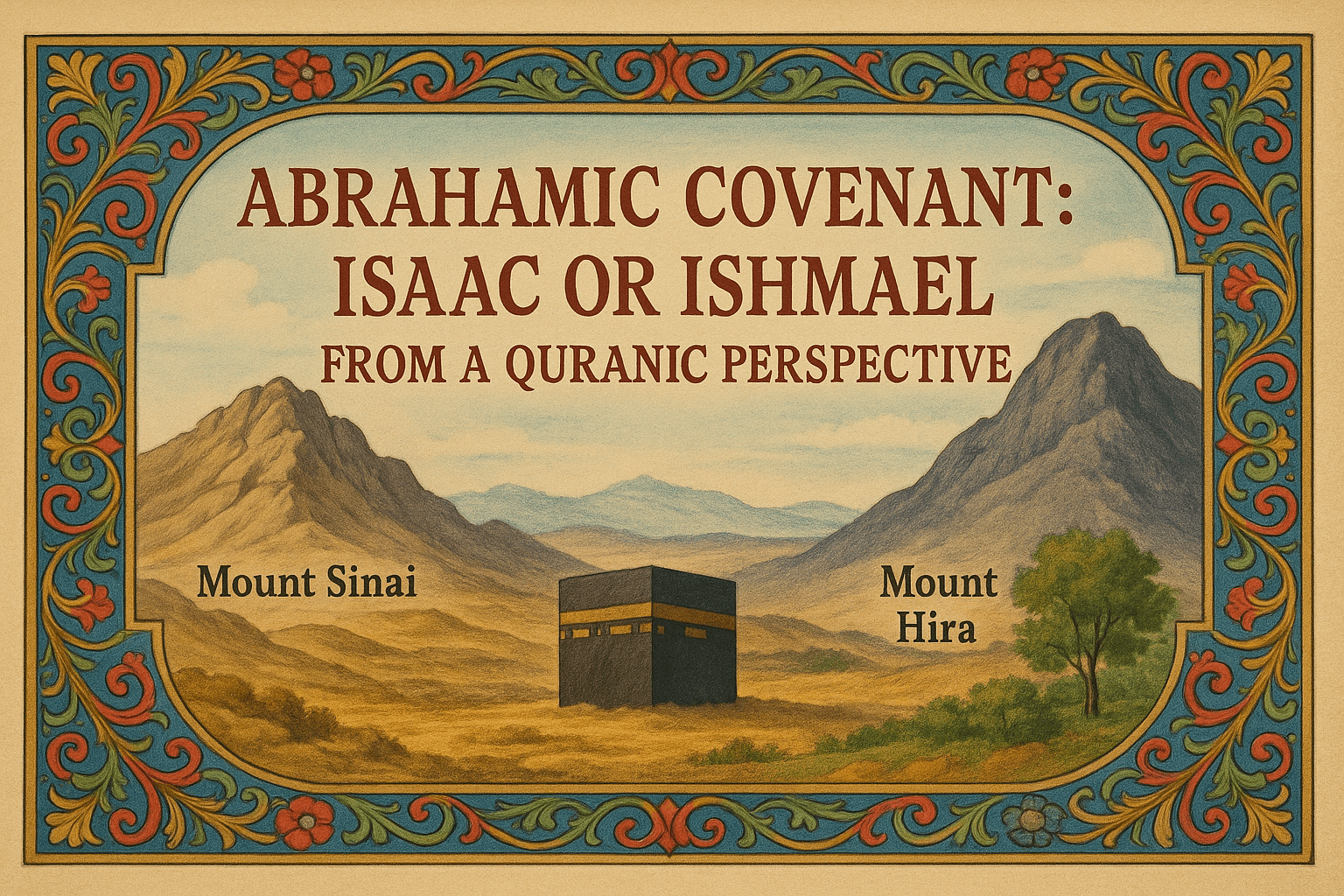
Azahari Hassim
In Surah 2, verse 124 of the Quran, it is stated that God made a covenant with Abraham through Ishmael instead of Isaac, and it is implied that Jewish scribes corrupted the Torah in favor of Isaac. How is this interpretation explained?
Surah 2, verses 124 to 125 reads:
“And when his Lord tested Abraham with certain words, and he fulfilled them. God said, “I am making you a leader of humanity.” Abraham said, “And my descendants?” God said, “My pledge (covenant) does not include the wrongdoers.”
“And We made the House a focal point for the people, and a sanctuary. Use the shrine of Abraham as a place of prayer. And We commissioned Abraham and Ishmael, “Sanctify My House for those who circle around it, and those who seclude themselves in it, and those who kneel and prostrate.”
The Quran clearly states in Surah 2, verse 124 that God made a covenant with Abraham through his son Ishmael, not Isaac. This contradicts the Biblical account which portrays Isaac as the son who was to inherit the covenant from Abraham.
The Quran suggests the Torah (the first five books of the Bible containing the story of Abraham and his sons) was corrupted by Jewish scribes who altered the narrative to favor Isaac over Ishmael. Evidence for this includes:
The Bible itself initially portrays Ishmael as the firstborn and heir before contradicting itself later by calling Isaac the “only son”.
Islamic sources consistently name Ishmael as the son taken by Abraham for the intended sacrifice, while the Bible names Isaac.
The Quranic narrative does not explicitly name the son of the near sacrifice, but Islamic tradition and many Muslim scholars have historically identified him as Ishmael. This is partly based on the sequence of events in the Quran, which suggests that the promise of Isaac’s birth came after the sacrifice narrative, implying Ishmael was the son involved.
The Quran establishes Ishmael’s lineage as the one that inherits the covenant and religious practices like the Kaaba in Mecca, contradicting the Biblical focus on Isaac’s descendants (the Israelites).
So according to the Quran and Islamic tradition, the Biblical account was distorted to displace Ishmael’s status as Abraham’s heir in favor of Isaac, likely due to Jewish scribes’ bias towards the Israelite lineage.
The Quran asserts that it rectifies this by confirming Ishmael as the son who carried on Abraham’s legacy in accordance with the original divine covenant, while the divine choice of the ancient Israelites and their Hebrew prophets before the arrival of Islam is intended to prepare the way for Muhammad, the final Prophet.
The Tests of Abraham: Interpretation of ‘Certain Words’ in Surah 2:124 of the Quran
In Surah 2, verse 124 of the Quran, God says to Abraham
“And when his Lord tried Abraham with certain words and he fulfilled them.” God said, “I am making you a leader of humanity.” Abraham said, “And my descendants?” God said, “My covenant does not include the wrongdoers.”
What is the interpretation of “the certain words” (بِكَلِمَٰتٍ) in Surah 2, verse 124, of the Quran according to the Quranic commentators? Can you provide a list of those “certain words”?
The interpretation of “the certain words” (بِكَلِمَٰتٍ) in this verse according to Quranic commentators refers to the tests and commands that God gave to Abraham. These tests included leaving his family in a barren land, sacrificing his son Ishmael, rebuilding the Kaaba, and instituting the rite of circumcision.
Some of the specific “certain words” mentioned by Quranic commentators include:
- Leaving his family in a barren land: God commanded Abraham to leave his wife Hagar and their infant son Ishmael in the desolate valley of Mecca.
- Sacrificing his son Ishmael: God tested Abraham’s devotion by commanding him to sacrifice his beloved son Ishmael. However, at the last moment, God provided a ram as a substitute for sacrifice.
- Rebuilding the Kaaba: After leaving Hagar and Ishmael in Mecca, Abraham was instructed by God to rebuild the Kaaba as a place of worship for monotheism.
- The rite of circumcision: Circumcision is a significant command given to Abraham as a sign of the covenant between God and his followers. It remains a practice among his spiritual descendants, particularly in Islam, symbolizing purification and faithfulness to God’s covenant.
These “certain words” (بِكَلِمَٰتٍ) were tests of faith and obedience for Abraham, which he successfully fulfilled, demonstrating his unwavering devotion to God.
Two covenants: Abrahamic and Sinai covenants from an Islamic perspective
Genesis 49, verse 10, reads:
“The sceptre shall not depart from Judah, nor a lawgiver from between his feet, until Shiloh come; and unto him shall the gathering of the people be.”
The verse implies that Judah’s offspring will govern Israel until the arrival of “Shiloh,” who holds all royal power. Here, Shiloh, similar to “the Seed” in Genesis 22, verse 18, refers to the future Messiah.
From an Islamic perspective, the word “Shiloh” in Genesis 49, verse 10, is connected to the Abrahamic covenant through Ishmael, who, not Isaac, is believed to be nearly sacrificed. Conversely, the terms “scepter” and “lawgiver” mentioned in Genesis 49, verse 10, are associated with the Sinai covenant. How is their argument articulated?
From an Islamic perspective, the interpretation of Genesis 49, verse 10, and its connection to the Abrahamic covenant through Ishmael involves several key arguments:
- Shiloh as Muhammad:
Some Islamic scholars interpret “Shiloh” as a reference to Prophet Muhammad. They argue that the prophecy indicates a shift in divine authority away from the line of Judah to a descendant of Ishmael. - Abrahamic Covenant through Ishmael:
Islamic tradition holds that it was Ishmael, not Isaac, who was nearly sacrificed by Abraham. This is seen as a pivotal moment in the Abrahamic covenant, establishing Ishmael’s line as the inheritors of God’s promise. - Scepter and Lawgiver:
The terms “scepter” and “lawgiver” in Genesis 49, verse 10, are associated with the Sinai covenant given to Moses. Islamic interpretation suggests that these symbols of authority and divine law would remain with the descendants of Judah until the coming of “Shiloh” (Muhammad). - Transfer of Authority:
The verse is interpreted to mean that the religious and political authority (“scepter” and “lawgiver”) would depart from Judah’s line when Shiloh (Muhammad) comes. This is seen as a prophecy of the transition of divine guidance from the Israelite tradition to Islam. - Gathering of the People:
The phrase “unto him shall the gathering of the people be” is interpreted as referring to the universal message of Islam brought by Muhammad, which would unite people from various nations and backgrounds. - Continuation of Abrahamic Legacy:
Islamic scholars argue that Muhammad, as a descendant of Ishmael, fulfills this prophecy by bringing the final revelation that completes and supersedes previous covenants, while still maintaining continuity with the Abrahamic tradition. - Non-Judahite Messiah:
Some interpretations suggest that the verse implies the coming of a messianic figure from outside the tribe of Judah, which aligns with the Islamic view of Muhammad’s lineage through Ishmael.
It’s important to note that this interpretation is specific to Islamic theology and is not accepted in Jewish or Christian exegesis. The Islamic perspective sees this verse as one of many biblical passages that they believe foretell the coming of Prophet Muhammad and the establishment of Islam as the final Abrahamic faith.
Karen Armstrong
“The figure of Abraham is central to all three monotheistic traditions, but in Islam, he is seen as a father not only to Isaac but to Ishmael, the progenitor of the Arab peoples. The Abrahamic Covenant in the Qur’an is seen as the foundation of the pure monotheism that Islam claims to restore, with Ishmael playing a key role in this divine plan.”
Ishmael: The Rightful Heir of the Abrahamic Covenant – Revisiting Biblical Circumcision and Lineage
The Abrahamic covenant stands as a foundational pillar in the sacred histories of Judaism, Christianity, and Islam. Central to this covenant is the rite of circumcision, instituted by God as a binding sign between Himself and Abraham’s descendants.
Traditionally, Jewish and Christian interpretations assert that Isaac, the son born to Abraham and Sarah, is the rightful heir through whom this covenant is fulfilled.
However, a careful reexamination of the biblical chronology challenges this assumption. This article argues that Ishmael, not Isaac, was the first and only son to receive the covenantal sign alongside Abraham himself—prior to Isaac’s birth—thereby establishing Ishmael as the sole and true heir of the original Abrahamic covenant. By exploring the timing, recipients, and implications of circumcision in Genesis 17 and 21, this piece invites readers to reconsider long-held views and appreciate the overlooked centrality of Ishmael in the divine covenant.
1. The Biblical Basis for Circumcision as a Covenant
The Bible establishes circumcision as the sign of the covenant between God and Abraham:
Genesis 17:9–11:
“Then God said to Abraham, ‘As for you, you must keep my covenant, you and your descendants after you for the generations to come. This is my covenant with you and your descendants after you, the covenant you are to keep: Every male among you shall be circumcised… it will be the sign of the covenant between me and you.’”
Here, circumcision is the definitive sign of the Abrahamic covenant.
2. The Timing of Circumcision Before Isaac’s Birth
The Bible affirms that circumcision was performed before Isaac was born:
Genesis 17:23–26:
“On that very day Abraham took his son Ishmael and all those born in his household or bought with his money, every male in his household, and circumcised them, as God told him… Abraham was ninety-nine years old when he was circumcised, and his son Ishmael was thirteen.”
At this critical juncture, only Abraham and Ishmael were Abraham’s natural descendants to receive the sign of the covenant. Isaac had not yet been born.
3. Ishmael as the Sole and True Heir of the Abrahamic Covenant
This sequence of events reveals that:
Circumcision is the outward and binding sign of the Abrahamic covenant.
Ishmael was the only son of Abraham present to receive this sign alongside him.
All others circumcised at that time were household members and servants—not Abraham’s direct offspring.
Therefore, Ishmael alone stands as the true and sole heir of the Abrahamic covenant, sharing this foundational covenantal sign with Abraham himself.
4. Isaac as Merely a Participant Like Other Household Members
When Isaac was born, he too was circumcised on the eighth day (Genesis 21:4). However, this circumcision occurred after the covenant was already established through Abraham and Ishmael. Like the other members of Abraham’s household, Isaac simply entered into an existing covenantal practice rather than establishing or uniquely embodying it.
In this understanding:
Isaac’s circumcision parallels that of Abraham’s other household members.
He was brought into the covenantal sign but did not share in the original covenantal enactment alongside Abraham.
Thus, Isaac is seen merely as a participant in the Abrahamic covenant, not as its unique heir.
5. Distinction from the Sinai Covenant
The Sinai covenant was revealed exclusively to the descendants of Isaac through Jacob (Israel), establishing a separate covenantal framework for the Israelites.
In contrast, the original Abrahamic covenant—established through circumcision before Isaac’s birth—finds its complete and exclusive fulfillment in Ishmael, who was the first to embody and share this sign with Abraham.
6. Challenging Traditional Jewish and Christian Views
Traditionally, Jewish and Christian interpretations place Isaac as the sole heir of the Abrahamic covenant. However, this argument radically reorients that view:
Ishmael alone shares the covenantal enactment with Abraham.
Isaac, like the other household members, enters a covenantal practice already established.
Therefore, Ishmael alone emerges as the true and rightful heir of the Abrahamic covenant.
Summary of the Articulation
Circumcision, the outward sign of the Abrahamic covenant, was first performed on Abraham and Ishmael before Isaac was born. This historical reality establishes that while Isaac and others in Abraham’s household were participants in the sign of the covenant, only Ishmael shared in the covenant’s original establishment and thus stands as its true and exclusive heir. In this perspective, Ishmael’s role transcends mere participation—he alone embodies the Abrahamic covenant in its full and foundational form.
How does the Quran obliquely refer to Muhammad as the “Shiloh”?
Some believe that Surah 2, verse 129 and 133 of the Quran points to Muhammad as the “Shiloh” prophesied by Jacob in Genesis 49, verse 10. How is this argument articulated?
The argument that Surah 2, verses 129 and 133 of the Quran point to Muhammad as the “Shiloh” prophesied by Jacob in Genesis 49, verse 10, is articulated through several points:
- Surah 2, verse 29, reads:
“Our Lord, and send among them a messenger from themselves who will recite to them Your verses and teach them the Book and wisdom and purify them. Indeed, You are the Exalted in Might, the Wise.”
This verse mentions a prayer by Abraham and Ishmael for a messenger to be sent among their descendants, which Muslims believe refers to Muhammad. This is seen as a continuation of the Abrahamic prophetic tradition.
- Surah 2, verse 33, reads:
Or were you witnesses when death approached Jacob, when he said to his sons, “What will you worship after me?” They said, “We will worship your God and the God of your fathers, Abraham and Ishmael and Isaac – one God. And we are Muslims [in submission] to Him.”
This verse mentions Jacob asking his sons whom they will worship after his death, and they affirm their worship of the God of their forefathers, including Abraham, Ishmael, and Isaac. This is interpreted as a testament to the continuity of monotheism and the prophetic mission culminating in Muhammad.
- In Genesis 49, verse 10, Jacob states:
“The sceptre shall not depart from Judah, nor a lawgiver from between his feet, until Shiloh come; and unto him shall the gathering of the people be.”
This biblical verse speaks of a ruler from Judah until “Shiloh” comes, interpreted by some as a messianic figure. The argument posits that Muhammad, as a descendant of Abraham through Ishmael, fulfills this prophecy by bringing a final and universal message.
These points collectively argue that Muhammad is the awaited “Shiloh” who brings the final divine guidance, aligning with the Quranic narrative of prophetic succession.
Islam as the Restored Faith of Abraham: Addressing Perceived Deviations in Judaism and Christianity
Islam is considered as a restored religion of Abraham due to Judaism corrupting their text as regards a son whom Abraham was commanded to sacrifice. At the same time, Christianity corrupted their scripture concerning the oneness of God and the rite of circumcision. What is the explanation for this?
The belief that Islam is a restored religion of Abraham stems from the belief that both Judaism and Christianity deviated from the original teachings of Abraham. According to Islamic beliefs, Judaism corrupted their text by incorrectly interpreting the command to sacrifice a son, as mentioned in the Quran. Muslims believe that Abraham was commanded to sacrifice his son Ishmael, not Isaac as mentioned in the Hebrew Bible.
Similarly, Muslims believe that Christianity corrupted their scripture by deviating from the belief in the oneness of God (monotheism) and by modifying the rite of circumcision. Islam emphasizes the concept of tawheed, which is the belief in the oneness of God, and questions the Trinity as mentioned in Christian theology. Islam also practices circumcision, although the method and significance may differ from those in Judaism and some Christian traditions.
These differences and perceived corruptions are seen from the perspective of Islamic theology, which asserts that Islam is the restoration of the original teachings of Abraham, as revealed in the Quran.
 ABRAHAMIC THEOLOGY