Azahari Hassim
What is the biblical controversy surrounding Haggai 2, verse 7?
The controversy surrounding Haggai 2, verse 7, revolves around different interpretations of the verse and its implications. In this verse, Haggai prophesies about the coming of the Messiah and states,
“And I will shake all nations, and the Desire of all nations shall come: and I will fill this house with glory, saith the LORD of hosts.”
Some interpretations suggest that the phrase “the Desire of all nations shall come” refers to the Messiah, who is the ultimate desire and hope of all nations. This interpretation aligns with Christian beliefs about the fulfillment of this prophecy in the coming of the Messiah.
However, other interpretations focus on the phrase “the Desire of all nations shall come” as referring to material wealth or treasures, rather than the Messiah. This difference in interpretation has led to some controversy and debate among biblical scholars and theologians regarding the true meaning of Haggai 2, verse 7, and its significance in relation to the coming of the Messiah.
Interpretative Variations

1. Jewish Interpretation:

	Jewish scholars and commentators, such as Rashi, typically interpret “the desire of all nations” as the wealth or treasures of the nations that will be brought to the Temple. This interpretation is consistent with the context of the passage, which focuses on the rebuilding of the Temple in Jerusalem and its future glory.

2. Christian Interpretation:

	In Christian exegesis, especially in historical translations like the KJV, “the desire of all nations” is often seen as a Messianic prophecy, with “the desire” being a reference to the coming of the Messiah, who is seen as the fulfillment of the nations’ ultimate longing.
Historically, who are the traditional commentators on the Bible who perceive “the Desire of all nations” of Haggai 2, verse 7, as a Messiah?
Many Christian commentators and theologians historically have interpreted “the Desire of all nations” in Haggai 2, verse 7, as a reference to the Messiah. Some of the notable commentators who have held this view include:
- John Calvin: The Protestant Reformer and theologian, John Calvin, interpreted this passage as referring to the coming of the Messiah, who would bring fulfillment and blessing to all nations.
- Matthew Henry: The famous English commentator, Matthew Henry, viewed “the Desire of all nations” as a reference to the Messiah, who would bring peace, prosperity, and salvation to the entire world.
- John Gill: The Baptist theologian, John Gill, also saw the “Desire of all nations” as a messianic prophecy, pointing to the coming of the Messiah as the ultimate fulfillment of this promise.
- Adam Clarke: The Methodist theologian and commentator, Adam Clarke, likewise interpreted Haggai 2, verse 7, as a messianic prophecy, identifying the “Desire of all nations” with the Messiah who would bring salvation and blessing to the world.
These commentators and many others throughout Christian history have viewed Haggai 2, verse 7, as a prophetic reference to the coming of the Messiah.
There is a belief that the Hebrew word “Desire” in Haggai 2:7 and the names Muhammad or Ahmad have the same root. How is this argument articulated?
The argument that the Hebrew word “Desire” in Haggai 2:7 and the names Muhammad or Ahmad have the same root is based on a linguistic comparison between the Hebrew and Arabic languages.
In Haggai 2:7, the Hebrew word for “Desire” is “חֶמְדַּת”, which is derived from the root word “חָמַד” meaning “to desire” or “to delight in.”
In Arabic, the name Muhammad is derived from the root word “حمد” (Hamd) which means “praise” or “commendation.” The name Ahmad is also related to the same root word “حمد“ (Hamd): and means “highly praised” or “one who praises.”
The argument suggests that there may be a linguistic connection between the Hebrew word for “Desire” and the Arabic names Muhammad and Ahmad due to the similarity in the root words and their meanings. However, it is important to note that linguistic connections between different languages do not necessarily imply a direct historical or religious connection.
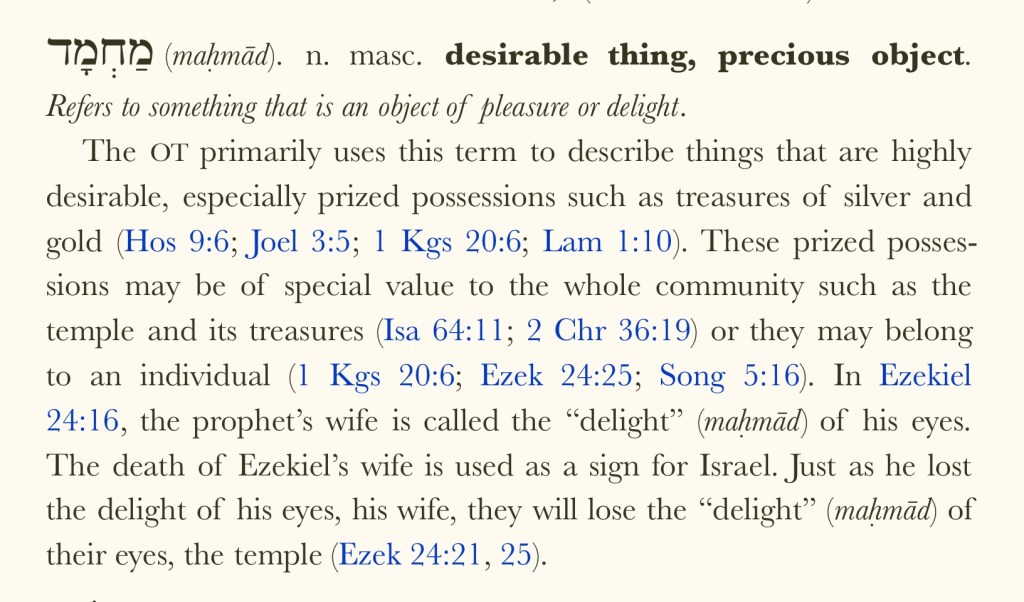
Mangum, Douglas, Derek R. Brown, Rachel Klippenstein, and Rebekah Hurst, eds. 2014. In Lexham Theological Wordbook. Lexham Bible Reference Series. Bellingham, WA: Lexham Press.
The Linguistic Link Between Haggai 2:7 and Muhammad’s Night Journey: An Islamic Perspective
It is believed that Haggai 2, verse 7, is a reference to the Night Journey of the Prophet Muhammad to Jerusalem. The word “Desire” in Hebrew is חֶמְדָּה, which has the same root letters as Muhammad in Arabic. How is this argument explained from an Islamic perspective?
This is an interesting question. The argument that Haggai 2, verse 7, is a reference to the Night Journey of the Prophet Muhammad (peace be upon him) is based on the following points:
The verse says, “And I will shake all nations, and the desire of all nations shall come: and I will fill this house with glory, saith the LORD of hosts.” (King James Version)
The word “desire” in Hebrew is חֶמְדָּה, which means something precious, delightful, or desirable.
The word “חֶמְדָּה” is the feminine form of the Hebrew word “חֶמֶד”, which means “desirable” or “beloved”. Both words share the same root letters (ח מ ד). In Arabic, both the name Muhammad and Ahmad also share these root letters and mean “the praised one.” This connection highlights a similarity in meaning between the Hebrew and Arabic words, emphasizing the idea of being beloved or praised. It shows how languages can have common roots and meanings, even across different cultures and religions.
The verse implies that the “desire of all nations” will come to the house of God, which is the Temple Mount in Jerusalem, where the Al-Aqsa Mosque is located.
The Night Journey of the Prophet Muhammad (peace be upon him) was a miraculous event in which he traveled from Makkah to Jerusalem on a winged creature called Buraq, and then ascended to the heavens, where he met Allah and other prophets.
From an Islamic perspective, the argument that Haggai 2, verse 7, is a reference to the Night Journey of the Prophet Muhammad (peace be upon him) is a possible interpretation, but not a definitive proof. It is based on linguistic similarities and historical coincidences, but not on direct evidence or revelation. It is also not a widely accepted or popular view among Muslim scholars or laypeople.
What Hebrew words are derived from the letters ח מ ד?
Here are some Hebrew words derived from the root letters letters ח מ ד.
1.
חָמֵד (Hamad):
“desirable,” “coveted”.
2.
חֶמְדָּה (Hemdah):
“delight,” “precious object”.
3.
נֶחְמָד (Nehmad):
pleasant, nice, desirable.
4.
מַחְמָד (Mahmad):
“delight,” “desirable thing”.
These words all share the root letters ח מ ד, which convey a sense of strong emotion and intense desire. In Hebrew, these words are often used to express a deep longing for something or someone, whether it be physical, emotional, or spiritual in nature.
 ABRAHAMIC THEOLOGY