Azahari Hassim
According to biblical accounts, Ishmael is described as a teenager at the time he and Hagar depart from Abraham’s household. In contrast, Islamic tradition presents him as an infant or young child whom Hagar nurses as they leave Abraham’s residence.
Was Ishmael placed on Hagar’s shoulder by Abraham in Genesis 21 before their departure? Was Ishmael able to walk when Abraham sent him and his mother away? How does the Midrash explain it?
Midrash is a term used in Jewish tradition to refer to a method of interpreting biblical texts. It involves exploring and expanding upon the stories, laws, and teachings found in the Hebrew Bible through storytelling, commentary, and analysis. Midrashic interpretations often seek to uncover deeper meanings or lessons within the text and can vary widely in style and content.
The Midrash provides an interpretation of the events in Genesis 21. According to the Midrash, Ishmael was indeed placed on Hagar’s shoulders, and this act is seen as a demonstration of Hagar’s devotion to her son. However, the Midrash also acknowledges the inconsistency between Ishmael’s age and his physical abilities, suggesting that the text may have been altered or fabricated to fit the narrative.
According to Rashi’s commentary, Ishmael was unable to walk at the time, potentially due to an evil eye cast upon him by Sarah that caused him to become ill. Rashi suggests Abraham placed the teenage Ishmael on Hagar’s shoulder along with their supplies because he was too feeble to walk on his own.
So in summary, while Rashi argues Ishmael was placed on Hagar’s shoulders because he was too ill to walk, this explanation is debated given Ishmael’s age and other details in the text and Midrash. The passage is ambiguous about how Hagar and Ishmael departed together. Alternative interpretations suggest Ishmael was old enough to walk, even if he required some support from his mother.
A passage from “Hard Sayings of the Bible” states:
A number of commentators have insisted on the fact that Ishmael was placed on the shoulders of Hagar when she left. This would imply that at the time the boy was a mere infant who needed to be carried by his mother. Then in Genesis 21, verse 15, he is spoken of as being cast or placed under a bush.
Now after these interpreters have reached these conclusions about Ishmael being a mere infant, they go on to declare that this assessment is in conflict with Genesis 16, verse 16, 17, verse 25, and 21, verse 5, where the boy seems to be at least thirteen or fourteen years old, and that this is the mark of multiple sources, for the texts were not edited as carefully as they should have been.
What is the explanation for this argument?
The argument you’ve mentioned is centered around the apparent discrepancies in Ishmael’s age in different parts of the Genesis narrative. The confusion arises from the portrayal of Ishmael as both an infant and a teenager in various passages.
According to Genesis 16, verse 16, Abraham was 86 years old when Ishmael was born. By the time Isaac was born, Abraham was 100 years old, making Ishmael approximately 14 years old (Genesis 21, verse 5). The event of Hagar and Ishmael being sent away occurs after the weaning of Isaac, which could imply that Ishmael was between 17 and 19 years old at that time.
The passage you’ve cited suggests that some commentators interpret the text as if Ishmael were an infant during this event, based on the description of him being carried on Hagar’s shoulders and placed under a bush. This interpretation could be seen as conflicting with the earlier texts that indicate Ishmael’s teenage years.
The explanation for this discrepancy is a subject of debate among scholars. Some propose that it might be due to multiple sources or redactions in the text, which were not perfectly harmonized. Others suggest that the narrative is not strictly chronological or that the descriptions are figurative rather than literal. It’s also possible that the term “child” or “boy” used in the text does not necessarily imply infancy but could simply refer to a son.
THE CSB STUDY BIBLE
Abraham lived some thirty-seven years after Sarah’s death and died at the age of 175.
The biblical writer’s comment that Abraham was gathered to his people hints at the Israelites’ early belief in an afterlife.
The patriarch’s two oldest sons Isaac (now seventy-five) and Ishmael (now eighty-nine) took the responsibility of burying their father.
The Importance of the Hajj in Islam as a reflection of alterations in the Torah and Islam’s role as a revived faith of Abraham
There is an argument among scholars regarding the significance of Hajj in Islam as a restored religion tracing back to Abraham. It is posited that Ishmael was exiled as a young child well before the birth of Isaac, and that Ishmael, rather than Isaac, was the intended sacrifice. How is this argument articulated?
The argument regarding the significance of Hajj in Islam as a restored religion tracing back to Abraham, and the associated narrative involving Ishmael and Isaac, is articulated through several key points:
1. Lineage and Prophetic Tradition:
In Islamic tradition, Hajj is deeply connected to the figure of Abraham (Ibrahim). Muslims believe that Abraham, along with his son Ishmael (Ismail), played a foundational role in establishing the rites of Hajj. The Kaaba, the central structure around which Hajj is performed, is believed to have been built by Abraham and Ishmael.
2. The Story of Ishmael and Isaac:
Exile of Ishmael: According to Islamic narratives, long before Isaac was born, Ishmael and his mother Hagar were settled by Abraham in the desert of Mecca, which is where the Zamzam well miraculously appeared to sustain both of Hagar and her infant son Ishmael. This event is commemorated during the Hajj.
The Sacrifice: Islamic tradition holds that it was Ishmael, not Isaac, who was the intended sacrifice. This is based on interpretations of the Quran, specifically Surah 37, verses 100 to 113, where it is generally understood that the son who was to be sacrificed was Ishmael. According to the sequence of events in the Quran, the promise of Isaac’s birth comes after the story of sacrifice, indicating that Ishmael is the son in question.
This contrasts with the Judeo-Christian tradition, which identifies Isaac as the intended sacrifice.
3. Symbolic Acts of Hajj:
The rites of Hajj include reenactments and commemorations of events from the lives of Abraham, Hagar, and Ishmael. For instance:
The Sa’i, which involves walking seven times between the hills of Safa and Marwah, commemorates Hagar’s desperate search for water for her infant son Ishmael.
The stoning of the Jamarat represents Abraham’s rejection of Satan’s temptation, which is believed to have occurred when he was about to sacrifice Ishmael.
4. Restoration of Abrahamic Monotheism:
Islam views itself as a continuation and restoration of the pure monotheistic faith of Abraham. The Hajj serves as a means to reconnect with the Abrahamic legacy, emphasizing monotheism, obedience to God, and the unity of the Muslim community.
In summary, the argument hinges on the belief that Ishmael, rather than Isaac, was central to the narrative of sacrifice and that the rites of Hajj are rooted in the events of Abraham’s life as they unfolded in Mecca with Ishmael. This perspective underscores the significance of Hajj in Islam and its connection to Abraham as a pivotal prophet in the monotheistic tradition.
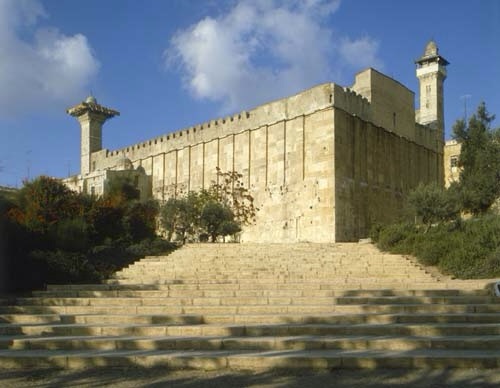
According to the Book of Genesis, Abraham purchased the cave from Ephron the Hittite as a burial site for his wife Sarah. This act is considered one of the first instances of land ownership in the biblical narrative. The cave and the surrounding field are mentioned in Genesis 23:19-20 and Genesis 49:29-32.
The site has great religious significance for Judaism, Christianity, and Islam. It is revered as a holy site, and a mosque was built there in the 7th century CE. The structure has undergone various renovations and expansions over the centuries, reflecting its importance to different faiths.
Today, the Cave of Machpelah is a place of pilgrimage and worship, attracting visitors from around the world. It is also a site of political and religious tension, given its location in a contested area.

Hagar and Ishmael in the Desert by Francois-Joseph Navez, c. 1820 CE
Royal Museums of Fine Arts of Belgium
Eerdman’s Dictionary of the Bible
HAGAR (Heb. hāg̱ār)
An Egyptian woman, servant to the matriarch Sarai. The story of Hagar, representing two strands of tradition in Gen. 16, 21, is one of status competition, surrogate motherhood, ethnic conflict, class struggle, abuse, exile, and triumph.
The barren Sarai gives Hagar to Abram “as a wife” (Gen. 16:3) making any would-be offspring a legal heir according to contemporary Mesopotamian law. Sarai comes to rue the day she manipulated such a union. Hagar, upon conceiving, scorns Sarai (Gen. 16:4), driving Sarai to abuse her in return. Hagar flees into the desert wilderness, pregnant and on foot, headed 240 km. (150 mi.) south to Shur. The angel of the Lord sends her back to Sarai with promises similar to those made to Abraham, Isaac, and Jacob. Her son, to be named Ishmael, would bear offspring too numerous to count (Gen. 16:10) — 12 tribes which would become a great nation (17:20).
Some years later (Gen. 21:8-21), at the weaning of Isaac, Sarah notices Ishmael laughing or playing with him. The incident, though positive, is interpreted by Sarah as bearing threat to Isaac’s inheritance. She asks Abraham to rid her family of Hagar and Ishmael once and for all. Hagar, finding herself once again in the wilderness without sustenance, leaves Ishmael to die (here her son’s age doesn’t quite fit the context). Once again, God intervenes, providing food and water and reiterating the earlier promises to Hagar. She later finds an Egyptian wife for her near-grown son.
The Apostle Paul later allegorizes the story of Sarah and Hagar (Gal. 4:21-31) to portray Sarah’s literal descendants as enslaved (like Hagar) to the old covenant, while Sarah’s descendants by faith (and promise) become the essence of the new covenant of freedom. Ironically, to make his analogy work, Paul, like so many commentators before and since, overlooks the ambiguous faithfulness of both Sarah and Hagar.
 ABRAHAMIC THEOLOGY